

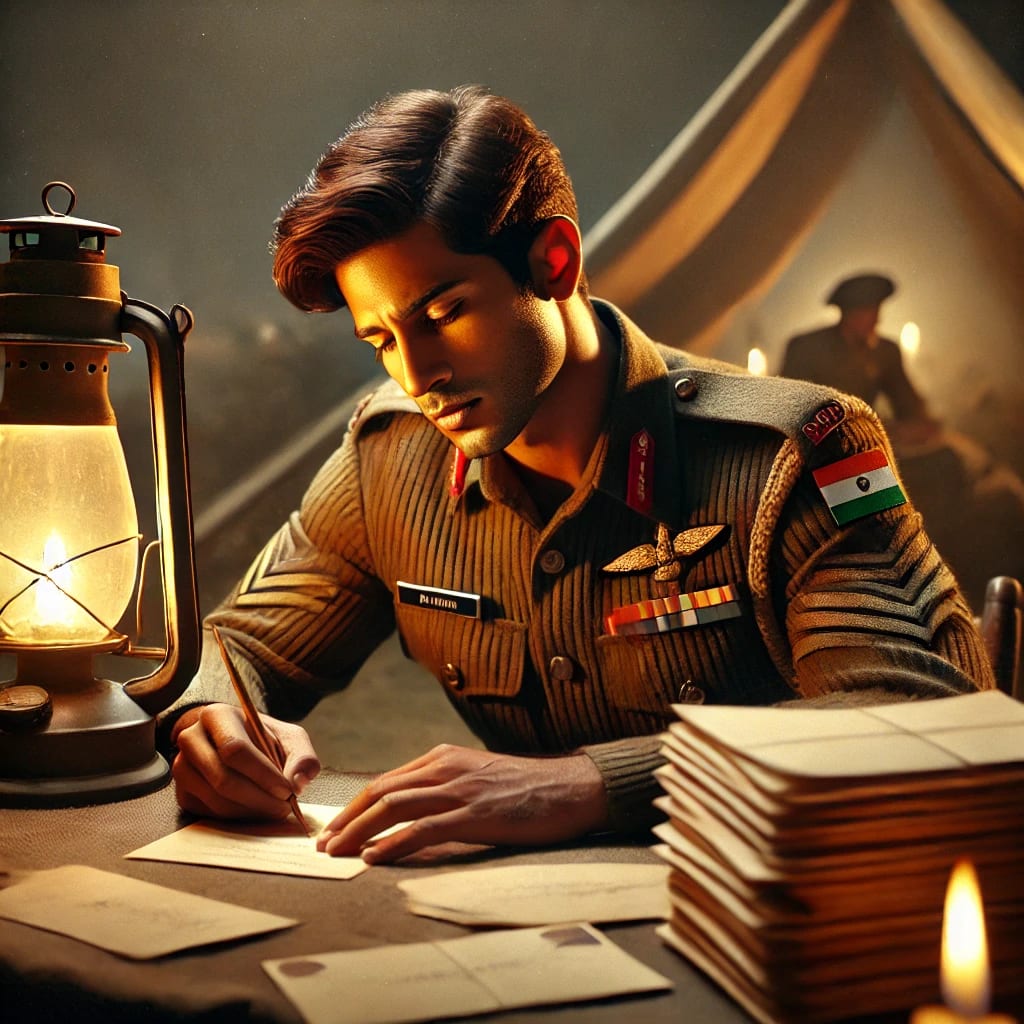
The static crackled like whispers of ghosts as Lieutenant Ramachandran adjusted the dial of the battered radio. It was one of those rare nights when the oppressive silence of the prisoner-of-war camp gave way to something else—something alive, fleeting, almost human. The faint strains of a sitar melody drifted through the airwaves, followed by a voice so calm it felt otherworldly.
“Are you out there?” the announcer asked, his tone warm but tinged with melancholy. “If you’re listening, we want to hear from you. Soldiers far from home, prisoners forgotten by time… tell us your story. Let someone know you still exist.”
Ram hesitated, his fingers hovering over the microphone. He hadn’t spoken to anyone outside these barbed-wire walls in months—years, maybe. What would he even say? That he was just another nameless face among hundreds, surviving on rice gruel and stolen moments of sunlight? That no one waited for him back home because everyone he’d ever loved had been swallowed whole by war or partition?
He leaned closer, his breath fogging the metal grille of the mic. “There’s no one,” he murmured, his voice rough from disuse. “No one waiting for me.”
And then he heard it. A soft intake of breath, barely audible over the static. Someone had been listening.
Or perhaps… someone had been watching.
April 5, 1947
To: Lieutenant Ramachandran, Prisoner of War Camp #34-B, Burma
From: Seetha Devi, Madras
Dear Lieutenant Ramachandran,
Your words reached me across the airwaves last month, carried by static and sorrow. You said there was no one waiting for you. But let me assure you, sir, your voice found someone willing to listen.
My name is Seetha Devi, and though we have never met, I feel compelled to write to you not out of pity, but because your admission struck a chord within me. Perhaps it is foolish to think a stranger’s pain can resonate so deeply, but yours did. Maybe it is because I too know what it means to lose people to feel abandoned by life itself. Or perhaps it is simply because your courage shines even through despair.
You spoke of being alone, but allow me to tell you something: loneliness is not always about the absence of others; sometimes, it is about forgetting how much you mean to the world around you. Even here in Madras, where the sea whispers secrets to the shore and jasmine garlands perfume the evening breeze, there are moments when emptiness creeps in. Yet, amidst all this beauty, I remind myself that every soul carries light, whether visible or hidden. Yours must be extraordinary, Lieutenant, to endure what you have endured.
If you permit me, I would like to correspond with you. Not as a savior or sympathizer, but as a fellow traveler navigating the storms of existence. Write to me when you can, and I shall do the same. Let these pages become bridges between two distant shores.
With sincerity and admiration,
Seetha
P.S. Enclosed is a pressed marigold from my garden. Its petals may be fragile, but its spirit remains unbroken much like you, I imagine.
May 10, 1947
To: Miss Seetha Devi, Madras
From: Lieutenant Ramachandran, Prisoner of War Camp #34-B, Burma
Miss Seetha,
When your letter arrived, folded neatly inside a small envelope bearing the scent of flowers, I confess I hesitated before opening it. Letters from strangers were uncommon in this place, and I feared reading words meant only to console. But yours… yours demanded attention.
How do I begin to thank you for seeing me not just the broken shell of a man trapped in this camp, but the person beneath? Your words pierced through layers of bitterness I didn’t realize I’d built. To say I am moved would be an understatement.
Yes, I will write to you. How could I not? In this desolate corner of the world, your letter feels like sunlight breaking through storm clouds. Funny, isn’t it? A single piece of paper holding such power.
You mentioned losing people. If you don’t mind sharing, who were they? And how did you find the strength to carry on? As for me, my story is simple enough: born into a modest farming family in Amritsar, I joined the army seeking purpose. Instead, I found chaos. Partition claimed everyone I loved parents, siblings, friends. By the time I landed in Burma, I believed myself immune to loss. Turns out, even soldiers aren’t spared grief.
Still, your marigold sits beside me now, tucked safely inside my journal. Every time I glance at it, I remember your promise: that even fragile things hold resilience. Maybe someday I’ll believe it applies to me too.
Until next time,
Ram
Over the following months, their exchange grew. Each letter became a lifeline, weaving together fragments of their lives. Seetha wrote of her childhood in Madras, her dreams of becoming a teacher, and the quiet rebellion she felt against societal expectations. Ram shared stories of his comrades, the horrors of battle, and the small joys he clung to a stolen mango, a starry night, the memory of his mother’s laughter.
Through her words, Seetha painted a world Ram yearned to return to. Through his, she discovered a depth of sacrifice and patriotism she hadn’t fully understood before. Their connection deepened, transcending the boundaries of circumstance and geography.
August 20, 1947
To: Lieutenant Ramachandran, Prisoner of War Camp #34-B, Burma
From: Seetha Devi, Madras
Dearest Ram,
Today, India breathes freedom. The streets of Madras erupted in celebration songs, dances, tears of joy. Yet, amidst the jubilation, my thoughts turned to you. Freedom tastes bittersweet knowing you remain imprisoned, unable to witness the dawn of this new era.
Do you remember the first letter I sent you? I enclosed a marigold, symbolizing devotion and sacrifice. Now, I wish to add another meaning: hope. For isn’t that what independence truly represents? Hope that tomorrow will be better than today. Hope that love, unity, and courage will triumph over hatred and division.
Ram, I want you to know something. Though we’ve never met, you’ve changed me. Your resilience inspires me to fight for causes greater than myself. Your honesty reminds me to cherish the present moment. And your vulnerability teaches me that strength lies not in invincibility, but in embracing our humanity.
Stay strong, my dear friend. This nation owes its freedom to soldiers like you. One day, when the gates of that camp open, I pray you find solace in the knowledge that your sacrifices were not in vain.
With all my heart,
Seetha
September 15, 1947
To: Miss Seetha Devi, Madras
From: Lieutenant Ramachandran, Prisoner of War Camp #34-B, Burma
Beloved Seetha,
Forgive me for taking so long to reply. Much has happened since your last letter. News of India’s independence reached us weeks ago, filling the camp with both elation and unrest. Some prisoners dared to dream of release; others succumbed to despair, fearing freedom might never come for them.
And then, yesterday, everything changed. A riot broke out among the guards. Chaos reigned. In the midst of it, one of my closest friends a young lieutenant named Arjun was gravely injured. He begged me to save the documents detailing atrocities committed by our captors, evidence crucial for exposing the truth once we returned home. Without hesitation, I agreed.
But betrayal lurks in unexpected places. Another prisoner informed on us. Last night, during a routine inspection, the guards discovered the papers hidden beneath my cot. They dragged me to solitary confinement, beating me until I confessed. Knowing Arjun would face execution if implicated, I took full responsibility.
As I write this, bruises cover my body, and blood stains the page. Tomorrow morning, they plan to execute me. There is no fear, Seetha only peace. I leave this life knowing I protected a brother-in-arms, upheld the honor of my country, and touched the heart of someone extraordinary.
Please don’t mourn me. Celebrate instead the freedom we fought for, the bonds we forged, the hope we nurtured. Keep fighting for justice, for education, for equality. Be the change this nation needs.
Thank you for reminding me that I was never truly alone. Your letters gave me purpose when I thought I had none. Carry the torch now, Seetha. Illuminate the path for others.
Forever yours,
Ram
Seetha received his final letter weeks later, along with official notification of his death. She wept for days, clutching the pages to her chest. But eventually, grief transformed into resolve. Inspired by Ram’s courage, she dedicated her life to teaching marginalized children, ensuring they knew their worth.
Decades later, when asked about the greatest love of her life, she smiled softly and replied, “He taught me that even in darkness, stars exist. All we have to do is look for them.”
Years Later – 1972
Madras, India
The monsoon rains swept through the city, drenching the streets in a symphony of water and wind. Seetha Devi stood on the veranda of her modest home, staring out at the downpour. Her hair was streaked with silver now, but her eyes still held the same fiery determination they always had. For decades, she had poured her heart into teaching, shaping young minds, and fighting for equality. Yet, there was one corner of her soul that remained untouched a secret longing buried beneath layers of duty and memory.
It had been twenty-five years since Ram’s final letter arrived. Twenty-five years since she read his words under candlelight, tears streaming down her face as thunder rolled outside. She kept every letter he ever wrote, bound together with a faded marigold pressed between the pages. They were sacred relics, reminders of a love that transcended time and circumstance.
But tonight, something felt different.
A knock echoed through the house, startling her from her thoughts. It was late far too late for visitors. Wrapping a shawl around her shoulders, she walked to the door and opened it cautiously.
Standing there was a man cloaked in shadows, his face obscured by the brim of an old hat. Rain dripped from his coat, pooling at his feet. He didn’t speak immediately, simply stared at her with an intensity that made her breath catch.
“Can I help you?” she asked, her voice steady despite the unease prickling her skin.
The man hesitated, then reached into his pocket and pulled out a small, weathered envelope. He held it out to her without a word.
Seetha’s hands trembled as she took it. The paper was brittle, yellowed with age, but the handwriting was unmistakable. Her name was scrawled across the front in Ram’s familiar script.
“What is this?” she whispered, looking up at him.
“It’s from Lieutenant Ramachandran,” the man said finally, his voice low and gravelly. “He wanted you to have it.”
Her heart pounded wildly. “But… how? He died in 1947. This isn’t possible.”
The stranger’s lips curved into a faint, enigmatic smile. “Perhaps some things aren’t meant to be explained.” With that, he turned and disappeared into the rain-soaked night, leaving Seetha clutching the letter like it might vanish if she let go.
Inside, she lit a lamp and sat at her desk, her fingers trembling as she carefully opened the envelope. Inside was a single sheet of paper, folded neatly. As she unfolded it, another object fell onto the table a tiny, dried marigold.
Her breath hitched. It was identical to the one she’d sent him all those years ago.
The letter read:
To My Dearest Seetha,
If you are reading this, then fate has played its hand once more. When I wrote my last letter to you, I believed it would be our final exchange. But life, as I’ve learned, is full of surprises.
After the guards sentenced me to death, I expected the end. Instead, I woke up in a makeshift infirmary, alive but gravely wounded. Someone a fellow prisoner who owed me a debt had bribed the guards to spare me. In exchange, I agreed to disappear, to leave behind everything I knew and start anew under a false identity.
Seetha, I don’t know where you are now or what your life looks like. Perhaps you’ve built a family, found happiness, moved on. If so, I am glad. You deserve nothing less than joy. But if there is even a sliver of hope left for us if you still feel the pull of what we shared I will wait for you.
Tomorrow evening, at sunset, I will be standing by the ancient banyan tree near Marina Beach. If you come, I’ll know your answer. If not, I’ll understand. Either way, please know that my heart has belonged to you since the day your first letter arrived.
"With a heart that aches but never forgets, I remain yours.",
Ram
About the Creator
Reader insights
Nice work
Very well written. Keep up the good work!
Top insights
Compelling and original writing
Creative use of language & vocab
Excellent storytelling
Original narrative & well developed characters
Heartfelt and relatable
The story invoked strong personal emotions
Bomb Scare
It was 2027, and the world never thought it would happen. A missle hit the United States, but it wasn't where they had anticipated. A little town in the northeast was hit by a missile strike, they didn't know why, and they didn't know exactly where it hit, but they did know it was a coastal community, somewhere between Maine and Delaware.
By Gregory Payton7 days ago in Fiction
Hottest in the Office
Dear Rafi, You’re very distracting to work around. For the first second I saw you the other day, I thought you were some type of executive. It took a moment to realize no, you were just the new guy, dressed up for the job he wants. Be still, my heart.
By Gabriel Shames2 days ago in Pride



Comments
There are no comments for this story
Be the first to respond and start the conversation.