
In The Age of Love and Lost Dreams
A Precious Commodity
Our name was Georgia.
I was never given a name, but that’s what I would have been called, at that time, because at that time I was hers.
~ o O o ~
I belonged to Georgia’s mother before her, and to her mother-in-law before then. A woman called Taylor was the first to wear me. I was given to her for her sixteenth birthday. Taylor was a popular name for girls at that time. Taylor passed me down to her daughter-in-law, Pandora, when Pandora married her son. Pandora was also a popular name of its own era, perhaps inspired by the legend of Pandora’s box, because in that time everyone was willing to take on the blame. It was considered the right thing to do; taking responsibility for everything that had gone wrong—the wars and diseases and genocides and discriminations and things that ancestors did and caused that the present generation inherited. There are few things that I am told, and fewer things that I have more than a vague understanding of. Taking blame didn’t stop the wars or diseases or natural disasters from raging across nations. It didn’t stop climate change or pollution or political tension, or the tension felt in a thrumming heartbeat that worries. The last one, I understood well.
~ o O o ~
Pandora died at the age of twenty six from the “aging illness,” that took hold of many young people seven years ago, rapidly mutating their brains. She had given me to her daughter Georgia, whom she had at eighteen, because people had started giving birth sooner in life. Georgia was not a popular name, but it’s possible that Pandora thought it would be popular, because it was unique and possibly vintage, and everyone wanted something unique and possibly vintage, but in an interesting and clever way, which the name Georgia wasn’t. Besides, as many people pointed out, Georgia was a font that had long gone out of style due to overuse. You might as well name a child Garamond or Papyrus.
Georgia was teased for her name, particularly when she was in her tweens. She was teased for other reasons also, like the fact that she wore dresses on a daily basis and daydreamed in class, and she once told a teacher that she wanted to die. She was twelve at this time, and the teacher thought she was merely seeking attention. Georgia died at the age thirteen. I’m not allowed to say how.
I was then given to Georgia’s father Arcade, or Cade for short, who never wore me. Arcade was considered a sort of vintage name, and was interesting and clever, because it came with an interesting story about Taylor and her husband Brian meeting at the last arcade in the country, just before it was shut down. It was a name that was quickly gaining popularity nowadays, due to the nostalgia of an older generation. Sometimes Cade would hold me and whisper their names, all three of them, over and over and over. I wished, for his sake, that holding me and saying their names would really bring them back.
~ o O o ~
Georgia ran away once when she was eight. She was an only child, and she ran away not because there was anything bad at home, but because there was nothing good at home, and because she was bored and tired of being ignored by her parents, who both worked most of the day. She soon felt guilty about it, because she knew that when her parents noticed, they would worry, and so she returned that same night, a little past one in the morning. But because her father returned home from work very late that particular night, and because her mother had a headache, neither had noticed her absence, and likely would not have until the next morning.
Georgia dug a hole in the backyard and buried me there the next day, but tearfully recovered me a month later, and that was how I learned that Pandora had died.
I don’t know where the aging illness started. Pandora was abroad when she became ill. Cade and Georgia were home. I was in the ground. The aging illness came after the world war that Cade and Pandora were too young to fight in, and before the storms that destroyed the coastline, and before the drought that sucked the hope out of those that were left. There were still storms. There was still drought. Hope was becoming a precious commodity.
The stigma surrounding “object sentimentalism” started in the beginning of the decade with the publishing of some study or other about the impact of reminiscing in regards to mental health. There was lots of attention given towards mental health these days, so it was taken most seriously. Georgia was thirteen, and had not taken me off since her mother died, not even in her weekly bath. Cade told Georgia that she should stop wearing me, that at the very least she should try having me off; if only for a bit. They fought over it. They fought over many things after Pandora’s death, like money and conservatism, but sentimentalism was now the hottest topic of conflict. Georgia eventually acquiesced, and with heavy emotions, Cade hid me away on a high shelf in his closet.
I never saw Georgia again. Cade told me what happened.
~ o O o ~
About one year after Georgia died, Cade stopped holding me regularly, and started keeping me in a wooden box under his bed. His therapist said it was bad for him to keep thinking about us.
It was two years after Georgia died that the Anti-Sentimentalism law was passed in our state, though it would be another six years before the law became national. The law was passed in our state for primarily four (given) reasons:
- Overpopulation and overcrowding was becoming a prevalent issue. People were having to move homes frequently, mostly moving inland, and all kinds of conflicts started due to a loss of personal property, particularly from the storms.
- Product production in general was down and it was seen as most efficient and conservative to focus on producing the essentials.
- According to national surveys, most people said that all of the things in life they needed—apart from food, appliances and living necessities—were virtual.
- Possession of material trinkets of sentimental value had a correlation with current suicide statistics.
Cade had pulled out my box and sat with me in his hands for several hours. He almost put me on—had unclasped my chain and held it to his neck—but decided against it. He opened me instead, and found that my contents were a tiny shamrock scotch-taped to the inside, which Pandora had found, and a picture of himself when he was small, which his mother Taylor had put inside, a long time ago. Georgia hadn’t left anything.
The Anti-sentimentalism law dictated that non-necessity trinkets which did not have current use or value were to be turned in to be recycled. Cade didn’t have to turn me in; he could wear me and make the argument that I was an article of clothing; an accessory. He did think on it for quite some time. In the end though, he did turn me in, and I don’t blame him for it. His therapist would say it was for the better, he told me absently. He wasn’t really talking to me, though.
The town was still in a state of wreckage from hurricane Medea, and I could feel Cade angrily kicking at a piece of trash. I counted his steps. Georgia used to count steps when she was younger. She would close her eyes and walk the length of the block, then turn around and walk back with her eyes still closed, counting her steps back home. I didn’t know exactly where I was going, but I counted anyway.
~ o O o ~
“What’ve you got?”
“It’s just this,” Cade said, setting my box down on a table in a busy lobby. Someone else picked it up, opened it to glance at me, said “Have a nice day, then,” and carried me away to a room of other sentimentalities. I could not see the other ones in the room, but I heard them. They were lost things, found things, lost and found things, inheritances, thrift shop extras, old toys, decorations—in one word: antiquity.
A city of trinkets. A land of memories. A place of love.
I used to be a symbol of love. Whoever gave me to Taylor loved her, and she loved Pandora, and Pandora loved Georgia, and Georgia loved me.
~ o O o ~
Hours pass by. There’s an antique clock somewhere in the room, ticking like a heartbeat. A woman then comes and handles me amongst other metal trinkets, roughly putting me in the bottom of a cardboard box, piling others on top of me. She hums while she does it. My box is carried to another room, and handed to a man. He’s talking with the woman.
“It’s a shame that all of this is being melted down,” the woman says.
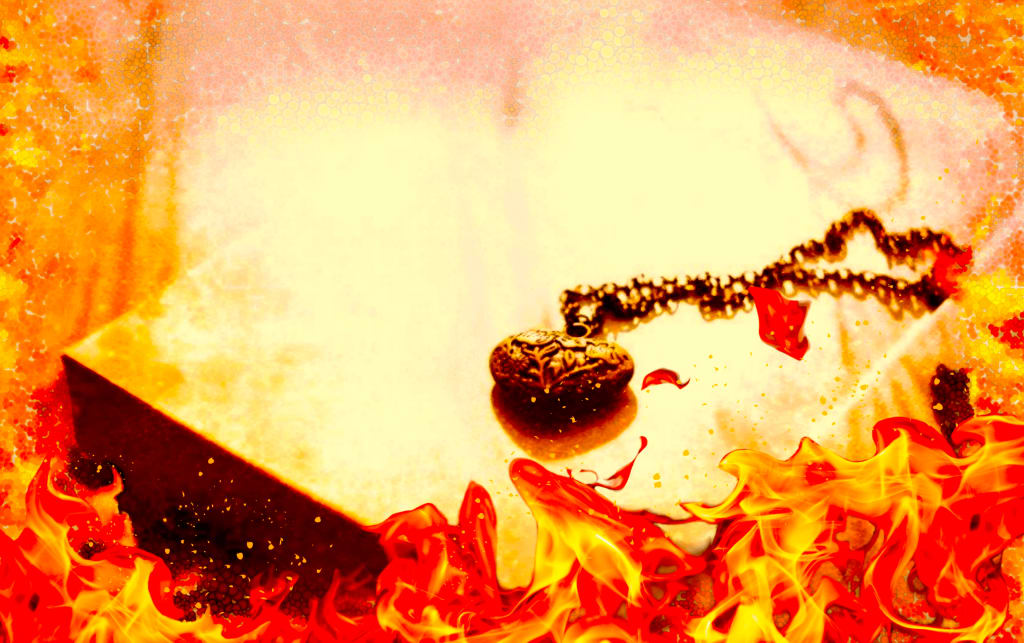
“They’ll make new things out of it,” he says, pulling items off of me. He takes me out last. I can feel the heat of a fire nearby, and it feels like coming home.
The man looks at me and runs his thumb over my symmetric hills, swooping down to a point; a shape so well known throughout the ages as to be unmistakable for anything else. A shape of love and lost dreams. He shows me to the woman.
“Looks like a flower petal,” he says, but I know he is lying.
About the Creator
Lijah Sampson
I'm a recent graduate of Beloit College. I majored in Creative Writing, Literary Studies and Psychology. I most enjoy writing speculative fiction.
Keep reading
More stories from Lijah Sampson and writers in Fiction and other communities.
The Inferno Elixir: A Legacy of Blood
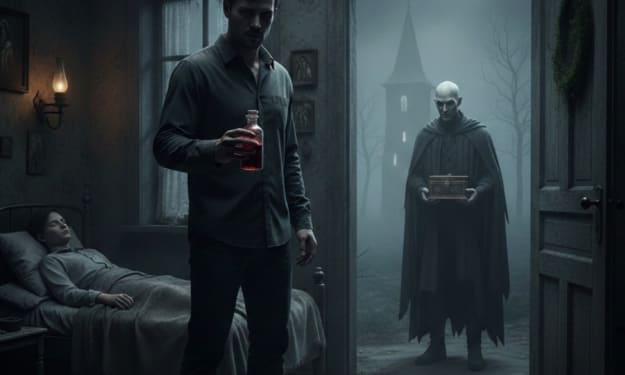
1. The Sinister Stillness of the Village My grandfather had always been an enigmatic man, but in the last three years, his eccentricity had crossed into something far more unsettling. He lived alone in a secluded house far from the city’s clamor, tucked away in a village perpetually choked by mist. We assumed he was merely grieving the loss of my grandmother and his lifelong friend, but his gaze hid something deeper than sorrow—a secret that was slowly devouring his soul. During my last visit, I was struck by the sight of his refrigerator; it was grotesquely overstuffed with heaps of raw meat. He claimed with a cold detachment that it was for the poor, but his face betrayed the lie. Even more disturbing was the reinforced steel door he had installed in the basement, from which a foul stench seeped through the cracks—a smell like a carcass that refused to stay buried. 2. A Descent into the Abyss Late that night, I took advantage of my grandfather’s heavy sleep. With trembling fingers, I pilfered a modern, sophisticated key from his cabinet. I descended the decaying stairs into the basement, my flashlight cutting through the oppressive gloom. The air there didn't just smell of rot; it smelled like a slaughterhouse. Dry bloodstains smeared the walls, and in the corners lay bleached-white human skeletons. I approached the reinforced room and peered through a tiny peephole. The blood froze in my veins. A gaunt creature, its bones protruding obscenely from its skin, stood there. Its hair was so long it trailed behind it like a shroud. It moved on all fours with a demonic fluidity. Suddenly, its eyes—completely white—locked onto the hole. It wasn't looking at me; it was scenting me. 3. The Bitter Truth Before I could flee, I felt the sharp sting of a needle in my neck. The world dissolved into darkness. I awoke inside a hermetically sealed glass chamber. My grandfather stood on the other side of the glass, weeping bitterly as he recounted the catastrophe: > "Three years ago, your grandmother was on the brink of death. A stranger with non-human features knocked on my door and gave me a dark red elixir, claiming it was the salvation. I injected her, but she transformed into this ravenous monster. I killed my oldest friend and fed him to her just to protect her secret. I love her, Alex, and I cannot let you leave to expose the truth of her 'death' to the world." > 4. The Banquet of Blood The glass barrier began to rise slowly, and the monstrosity crouched, ready to pounce. Suddenly, a scream pierced the silence. My younger brother, Thomas, had followed me. With a heavy blow from a sharp tool, he struck our grandfather, sending him sprawling into the room. In a moment of primal madness, the creature lunged at my grandfather, tearing into his flesh with unspeakable ferocity. Thomas and I fled, the screams echoing behind us, until the police arrived and ended the nightmare with a hail of bullets into the body of what was once my grandmother. 5. The Vicious Cycle A year has passed since that night, and I thought I had survived. But fate plays a cruel game. It is now the anniversary of my grandfather’s death, and my brother Thomas is wasting away from a rare, terminal illness. Last night, amidst the darkness, a stranger knocked on my door—matching the exact description my grandfather once gave. He placed a small box in my hand containing a vial of dark red liquid and hissed into my ear: "This is the only cure for your brother." The stranger vanished as if he never existed. I analyzed the liquid in a lab, and the results were bone-chilling: "A substance extracted from an unknown biological entity, non-existent in any natural record." I hold the vial in my hand now, looking at my pale brother, hearing the echo of my grandfather’s voice in my head. Do I repeat the tragedy? Do I begin a new massacre in the name of love? The elixir is before me, and hell is waiting just behind the door. Would you like me to create a "Book Cover" style description for this story, or perhaps suggest a sequel?
By Mayar Younesabout 8 hours ago in Fiction



Comments
There are no comments for this story
Be the first to respond and start the conversation.