
How the Moon Was Made
The Fascinating Story of Earth’s Celestial Companion

How the Moon Was Made: The Fascinating Story of Earth’s Celestial Companion
From mythology to modern science, the Moon has fascinated us for thousands of years. It influences the tides, lights up our night sky, and even guides our calendars. But have you ever wondered how our moon was created?
Though theories about the origins of the Moon have evolved over time, the giant impact hypothesis remains the most commonly accepted explanation. In this article, we will examine the composition, formation, and significance of the Moon.
The Solar System's Formative Years
To understand how the Moon was formed, we need to travel back 4.5 billion years, when the solar system was still forming. Back then, the Earth was just a young, molten planet surrounded by debris, dust, and other forming planetary bodies.
During this chaotic time, collisions between objects were common. Planets were still growing by merging with other celestial bodies through a process called accretion.
The Giant Impact Hypothesis
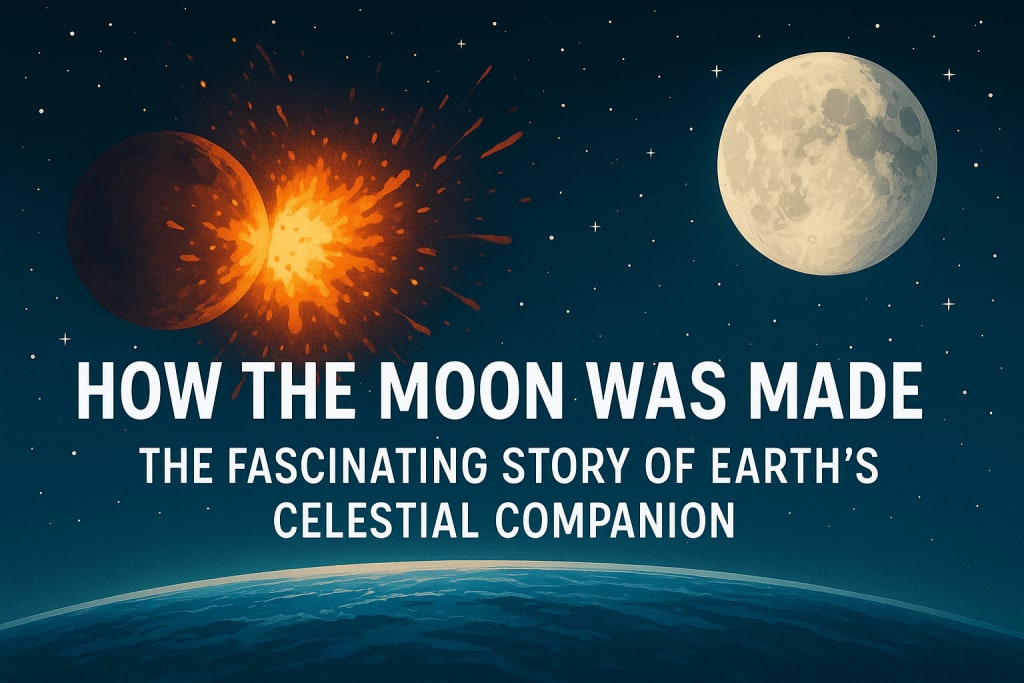
The leading theory about the Moon's origin is known as the Giant Impact Hypothesis. It suggests that a Mars-sized body named Theia collided with the early Earth.
Here's how the event likely unfolded:
1. Theia and Earth Collide
Around 4.5 billion years ago, a celestial object roughly the size of Mars—possibly named Theia—smashed into the Earth. This was a massive, high-energy impact.
2. Material Ejected Into Space
The collision sent a huge amount of debris from both Theia and Earth into orbit around the Earth. This debris was mostly rock and metal.
3. Formation of a Disk
The debris didn’t float away into space. Instead, it formed a ring of material around Earth, much like the rings around Saturn.
4. Accretion of the Moon
Over time, the debris in Earth’s orbit started to clump together. These clumps eventually merged to form a single object — the Moon. This process may have taken just **a few months to a few years**.
---
Evidence Supporting the Impact Theory
Scientists support the giant impact hypothesis for several reasons:
Similar Composition: Rocks brought back by astronauts during the Apollo missions show that **moon rocks have a similar isotopic composition to Earth rocks**, suggesting they share a common origin.
- **Angular Momentum**: The Earth-Moon system has a high level of angular momentum (the way things spin), which fits with a massive impact.
- **Moon’s Size**: The Moon is **unusually large** relative to Earth compared to other moons in the solar system. This hints at a dramatic origin.
- **Iron Core Difference**: The Moon has a **small iron core**, much smaller than Earth’s. This supports the idea that the Moon formed mostly from Earth’s outer layers and not from the core.
---
Other Moon Formation Theories (and Why They Don’t Work as Well)
Before the Giant Impact theory became dominant, there were other ideas about how the Moon formed. Let’s take a quick look:
1. **Fission Theory**
This theory proposed that the Moon was once part of Earth and was flung off due to Earth’s rapid rotation. It doesn’t explain the Moon’s orbit or chemical differences well.
2. **Capture Theory**
According to this idea, the Moon formed elsewhere in space and was captured by Earth’s gravity. But this would require a very precise set of conditions, which is unlikely.
3. **Co-Formation Theory**
This suggests that Earth and the Moon formed at the same time, side by side. But it doesn’t explain the differences in composition between the two.
These alternative theories fail to fully explain the unique relationship between Earth and the Moon. That’s why the Giant Impact hypothesis remains the strongest.
---
**What Is the Moon Made Of?**
The Moon has three main layers:
1. **Crust—The outermost layer, made mostly of oxygen, silicon, and aluminum. It's what we see when we look up at the moon.
2. **Mantle—Made of silicate rock and magnesium. This layer lies beneath the crust and extends down to the moon’s core.
3. **Core—The Moon has a small, partially molten iron core that’s much smaller than Earth’s.
Moon rocks also reveal **evidence of past volcanic activity** and **impact craters**, some billions of years old.
---
### **Why Is the Moon Important to Earth?**
The moon is not just a beautiful object in the sky. It plays a **critical role** in Earth's stability and environment.
Tides: The moon’s gravitational pull causes tides in Earth’s oceans, helping circulate nutrients and regulate marine life.
- Stabilizes Earth’s Tilt: The Moon helps **stabilize Earth’s axial tilt**, preventing extreme climate swings.
Time and Calendars**: Many ancient calendars were based on lunar cycles. Even today, we use the **lunar month** in some religious and cultural practices.
Slows Earth’s Rotation The Moon is gradually slowing down Earth’s rotation, making our days a little longer over millions of years.
The Moon Is Still Changing
While the Moon appears static, it is slowly moving **away from Earth** at a rate of about **3.8 centimeters (1.5 inches) per year**. Over time, this will affect tides and even Earth's rotation. Billions of years from now, Earth’s day could be significantly longer!
---
Did the Moon Ever Have Water?
Yes! In recent years, scientists discovered **traces of water ice** in permanently shadowed craters near the Moon’s poles. This has huge implications for **future lunar missions, as water could be used for **drinking, oxygen, and rocket fuel.
Future Missions to the Moon
Countries like the United States, China, India, and others are planning or already launching **lunar exploration missions**. NASA’s Artemis program plans to land the first woman and the next man** on the Moon and set up a permanent base.
The goal? To use the Moon as a stepping stone for human missions to Mars
Conclusion
The moon’s formation is a dramatic tale of destruction and creation. Born out of a cosmic collision, our Moon is a unique and vital part of Earth's history and future. It helps stabilize our planet, inspires art and science, and may one day be the launchpad for human journeys into deep space.
So next time you look up at the moon, remember—you’re looking at a **4.5-billion-year-old survivor**, formed in fire, shaped by gravity, and forever connected to Earth.
About the Creator
Mubarak Hossain Akash
Writer with a passion for storytelling, social issues, and meaningful content. Sharing words that inspire and inform.
Keep reading
More stories from Mubarak Hossain Akash and writers in Fiction and other communities.
Jupiter—The King of the Planets: Fascinating Facts About the Gas Giant
Jupiter—The King of the Planets: Fascinating Facts About the Gas Giant When you gaze at the night sky, you might not notice it on every occasion, but Jupiter—the most massive planet in our solar system—exists up there, ruling like a genuine monarch. With its vast dimensions, swirling cloud formations, intense storms, and numerous moons, Jupiter has intrigued astronomers and stargazers for ages. In this article, we will explore the details, characteristics, and enigmas of this formidable gas giant.
By Mubarak Hossain Akash9 months ago in Fiction


Comments
There are no comments for this story
Be the first to respond and start the conversation.