
Henry and Emma

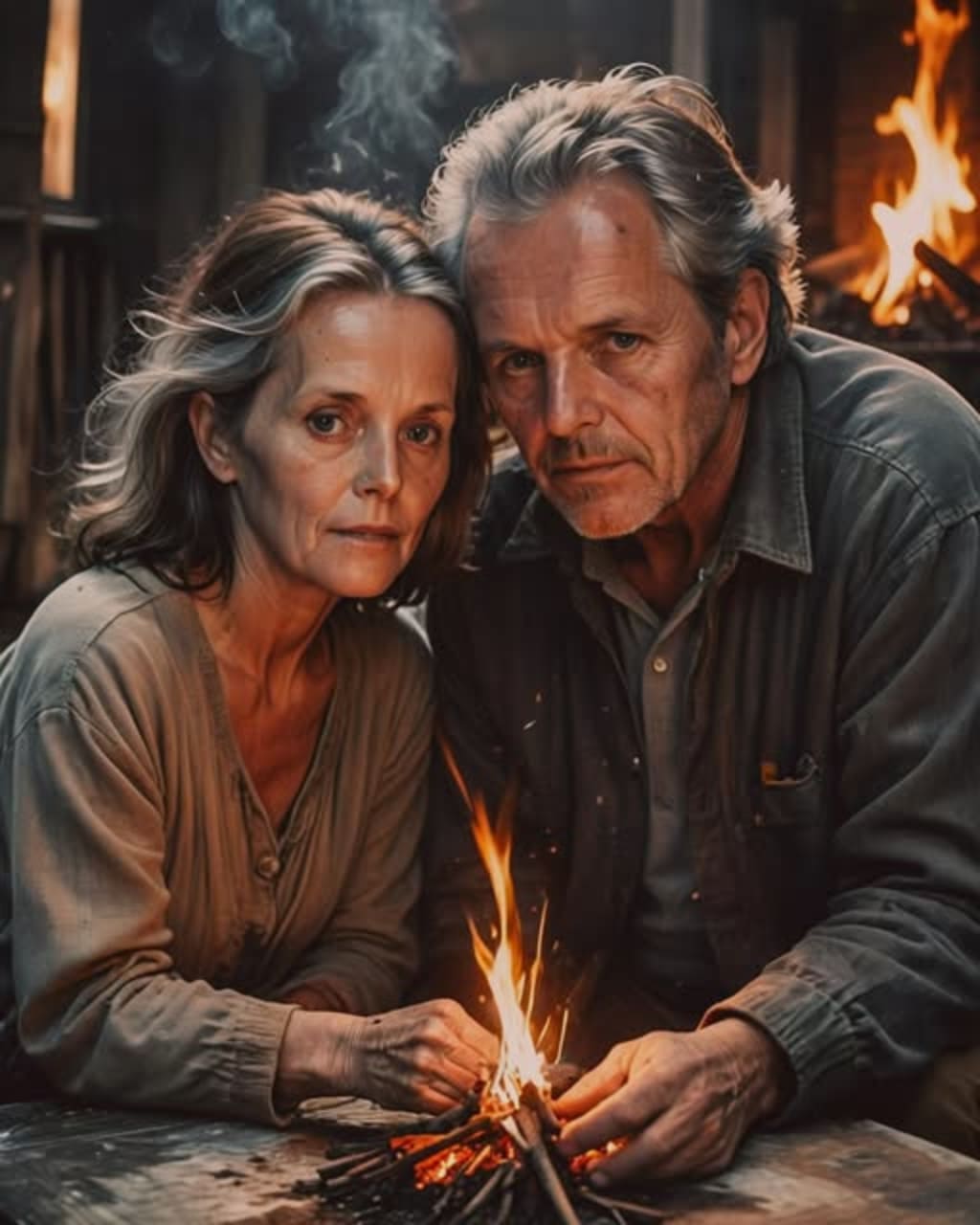
In Navasota the summer had a way of varnishing every story until it shone. The day Emma married Henry, people said shotgun as if it were both a joke and an algebra problem, something solved in haste on a front porch while cicadas racked up their noise. The pastor spoke over it all, “A mighty fortress,” and the bell clanged twice because the rope caught, and that, too, became part of the town’s version.
Emma wore a dress that looked like it had been ironed with prayer. Her smile was the small, careful kind you put on a shelf and dust. Henry stood with the same square-shouldered patience he would later take to The Lumber Yard, the smell of planed pine already about him like a promise he actually meant to keep. He held her hand as if it were a tool he’d been given with no manual, and he would figure it out or ruin his thumbs trying.
They were the talk for a while. Navasota is generous with attention the way a river is generous with mud. Then diapers and hymnals and supper rosters swept in; nine babies came, one after another, like seasons that refused to take turns. The house on Cedar Street stretched to hold them--Henry tacking on a sleeping porch, a shaded lean-to for shoes. At the kitchen table, there was always room for one more chair and never room enough for silence.
Emma’s sadness was not the dramatic kind; it was a low river that kept its banks, brown and steady, turning everything, it touched the same color. Some mornings she was bright as fresh water and the children crowded for it, bringing her book reports, scraped knees, a joke stolen from the barber. Some mornings she moved through the house like a cloud the windows couldn’t argue with, and Henry would stand at the back door with his lunch pail and want to say something useful and know only how to sand an edge.
They were staunch German Lutherans because that was the language the house already spoke: coffee strong as a decision, Saturday floor-scrubbing, a stack of pie plates ready in the pantry for someone else’s grief. On Sundays the children filed into the pew like a small parade, hair slicked, shoes polished, each one learning to sing from the diaphragm and to keep an eye on who heard them. Pastor Klein’s sermons hit pride hard and often, but pride was a hard seed; it sprouted in the dark when no one watched.
In a house with nine claimants, attention is a currency and a mirror both. The Bauer children learned to shine themselves up. They learned how to turn a B+ into a story about grit, how to stand at the sink and find the light that made their cheekbones look like destiny. They learned that if someone else’s tale was taller, you climbed up it or sawed it down to size. A mother’s soft days make an echo; they filled it with themselves.
Henry, for his part, kept bringing home rectangles--offcuts from The Lumber Yard, frames he knocked together in the evenings with the radio low. He mounted awards and report cards and a ribbon from the county fair that insisted it was blue and important. The hallway became a narrow gallery of accomplishment: spelling bees and 4-H photographs, a church program starred where a solo happened. He called it the wall, and it was, in time, load-bearing.
Emma baked kuchen when she could and set her palm against the children’s foreheads when they grew too hot with their own telling. She had a way of sitting on the back steps at dusk, the storm cellar to her left, the pecan tree to her right, watching a slice of sky as if a memorandum were coming down and she alone could read it. The children would call to her through the screen door with fresh victories: “Mama, guess what Pastor said?” “Mama, Coach picked me first!” Sometimes she answered. Sometimes she turned her face away, not from them but from a grief that sat down uninvited and asked for coffee it did not deserve.
The town kept talking--about the wedding that started it all, about how Henry’s hands got more nicked every year, about how the children were something else, weren’t they, so sure and shiny. At potlucks the Bauer kids arranged the deviled eggs like medals and presented their pies with speeches. Other parents smiled and said bless their hearts in the tone that means exactly the opposite.
Once, during a heat like a held breath, the fourth child--Ruth, who had the family’s tidy mouth and a mind like a pocketknife--won an essay contest about Texas history. The pastor mentioned it from the pulpit; the newspaper ran her photograph; the wall got another frame. That evening, Henry found Emma on the back steps, the sky a thin bruise. He sat beside her, his shirt still smelling of cedar and sweat. “She did good,” he said, which was the entire language he had.
“She did,” Emma said. Her voice was a careful instrument. “We are teaching them how to be seen.”
“That’s…good?” Henry offered, gentle as a man can be when he is all corners.
“It can be.” She tipped her head toward the house, where laughter wore boot heels. “But they are not learning how to look.”
The next Sunday, after dinner and dishes, Henry stood in the hallway with a level and a handful of nails. He took down half the frames, not from spite but to make room. He built a narrow shelf along the baseboard, just high enough for a child’s hand. When the children asked, he said, “For important things.”
They tested him. A baseball signed by nobody, a cracked marble, a dry magnolia leaf, a rubber-band ball the size of a fist. He nodded at each, grave as a judge. Emma placed a bent spoon and a ticket stub from a train she did not take. Later, she added a tiny jar of salt she kept for tomatoes, labeled in her careful print: for tasting.
The shelf filled. The wall still shone; pride does not dull just because you make a place for humility. But the children began to bring home other stories. How the new girl in Sunday School sat alone. How the cat behind the hardware store looked like it needed a name. How the river ran high after Wednesday’s storm and the sycamores held their ground without bragging once.
Navasota adjusted its story the way towns do, without admitting it. People still called it a shotgun wedding when the heat came back around to that month, but now they said it with a smile that held less mathematics and more weather. They still shook their heads at the Bauer brood--“Lord, they do love the mirror”--but they said it while asking one to stay and help stack chairs.
Emma’s sadness never left. You cannot exorcise a river; you can only learn its current and watch that no one is swept too far. On her best days she was a shore. On the others, she sat with the salt jar and let the world touch her tongue until flavor came back.
Henry worked until his shoulders made tiny complaints even when he slept. He didn’t retire so much as put his hammer down between one job and the next and forget where. When the ninth child graduated, the house loosened its belt and breathed. The shelf stayed. The wall stayed. The children left one by one to lives that had the shine of their raising, and in their offices and kitchens and pews they kept mirrors handy--but some kept shelves, too.
Years later, when folks in Navasota talked about Emma and Henry, they talked about the long marriage that began in a hurry and lasted like a slow hymn. They talked about the nine--“my Lord, nine”--and how every one of them could make a case for themselves that’d sell a goat on ice. But sometimes they talked about this: that in a narrow hallway, in a house that had held too much and somehow not enough, there was a low shelf where you could set down a small, ordinary thing and declare it worth keeping. And that, for people who had learned to be seen, turned out to be a way of learning how to look.
I am a global nomad/permanent traveler, or coddiwombler, if you will, and I move from place to place about every three months. I am currently in Peru and heading to Chile in a few days and from there, who knows? I enjoy writing articles, stories, songs and poems about life, spirituality and my travels. You can find my songs linked below. Feel free to like and subscribe on any of the platforms. And if you are inspired to, tips are always appreciated, but not necessary. I just like sharing.
YouTube Top Song List.
https://www.YouTube.com/results?search_query=julia+o%27hara+top+songs
Amazon PlayList
https://www.amazon.com//music/player/artists/B0D5JP6QYN/julia-o'hara
Spotify PlayList
https://open.spotify.com/artist/2sVdGmG90X3BJVn457VxWA
You can also purchase my books here:
https://www.lulu.com /spotlight/julie-ohara
I am also a member of Buy Me A Coffee – a funding site where you can “buy me a cup of coffee”
https:www.buymeacoffee.com/JulieOHara
About the Creator
Julie O'Hara - Author, Poet and Spiritual Warrior
Thank you for reading my work. Feel free to contact me with your thoughts or if you want to chat. [email protected]
Keep reading
More stories from Julie O'Hara - Author, Poet and Spiritual Warrior and writers in Fiction and other communities.
The Ink of Destiny
The Ink of Destiny Clara stood in the dim light of the attic, dust motes swirling around her. The voices of her childhood echoed through her mind—laughter, warmth, but now, silence. Her grandmother had passed just weeks ago, leaving behind a legacy of love and unspoken regrets. The trunk in front of her was old, locked tight, its wooden surface engraved with faint floral patterns.
By Julie O'Hara - Author, Poet and Spiritual Warrior4 months ago in Fiction
Affection and Healing for Yourself
During the night of the last quarter moon, I gathered my ritual supplies. I carefully handled the chunk of black tourmaline that would protect me from your overall negative and narcissistic energy. I carefully walked the house with my stick of selenite in hand, asking the universe to cleanse our working space.
By Alisha Wilkins ✒️🦋🖋️5 days ago in Fiction
📢 Raise Your Voice Thread: 01/22/2026
Our “Raise Your Voice Threads” are hosted most alternating Thursdays at 12PM ET to offer creators more avenues to uncover exceptional stories on Vocal. As we are continuously searching for fresh creators and inspiring stories, this thread provides an opportunity to exchange and discuss the stories that have moved and motivated us on Vocal.
By Raise Your Voice by Vocal2 days ago in Resources



Comments
There are no comments for this story
Be the first to respond and start the conversation.