
Halimaw
Yan recalls the history of her Tribal village's past as she is about to encounter her first sacrificial ritual of a Halimaw, or monster.
“Keep your eyes forward,” my mother instructed me as she tightly gripped my hand, “move quickly, Yan.” We shoved our way through the crowded marketplace. Despite the bustling streets of Toko, it was eerily quiet. My mother had a concerned look on her face. “Ma, are we still getting oranges for Tamah?” I innocently asked for it was my sister’s birthday. “Quiet. Now is not the time for buying oranges. The Patrol captured a Halimaw,” she said in a hushed tone. She quickened her pace.
From a distance, I could hear the Patrol van’s shrieking sirens growing louder as it was drawing near. We were herded across the street to make room for the parade that was about to happen. It was a ritual that celebrated the capturing of a Halimaw, or monster.
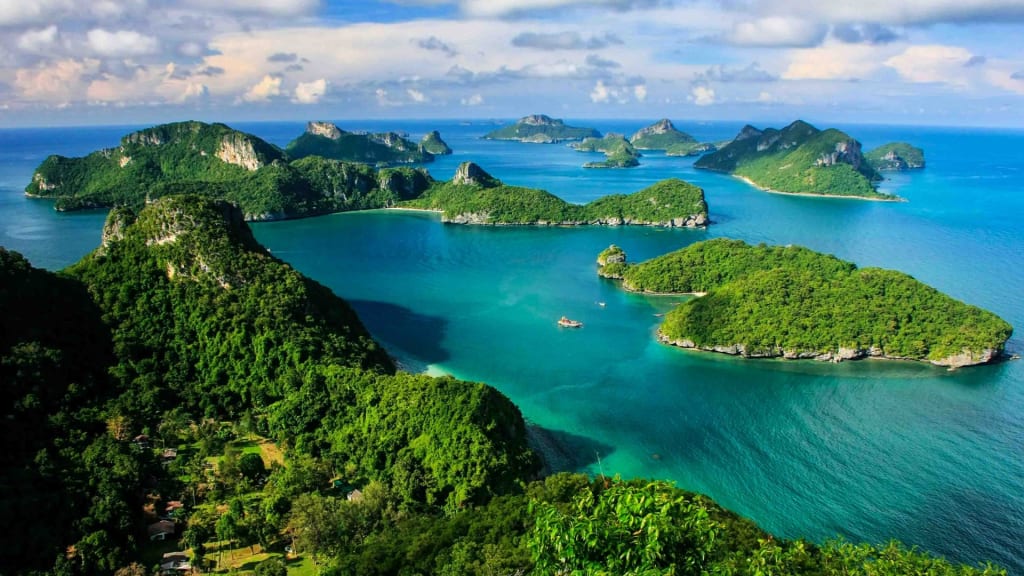
Toko is a peaceful village. It sits on top of a mountain where you can see the gleaming ocean interweaving thousands of islands siloed onto themselves. The Elders once told me that before the last World War the islands used to belong to a single mass of land. It was said that when Big Industries took over local farmlands, many natives lost their local businesses and poverty rates were at an all-time high. The facilities that were built made the land inhabitable by polluting the air, water, and soil. Food was tough to acquire as the few native lands that were preserved became infertile due to over cultivation. Many people struggled to survive. There was much civil unrest as wealthy and powerful government officials hoarded the last bits of resources and monopolized native land. Globally, civil unrest ignited rebellions to overthrow these oppressive governments and restore the imbalance of power amongst local tribe leaders.
As nations struggled to appease the needs of their own people, internal pressure to seize resources from neighboring countries gave way to horrific crimes against humanity over the last bits of clean water. The extent of violence by human hands nearly ended humanity. It was a time when the world needed a global reset.
Amidst the war, there was a massive nuclear explosion which divided the land into thousands of islands and left half of the world’s population dead or missing. The Meridians, who were considered rebels at the time, seized the opportunity to establish a New World Order in the name of prosperity and peace. The Meridians envisioned a New World Order that bought people back to a simpler time when the Earth and all that inhabited its land was honored. Guided by the slogan, “Divided We Stand, United We Fall” they restricted travel as clear boundaries guaranteed national sovereignty. Interaction amongst different tribes became limited to prevent ideological, political, and economic tension and conflict. Technology was banned. Martial Law was enacted to protect each tribe from the dangers of the outside world which could threaten the restored order. Any rebels who tried to challenge and overthrow the Meridians disappeared by the state instated Patrol.
As major world leaders and diplomats started to mysteriously disappear, Hamilaws started appearing in massive numbers onto the shores of Toko. The Elders believed them to be a sign from the gods indicating divine providence-that the natives are now protected and will be restored. Hamilaws were creatures often depicted as cunning yet devious, whose velvety skin and blood have magical medicinal healing properties to the land and to humans. The Elders used to tell me that during night, their skin looked so radiant from the moonlight that the sand looked like stars in the sky. The Meridians demonstrated how these creatures can be used to fertilize the land by sprinkling its blood on the soil and taught the Tokon people how to concoct different medicines to heal the various parts of the body. Slowly, vegetation started appearing in the islands. Animals started reproducing and returning to their habitats. Eventually, there was peace. The more nations were prospered, the less Hamilaws appeared. The Meridians slowly disappeared from the public eye. It was a return to the past as the Meridians had hoped for.
At the time of the parade, I was nine years old and only heard about Halimaws from the Elders’ stories. These ancient creatures shaped the identity of Toko. Its image is embedded on the village crest which is shaped like a heart shaped locket. Upon birth, my people honor our history of triumph by tattooing our tribal crest on our chest as a sign of loyalty and unity. To have the opportunity to partake in a sacrificial ritual of a Halimaw holds special sacredness to the Tokon people as it unlocks our village history and ties us to our past ancestors’ struggle.
Soon, my mother and I were enveloped by the deafening sounds of the siren’s cries as several Patrol vans passed us following a myriad of men carrying flags with the Tokon crest. My mother’s grip tightened as we were directed to stay still by the surrounding Patrol. Her facial expression was solemn and signaled me to stop fidgeting. Everyone around me shared that same expression as they awaited for the arrival of the Halimaw. As a young child, while I was excited to participate in this sacred ceremony it was difficult for me to process the solemness of the Tokon people who surrounded me. It was apparent that many of the Elders have experienced this before so I heeded to their lead and mimicked their expression and posture as to not appear to be irreverent. Still, I was confused because instead of this sacrificial ritual being a joyous occasion for bringing more prosperity to our village, the atmosphere of our people felt somber.
Suddenly, the marketplace was still and everyone looked up. There was a faint smell of myrrh in the air signaling that the parade was about to pass my area. My face went numb for a moment as I laid my eyes on the Halimaw that was being carried by a Patrol officer.
Its skin was not radiant like the stars in the sky nor did it look devious and cunning as we were told in the stories. In fact, the creature did not look like a monster nor magical as depicted in the Elder’s stories. It looked like my people but with slightly lighter skin. Its stature was not tall, rather it was about my size. Its mouth was sewn shut and had the look of dread in its eyes as though it would prefer death over more violence and public humiliation. As the Patrol officer lifted the creature above his head, I saw a faint tattoo on the Hamilaw's forearm that looked distinct from the Tokon crest tattoo my people shared. It was shaped like the letter “M” transforming into a compass. This is when I realized why all the Elders were somber. The Hamilaw was not a monster as my village created it to be. The Hamilaw was human, possibly a refugee from a surrounding tribe or island.
“Behold, the sacred Hamilaw,” the Patrol officer announced while everyone bowed with deep reverence, “we thank you for your life and sacrifice. For death brings life and no soul is forgotten. We will drink its blood to honor our past, to honor our struggle and triumph, and to preserve our future survival.”
About the Creator
Wren
Life has shaped me, but I’ve stayed true to who I am, steady and deliberate. Growing up on the back forty, I didn’t just live life, I soaked it in. Now, I carry those stories with me, always creating, always writing.
Miss Persephone's Manual to a Seemingly Ordinary Life
Miss Persephone was found at the dining table, her blue eyes swollen, her tears arriving and retreating like the tides of the ocean. Earlier that day, her family had visited her in the retirement home where she had lived for eight years. It was her eightieth birthday.
By Imola Tóth4 days ago in Fiction


Comments
There are no comments for this story
Be the first to respond and start the conversation.