
h*story
'There is nothing heroic or skilful about my having survived that dark time. I was just another of the scavengers that were so common in the outer suburbs, in that long decade after it all fell apart.'

If you were to ask me to name the most impactful moment of my life, I wouldn’t be reminiscing about some significant historical event, or the acts of a great leader. It has seemed rather that the small things made the greatest difference to me.
There is nothing heroic or skilful about my having survived that dark time. I was just another of the scavengers that were so common in the outer suburbs, in that long decade after it all fell apart. If there is anything special about me, it’s that I have always been interested in people, in what motivates them.
In those days, I would sometimes sit by the fire at night, after we returned from our work, asking question after question of the others who came and went. They mostly had no patience for this inquiry. I used to believe that this brand of amateur psychology was the closest anyone could get to doing science, at that time.
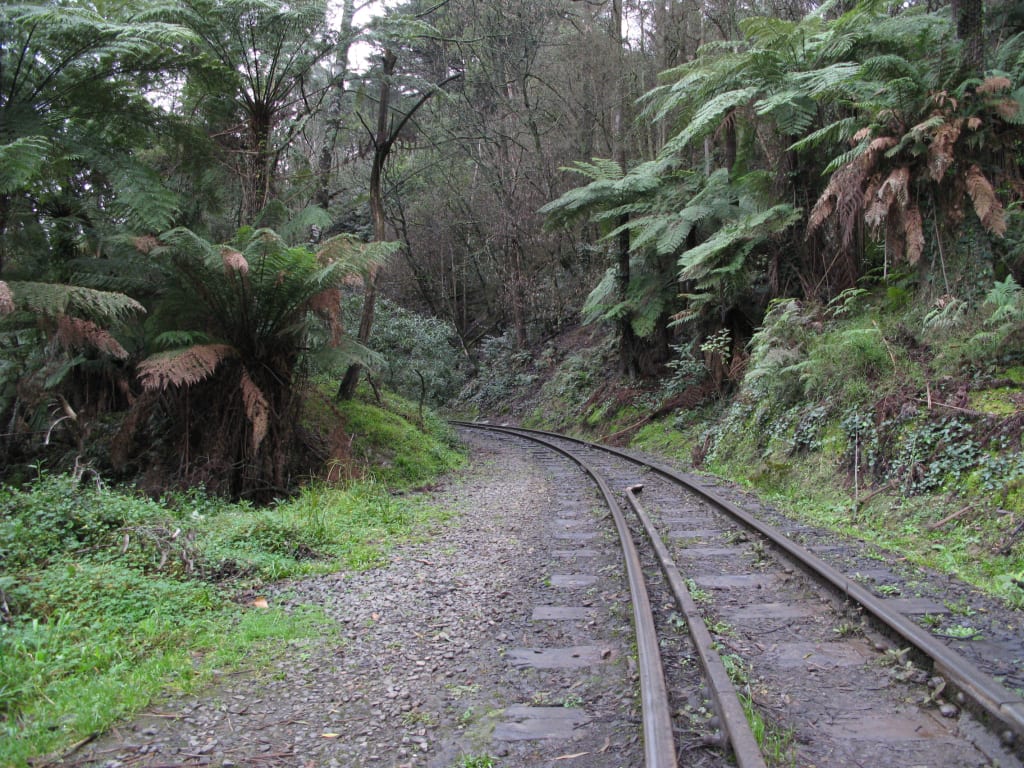
My life back then was lived on and around the tracks of that old steam train. I spent so much time feverishly picking over the tracks that I came to form some strange beliefs about them. I found the sleepers the most awe-inspiring: the hardness of the wood, the finality of their position beneath the steel rails. I or anyone could have destroyed them given enough time and effort, but that didn't make them any less indomitable. In burning them, chipping away at them, they would be winning, in some primal way that I remain unable to articulate.
We searched at night, to minimise risk. We all had torches, our one remaining technology, repaired to minimum functionality by Bella. She once told me, in a rare moment of exposure, that she had been an engineer in the old world. It was considered shameful among us to talk about the world before. We never said so explicitly to one another, but we all felt it.
Something of some small value meant a week’s food; something better, a ticket to some larger comfort. Whatever we found was taken by the person who found it, nothing was divided. Kindness had gone out with the other benevolent emotions. That rule had been violated only once, by a man braver and more violent than the rest of us. The rest of the group, in unspoken agreement, had forgotten that event quickly enough. There was never a chance of fighting back.
The tracks were our Eden, those long lines of steel dissipating the loneliness of the broken down houses and empty streets of the smaller population centres thereabouts. The story was, the old government had commandeered the steam trains to distribute food and other essentials to the region after the electric trains had broken down, minor functionaries tossing parcels from the train to the left and to the right. Many desperate people came to the tracks in the hope of exchanging their valuable items for more food. They were shocked to discover that their gold and jewels were worthless then. Food and water were the scarcer commodities. In the fights that broke out there, many of their valuables had found their way to rest shallowly in the dirt.
In picking through the remains of those small tragedies, we were like half-people, empty of ourselves. We didn't want to stay that way, not any longer than we had to. There were some people in the city that would buy these items now, so the rumour went. Any find was a chance.
When Thomas found the woman by the tracks, let’s call her X, I felt less at first than I perhaps should have. X groaned a little and turned her head, a dry husk, tucked up against the embankment as if to drink from the pools of rainwater. No-one spoke a word at seeing her. She was one of those wonderful few, those charismatic monsters that had burned a line into the world, a line that we thought we were all on one side of together, before it ended with them alone.
I held no desire to hurt them, though many at that time did. I have never been motivated to participate in savagery.
Thomas gave her water, made caring noises, and engaged in mimicking other of the instinctual kindnesses we had once visited on the sick. We helped her stand. The third there, Bella, was obviously uncomfortable. I understood quickly enough and waved her away with my free hand, though there was nowhere to go and we both knew it.
My old values were competing with my self-interest. I wanted on one hand to let X go, and on the other to scream my history at her, as if that would solve, or repair, or replace anything or anyone. Life had taught me by then that we mourn from the world that the dead leave behind. The world in which my family had lived was as gone as they were; therefore there was nothing left to mourn.
There was salvation here for whichever of us took her. She was remembered, and the inevitable burning desire of those who could pay would set her price beyond anything we could imagine.
I told myself that we could just let her go. I told myself it would have been the right thing to do, once. Whatever that means. I don’t think I have ever known.
Thomas leaned forward, folding his hands reverently around something hanging from X’s neck.
I knew what this signified, and was powerfully envious. I had only ever come across a few small valuable items myself, enough to get along. I guessed that they would come readily to a man like Thomas. He was the sort that is heaven's favourite, white and young and ignorant. It was enough for him to walk around and say things, and to do things only from time to time. He probably never really needed to work before, not like you and I. So he sat, and I sat in my envy, and I wanted so badly to hit him over the head and take what he held, and perhaps to take X, but I hated myself enough to sit there, still. The forest, dark to each side, kept watch over our uncertainty.
He sat too long in silence. I was overwhelmingly anxious. X seemed like she would become conscious soon, and we needed to come up with a plan. I said as much to Thomas, although I don’t think he particularly appreciated my input. I suppose I was afraid that something like this might be enough to turn him, that he would become as covetous and violent as that other man, just as suddenly.
And X groaned. I could almost remember her real name, from those old broadcasts on the television.
X moved weakly, perhaps wanting to cough. Thomas looked at her, his expression a strange mask of care, there in our meagre pool of torchlight. Perhaps he was trying to make her more comfortable. Maybe he was cunning enough to know that if she felt comfortable there might be more of value forthcoming, or the journey to the city, to her end, might be easier. Who could say?
'Water,' X said, dying slowly in the dirt. Thomas gave her a little, from a pouch he kept in his bag. She relaxed back into the embankment with a sigh. Suddenly she shot up into a sitting position, agitated.
'Where are they,’ X mumbled. ‘Where are my friends? Did you see anyone-'
She was delirious. She could not have seen her friends recently. Even those of them not known to be dead were assumed to be. Her hand leapt fearfully to her neck, which drew my attention to the object Thomas had been holding. It was a heart-shaped locket, a small thing, grubby with age. Probably gold. Set with at least one diamond, maybe two.
We reassured X: her friends were gone, but she was safe. When we were done, there was a lull, after which I was the next to speak.
'Why did you leave?'
I felt so much. I wanted them to have been different, X and her friends. Better yet, I wanted a world in which they had never existed in the first place.
Bella stepped forward then. Of the group, she was the most forthright. She spat full into the face of our guest. Neither of us was inclined to stop her. X turned her head, too late to avoid the insult. I thought of how her kind had turned their head from our suffering during the worst of it. I became angry, I’m not ashamed to admit it.
I said, ‘Why did you do it, you grandiose children.’
I said, ‘You thought you were saving the world, didn’t you. Making things right.’
I said, ‘You’ve learned now, with all of us living out the consequences of your mistakes. You couldn’t dethrone them without destroying everything else we had. Just because you had the power to do it, doesn’t mean that you should have.’
I said, ‘It’s all fucked now. We can’t feel anything but bad, we’re scavengers, at the bottom of the ladder, worse off than before. You fucked us over, you betrayed our hope,’ I jabbed my finger at X, ‘You betrayed us.’
It was in reflecting on that day that I learned just how ordinary I was. For someone who thought themselves curious about human nature, I wasn’t interested in any answers X might have given. I wanted my voice to sound loudly in the night, to mean something in connecting with her story, with this living artifact.
I’m proud to say now that I didn’t threaten or hurt her. I didn’t do anything but talk, tired as I was.
I had participated in the big historical moment of X and her kind, of course. The mad dance of the uprising, the makeshift trials and the subsequent executions, and the breaking of our cities, those haunted memories that can never be unmade. It wasn’t our fault, not then. We were just following orders.
Thomas had watched this outburst of mine carefully, thoughtful. He reached out and took the locket firmly in his hand, pulling it from her without ceremony, breaking the chain. The sound of it was loud enough to be heard over the wind rising in the trees.
X cried out and tried to struggle to her feet, but failed, too weak. ‘You can’t, you can’t,’ she whispered, ‘It ties me to them.’
She reached out her thin hand.
‘You don’t know what it means.’
Thomas was still, his face heavy with pity.
‘No, it’s a new world now,’ he said, ‘Even if not the one you imagined.’
The revolution and its aftermath had made us all strange. I’d thought that about everyone and everything else, but never myself. I would have killed her, but I didn’t want to be that anymore. The next best thing was to leave her there by the tracks, cast away among the remains of the charity of the old order.
At Thomas’s insistence, we shared the bounty of the locket. When the three of us gently unwrapped it each evening to on the way to the city, it seemed full of promise. We stared at it greedily, as if to confirm its reality each day, as if it would disappear if we didn’t.
Funny - I didn’t think of X for years after that, as if she were the less important part of the memory. It seems to me now that we might have done the best thing for her by taking the locket, the last of her hope, from that world that was so greedy for it.
I hope she lived on, that she was able to forget about her friends, and whatever it was they had tried to do.
About the Creator
James O'Brien
James is a queer writer working in Melbourne, Australia. He was awarded third place in the national queer short story competition OutStanding in 2019. He mostly loves people, and the incredible stories they live.
Keep reading
More stories from writers in Fiction and other communities.
A Love Forboding
The chipped stone slope caused unbearable footing. I slid, skirting on my heels. I cast my shield, relinquishing my guard to stay upright. Left with my double-edge and a prayer to the maker, I skated toward my objective. The earthly stubble gave way to solid ground. I found myself restored, a trail of dust in my wake.
By James U. Rizzi5 days ago in Fiction
Spellslinger
The desert stretches its dry mouth out before me, dust filling my lungs as the light filters from the sky. I can see, just barely, the outlines of the next town on the horizon, and I lean forward and stroke Silas's mane. "Almost there, boy," I whisper, hoping the heat of the bodies I sense with the probing fingers of my magic isn't an illusion. This inhospitable land can do strange things to a person over time, and I've already been on the road for days.
By Raistlin Allen5 days ago in Fiction
Self Help: Grifters' Gospel
On Self-Help, Snake Oil, and the Illusion of Change Psychology professionals and students can be imagined on two opposite sides of a line called self-help books: likely a larger group opposes pop-science and step-by-step manuals filled with talk of success, journaling, and not giving a f**k; others love them, but they aren’t many.
By Avocado Nunzella BSc (Psych) -- M.A.P 2 days ago in BookClub



Comments
There are no comments for this story
Be the first to respond and start the conversation.