

1. THE COSMIC ORIGINS OF TARTAROS
1.1. The First Powers from Chaos
According to Hesiod's Theogonia, one of the main sources of ancient Greek mythology , everything started with Chaos at the beginning of the universe. Chaos refers to an infinite and formless void in which order, form, and meaning do not yet exist. This "first" being or state is the starting point of the basic building blocks of the universe. Among the first beings to come after Chaos are Gaia (Earth), Tartaros (Depth), Eros (Love), Nyx (Night), and Erebus (Darkness). These beings are not gods or goddesses in the classical sense, but are direct cosmic forces. That is, they are the first energy fields that determine the functioning of the universe.
The fact that Tartaros is one of these firstborn beings indicates that it is not an ordinary underground region, but one of the fundamental dynamics of direct existence. While Gaia represents fertility and life; Tartaros is identified with its opposite, which is absence, darkness, death and imprisonment. While Gaia gave birth to the sky, mountains and seas; The presence of Tartaros remains more of a hidden, secluded but menacing potential force.
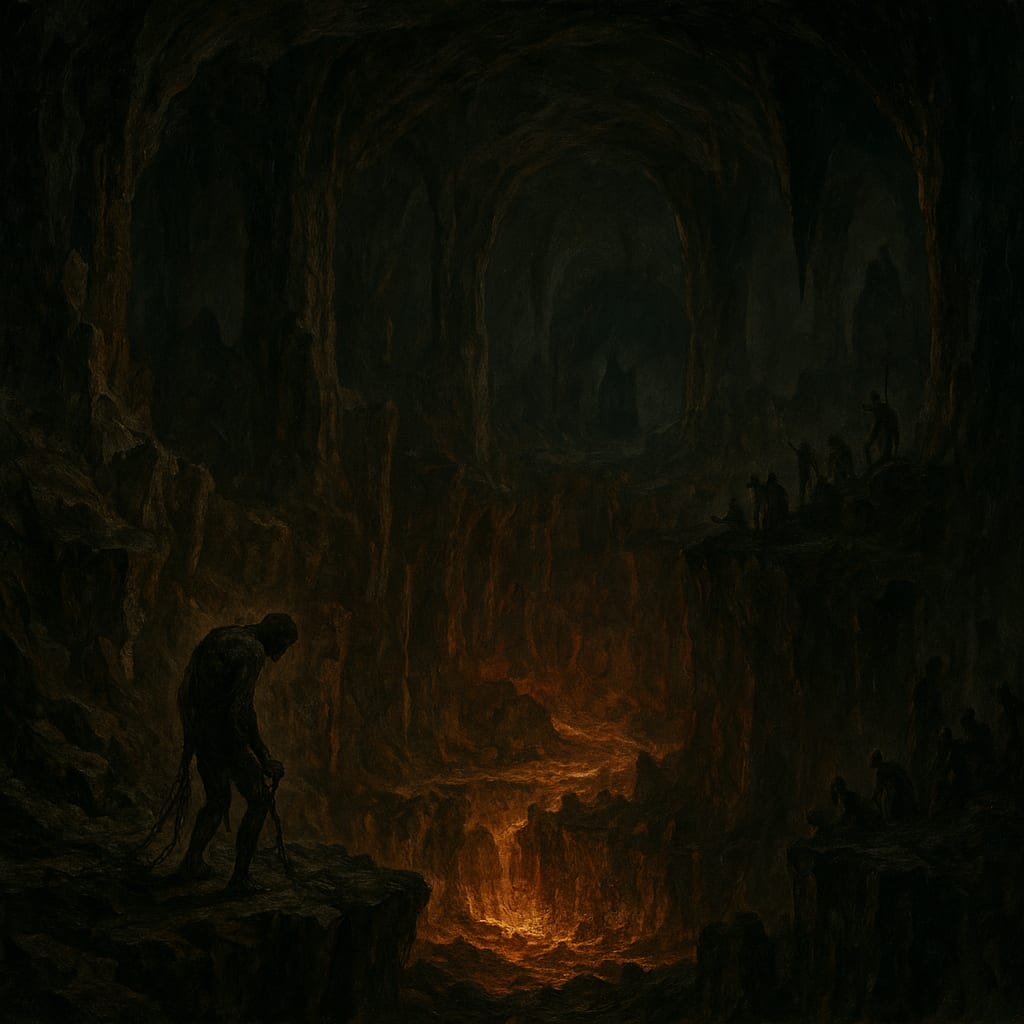
At this point, the two-way nature of Tartaros draws attention. The first is that it is treated as a personality in the sense of "being". In this context, Tartaros, like other cosmic beings, carries a consciousness; He united with Gaia and had a child. The second aspect is that Tartaros is thought of as a "place". In this respect, Tartaros is a kind of dungeon, a prison, a punishment area located in the deepest part of the universe. This dual structure – person and place – is one of the most interesting dimensions of Tartaros in mythology and distinguishes it from other cosmic beings.
1.2. Hesiodos ve Theogonia’da Tartaros
Hesiod's Theogonia, one of the basic building blocks of Greek mythology , is a comprehensive narrative that describes how the universe, gods and cosmic order came into being. While this work draws up the family tree of the gods, it deals in detail with how Tartaros has a place in this cosmic formation.
According to Hesiod's account, Gaia (earth), which comes after Chaos, gives birth to Uranos (sky), mountains and Pontos (sea) on its own. What is interesting, however, is that Tartaros, like Gaia, came into existence on its own as a primordial being. The most remarkable creature born from the union of Gaia and Tartaros is the terrifying Typhon. This creature is a kind of apocalyptic threat to the gods. Typhon's birth shows that Tartaros is not only a place of punishment, but also harbors a fertile, creative and chaotic potential.
In this context, Tartaros is not only a place for the gods, but also a "source". Evil, threat, and chaos arise from it. Typhon, which emerged as a result of Gaia's union with this deepest darkness, threatens the order of the gods. Zeus' defeat of Typhon and imprisoning him in Tartaros again means the restoration of the mythological order. There is a kind of cyclical structure here: the forces born of Chaos threaten the world, the gods suppress this threat, and the source of the threat is sent back to the chaos. This cycle represents the order of the universe and the understanding of justice in mythology.
The mythological significance of Tartaros is once again emphasized here: it is a center of power located in the deepest part of the universe, which is both a source and a threat and an area of ultimate punishment. The fact that Tartaros assumes such a dual role spatially and conceptually increases its mythological value.
1.3. The Personification of Tartaros and Its Relations with Other Beings
In Greek mythology, most entities represent a particular trait or power. However, the fact that Tartaros is a personified entity makes him a much deeper metaphor than an ordinary depiction of hell. Along with Tartaros' personification, his relations with other divine figures also draw attention in mythology. Especially his association with Gaia is important in this sense. Like Gaia, the goddess of fertility and fertility uniting with her birth to Typhon, symbolizing the dilemma between the fertility of chaos and the fertility of order.
While Gaia's nature is life-giving and constructive, Tartaros' nature is destructive and disintegrating. This contrast constitutes one of the basic dynamics of mythology. The fact that a being like Typhon is born from the combination of these two extreme figures allows it to be explained directly by darkness as the source of evil or chaos in the mythological world. In other words, evil is not something external in this narrative; It is a natural consequence arising from the duality within the universe itself.
There is hardly another example in mythology where Tartaros has directly merged or interacted with another being. This indicates that he is not an "external" figure, but rather the lowest, most fixed and unchanging layer in the universe. While the other gods love, marry, fight, and act; Tartaros stands put. He doesn't go anywhere, he doesn't interfere directly with anyone, but everyone is afraid of him.
In this respect, Tartaros is in a way like the subconscious of antiquity. When gods, heroes, and humans face the consequences of their own actions, they ultimately arrive in Tartaros. Just as a sinner is finally left alone with his conscience, mythological figures finally face their punishment in Tartaros. Its unchanging and immobile nature shows that these punishments are also eternal and eternal.
2. STRUCTURE AND LOCATION OF TARTAROS
2.1. The Place Underground: The Depth of Tartaros
In ancient Greek cosmology, the layered structure of the universe is quite evident. At the top is Mount Olympus; Gods live here. Below it is the earth (Gaia), below it is Hades (the land of the dead), and at the bottom is Tartaros. Tartaros is depicted as a place even deeper than Hades, a place that even the dead could not reach after burial. For this reason, ordinary souls do not descend on Tartaros; Only the gravest criminals and those who rebel against the gods are banished to this deepest place.
This extraordinary depth of Tartaros is described with striking descriptions in many mythological texts. Hesiod, for example, says in the Theogonia:
"An anvil made of iron, if it fell from heaven to the ground, would fall for nine days and nine nights, but on the tenth day it would reach Gaia. In the same way, it takes nine days and nine nights to fall from Gaia to Tartaros."
This narrative implies that Tartaros is not only a mythological hell, but also an "abyss" independent of time and space. Not only vertically, but also conceptually, the idea of depth, infinity and irreversibility is inherent in Tartaros. In this respect, it is possible to evaluate it as both a spatial and existential boundary.
Tartaros is the bottom, the end, and the emptiness of everything that exists. It is not only the area of punishment, but also the "devouring" point of the universe. In this respect, Tartaros is not only a fear of the afterlife for the people of antiquity; It is almost the lowest limit of existence. The fact that even the gods can be condemned there suggests that it is a place outside and above the divine order.
2.2. Tartaros on Cosmic Maps
The ancient Greeks often envisioned the universe as a three-layered structure: the sky (Ouranos), the earth (Gaia), and the underworld (Hades). But underneath this tripartite structure, there is a hidden fourth layer: Tartaros. This layer is inaccessible to ordinary mortals and is a place that even the gods commemorate with fear. The location of Tartaros on this cosmic map adds to its importance and intimidation.
The Greeks imagined the universe as a spherical or flat disk. In this vision of the disk-shaped universe, Tartaros is the farthest point from the center of the universe. Tartaros, therefore, is "distant", "unattainable" and "unsacred", not only physically, but also metaphysically. The place where it is located is a void where there is no order, where the justice of the gods is applied in its harshest form.
The special place of Tartaros on this cosmic map indicates that it was the border even for the gods. The imprisonment of the Titans here is not just a physical imprisonment, but an exclusion from the divine order. They are no longer simply chained; At the same time, they have been erased from the order of the universe, even from its remembrance.
On mythological maps, Tartaros is often depicted surrounded by massive bronze gates. These doors are so powerful that they can only be opened and closed by divine forces. The gates are guarded by giant creatures with one hundred arms, called Hekatonkheir. The presence of these creatures shows how terrifying the contents of Tartaros are. Because the fact that such powerful beings are only tasked with keeping things inside implies what a dangerous and powerful place Tartaros is.
Not much detail is given in ancient texts about the architecture or physical structure of Tartaros. But in general, it is depicted as a vast, dark, cold, vast, and resounding void. It's not walled off; Because it is a bottomless place that there is no need for a wall and there is no escape.
2.3. Hades and Tartaros: Differences
A topic that is often confused in modern interpretations is the idea that Hades and Tartaros are the same place. However, in the mythological context, these two regions serve completely different purposes. Hades is the underworld where souls go after death. Souls are distributed here in various areas: heaven-like realms such as Elysion, neutral regions such as Asphodel, and punishment areas for criminals. However, Hades is a place of waiting and dissociation for souls in general. It punishes injustice, but the real judgment, punishment and absolute exclusion are reserved for Tartaros.
Tartaros, on the other hand, is a prison where divine justice is directly applied. This place is only for gigantic criminals who rebel against the gods. Like the Titans, Typhon, and mortals who fool the gods. In other words, Tartaros is not a place that spirits can reach ordinarily; It is a "divine court" for the most serious crimes.
Ancient poets such as Homer and Hesiod make this distinction clearly. In Homer's Odyssey, Odysseus descends into the realm of the dead but does not enter Tartaros. Because his mission is to see the souls of the dead and to receive divination. However, the descent to Tartaros is reserved only for gods with divine power or punished giant figures.
In this context, Hades can be interpreted as a more neutral, sometimes even "understanding" space. However, this is not the case for Tartaros. It is a place where there is no mercy, no compassion, and no salvation. Those present are not only punished; At the same time, they are pushed out of the universe. In this respect, Tartaros is the ultimate form of exclusion in Greek mythology.
3. PRISONERS AND PUNISHMENTS IN TARTAROS
In Greek mythology, Tartaros is not only the deepest and darkest place in the universe, but it also functions as the place where the most serious criminals are punished. It's not just ordinary mortals who are punished here; Titans are extraordinary figures, such as kings who mock the gods, heroes who disrupt the divine order. Punishments, on the other hand, are not ordinary: they are tortures that often stretch for eternity, from which there is no escape, and which are both physically and mentally exhausting. In this sense, Tartaros is not only a mythological prison, but also the place where justice is applied most extremely, absolutely, and most frighteningly.
3.1. Titans and the Fall of Kronos
The first major figures to be punished in Tartaros were the Titans, the predecessors of the gods. The Titans are the children of Uranos (Sky) and Gaia (Earth) and are the rulers of the first divine order. Kronos, one of the most powerful, ruled the universe for a while after castrating his father Uranos and seizing the throne. However, because he was afraid of his own children, he swallowed them, causing a new generation of gods, the Olympians, to be born.
The great war between the Olympian gods and the Titans, led by Zeus, that is, Titanomakhia, lasted ten years and finally resulted in the victory of Zeus. After this victory, the gods, led by Zeus, decide to punish the Titans. Tartaros, the lowest and farthest point of the universe, is chosen as the place of punishment.
Titans thrown into Tartaros include Kronos, Iapetos, Koios, Krios, Hyperion, and other rebel titans. However, some Titans – those who remain neutral in battle, such as Okeanos – are not punished. The sending of the Titans to Tartaros is not just a physical exile, but the price of defying the divine order in the sight of the gods. They are no longer condemned to live inside the universe, but on the outskirts of it.
In Tartaros, the Titans are held in a dark prison surrounded by bronze walls. Behind these walls, giant beings with one hundred arms, called Hekatonkheir, stand guard. These creatures are so powerful that they can rip out the top of a mountain and throw it away. The fact that they keep the Titans under control also reveals how dangerous the criminals in Tartaros are.
3.2. Kykloops and Hekatonkheirs: First Imprisoned and Then Released
An interesting detail in mythology is this: After Kronos overthrew his father Uranos and seized power, he also threw his own brothers, the Kykloops (one-eyed giants) and Hekatonkheirs, into Tartaros. These creatures represent great powers, both physically and symbolically. Kykloops are beings that can control the lightning, storm, and fiery powers of the sky. Hekatonkheirs, on the other hand, have the potential to push the limits of the universe with their hundred arms and fifty heads.
However, Kronos fears the threat of these powerful beings, so he chains them and sends them to the depths of Tartaros. This reflects Kronos' fear of power and his effort to keep the order under control. However, these creatures are later expelled from Tartaros by Zeus. Because Zeus needs their power when fighting the Titans. Kykloops give Zeus lightning; They make Poseidon his trident and Hades his helmet of invisibility. Thus, the former prisoners become the gunsmiths of the new order.
This narrative also illustrates the circularity in mythology: those who were once imprisoned may play the greatest role in establishing new power. Tartaros is not only about punishment; It is also a pool of potential power. When used correctly, even the dark forces there can reinforce the divine order.
3.3. Legendary Prisoners Punished in Tartaros
One of the most well-known aspects of Tartaros is that it punishes not only titans, but also mortals who deceive the gods or violate divine laws. In this section, we will examine some of the famous figures who were condemned in Tartaros and the punishments given to them.
Tantalos
Tantalus is known as the king of Lydia and stands out for his friendship with the gods. However, by pushing the boundaries of this friendship, he commits a great disrespect to the gods: he cuts his son Pelops and offers it to the gods as food. This incident is one of the most serious crimes, violating the trust in the gods and the sacredness. The gods react to this crime with great anger.
Punishment: Tantalus is sentenced to eternal torture in Tartaros. It is submerged in water up to its neck and there are fruit trees around it. Whenever he wants to drink water, the water is withdrawn. Whenever he reaches for the fruit, the branch retracts. This punishment is both physical and mental torture. Tantalus is condemned to live on the threshold of desire, in eternal dissatisfaction. His name even inspired today's word "tantalize" (to show something from a distance).
Sisyphus
Sisyphus is the king of Corinth and is known for his intelligence and cunning. He is known for chaining Thanatos, the god of death, deceiving the gods and delaying his own death many times. These cunnings are a cynical rebellion against the order of the gods.
Punishment: Sisyphus is tasked with raising a large boulder to a hill in Tartaros. However, each time, the rock rolls back just as it approaches the summit. It's an endless cycle, and it never succeeds. This punishment is also a symbol of meaninglessness. The French philosopher Albert Camus saw Sisyphus' punishment as a metaphor for the "absurd life."
Ixion
Ixion is considered one of the first killers in human history. Ixion, who killed his father-in-law and was forgiven by the gods without punishment, is taken to Olympus after this pardon. However, here, too, he sets his eyes on the goddess Hera. Zeus creates Hera in the form of a cloud to test Ixion, and Ixion merges with her. From this union, the Kentauros (half-human, half-horse creatures) are born.
Punishment: Ixion is tied to a fiery wheel that spins forever in Tartaros. This return symbolizes the eternity of punishment, both physical and spiritual.
Danaidler
The Danaids are the daughters of king Danaos. They are all married to the sons of Aigyptos, the brother of Danaos, but on the wedding night they kill their husbands on the orders of their father. Only one, Lynkeus, disobeys this order.
Punishment: They are sentenced to carry water to a large barrel in Tartaros for eternity. However, the barrel is a hole and never fills. This punishment is the eternal price of both obedience and slaughter. It also emphasizes the concept of futile effort.
4. THE OVERSEERS OF TARTAROS AND THE DIVINE ORDER
Tartaros is not only a space where mythological criminals are imprisoned, but also a place under strict surveillance where divine justice is practiced. There is no randomness here; Everything is part of a divine order. In this section, the guardians of Tartaros, the security systems, the beings who ensure the execution of sentences, and especially the role of divine figures identified with justice in this dark land will be discussed.
4.1. Hekatonkheirs and the Gates of Tartaros
One of the most distinctive structural features of Tartaros is its legendary "bronze gates". These gates are the only passage point that isolates Tartaros from the rest of the universe. According to mythological sources, these doors are so heavy that they can only be opened and closed by gods or special creatures. It is not known what is behind these doors, but once inside, he cannot get out.
These doors have not only a physical but also a symbolic meaning in Greek mythology. Bronze represents durability and indestructibility in antiquity. The gates of Tartaros reflect the irreversibility of this place. Everything that enters is now considered outside the divine order.
The guarding of the doors is not left to ordinary beings. This task was assigned to three giant brothers called Hekatonkheir: Briareus, Cottus and Gyges. These creatures are the children of Gaia and Uranos, and each of them has a hundred arms and fifty heads. This immeasurable strength and body structure indicates that they functioned not only as watchmen, but also as enforcers.
Characteristics of the Hekatonkheirs
• Each of them has a hundred arms: This represents the all-round offensive and defensive capacity.
• Fifty heads: It is an oversaturated state of consciousness, perception and awareness.
• Although they were born by Gaia, they were rejected first by Kronos and then by Uranos.
• Zeus sought their help at Titanomakhia and won the battle by driving them out of Tartaros. After the victory, they were also made the guardians of this dungeon.
The fact that these creatures are stationed at the gate of Tartaros shows that there are limited beings to be trusted, even among the gods. So even Zeus has to take extraordinary measures to contain his old enemies.
4.2. Goddesses of Justice and Erinnyes
Not only physical guardians serve in Tartaros, but also guardians of the moral order. In this section, the roles of goddesses such as Nemesis, Themis, and Erinnyes in Tartaros will be discussed.
Nemesis: Goddess of Divine Vengeance
Nemesis represents a balanced distribution of justice. However, his field is not law in the classical sense; It is more commonly called hybris is a crime of arrogance and defying the gods. In case of transgression by humans or demigods, their punishment is carried out in Tartaros.
Nemesis plays a role in the design of punishments; It determines the crime, locates it, and sets the scales of justice. Criminals such as Tantalus, Ixion, and Sisyphus were punished under his influence. The ethical aspect of the operation in Tartaros is carried out by his hand.
Themis: Symbol of the Cosmic Order
Themis represents the more universal and cosmic aspect of justice. As an advisor to Zeus, he directs the divine order. The function of Themis is to ensure that punishments are not arbitrary, but in accordance with the universal order. His symbol, the scale, is not only an instrument of judgment, but also a symbol of balance in Tartaros.
The punishments imposed on criminals in Tartaros are not only physical, but also directly related to the balance of the universe. A punishment contrary to the principles of Themis is not enforced in Tartaros; for this would disrupt the divine order. In this context, Tartaros is not the cause of disorder; it is the dark side of the order.
Erinnyes (Furies): Spirits of Moral Vengeance
Erinnyes, or "Furies" in Latin influence, are more often punishers of personal crimes and domestic betrayals. In particular, they have a great influence on crimes such as fratricide, rebellion against parents, and breaking divine laws.
The Erinnyes are three brothers:
• Alekto (unending),
• Tisiphone (executor of vengeance),
• Megaira (öfke).
These entities haunt the person who committed the crime; He curses her with mental illness, hallucinations, and insanity. But when they are stationed in Tartaros, this internal torture turns into physical punishment. The Erinnyes make the prisoner feel repentance, forcing him to repent, but there is no salvation from this repentance. Because in Tartaros there is no forgiveness, only confrontation.
4.3. The Operation of Divine Justice
Tartaros does not function like a penal institution in the modern sense. This is the ultimate arena where the most sacred laws of the universe are violated, the divine balance is disturbed, and events are concluded. The operation of divine justice here is based on three basic principles:
1. Inevitability: No matter how powerful or clever they are, a criminal is ultimately punished.
2. Eternity: The punishment imposed is not conclusive. There is no purification or forgiveness of the guilty.
3. Symbolism: Punishments are applied to educate the entire universe, not just the prisoner. Each punishment is a lesson to other beings.
Even among the gods, it takes courage to go against this order. Zeus fears Tartaros, even though he is the most powerful god; for it is a place where his authority is limited, and even justice operates independently of him.
5. THE SYMBOLISM OF TARTAROS
Tartaros is not just a mythological underground region. It is also a metaphorical product of the ancient Greek world's effort to understand the universe, order, and human nature. The symbolism of Tartaros goes beyond being just a dark dungeon or a place where criminals are kept. He; It is a universal symbol that reflects many philosophical and psychological themes, such as fear, punishment, eternity, justice, corruption, and the limits of existence.
5.1. Tartaros as a Cosmic Hell
The most common symbolic interpretation of Tartaros is to treat it as a "hell". However, this hell is quite different from the concept of "the land of eternal fire where sinners are burned", which is central to post-Christian divine judgment. Tartaros is not a "vengeance-taker"; rather, it is a system of punishment used to restore the cosmic balance against the violation of the universal order.
In this context, Tartaros:
• It is not born as a result of divine wrath; The universe has existed since the beginning.
• It was not created by a god; He is one of the first beings to come after Chaos.
• It is not a sin, but a place of punishment as a result of "hybris", that is, exceeding the limit.
These characteristics distinguish Tartaros from the religious concept of hell, making it a philosophical symbol of punishment. While hell has a moral and religious dimension in Christianity; Tartaros is a mechanism triggered by the breaking of the cosmic order.
In ancient times, especially Stoic thinkers directly considered Tartaros as a "subsystem of universal balance". According to them, every action in the universe produces a corresponding counter-reaction. If this counter-reaction does not arise directly in life, it continues to operate on a metaphysical plane such as Tartaros.
5.2. Time, Eternity, and Meaninglessness
One of the most important symbolic dimensions of Tartaros is its relationship with time. Most of the punishments here are not related to time, but to the absence of time. The eternal thirst of Tantalus, the cyclical effort of Sisyphus, the never-filling barrels of the Danaids... In these penalties, the duration of the penalty is not specified; Because there is no such thing as "duration" here. Time has stopped in Tartaros.
In this respect, Tartaros also represents the concept of "existential emptiness" in the modern sense. It's not just the pain that's going on there; it is also meaninglessness in eternity. This is especially important for the ancient Greek philosophers. Because the greatest punishment for them is the absence of a result of an action. As the story of Sisyphus shows, when an effort goes nowhere, it is actually more draining than any physical pain.
The French philosopher Albert Camus, while adapting the symbolism of Tartaros to modern philosophy, described Sisyphus as the "hero of the absurd". According to him, humanity, like Sisyphus, is confronted with emptiness in an endless cycle while searching for the meaning of existence. This interpretation suggests that Tartaros is not only mythological; As a psychological and philosophical symbol, it also shows that it has powerful effects.
5.3. Spiritual Depth and Psychological Interpretations
From a psychological point of view, Tartaros is the place where man confronts the deepest, darkest aspects of his inner world. In Jungian psychology, this coincides with the "shadow" archetype. The shadow represents aspects of the individual that they repress, do not want to see, and are not socially accepted. Tartaros, on the other hand, is the mythological equivalent of this shadow.
When an individual violates moral, social, or personal boundaries throughout his or her life, he subconsciously creates a kind of "Tartaros." In this area, regrets, repressed desires, torments of conscience, fears and sins accumulate. In this respect, Tartaros is not only the place of gods or mythological figures; It is a "dungeon" that every person potentially carries inside.
Psychoanalytically, Tartaros is the mythological reflection of shared fears and figures of punishment that take place in the collective unconscious. The fact that each culture has its own narratives of hell or post-mortem punishment is a testament to this collective unconscious.
5.4. Tartaros and Social Morality
Societies establish reward and punishment systems to educate and guide individuals. In ancient Greece, these systems were modeled on the actions and punishments of the gods. In this sense, Tartaros is the most extreme point of social morality. While teaching people "things you shouldn't do," he offers punishments as examples.
The story of Tantalus is the punishment for not respecting the sacred.
The story of Sisyphus teaches the impossibility of deceiving the establishment.
The story of Ixion shows that betrayal can become eternal punishment.
The Danaids, on the other hand, show that even blind enforcement of obedience is punishable.
All of these punishments were also used as a means of moral education in ancient societies. In other words, Tartaros is not just a mythological place of punishment; It is also part of the social control mechanism.
5.5. The Value of Tartaros as an Ancient and Universal Symbol
The symbolic power of Tartaros is not limited to Greek mythology. The concepts it represents—eternal punishment, inner confrontation, the cessation of time, the expulsion from order—manifest in similar ways in many different cultures, religions, and systems of thought. In this respect, Tartaros has become an intercultural symbol.
Concepts such as "Duat" (underworld) in ancient Egypt, "Hell" in Islam, "Hell" in Christianity, "Druj Demana" in Zoroastrianism, and "Naraka" in Hinduism all have similar functions to Tartaros in their respective cultural contexts:
• Where justice is delayed but inevitably served
• The area where the individual experiences inner or spiritual purification and is forced to face
• Exclusion and punishment mechanism for the preservation of the universal order
In this respect, Tartaros is not only a part of Greek mythology; it is a symbol of the universal fears and hopes of the human mind. Although it is dark, cold and frightening; The existence of Tartaros is necessary for the sustainability of order, morality and justice.
6. TARTAROS IN LITERATURE AND ART
Tartaros has left deep traces not only in mythological texts, but also in literary works, paintings, sculptures, theaters, and modern popular culture. In this section, the influence of Tartaros on art and literature will be examined; These effects will be revealed with examples from both the Ancient Greek period and later ages.
6.1. Tartaros in Ancient Greek Literature
Tartaros is first mentioned in detail in Hesiod's Theogonia . Here, it is both depicted as a place and positioned as the place where the Titans are punished. Hesiod's descriptions provide important clues to both the physical and cosmic structure of Tartaros:
"It's a dark, gloomy place; an abyss in the depths that Zeus feared, surrounded by iron gates."
In Homer's epics such as the Iliad and the Odyssey, Tartaros is mentioned with shorter references, but each time it is described as an irreversible place that even the gods are afraid of. This fear is especially emphasized in the scenes where Zeus threatens to throw those who rebel against the gods into Tartaros:
"Zeus said: 'If you ever disobey me again, I will throw you to the bottom of Tartaros!'"
Tragedians such as Euripides, Aischylos and Sophocles, on the other hand, do not see Tartaros as a direct place; They use it as a threat, an end, and a symbol of divine justice. The characters are afraid of Tartaros, want to run away, and experience an inner shudder when his name is mentioned. This shows what an impressive metaphor Tartaros was in the ancient theater.
6.2. Tartaros in Roman and Latin Literature
Roman mythology was heavily inspired by Greek mythology. For this reason, Tartaros also occupies an important place in Latin literature. The most influential account is undoubtedly found in Virgil's epic called the Aeneid. Aeneas descends to the land of the dead, Hades, where he also sees the gates of Tartaros.
According to Virgil, Tartaros is:
• Surrounded by huge walls,
• Protected by the goddesses of anger (Furyas),
• In which shouts echo forever,
• It is the place where the most horrific crimes are punished.
These scenes also show how Tartaros relates to the pre-Christian concept of hell in Roman literature. This landscape, especially drawn by Virgil, forms the basis of the idea of a "layered hell" that would be traced back to Dante in the following centuries.
6.3. The Tartaros Influence in the Middle Ages and Renaissance
Although the concept of Tartaros was not used directly in the Middle Ages, it indirectly permeated the Christian understanding of hell. The Inferno section in Dante Alighieri's Divine Comedy is a reinterpretation of ancient Tartaros.
Dante divides hell into layers, and in each layer, a different sin is punished. This structure was inspired by the individual and symbolic punishments in Tartaros in Greek mythology. In particular, themes such as the eternal punishment of Sisyphus or the thirst of Tantalus are revived in new forms in Dante.
During the Renaissance, when the interest in mythology increased again, Tartaros began to appear in the art of painting and sculpture. Especially in Michelangelo's "Judgment Day" fresco in the Sistine Chapel, images similar to Tartaros stand out in the depiction of souls falling into hell.
6.4. Tartaros in the Visual Arts
In many works of art from the Renaissance to the present day, the theme of Tartaros has been used directly or indirectly. In this type of artwork usually:
• Chained figures (Titans),
• Souls dragged to hell,
• A man struggling with a big rock (Sisyphus),
• Fruits that shine in the distance but cannot be reached (Tantalus),
• Figure tied to a spinning wheel (Ixion)
Classical Tartaros scenes are depicted.
Baroque and romantic period painters frequently include Tartaros scenes, especially in their emotional compositions emphasizing human suffering. Some of Francisco Goya's works from his dark period can be evaluated in this context. These paintings are not just a mythological narrative; It is also a reflection of the dark sides of human psychology.
6.5. Modern Kültürde Tartaros
Today, Tartaros has been reborn in many fields such as literature, cinema, comics and video games. Especially in fantasy literature and fiction based on mythology, Tartaros is an important building block.
Literature:
• In Rick Riordan's Percy Jackson series, there is a direct trip to Tartaros. These chapters are blended with contemporary youth language while paying homage to ancient sources.
• Science fiction writers such as Dan Simmons have combined Tartaros with scientific philosophy into the concept of the "limit of existence".
In Cinema and TV Series:
• In films such as Clash of the Titans and Wrath of the Titans, Tartaros is shown as the exile and hell of the gods.
• In the God of War game series, Tartaros is portrayed as a dark and fascinating place where mythological enemies are imprisoned.
In Comics and Games:
• In Marvel Comics, Tartaros is referred to as the lowest layer of the universe of gods and is used as a cosmic prison place.
• In games like Assassin's Creed Odyssey, Tartaros is woven into the game's script as both a mythological and philosophical element.
6.6. The Evolution of Tartaros Through Art
Looking at the history of art, formal representations of Tartaros have evolved over time:
• Antiquity: Symbolism is at the forefront; representation of divine justice.
• Middle Ages: Intertwined with Christian hell; reflection of religious fears.
• Renaissance: Representation of human emotions, especially guilt and remorse.
• Modern period: Metaphor with psychological, sociological and philosophical depth.
This evolution shows that Tartaros is not only mythological; It shows that it is a multi-layered and universal narrative. Each age redefines Tartaros in line with its own fears, values, and hopes.
7. CONCLUSION: TARTAROS' PLACE IN MYTHOLOGY AND HIS UNIVERSAL MESSAGE
Tartaros is not only a dark dungeon set deep in Greek mythology, but also the core of humanity's effort to understand the universe, order, crime, and the nature of punishment. Much more than a mythological figure, Tartaros serves as a boundary line for gods, humans, and ideas alike. What those who go beyond this limit face is not just physical torment, but an existential confrontation.
7.1. The Place of Tartaros in the Cosmic System
Tartaros is one of the fundamental structures of the universe, being one of the first beings born from Chaos. It is located far below the earth and the sky, too deep for the reach of conscious life. This place is the border point where the universe no longer receives light, where it is beyond logic and order.
Yani Tartaros:
• It is the outer boundary of the universe,
• It is a place where even the gods are afraid,
• It is the last line of defense of the divine order.
These characteristics allow it to become a universal symbol of "anti-order". The fact that he was one of the first beings to come after Chaos shows that he was not only punishing, but also a peculiar part of the universal structure. Without Tartaros, the cosmos is not complete.
7.2. Mythological Function: The Other Side of Divine Justice
In Greek mythology, justice (Dike) is often represented through virtue, temperance, and balance. However, in order to achieve this balance, there is also a need for a mechanism to punish those who go out of balance. That mechanism is Tartaros. The gods may maintain order, but the permanence of this order depends on the deterrence of Tartaros.
Tartaros fulfills the following functions in mythology:
• Defeats the rebels: It is the place where the Titans and other godlike criminals are imprisoned.
• It is a lesson to people: The stories of characters such as Tantalus, Sisyphus, Ixion show people their limits.
• It ensures the continuity of the divine order: if there is crime, there must be punishment. The place where these penalties will be applied is Tartaros.
In this sense, Tartaros is not the place where punishment is applied in mythology, but the place where it gains meaning.
7.3. Universal Messages
The messages presented by Tartaros are not only to the ancient world; It also appeals to today's people. These messages are multi-layered:
a) Every action has a response.
In Greek mythology, the Gods are not always fair. But there are universal laws, and when these laws are violated, the price is paid. Tartaros is where these laws are enforced. Today, this understanding is reflected in concepts such as "karma", "moral balance" or "natural justice".
b) Eternal punishment is the result of intention, not action.
Sisyphus' punishment is not that a stone cannot be lifted up; it is wallowing in a futile action. Tantalus' punishment is not thirst; it is the inaccessibility of desire. These situations are not the result of action; It can be interpreted as the price of intention and arrogance.
c) There is a "Tartaros" in every person.
Psychologically, the aspects that a person represses, the mistakes he has made in the past but cannot face, or the parts of himself that he does not forgive, create an inner Tartaros. This dungeon sometimes manifests itself with shame, sometimes with guilt, sometimes with a feeling of emptiness. Mythological narratives express this inner darkness through symbolic language.
7.4. Connection to the present
The narrative of Tartaros is still relevant today. Because modern man faces the same questions:
• "Will I be rewarded when I do it wrong?"
• "How can I get rid of endless loops?"
• "How can I make peace with the darkness within me?"
Tartaros answers these questions in a mythological language:
"If you run away, you will be dragged. If you face it, you will be free."
It's not just individual; It is also valid at the societal level. Individuals and societies who understand that justice is not just an external judgment but an internal order can turn the darkness of Tartaros into light.
7.5. Closing
Far from being a mythological dungeon, Tartaros is a poetic answer to the universe's most fundamental questions. It's not just a place where the gods fear; it is the depth that man will eventually face while escaping from himself. Every culture has a hell; but Tartaros is the first, the most fundamental and the most symbolic of these hells.
In this respect, Tartaros is one of the immortal teachings of mythology. If a story that began to be told hundreds of thousands of years ago can illuminate the inner world of man even today, this is a proof of its universality and truth-bearer.
About the Creator
Remzi Kazdal
I apologize to everyone.I translate my articles from Turkish with the help of translation software, which sometimes results in misunderstandings. I am working hard to improve in this area. Thank you for your understanding.
Keep reading
More stories from Remzi Kazdal and writers in Fiction and other communities.
Greek Mythology
Chaos in Greek Mythology: The Birth of Order from Cosmic Void Introduction: The Gates of the Mythological Universe Ancient Greek mythology is not only the world of gods, heroes, and monsters. It also offers a profound cosmological narrative about the origin of the universe, time, and order. At the very beginning of these narratives, there is a being that existed before everything else: Chaos. But who is Chaos? Or, more accurately: What is Chaos?
By Remzi Kazdal7 months ago in Fiction


Comments
There are no comments for this story
Be the first to respond and start the conversation.