

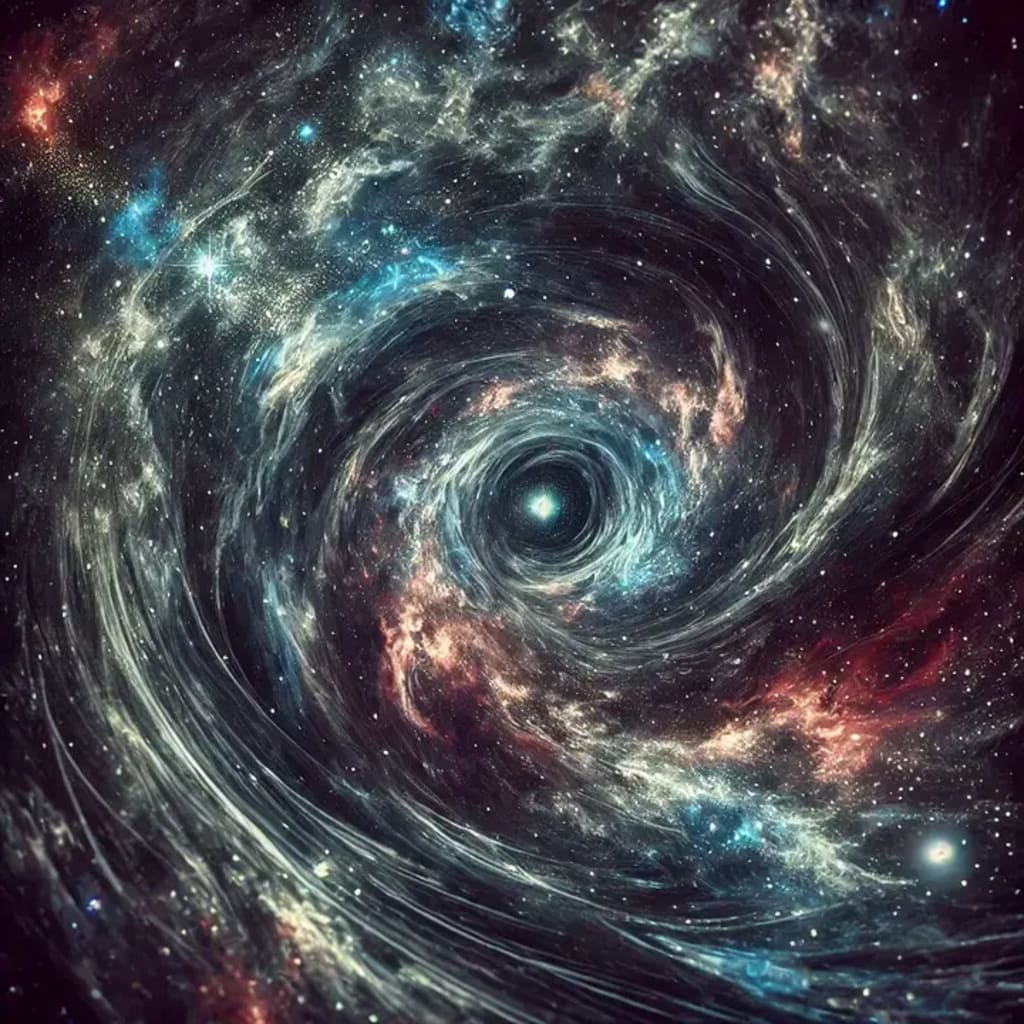
Chaos in Greek Mythology: The Birth of Order from Cosmic Void
Introduction: The Gates of the Mythological Universe
Ancient Greek mythology is not only the world of gods, heroes, and monsters. It also offers a profound cosmological narrative about the origin of the universe, time, and order. At the very beginning of these narratives, there is a being that existed before everything else: Chaos. But who is Chaos? Or, more accurately: What is Chaos?
Chaos is one of the oldest and most mysterious figures in Greek mythology. It is not a god. Nor is it a Titan. In fact, it is not even a personality but rather a state, a condition, a primordial void before existence. In this article, we will deeply explore the nature of Chaos, its role in mythological narratives, philosophical interpretations, and its reflections in modern culture.
I. The Definition of Chaos: A Mythological Void
1.1. The Etymology of Chaos
The word "Chaos" comes from the Ancient Greek word "χάος" (chaos). It derives from the verb chainein, meaning "to open" or "to gape." This provides the basis for understanding Chaos as a limitless void in which the universe had not yet taken form. In other words, Chaos can be understood as a kind of "chasm," "abyss," or "infinite expanse."
1.2. The Nature of Chaos
In Hesiod’s Theogony, Chaos appears at the very beginning of creation:
“First came Chaos, then broad-breasted Gaia…”
Here, Chaos is not depicted as a personality but rather as a cosmic environment from which all things could emerge. Emptiness, darkness, formlessness... All of these help us understand the nature of Chaos.
II. The Offspring of Chaos: What Emerged from the Void
Chaos was emptiness; yet at the same time, it was a fertile power. Over time, this void gave birth to several primordial entities.
2.1. Nyx – Night
One of the children of Chaos is Nyx (Νύξ), or Night. Nyx represents darkness and is a powerful divine figure in her own right. It is even said that Zeus feared her.
2.2. Erebus – Darkness
Another entity born from Chaos is Erebus, the darkness of the underworld. Together with Nyx, Erebus represents the shadowy face of Chaos.
2.3. Gaia – Earth
After Chaos came Gaia, the Earth — the first form of tangible existence. Gaia is the mother of all and gives birth to the Titans.
2.4. Tartarus – Depth
Another being born soon after Chaos is Tartarus, the deepest part of the underworld. It is so deep that even Zeus sends only the most dangerous beings there.
2.5. Eros – Love
In some versions, Eros is considered a primordial being born from Chaos. This Eros is far more than the later-known god of love; he represents the creative force of attraction, the fundamental energy that binds matter together.
III. Chaos and Cosmogony: The Creation of the Universe
In Greek mythology, Chaos is not only the starting point but also the womb of creation. Everything is born from it, and over time, order (cosmos) emerges. This process is known as cosmogony.
3.1. Cosmogony in the Theogony
According to Hesiod’s Theogony, after Chaos, a sequence of fundamental beings such as Gaia, Uranus, and Nyx emerge. This order reveals how the universe was structured.
3.2. From Chaos to Cosmos
The key idea here is this: Chaos is formlessness, but from it, form is born. Mythology offers a narrative of transition from chaos to order. This theme is not unique to Greek mythology—it appears in Mesopotamian, Egyptian, and Hindu mythologies as well.
IV. Chaos and the Titans: Ancestral Distinction
Although Chaos is often associated with the origins of everything, including the Titans, it is important to distinguish between these ancient entities. Chaos is not a Titan. The Titans are the offspring of Gaia (Earth) and Uranus (Sky), who themselves appeared after Chaos.
Chaos is a primordial condition, whereas the Titans are second-generation deities with specific forms, names, and functions. Thus, Chaos represents the cosmic backdrop, while the Titans are the actors that appear once the stage has been set.
V. Deifying Chaos: Symbolism and Mythological Legacy
In later mythologies and philosophical interpretations, Chaos began to be viewed not just as a space or condition but as a conceptual force. Although Chaos was never fully anthropomorphized like Zeus or Athena, it was increasingly seen as a symbol of raw potential and unshaped matter.
Chaos also began to appear in poetry and literature as a metaphor for internal turmoil, societal disorder, and emotional confusion. In this sense, Chaos became more than a mythological element—it became a symbolic mirror of the human condition.
VI. Philosophical Interpretations of Chaos
6.1. Plato and Formlessness
In Plato’s works, Chaos is sometimes compared to the “receptacle” (hypodoché) in the Timaeus—a kind of shapeless medium that can receive all forms. While not identical to Hesiod’s Chaos, Plato’s concept borrows from the idea of a primordial base without structure.
6.2. Aristotle and the Unmoved Mover
Aristotle, in contrast, focused more on causes and movements than mythological narratives. For him, everything had a cause, and the universe must have a prime mover. Chaos does not fit neatly into this model, but it can be loosely understood as the absence of order that the Unmoved Mover organizes.
6.3. Stoics and Logos vs. Chaos
The Stoics introduced a powerful duality: Logos (reason, divine order) vs. Chaos (disorder). According to Stoic thought, the universe was governed by reason (Logos), and Chaos represented a lack of alignment with this reason. However, Chaos was not evil—it was simply disorganized matter waiting to be shaped by rational order.
VII. Chaos in Christianity and Post-Classical Thought
With the spread of Christianity, the concept of Chaos was often integrated into biblical cosmology. In the Book of Genesis, the Earth is described as “formless and void” before creation. This phrase closely echoes the idea of Chaos in Hesiod.
Early Christian thinkers such as St. Augustine and Origen reinterpreted Chaos as a state of imperfection that God orders. Thus, Chaos evolved from being a creative void in Greek myth to a precondition of divine creation in Christian theology.
VIII. Chaos in Modern Culture: Art, Literature, and Philosophy
Chaos has had a powerful presence in modern thought and imagination.
8.1. Literature
From John Milton’s "Paradise Lost" to modern dystopian fiction, Chaos appears as a force of destruction, rebellion, or freedom. It is often juxtaposed against oppressive systems, symbolizing the creative power of rupture.
8.2. Visual Arts
In visual arts, especially in abstract expressionism, Chaos is often portrayed through formless shapes, disordered strokes, and explosions of color. Artists like Jackson Pollock embraced Chaos as a method of expression rather than disorder.
8.3. Psychology and the Self
In Jungian psychology, Chaos is seen as a part of the unconscious, representing the unknown aspects of the psyche. Individuation, or personal growth, requires a confrontation with this internal Chaos.
IX. Scientific Chaos: A Modern Reinterpretation
In modern science, especially in physics and mathematics, chaos theory emerged in the 20th century as a way to understand complex systems.
9.1. Chaos Theory
Chaos theory studies systems that appear random but are actually governed by underlying patterns. This has revolutionized our understanding of weather systems, planetary motion, ecosystems, and even economics.
Ironically, scientific Chaos is not about complete disorder—it is about complex, non-linear patterns that defy simple prediction. Thus, the ancient Chaos as a creative matrix finds a surprising echo in modern science.
9.2. The Big Bang and Primordial Conditions
In cosmology, the Big Bang theory describes the universe as having emerged from an extremely hot and dense singularity. While this is not "chaos" in the mythological sense, it similarly posits a primordial state before matter and form—a concept reminiscent of Chaos.
X. Conclusion: The Enduring Power of Chaos
Chaos, far from being a relic of mythological past, remains eternally relevant. Whether in ancient cosmogonies, philosophical reflections, artistic creations, or scientific models, Chaos represents the beginning, the mystery, and the potential from which everything arises.
It is not simply “disorder,” but the fertile soil of existence. The Greeks saw in Chaos the womb of the cosmos—a vast, unknowable presence that gave birth to gods, worlds, and meaning itself.
To understand Chaos is to understand the mystery of beginnings—of how something comes from nothing, of how form emerges from formlessness. And perhaps, in every moment of uncertainty in our own lives, Chaos whispers the same promise it did to the ancients:
“From me, everything is born.”
About the Creator
Remzi Kazdal
I apologize to everyone.I translate my articles from Turkish with the help of translation software, which sometimes results in misunderstandings. I am working hard to improve in this area. Thank you for your understanding.
Keep reading
More stories from Remzi Kazdal and writers in Fiction and other communities.
Atlantic
A civilization that lies deep in the seas... A legendary city that rules the world with its advanced technology, but was buried in the waters overnight by incurring the wrath of the gods: Atlantis! So is this story real, or is it a metaphor thousands of years old? Today, we are putting all the details on the table, from Plato's writings to modern conspiracy theories, even NASA's explanations!
By Remzi Kazdal7 months ago in Fiction
7 Deadly Syns
Arlington, VA The wallet isn’t supposed to move. Watkins knows this before the alert finishes loading. Dormant for eleven years. No outgoing transactions. No inbound noise. A cold address so old it might as well be comprised of hieroglyphics. Created in a time when people mined coins on laptops and forgot them like spare change in a drawer.
By Kristen Keenon Fisher5 days ago in Fiction



Comments (1)
interesting 😊💗