

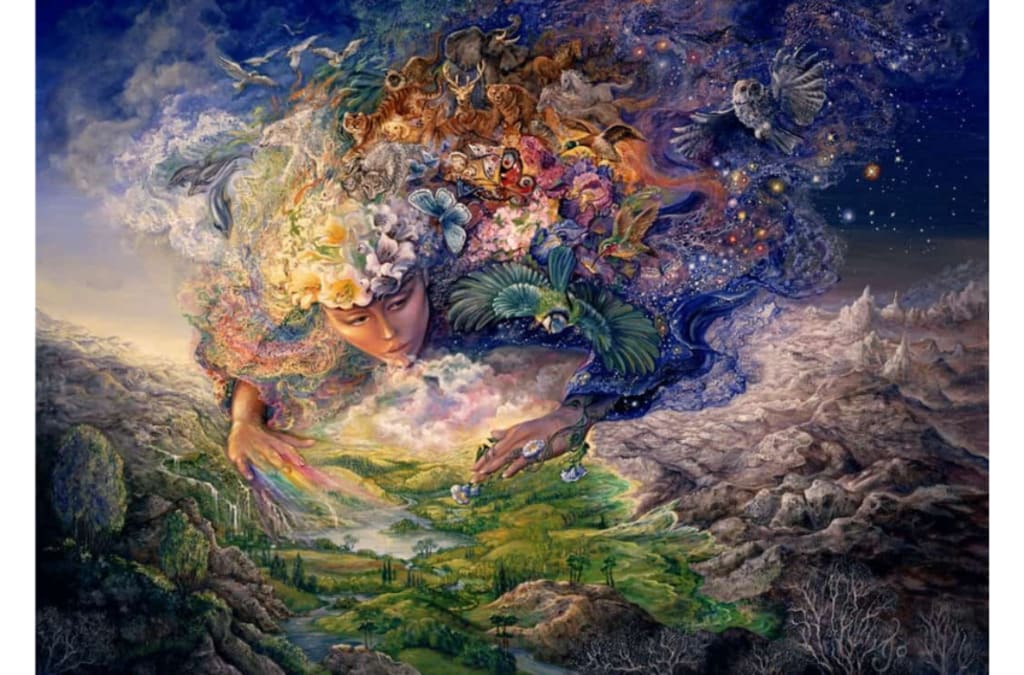
Gaia: The Mother of Greek Mythology
Gaia's Place in Mythology
Gaia, one of the most fundamental figures of Greek mythology, is considered the mother of all living things, mountains, seas and sky, not just the gods. She is "Mother Earth" – one of the first conscious beings in the universe and the basis of life. One of the first formations born in the wake of Chaos, Gaia is not only a mythological character, but also a symbol of cosmic order, fertility, and universal balance.
To the ancient Greeks, Gaia meant more than just a goddess. He was both a physical earthly and a spiritual being. When seeds were planted in the fields, when nature woke up and bore fruit, when storms broke or earthquakes occurred, people thought that Gaia was breathing. Its power was both life-giving and destructive. In this respect, he is seen as both a protective and punitive figure.
Gaia's mythological journey is not limited to being a creator goddess. He takes sides in the war of the gods, prophesies, takes revenge, and even risks sacrificing his children. This multi-layered nature makes him one of the most impressive and enduring figures in Greek mythology.
Throughout mythology, Gaia's influence is felt in almost every important event, from Titans to Olympian gods, from giant battles to prophecies. His story allows us to witness the birth and evolution of a universe, not just an entity.
The Cosmic Beginning: The Birth of Gaia and the Order After Chaos
In the cosmogony of Greek mythology, that is, in the myths that tell about the birth of the universe, the beginning of everything begins with Chaos. Chaos symbolizes the eternal and formless void before existence. There is no sky with a definite direction, nor is there a world with borders. There is only a chaotic, timeless, limitless existence. It is after this abstract and ambiguous state that Gaia comes into existence: the first tangible and permanent entity that takes shape.
Gaia is one of the first elemental beings to appear. Gaia, who comes after Chaos, is the first "form" of the world of being. It is not only a physical earth, but also a source of life. It is a fertile and productive force that gives birth to everything that comes after it. Gaia is followed by Tartarus (the void of the underworld), Eros (the force of love and unification), Nyx (night) and Erebus (darkness). However, Gaia is the most tangible, influential and prolific figure of this group.
In mythological narratives, Gaia is depicted as a being who can give birth on her own and has potential within herself. In this respect, he is a figure who creates in "parthenogenetics", that is, virginity. Among the children she gave birth to were Uranos (Sky), Ourea (Mountains) and Pontos (Sea). These children are the elemental forces that Gaia derives from her own nature. While Uranos is depicted as the sky that surrounds it; The mountains are the elevations on its ridge, and the seas are the salt waters around it.
After these first creations, the basic structure of the universe begins to take shape: the sky, the mountain and the sea. This triad constitutes the cosmic order of existence. Gaia is at the center of this process. In this respect, it is the origin not only of living things, but also of all natural phenomena, geographical elements and even gods.
The appearance of Gaia in mythology is not just the birth of a character; It also symbolizes the beginning of the cosmic order, that is, an ordered universe. The emergence of order from chaos is a conception that underpins Greek thought: Out of uncertainty emerges a meaningful structure. Gaia is the first stone of this structure.
In ancient Greece, cosmogony describes the origin of not only the universe, but also society, culture, morality and the laws of nature. Gaia's birth and self-reproduction is a reflection of the creative power inherent in both nature and human life. With his presence, the universe is now shaped, meaningful, and fertile.
Gaia's Children and Family Tree
Gaia, as "Mother Earth" in Greek mythology, not only forms the basis of the universe; It is also the mother of many powerful and important beings mentioned in mythology. His fertility is limitless; It is the main source that feeds the heavens, mountains, seas, and later all the layers of the mythological universe, giving birth to gods, giants, monsters. That's why Gaia's family tree is like a tree that encompasses almost all of Greek mythology.
What They Give Birth To On Their Own
The first beings that Gaia gave birth to on her own, that is, without the need for any mate, are:
• Uranos (Sky): The firmament that spreads over Gaia. Later, she merges with him, giving birth to many gods.
• Ourea (Mountains): The mountains on Gaia's ridge; each considered a separate mountain god.
• Pontos (Sea): It is the primordial sea god that surrounds Gaia. Later, she gives birth to the gods of the sea.
These three entities represent the essential elements of nature: the sky, the land, and the sea. Gaia's unique single-handedness gives rise to her creative power.
Born of His Union with Uranos
Gaia unites with her own son, Uranos, giving birth to many powerful and cosmic beings. Those born from this union are the most important beings of Greek mythology, both in terms of gods and disasters:
Titans (12 pieces):
Titans, as both gods and forces of nature, direct the fundamental order of the universe. Their number is 12:
• Okeanos: Giant god of water representing all the oceans.
• Koios, Krios, Hyperion, Iapetus: representatives of abstract concepts such as astronomy, time, light.
• Theia, Rhea, Themis, Mnemosyne, Phoebe, Tethys: Wisdom is associated with memory, order, motherhood, and prophecy.
• Kronos: The youngest and most ambitious Titan, the figure who would overthrow his father, Uranos.
Cyclops (One-Eyed Giants):
• Brontës (Thunder)
• Steropes (Şimşek)
• Arges (Glitter)
These three Cyclops are the artisans who will give Zeus the lightning. They were imprisoned underground by Uranos on the grounds that they were ugly.
Hekatonkheirs (Giants with Hundred Arms):
• Kottos, Briareos, Gyes
Each of them has a hundred arms and fifty heads. They have immense powers, but as soon as they are born by Uranos, they are thrown underground. Later, Gaia will mobilize Kronos to save these children.
Born of Its Union with Pontos
Gaia unites with her son Pontos to give birth to the gods of the seas and oceans:
• Nereus: The old and wise god of the seas. Their daughters are sea nymphs as Nereids.
• Thaumas: Father of sea miracles and strange creatures.
• Phorkys and Keto: They are the ancestors of sea monsters. She is also a descendant of creatures such as Medusa.
• Eurybia: Goddess of the navy.
These beings, born with Pontos, symbolize both the beauties and dangers of the undersea world.
Born of His Union with Tartaros
Gaia merges with Tartaros, the underground cavity, giving birth to terrifying beings:
• Typhon: It is one of the most terrifying monsters. It has huge wings, snake legs, and a flaming body. He wages war against Zeus.
• Ekhidna: A mixture of a woman and a snake. By merging with Typhon, he gives birth to many monsters.
The monsters born from this union are among the darkest figures of mythology.
Other Descendants and Descendants of Gaia
Apart from the beings directly born by Gaia, her descendants are also among the important figures of mythology:
• Atlas (Titan): Punished by carrying the sky on his shoulder.
• Prometheus (Titan): The god who gave fire to people, he is one of the figures who laid the foundations of civilization.
• Zeus, Hades, Poseidon: As descendants of Gaia, they are the chief gods of mythology.
• Gigants (Giants): They are giants born from the blood of Uranos and wage war on the Olympian gods.
• Erinyes (Goddesses of Vengeance): They are goddesses born from the blood of Uranos and punish crimes.
• Meliai (Ash Fairies): They are seen as the spirits of nature.
Symbolic Interpretation of the Family Tree
Gaia's children represent various aspects of nature:
• Titans → Cosmic order and natural forces
• Cyclops and Hekatonkheirs → Primitive forces and chaotic forces
• Sea gods → Both beautiful and destructive aspect of nature
• Monsters → Humanity's inner fears and mythological trials
• Gods → Order, morality and authority of society
This vast family tree shapes both the creation story and the allegorical narrative of Greek mythology on nature, morality, and human behavior.
Gaia and Uranos: The First Mating of the Universe
The Confluence of Uranos and Gaia
Gaia is mother earth, the first concrete form of the universe; Uranos, on the other hand, is the eternal sky that spreads over it. Although Uranos is the son of Gaia, she becomes her consort on the mythological plane. This union is not just a sexual relationship, but it means that the forces of nature unite to give birth to new lives.
Every night, Uranos lies over Gaia and merges with her. From this union, Titans, Cyclops and Hekatonkheirs are born. However, Uranos dislikes some of the children born – especially the ugly and powerful ones such as the Cyclops and Hekatonkheirs – and imprisons them as soon as they are born in the depths of Gaia, that is, underground.
Gaia's Suffering and Rebellion
Gaia is very upset that her children are locked up in the dark underworld. She sees this action as an injustice, a disruption of balance, not only as a mother, but also as a force of nature. Uranos' tyranny and imprisonment of his children underground is a threat to the universal order.
Gaia wants to put an end to this situation. She can't bear to see her children suffer like this any longer, and she chooses the bravest of them all, her youngest son – Kronos, and presents her with a plan. This plan is the overthrow of Uranos and the restoration of order.
Doomsday Plan: The Sickle and the Uprising
Gaia gives her son a special sickle . This sickle represents both farming and sharp transformation in mythology. This weapon, given by Gaia, symbolizes the son's defiance of the father and the beginning of a new era.
Kronos sets up an ambush at night according to his mother's plan. When Uranos lies down on her to merge with Gaia, Kronos emerges from his hiding place and cuts off his father's genitals with a sickle. This mythological scene is not just a physical act; It symbolizes the overthrow of the old order and the beginning of a new era.
Gaia and the Titans
The Beginning of the Age of Titans
After the overthrow of Uranos, Gaia's youngest and most cunning son, Kronos, becomes the new ruler of the universe. Together with his other Titan brethren, he shares the universe. Each of them assumes different cosmic and natural functions:
• Okeanos is the head of the oceans and rivers.
• Hyperion represents the sun and the celestial light.
• Koios symbolizes the cycle of the stars.
• Themis becomes the representation of divine justice and order.
• Mnemosyne is the recorder of memory and time.
• Rhea becomes the wife of Kronos as the goddess of fertility and motherhood.
Although the Age of Titans begins as a period of relative peace, something begins to develop that disturbs Gaia: Kronos becomes oppressive and cowardly, just like her father Uranos.
The Fear of Kronos: Escape from Prophecy
Kronos has not forgotten the prophecy of his father Uranos: "You, too, will be overthrown by your children." This fear gnaws at Kronos' insides. He fears that Gaia's children will overthrow him, as she did to Uranos. Therefore, he swallows every child that his wife, Rhea, gives birth to, as soon as he is born .
The children swallowed by Kronos are:
• Hestia
• Demeter
• Hera
• Hades
• Poseidon
These children, each of whom will become future Olympian gods, are imprisoned in the dark belly of Kronos. This is the second great tragedy for Gaia. He had previously suffered from Uranos' imprisonment of his own children underground; now he sees the same cycle repeated by Kronos.
Gaia's Help to Rhea
Gaia does not remain silent this time. His daughter Rhea is fed up with Kronos' cruelty and wants to save her last child, Zeus. Rhea consults with Gaia. This time, Gaia comes up with a plan.
Rhea secretly gives birth on the island of Crete and hides the newborn Zeus in a cave with the help of Gaia. He gives Kronos a swaddle wrapped in stone. Kronos swallows it, thinking it's a real baby.
In this event, Gaia once again becomes the architect of the intergenerational revolution. Just as he incited Kronos against Uranos, he now lays the foundation for Kronos' downfall by protecting Rhea's son.
Rise and Fall of the Titans
Zeus grows, protected by Gaia and sacred animals. In the end, his father opposes Kronos. With the help of Metis, he vomits his brothers, whom his father devoured, and takes them with him and declares war on the Titans.
This battle is known as Titanomakhia (War of the Titans). Gaia is not neutral in this war. At first, he takes the side of his children, the Titans, but over time he realizes that they are also arrogant and destructive. Whereupon Gaia said:
• He frees the Cyclops and Hekatonkheirs, allowing him to join Zeus' side.
• These beings give Zeus lightning and the forces of nature.
The war lasts for ten years. Heaven and earth shake, mountains crumble, oceans overflow. In the end, Zeus and his brothers are victorious. The Titans are shut up in Tartaros, Kronos is deposed. The Olympian gods become the new rulers of the universe.
Gaia's Attitude: A Mother's Dilemma
For Gaia, this period holds both satisfaction and pain. Like Uranos, Kronos was overthrown, but there was a great war between his own children for this cause. The Titans born to Gaia are now chained in Tartaros. This upsets him. For she is the mother of all beings; It always hurts him to choose sides.
Therefore, Gaia gives a warning to this new generation – that is, to Zeus and his brothers – : Do not be arrogant, do not disturb the order, otherwise the same fate awaits you. However, this warning does not stop the mythological chain of fate from working.
Gaia's Role Is Evolving
At the end of this period, Gaia's role in mythology ceases to be that of a primary goddess. It gives way to more personal gods, human-like characters. However, Gaia still exists as a sacred being who prophesies, is the voice of nature, and is considered the basis of everything.
He is no longer a revolutionary initiator, but a figure who wants to maintain order, who wants peace, who takes care of the balance of nature. Gaia, who was the first to rebel against authority, is now a balance that wants to prevent authority from being overdone .
The Birth of Gaia and Typhon: Nature's Final Battle Against the Gods
The Imprisonment of the Titans on Tartaros and Gaia's Rage
After defeating the Olympian gods, Kronos and the Titans, they imprisoned them in Tartaros, another child of Gaia . Tartaros is the deepest and darkest place in the universe. Gaia's children are chained here, left to rot without seeing the light.
Gaia cannot accept this situation. The Titans may have committed crimes, but they are still his children. Their humiliation in this way is contrary to Gaia's core nature—motherhood, protectiveness, and the balance of nature.
The bitterness and anger inside him begin to build up. The fact that these punishments are inflicted on her without any consultation breaks Gaia's pride. The fact that Zeus gradually turns into an arrogant and despotic god shows that in Gaia's eyes, the new generation is as dangerous as the old ones.
So Gaia decides to create a new entity with Tartaros: Typhon.
The Birth of Typhon: The Body of Calamity
Typhon is the most terrible and powerful monster in mythology. It is a catastrophe that Gaia gave birth to as a means of revenge against the gods. His birth is not just a birth, but a manifestation of the most destructive face of nature.
Typhon's depiction is extremely frightening:
• It has a giant body; His head reaches for the sky, his hands reach out to the east and west.
• His body is surrounded by snakes. Each finger is the head of a snake.
• Fire comes out of your eyes.
• He makes no sound, his roars shake the mountains.
• It has wings, but when it flies, it brings storms with it.
Typhon is a physical reflection of the anger in Gaia's heart and the boundless power of nature.
Typhon's Attack on Zeus
As soon as Gaia gives birth to Typhon, she unleashes him on the gods. Typhon attacks Mount Olympus. The gods are so terrified by this encounter that many of them flee to Egypt and turn into animals. (This myth is the basis of narratives about the Greek gods taking animal forms.)
Zeus does not give in to this fear. He takes his lightning bolt and fights against Typhon. However, this war does not pass easily. Typhon robs Zeus of his weapons, wounds him, and even, according to one legend, imprisons him in a cave near Mount Sinai. There, Zeus manages to escape from Typhon's grasp and gets his lightning bolts back.
In the second encounter, Zeus is more determined. He buries Typhon under Mount Etna. Today, the eruptions of Mount Etna in Sicily are mythologically explained by the fact that Typhon is still stirring underground.
Typhon's Symbolism: The Unrestrained Power of Nature
Typhon is the side of nature that cannot be tamed. Even the Cyclops, Hekatonkheirs and giants that Gaia gave birth to before can be connected to an order, while Typhon is a symbol of chaotic and utter destruction. His birth is a rebellion against the divine order of Zeus. This is also the mythological explanation of natural disasters, volcanoes, earthquakes, storms.
This is the first time that Gaia has taken a stand so directly against the gods. Because this time, the gods disregard nature, which is their own creator, and fall into injustice.
Gaia's Solitude and Retreat
The defeat of Typhon is not the defeat of Gaia; but it is the moment when his direct intervention ends. After this event, Gaia does not directly fight the gods. It now remains the voice of nature: it appears in prophecies, warnings, moments of disruption of the divine order. But it does not take place on the battlefields.
After this stage, Gaia is referred to as both the physical earth and the universal wisdom . The gods must now respect his existence and observe the balance of nature. Otherwise, it is inevitable that disasters like Typhon will be reborn.
The Role of Gaia in the Olympian Era
Gaia's Position in the New Era
With the defeat of Typhon and the eventual domination of the universe by the Olympian gods, a new order is established in Greek mythology. This order now operates by the will of Zeus, the god of the sky. But Gaia still exists, she is still the foundation of the universe. The earth breathes with it, the mountains are its heart, the rivers are its veins.
In this new era, Gaia no longer directly participates in wars, revolutions, rebellions. However, this does not mean that it has lost its importance. On the contrary, Gaia now assumes a much deeper, more symbolic, more metaphysical role: wisdom, prophecy, and the conscience of nature.
Mother of Prophecies: Gaia's Role in Delphoi
In Greek mythology, the most famous oracle center is Delphoi. Although this sacred center later belonged to Apollo, one of its first owners was Gaia. In some myths, Gaia is described as the first prophetic being. It is said that he transferred the power of prophecy to Themis, Phoebe, and finally Apollo, respectively.
Located in the center of Delphoi, the sacred stone "omphalos" (navel stone) is considered the center of the world. This stone is a symbol of Gaia's consciousness ruling over nature and the gods.
Through this divination system, Gaia represents the cosmic truth that even the gods cannot reach . Humans and gods hear her voice through dreams, signs, or priestesses called the Pythia.
Gaia and the Trial of the Gods
In mythology, Gaia is not only life-giving, but also an earthly consciousness that represents justice.When a dispute arises between the gods, or when a god overstepped his bounds, Gaia's warning is of great importance.
For example:
• When warrior gods like Ares drench the earth in blood, Gaia responds with natural disasters.
• When Zeus behaves unjustly or threatens people with disaster, Gaia intervenes indirectly – sometimes in the form of a dream, sometimes in the form of a direct prophecy.
• In events such as the punishment of Prometheus, even Gaia's silence is of great significance, because no universal punishment without her approval is eternal.
The Connection Between Nature and People
During the Olympian period, Gaia begins to be seen as the protector of not only the gods, but also humans . The fertility of the soil, the order of the seasons, the fertility of animals depend on Gaia. For agrarian societies, Gaia is considered sacred. In some regions, special festivals are even held for Gaia:
• Gaia Festival – Celebrations for prayers of fertility.
• Cult of Plouton and Gaia – Symbolizes the return of the dead to the earth.
In addition, death is also associated with Gaia. After people die, they dissolve into the earth, which returns them to Gaia's womb. Thus, Gaia becomes the beginning and end of the cycle of life.
Gaia and the Archetype of Femininity
While the Olympian gods have individual traits, Gaia is a universal feminine archetype. She is not just an individual, but a symbol of concepts such as motherhood, fertility, protectiveness, nature, and intuition. That is why it represents the inner strength of both goddesses and mortal women.
Some important female figures in mythology have ties to Gaia as follows:
• Demeter: Goddess of agriculture and harvest – granddaughter of Gaia.
• Persephone: Represents the cycle between the underworld and the earth – a symbol of Gaia's transformative power over nature.
• Artemis: Protector of wildlife and birth – represents the wild side of Gaia.
Gaia's Balanced Relationship with the Gods
Gaia no longer fights the gods, nor is she directly involved in struggles for the throne. But its silent power is always felt. When a god neglects nature or creates an imbalance, Gaia's symbolic "humming" is heard.
In this respect, Gaia now becomes the consciousness of the universe. The flow of rivers, the posture of mountains, even the orbit of the stars depend on his tranquility. When both humans and gods harm nature, Gaia's wrath is revealed by natural events: earthquakes, droughts, floods...
Reflections of Gaia in Other Cultures
Mother Earth Archetype: A Universal Concept
Gaia is not a creation unique to Ancient Greece. The values it represents—earth, fertility, the force of nature, the cycle of life, motherhood, fertility, and destruction—resonate in the much deeper cultural layers of humanity. Although it is called by different names in different geographies, the idea of "Mother Earth", which lies at the core of Gaia, is universal.
Archetypally, Gaia; Nature itself is the mother of humanity and the source of life. Let's take a look at how we trace Gaia's analogues across different cultures.
Roman Mythology: Tellus Mater
In ancient Rome, Gaia's counterpart was known as Tellus Mater (Mother Earth). Tellus is a very similar figure to the Greek Gaia, both mythologically and ritually.
• The Romans worshipped Tellus along with their agricultural gods.
• There was a festival called "Fordicidia", which was held for Tellus . At this festival, sacrifices were made for fertility and fertility.
• Tellus was also referred to as the goddess of peace so that wars could end and the land could be plowed again.
The worship of Tellus was an integral part of the daily life of Rome. Like Gaia, she identified with the order of nature, the cycles of the seasons, and man's ties to the earth.
Anatolian Civilizations: Cybele (Cybele)
One of the oldest and most powerful reflections of the Gaia archetype is Cybele, the mother goddess of Anatolia. Cybele had a very strong worship, especially in the Phrygian and Lydian civilizations.
• She is the goddess of fertility, fertility, nature and wild animals.
• Cybele was called the "Mother of the Mountains"; just as Gaia gave birth to Ourea (mountains).
• His temples were built on the mountain tops.
• Worship rituals included nature sounds, drums, and trance dances.
One of the most remarkable aspects of Cybele is that she is both protective and destructive. Like Gaia, she gives life, but destroys when necessary.
Egyptian Mythology: Geb and Nut
In ancient Egypt, the gods of the earth and sky were also in a Gaia-Uranos-like structure.
• Geb is the male god of the earth.
• Nut is the female goddess of the sky.
• In this system, the roles are reversed: the earth is male, the sky is female. But the relationship is similar: Nut is spread over Geb.
Geb is a fertile figure, just like Gaia. The fertility of the fields, the flooding of the rivers, the mixing of dead bodies into the soil are attributed to Geb.
Indian Mythology: Prithvi
In Indian cosmogonies, the goddess named Prithvi is the representative of the land and nature. Its name directly means "Earth" in Sanskrit. Prithvi:
• She is referred to as "Mother Earth".
• Together with the god Dyaus, he forms the pair of heaven and earth.
• It represents agriculture, nature and life.
• In the Vedic poems, she is spoken of as a cow giving milk – just like Gaia's fertility.
In villages across India, Prithvi is still venerated in traditional ceremonies, and her name is mentioned before seeds are planted.
Norse Mythology: Jörð
Jörð, the goddess of the "earth" in Norse mythology, is the mother of Thor. Its name, which means "Earth", can be directly identified with Gaia.
• Jörð represents the land; It is the force of nature.
• The fact that she is the mother of Thor indicates that she gave birth to powerful forces of nature.
• His name is used in poems to mean "world".
Although Jörð is not mythologically visible, it is considered to be nature and the world itself.
African, American and Far Eastern Traditions
Gaia-like figures appear not only in Europe and Asia, but also in the indigenous cultures of Africa and the Americas:
• Among the Dogon in Africa, the earth goddess Yasigi is the source of fertility and female wisdom.
• Among North American Indians, the concept of "Mother Earth" is sacred. The soil is considered a living entity.
• Pachamama, in the South American Andes, is the spirit of nature. Offerings are made to him.
• In Japan, on the other hand, in Shinto belief, earth spirits such as Kuni-no-Satsuchi are figures similar to Gaia.
Common Symbols, Common Archetypes
Different names, different narratives, but common meanings:
• Soil = Main
• Nature = Wisdom
• Life = Transformation
• Disaster = Punishment for those who disturb the balance
These concepts show how Gaia has become a universal symbol in all these cultural forms.
About the Creator
Remzi Kazdal
I apologize to everyone.I translate my articles from Turkish with the help of translation software, which sometimes results in misunderstandings. I am working hard to improve in this area. Thank you for your understanding.
Keep reading
More stories from Remzi Kazdal and writers in Fiction and other communities.
Greek Mythology
1. THE COSMIC ORIGINS OF TARTAROS 1.1. The First Powers from Chaos According to Hesiod's Theogonia, one of the main sources of ancient Greek mythology , everything started with Chaos at the beginning of the universe. Chaos refers to an infinite and formless void in which order, form, and meaning do not yet exist. This "first" being or state is the starting point of the basic building blocks of the universe. Among the first beings to come after Chaos are Gaia (Earth), Tartaros (Depth), Eros (Love), Nyx (Night), and Erebus (Darkness). These beings are not gods or goddesses in the classical sense, but are direct cosmic forces. That is, they are the first energy fields that determine the functioning of the universe.
By Remzi Kazdal6 months ago in Fiction
The Last Echo
The rain had stopped, leaving the city streets slick and reflective, like broken mirrors catching neon light. I stood at the edge of the alley, heart hammering, breath fogging in the cold night air. The folder in my hands felt heavier than it should—its contents could ruin a life. Or end one.
By Imran Pisania day ago in Fiction



Comments
There are no comments for this story
Be the first to respond and start the conversation.