
From the Perspective of a Nightmare
Short story by Jesse Allan

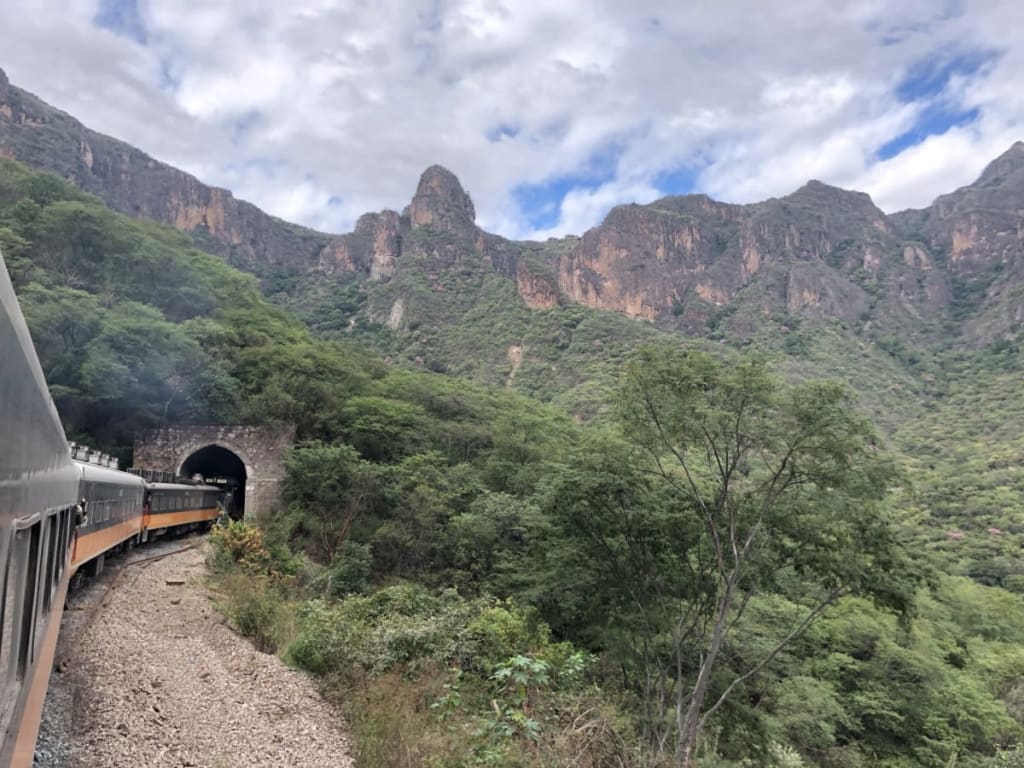
When I wake up, my body feels heavier than usual. I use my frail limbs to lift my concrete torso, and they shake twice as much under the weight. The air feels thick—almost solid like jelly that’s just begun to set—yet I don’t remember a forecast for fog. Perhaps, my ageing brain simply forgot. I wander over to my dresser and begin preparing my outfit for the day. I’m taking the train, I remember, so I make sure to wear layers. The trains here are cold, and it’s more than likely my destination will be too.
Once prepared, I take my suitcase from beside my bed and head out my front door. I don’t stop by the kitchen for breakfast, I haven’t had the appetite for morning meals in weeks, and today is no exception.
The train, predictably, is late. I sit on the cleanest bench I can find, propping my suitcase up next to me, whilst I wait for the train to arrive. One minute turns to five, which turns to ten. When the train still doesn’t pull into the station I decide to investigate a little, I don’t want to keep my husband waiting. Curiously, there’s no one present at the counter. I’m about to call out when I hear the familiar chug-chug-chug of the train. I turn as it slows to a halt, wheels screeching against the tracks. Without a second thought, I board through the open doors.
As predicted, the train is freezing. Strangely, there’s no one sitting in any booth I pass-by on the way to my seat—there aren’t assigned booths on this train, but I prefer to sit in the same one each time; It has the least stains, and no hooligan children have scratched words into the window. I would like to believe the trains have better upkeep than they do, but alas, public transport in this country is largely neglected. I long for the days when the small details were cared for, but those days are well past me.
As I enter my booth I close the sliding door. I sit down on the left and smooth out the creases in my dress, then prop my bag up next to me. In no time, the train begins to move, the window passes by the station and moves onto the grassy fields. I notice, to my displeasure, how foggy it is outside. So thick it’s impossible to see the horizon.
Time seems to move slower in this carriage. With nothing to do and no one to speak to, I sit in silence staring out at the concealed landscape. I wonder how my husband has fared without me, if he’s been eating enough and managing to iron his clothes. I’ve never seen him use the iron, but I’m sure a businessman would understand the importance of a clean, tidy appearance. I wouldn’t have left, but he insisted I needed a break. He had purchased a spa weekend for my birthday. Endless pampering, plus my own room? I could hardly refuse an offer that grand.
The sound of the carriage door sliding open catches my attention, and I turn my gaze away from the window towards the sound. Standing there in the doorway is my husband. Shirt and pants un-ironed—I’m not surprised—the look on his face one of pure, undiluted grief.
“Johnathon?” I exclaim, taken aback by his presence on the train currently headed towards where he’s meant to be.
“Martha, oh Martha.” He speaks my name through sobs.
“Johnathan, dear,” I lift myself up, shaking as I do, to go comfort him, “whatever’s the matter?”
I take his shoulder with one hand and guide him to the seat, I move my bag out the way to make room next to him. He takes a while to calm down enough to talk, all the while I’m rubbing his back in circles, trying to comfort him. The motion only seems to make him more distraught.
Tears trace the curves of his cheekbones and cling to his jaw, yet he makes no move to wipe them away. I would, but my handkerchiefs are packed away in my suitcase, and moving to dig them out is much too much effort for me right now. “It’s—” he gasps, “it’s not fair.” He’s stopped crying now, but his breathing is still unsteady.
“What? What’s happened?” I think back to the only other time I’ve seen him like this. When his mother passed. He barely ate, didn’t even leave the house, for weeks. I look at his hand over mine, his skin is dull, even his father’s ring seems to have lost some of it’s shine.
A memory comes to me, a whisper from another timeline. So fragile and transparent, I’m afraid if I focus for a second on anything else it’ll be gone forever. The ring. The photo. The memory is of me, scrolling through Facebook on my phone and seeing Lucy’s post. Her damned post showing off her new pin straight black bob, in which she forgot to crop out Johnathon’s hand wrapped around her tiny waist. I knew it was his, because he was wearing his father’s ring. A simple gold band with miniscule emeralds embedded in the centre. The same ring he’s wearing now, on the hand that’s folded over mine.
As the realisation dawns on me, of what I discovered on this day in this very seat, I wonder how I could know this if that series of event was meant to occur in these moments.
I pull myself out of his arms, he doesn’t protest. “Johnathon, what’s going on? How are you here?” I say it with as much calm as I can muster, because I know yelling at him won’t get me answers.
He looks at me, shining eyes wet with grief, adorned by heavier-than-usual eyebags. I notice, now I’m looking him in the face, that his skin is unwashed, and his hair is greasy. On that, there seems to be less of it; Despite ageing he always had most of his hair, and now it’s looking sparse. He hesitates before he speaks, “I’m not really here. Neither are you.”
I try to fit together the puzzle pieces he’s giving me. Memories from the present, we’re not really here, fog on a morning where no fog was forecasted, the train is empty, and so was the station. In fact, now that I think on it, I haven’t seen a single person other than Johnathon all day. It’s like I’m in an episode of The Twilight Zone. Dead, but I don’t know it yet.
Dead, but I don’t know it yet.
“How can that be?”
He doesn’t answer.
“How can that be, Johnathon?” I know the answer, but I ask anyway.
He starts crying again, fresh tears tracing over the marks on his cheeks, “I’m so, so sorry Martha, it’s all my fault.”
Time stops. The bumping of the train no longer registers in my body as I process what my husband has just said. My mouth opens and closes like a fish trying to breathe out of water; I feel very much the same, like the fog has seeped in through the cracks around the window and is filling my lungs. I feel my own eyes begin to water, not in sadness or grief but rather confusion, desperation, even a bit of annoyance. I want air, I need air. I step up and around Johnathon to open the smaller window. To my dismay, it doesn’t budge. That small setback is enough to send me down a spiral. It’s the hand that knocks the dominoes in my mind, setting off a twisted chain of events and emotions that ends in me curled up on the floor of a train carriage, breathing but somehow still gasping for air. I think I’m wailing, but I can’t hear much over the loud and persistent ringing filling my ears.
I lie there with hands over my ears, the cold floor of my carriage pressed against my cheek, facing the Chrysanthemums carved along the bottom of the carriage door. I lie there for I don’t know how long, before Johnathon places his hand on my back, patting gently. The sensation of him touching me is enough to bring me back to ‘reality’, and once I’m calm enough he moves on to rubbing the length of my arm, his touch still feather light.
He knows me well.
Damn him.
I don’t want to calm down, I want to scream, wail, I want to make him feel guilt over what he’s done. But I can’t choose my emotions, or their strength. I can only control how I handle the situation, and I know screaming won’t get me answers.
I shift so I’m sitting up, my legs tucked to one side. He’s kneeling next to me, arm around my shoulder. I resist the urge to shake it off. I look at him, he looks at me, “Why are you dreaming of this moment?”
He blinks, I smile, “Really, Johnathon, aren’t we beyond you being surprised when I work things out myself.”
He closes his eyes, shaking his head. “No, we’re not. You’ve always been so sharp, I suppose it’s fitting that even in death, you’d be miles ahead of me.”
I knew it, but the admittance from Johnathon that this moment isn’t real still shocks me. I’m dead, and I should’ve guessed it sooner. I’m aware of how cold my skin is despite the absence of freezing temperatures, and the absence of a beating rhythm in my chest. There’s just one more thing I need confirmation on.
I put a hand on his arm and repeat my question, the sweet lilt of my voice makes me sick, “Why are you dreaming of this moment?”
He hesitates. I’m looking at him, but he isn’t looking at me. When he speaks, his voice quivers, “Because I know it’s my fault. If I hadn’t sent you away, you’d still be alive.”
I play the part, “Oh, John, no. You could never have known this would happen. You did a good thing giving me that weekend away.”
“My intentions weren’t all pure.” He looks like he’s about to start crying again.
I lean back slightly, “What do you mean by that?”
He hesitates. I see the look in his eyes, the same one our neighbour Carl gave me as he confessed his infidelity. His poor wife, my best friend Lucy, was torn up for weeks. I don’t want to believe it.
Johnathon has never been confrontational. Sometimes, I could swear he was afraid of me. But he has this new look about him, new feel, like my death has caused something to shift. There are new cogs turning that weren’t moving before, and for once in his life, he has the courage to tell me the truth to my face, “I sent you away because I was staying with someone else, and I didn’t want you to find out.”
I huff, not all of that reaction is fake, “I don’t believe it. Who?”
He doesn’t answer. “Who, Johnathon?”
He flinches, still silent. He opens his mouth, I’m not prepared for the words, “It was Lucy.”
Lucy. I knew it, that bitch. My best friend from the day we moved in up until the day I died. Lucy, with whom I shared my great grandmother’s lemon bundt cake recipe, a family treasure. Lucy, who comforted me through all my tough times as I did the same for her. The two people I loved the most, betraying me.
Despite being right, my silent heart still breaks.
Shatters, like the glass window in our living room Lucy’s son Adam broke with his new football, and I told her not to worry about, because that’s what friends do. And I wish I had something equally painful to come back at Johnathon with, but I’ve never done anything this despicable. Sure, I’ve done bad—I’m human after all—but nothing I’ve done measures up to the heart shattering pain I feel now. Not even my death.
I no longer bother hiding the anger behind my words, “Why are you telling me this?”
“Because, I believe if I confess, and you forgive me, these dreams will stop.”
I’m quiet for a bit, chewing on my next question before I spit it out. “So, you expect me to have sympathy for the man who hurt me? Who cheated on me, with my best friend?”
He doesn’t answer. His silence breaks me more.
“Tell me, Johnathon!” I’m yelling through tears, and I don’t wipe them away. I want him to see how much he’s hurt me. I thought we were going well, I thought he still loved me.
But he doesn’t look me in the eye, just keeps staring at his whitened knuckles. We sit there, me quietly seething, him tenser than a jockey on a racehorse. After a minute or two, he breaks the silence. “I’m so very, truly sorry Martha.”
I sniffle, “That’s not good enough. I need you to pay for your infidelity.”
He winces, “I have. I am.”
I realise, my death was his punishment. God’s way of making him sorry. I nod, acknowledging his words and my conclusion. I think for a moment, then ask, “How long were you two… together?”
He lets go of a breath, “That was the second time we had met under that context.”
“And have you since?”
“No.”
So, he feels guilty. Maybe, I think to myself, that’s punishment enough.
But I can’t let him know that. I drag this out further.
“Why?”
He looks at me like I should know. For once, I don’t. “I thought we were going well,” I pause and look away, pulling my face into an expression of heartbreak and forcing the shake in my voice, “I thought you still loved me.”
“I do. And I’ll never stop loving you,” I look at him, we make eye contact, “But I should’ve left a long time ago.”
I stare at him, eyes wide, jaw hanging open. “So, you kill me, then you tell me you wanted to leave me, then, to top it off, you have the audacity to tell me you still love me?” He flinches and looks down. Good.
I keep going, “You’re right about one thing, it’s your fault I’m dead. If you hadn’t been an unfaithful bastard, I’d still be alive.” I scoff, “I always knew your idiocy would be my downfall. You think you should've left me. Ha! I should’ve left you.”
That last sentence cut him deepest, I see it in the way his shoulders curl inwards and his head hangs lower. I hear it in the shaky breaths and the quivering voice, “This. This is why.”
“I look down my nose at him, “What do you mean?”
He doesn’t speak for a bit. I’m about the get up and walk away when he opens his mouth, “This is why I confided in Lucy. She’s the only one who knows, how cruel you were, she was the only one who understood how I felt.”
This is unlike him, confronting me like this. Moreover, I have absolutely no idea what he’s talking about. “When have I ever been cruel, to you or Lucy?”
He’s found his courage since I’ve passed, he says, “You just told me I’m the reason you’re dead.”
“Aren’t you?”
He hasn’t looked up at me in a while. “Look at me.”
He complies.
The look in his eyes tells me he’s being truthful. I scoff, “You’re lying.”
He looks down, resigned.
I sigh, as if this whole ordeal has been a toll on my non-existent conscience, “I’ll forgive you,” my words cause him to lift his head, his brown eyes piercing mine—a million times more striking with the light from the window now creating a halo around his head, “If you promise me you’ll never meet with Lucy under that context again.”
“Done.”
The train hits a bump, and I fall into him. He curls his arms around me, holding me tighter than I can remember. “Thank you.”
I say I forgive him, I accept his embrace, but I feel in my heart my forgiveness isn’t true. I look over his shoulder out the window, the fog has lifted, it’s a beautiful sunny day.
It’s much more difficult to resign to death when you can see it coming. That’s what they don’t tell you about growing old—or being an unwilling participant in someone else’s nightmare. I can see my cold body as the train’s rattling intensifies. I can see the look on my husband’s face when he receives the news of my death as the train begins to sway off the tracks. I can see my casket and my grieving family as the train finally swings off the tracks entirely, becoming airborne. For a moment, there’s peace. We float, held together by our strong embrace. For a moment, it’s easy to close my eyes and forget how this ends. For a moment, I’m in my husband’s arms, and it’s like we’re safe in our home; cuddling on the couch, young and hopeful and alive. Then, that moment is over. We hit the window. The train hits the ground. There’s pain. Then there’s nothing.
Until…
…When I wake up, my body feels heavier than usual.
About the Creator
Keep reading
More stories from writers in Fiction and other communities.
The Ancient Egyptian Goddess Ammit
In Egyptian mythology the ‘Hall of Ma'at’ is a forsaken place, dark and unforgiving. The rite of passage to immortality of one’s soul hangs in the balance. A ceremony named quite appropriately as the “Weighing of the Heart” has two potential outcomes, a pathway to eternity for the pure of heart, the other a dark voyage into everlasting agony and condemnation.
By Michael Langille5 days ago in Fiction


Comments
There are no comments for this story
Be the first to respond and start the conversation.