
From Rags to Resolve
How One Young Man Defied Poverty to Chase His Dreams


In a small village tucked between dust-laden fields and fading skies, lived a young man named Ayaan. With torn sandals, calloused hands, and eyes that shimmered with dreams too big for the world he was born into, Ayaan was the boy everyone pitied, but few believed in.
He lived with his mother and younger sister in a one-room mud house. His father, a daily wage worker, had died in a construction accident when Ayaan was just twelve. Since then, survival became their family’s only ambition. But Ayaan… Ayaan had other plans.
By day, he carried sacks of rice in the market for a few coins. By night, he sat under a flickering streetlight with an old second-hand book in his hands—“The World’s Greatest Scientists.” He didn’t understand half the words, but he understood the feeling: that knowledge could be a way out.
He would often say to his sister, “Zara, one day, this world will know my name. I’ll build something, invent something, be something. You’ll see.”
Zara would nod, her eyes wide, sometimes in awe, sometimes in disbelief. Dreams were dangerous in a village where most didn’t dare to think beyond the next meal.
But Ayaan was different.
One afternoon, while working at the market, Ayaan overheard a conversation between two city men. They spoke of a scholarship exam that could get students into a prestigious engineering college in the city. It was free. The catch? The competition was fierce, and most students prepared for years.
That night, Ayaan didn’t sleep. The idea ignited something in him. The next morning, he used half his savings to take a bus to the city library. He didn’t belong there—his clothes were dirty, he smelled of sweat—but he didn’t care. He sat on the floor, reading books on math and science like his life depended on it. Because, in truth, it did.
For six months, Ayaan led a double life—laborer by day, self-taught student by night. He scribbled formulas on old newspapers, memorized scientific theories while carrying sacks, and solved equations with a piece of coal on walls.
Mocked by some, ignored by many, Ayaan moved forward anyway. “You think you’re one of them?” a fellow worker scoffed one day, seeing him study. Ayaan didn’t answer. He didn’t need to.
The day of the exam arrived. He walked into the hall barefoot, nervous but burning with purpose. Around him were boys in neat uniforms, coached in air-conditioned rooms. Ayaan had nothing—except grit, faith, and a dream larger than any obstacle.
Two months passed. He heard nothing. People said, “Forget it, boy. That world’s not for you.”
Then, on a blazing afternoon, a letter came. Ayaan didn’t know how to read it properly, so he ran to the schoolmaster. The old man adjusted his glasses, read silently, and then looked up at Ayaan with watery eyes.
“You’ve made it,” he whispered. “You passed. Full scholarship.”
Ayaan froze. His heart beat so loudly, he could barely hear the rest. The room spun. Then came the tears—silent, overwhelming tears. His mother fell to her knees in prayer. Zara screamed in joy. That night, the whole village lit lamps in his honor.
The city was hard, colder than he expected. He didn’t understand the language at first, nor the people. He missed home, missed simplicity. But every time he felt like giving up, he remembered the dusty road he came from and the promise he made under a flickering streetlight.
Years passed.
Ayaan not only completed his engineering degree but topped his university. His final year project—a solar-powered water purifier for rural areas—won national awards. Big companies offered him jobs with salaries his entire village couldn’t dream of.
But Ayaan returned home.
He didn’t come back in a luxury car or wearing a suit. He came back with a blueprint and a purpose. With help from government grants and local partnerships, he built solar-powered water filters for every house in his village. He set up a free library and a small school, where no child would ever have to read by a streetlamp again.
People started calling him “Engineer Saab.” But to his mother, he was still her little boy with big eyes and bigger dreams.
At the inauguration of his village’s first science lab, a journalist asked him, “What kept you going when everything was against you?”
Ayaan smiled, looked around at the dusty paths, the small houses, the hopeful eyes, and said:
“Poverty taught me hunger. Not just for food—but for a better life. I didn’t escape my roots. I turned them into my wings.”
About the Creator
Daniel Henry
Writing is not a talent; it's a gift.
story wrting is my hobby.
Keep reading
More stories from Daniel Henry and writers in Fiction and other communities.
A Drop’s Tale
High above the world, in the hush of a silver-lined cloud, a tiny drop was born. She shimmered softly, round and perfect, nestled among thousands of others just like her. But she wasn’t like the others—not exactly. While most drops dreamt only of falling, of the rush and splash of reaching the Earth, this little drop listened. She listened to the wind whispering through the sky, to the thunder rumbling like an old giant, and most of all, to the heart of the rain.
By Daniel Henry11 months ago in Fiction
Flower Bloom 369
FLOWER Bloom 2/25/26 Wednesday By Mariann Carroll Karen had been with Tony for 7 years. Tony started acting strangely after her surgery. He would mow the lawn in the rain and be on his cellphone. He started pushing Karen away. Tony came clean about seeing someone. Karen moved out two months later. Karen moved in with a friend. She felt betrayed.
By Mariann Carroll5 days ago in Fiction
THE EXTRA CHAIR
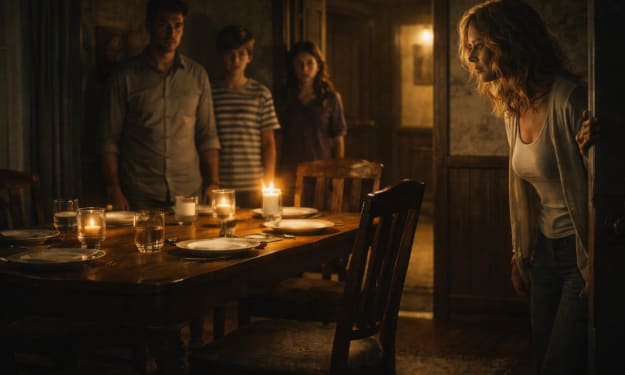
The first time the chair appeared, it was already set for dinner. Marianne noticed it when she brought the pot roast to the table. There were five place settings instead of four. Five forks aligned like silver ribs. Five water glasses catching the yellow light.
By Lori A. A.2 days ago in Fiction
When the Shelter Closes
Across the street from my house, a man slept under a tree, his dog by his side. My first, naive thought: he must be traveling through. But he kept coming back, often sleeping there during the day. Then it hit me—that person might not have a home.
By Bride of Sound5 days ago in Humans



Comments (1)
interesting