
From Favela to Champion
A fighter’s journey is never truly over.


From Favela to Champion
The slums of Rio de Janeiro were not a place for the weak. João “Jota” Pereira had learned that the hard way. Growing up in the favelas, every day was a battle—for food, for safety, for survival. There were no silver spoons here, no second chances. Just a boy, his fists, and a world that refused to give him anything.
As a teenager, Jota had found solace in fighting. Kickboxing became his escape, his way of defying the world that had written him off before he could even dream. He trained at a rundown gym, its walls cracked, its mats torn, but its fighters were tough—warriors molded by the struggle of the streets.
By the time he was eighteen, Jota had promise. He was fast, powerful, relentless. He won amateur fights, then regional tournaments. There was talk of turning professional. But life in the favelas didn’t care for dreams. It swallowed them whole. When his mother fell sick and hospital bills piled up, he had no choice.
He quit fighting.
The next decade blurred into routine. The sound of gloves striking pads was replaced by the rhythmic clang of tools in a lastik tamircisi—a tire repair shop. The smell of sweat and adrenaline was replaced with burnt rubber and motor oil. Every day, Jota worked long hours, fixing cars for people who barely noticed him.
The hunger for combat never left him. Some nights, he shadowboxed in the dim light of the shop, throwing combinations at ghosts of his past. But his body grew softer, his movements slower. The fighter in him was fading. He was becoming what he feared most—a man who had given up.
Then, one night, fate intervened.
He had stayed late at the shop, wiping grease from his hands, when he saw a familiar face on the small, flickering TV in the corner. Thiago “El Matador” Costa, a man Jota had trained with years ago, now standing in the UFC octagon. The Brazilian crowd roared as Costa’s hand was raised in victory.
Jota’s stomach twisted. That should have been him.
He clenched his fists, feeling the callouses, the years of hard labor. Maybe it was too late. Maybe the ship had sailed. But deep down, something stirred.
Was it really over?
The next morning, Jota made a decision.
He walked into the same gym he had abandoned a decade earlier. It had changed. New faces, younger fighters. But the moment he stepped inside, the smell of sweat and blood pulled him back like a punch to the gut.
The old trainer, Marcos, barely looked up from the pads he was holding. “You’re late,” he said, smirking.
Jota nodded. “I want to fight again.”
Marcos studied him for a moment. “You’re out of shape. You’re old.”
“I’m thirty-two.”
Marcos chuckled. “That’s ancient in fight years.”
Jota wasn’t smiling. “Train me.”
The old man sighed. “You know what this means, right? No half-measures. No quitting when it gets hard.”
“I know.”
Marcos stared at him, then tossed him a pair of gloves. “Show me what you got.”
The first week was hell. His lungs burned, his muscles screamed. His body, once sculpted for combat, had betrayed him. He was slow, sloppy. But each day, he stayed a little longer. Pushed a little harder.
The rust began to shake off. His strikes grew sharper. His footwork returned. The hunger in his eyes burned brighter.
Six months in, he took his first fight in over a decade. A regional circuit bout against a younger, faster opponent. Everyone expected him to lose. He didn’t.
Then came another. And another. By the end of the year, Jota was back.
He clawed his way through the Brazilian circuit, earning a reputation as “O Renascido”—The Reborn. His story spread. The man who had quit, who had worked in a tire shop for ten years, now knocking out opponents half his age.
Then the call came.
UFC.
His first fight in the biggest organization in the world was brutal. Three rounds of war. Blood, sweat, exhaustion. But when the final bell rang, it was Jota’s hand that was raised.
Over the next three years, he climbed the ranks. Fighting. Winning. Defying time itself. His hands grew heavier, his mind sharper. He wasn’t just fighting to win—he was fighting for the years he had lost. Fighting for the kid in the favela who was told he’d never make it.
Then, at thirty-six years old, against all odds, he stood across the octagon from the reigning UFC Heavyweight Champion.
The arena was electric. The world watched as the former tire repairman, the washed-up dreamer, the man who had once given up, stepped into battle for the ultimate prize.
The bell rang.
Jota moved like a man possessed. His kicks landed like sledgehammers, his hands like iron. The champion was younger, faster—but he had never faced a man who had already lost everything before. Jota had nothing to fear. Nothing to lose.
By the third round, the champion’s legs wobbled. Jota smelled blood.
A right hook. A left knee. A final, crushing overhand right.
The champion fell.
The referee waved it off.
Jota collapsed to his knees as the announcer’s voice boomed through the arena.
“AND NEW… UFC HEAVYWEIGHT CHAMPION OF THE WORLD… JOÃO ‘JOTA’ PEREIRA!”
Tears burned in his eyes as the belt was wrapped around his waist. The crowd chanted his name. He had done the impossible.
He had started over.
And this time, he wasn’t letting go.
About the Creator
Alpha Cortex
As Alpha Cortex, I live for the rhythm of language and the magic of story. I chase tales that linger long after the last line, from raw emotion to boundless imagination. Let's get lost in stories worth remembering.
Keep reading
More stories from Alpha Cortex and writers in Fiction and other communities.
A Second Chance
A Second Chance The café on the corner of Fifth Avenue hadn’t changed in ten years. The same wooden tables, the same jazz playing softly in the background, the same smell of freshly brewed coffee filling the air. It was as if time had stood still—except for the people who walked through its doors, each carrying their own stories of love, loss, and life.
By Alpha Cortexabout a year ago in Fiction
Bomb Scare
It was 2027, and the world never thought it would happen. A missle hit the United States, but it wasn't where they had anticipated. A little town in the northeast was hit by a missile strike, they didn't know why, and they didn't know exactly where it hit, but they did know it was a coastal community, somewhere between Maine and Delaware.
By Gregory Paytonabout 19 hours ago in Fiction
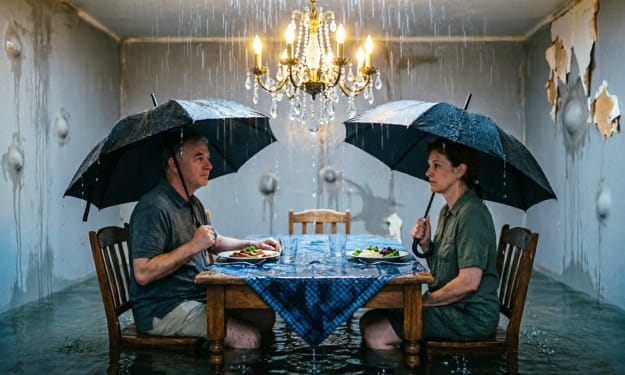
The Tuesday It Rained Inside
The first drop landed in my mashed potatoes with a soft plip. I didn't flinch. I didn't look up at the ceiling. I simply scooped the wet potato into my mouth, chewed, and swallowed. It tasted like starch and cold water.
By Edward Smithabout 10 hours ago in Fiction
A Knight of the Seven Kingdoms Series Review (Season 1)
As one of the biggest properties in fantasy, A Song of Ice and Fire remains immensely popular with audiences. After reaching far into the past with House of the Dragon, a second spin-off was on the cards. A Knight of the Seven Kingdoms serves up a bite-sized slice of action and drama, but it still claims a spot among the best small-screen titles.
By Robert Cain7 days ago in Geeks



Comments
There are no comments for this story
Be the first to respond and start the conversation.