
Father Squire, Son Knight
A Conversation w/ John McCarthy's the Road


“How many of them are there?”
“Four,” his son whispered.
“Four?” his father words barely heard over the fire chewing on a log.
“There’s more?” his son questioned.
His father shrugged, fingers working wood into something nearly a horse and rider.
“A knight would know.”
Father’s words wounded the boy. The son closed his eyes and listened. The men in the wood had stopped moving. He strained for the creak of the bow, for the whispers of the undergrowth, the rasp of breath. He could smell nothing but smoke.
His father would chide him for that.
The pine and fur leaned near their little campfire, as the redwood watched from above. It was too small a fire to make much warmth, but it was enough to cook a handful of rabbits.
“There’s six, son.”
He’d missed two.
He ground his teeth. What signs had he overlooked? He’d centered himself—focused every sense—yet still failed to see what was plain to his father. He shook his head, trying to cast off the shame of another lesson unlearned.
He glanced across the fire, where their armor lay.
“It’s too late for that. They’re near now. Little room for mistakes tonight…”
His father set down the carving and stood. The boy’s gaze stopped on the wooded upon atop a horse. His father had cut in eyes of bewildering precision. They were intense and haunted. His father returned with an armful of logs—six of them. He stacked them like a pyre. The coals were hot, the new wood would burn quick and give them more light work in.
Someday he hoped to be that wise.
“There are hard deeds ahead.”
The boy knew it.
Shadows crept in from the forest, their talons and claws reaching.
“Our quest is undone,” the father said and nodded to the wagon, “if our quarry is taken…”
He met his son’s gaze, hunting for understanding.
“We won’t be able to kill it,” the boy replied.
“That’s right,” he went back to carving his little wood figure. “If we fail, it won’t be like the woman Edhra…”
Shame fell on the boy—an old weight, heavy as a cloak. He’d never be rid of it. The eyes of a doe. The words of a mother. He’d caught the wayward child that wasn’t hers.
By the time his father returned with truth of the witch, it was too late. The child had been gutted and burned—offered to her pagan gods.
“People will burn, son—and not just one.”
His father held up the carving to inspect it. His voice hard, sharp-like.
“Burning isn’t quick. It’s one thing to watch a man burn in battle—another to watch a babe die that way.”
The boy thought of when he had a sister. What it would’ve been like to watch her burn. His eyes misted.
“You have a decision to make, son.”
The boy stared at the six pyre logs. Fire kicked up around their feet. He thought of the men wading in the shadows.
“Why are they in the dark?” his father whispered. The carving was nearly ready for the fine line work. His father excelled in the line work.
“They could be scared,” said the boy.
The old man nicked the wood in error, and shook his head in disappointment. He started carving again. “The wicked and the good alike feel fear.”
The father asked another question.
“Why haven’t they called out to announce themselves?”
“They could be estimating the nature of men we are.”
“They’ve circled ‘round us.”
“It’s a good strategy,” the boy shrugged. “In case we are a threat.”
“Are we a threat?”
“Only if they prefer violence.”
“What’s the wise thing?”
“Coax them from the shadows into the light. Close the distance,” the boy said.
His father nudged a log into the fire. Flame leapt up around it. It breathed a welcomed heat upon the old knight and pushed the darkness back into the woods.
“You have a decision to make.”
“I shall give them a chance.”
His father pursed his lips and nodded once, slowly but remained implacable.
The boy never knew if the nod meant “well done” or “so, that is the choice you’ve made for us.” He couldn’t tell this time either. But he’d declared his intent. There was no going back now.
“If you are hungry,” the boy called out to the darkness, “come join us by the fire, and we shall share our meal and warmth, and you shall have good communion with kind strangers.”
There was silence, then the darkness was full of noise. Four men took shape from out of its bosom: road leathers and crude iron weapons; nervous hands and greedy eyes. The boy did not favor the look of their countenance. The one at their head had a great sword in his hand, its blade broken at its half.
“Come, good sirs!” the boy said, and his father kept at his work. “Sit, and we shall give you meal.”
There was the unmistakable sound of a sword slithering out of its sheath, followed by another and another. It was a brood. His father looked at him.
“Fear in a good man can spoil his honor,” the boy recited his father’s words back to him. The old man didn’t look up from the fire. It was growing now and throwing the forest’s shadows back.
The four came slow on cautious feet.
“Are you of a mind to let them reclaim their honor?” his father whispered.
The boy stared back at the eyes that bored into him. He searched them and wandered through their depths but came away with little.
“There is no need for swords,” the boy called out to the endless wood, “no need to make blood. We have enough meat to fill the bellies of you and all your friends.”
The crunching pads of four men moving stopped then.
“We’ve only come to make friends,” came a spindly voice.
“Kindly men announce themselves in the dark,” the boy said and turned to great the man.
“I beg your pardon, good sir. We only wanted to measure you with our eyes, b’fore we be making proper acquaintance. Cain’t be too careful these days.” He strode up onto the fire, but his eyes betrayed him. He was looking at the wagon.
“Then return your swords to their sheaths and join us for our meal,” said the boy.
“Name’s Willem,” he said, sinking to his haunches.
The man didn’t heed the boy’s behest. He laid his broken sword across his lap, ready to use in a moment. Its hilt was immaculate, castle-forged and princely. Willem was clad in the dappled leather of a dragon-kin. It was a tough hide to cure, but it was tougher to earn. The great claw of a wolf-lizard hung from his neck just above the sigil of the same beast. By the look of it, his face had been chewed on.
There was no mistaking it. The man was a killer. Willem looked back at the others. The three of them were imposing, with swords drawn—each of them near enough to spill blood, if they chose.
“Your fire ain’t so big; need a few logs yet if you mean to keep ya warm through the night.”
Willem made a sharp jab with his head toward the wagon. The thin one peeled off to inspect it. The boy wished his father would start talking. He was good at it, but tonight father was the squire and the boy was the knight.
“It’s big enough for now,” the boy said as his father whittled. He was cutting a helm upon the rider’s head.
“I got some fowl. We’ll share if I can have a bite or two of one of your hares,” said Willem.
The lad nodded.
“Matty, bring those birds over here and put them on the fire.”
Matty was a small man, but he wore leather from one of the meadow lizards that were kin to dragon.
The lad gave Willem half a rabbit. He took it politely but ate it up greedily. The father never looked up.
“Hey, what you making, friend?”
His father held it up in the light of the fire. The man plucked it from his hands. “A knight.”
“Just about.”
“That’s real fine work there, friend,” he said to the father, “Plain to see you got a gift with a knife.”
“It ain’t so much about knife work…” the father said.
“No?” Willem said.
The old man shook his head and held a hand back out for the carving. Willem returned it almost reluctantly.
“Oh,” his father began, “It’s more about seeing what isn’t there before it is. Then just cutting everything else away.”
Willem hunkered down and warmed his hands.
“You seem like good company,” Willem said.
“Willem!” called the man at the wagon, his voice full of wonder. He flung the wagon’s canopy back. “Look at it! Dragon scales and bones and claws—the lot of it!”
Willem turned and looked. Want in his eyes. His hand slipped to the hilt of his sword.
“Where’d you get those bones?”
Son looked to father. Father never looked up from the wood. His knife kept whispering.
“Up in the high places, where the carcass of the Great Old One lay.”
“Bullshit,” Willem said, “No one goes that high. Too many flying dragonkin. How’d you find ‘em?”
Willem looked the boy up and down. The thief wasn’t wrong.
“We didn’t find it, we were there when it died… the day the world broke.”
“Bull—,” Willem said looking at the old man, but the father looked up from his woodwork and nodded. Then he went back to it.
“You watched it die?” Willem asked, his voice hungry. The rest of his crew drew a little nearer.
“I was just a lad.”
Willem laughed, “You’re just a lad by the look of ya.”
The boy looked up at him. It was the first time Willem had a good look at his face.
“ By the stars, you got some pretty eyes, boy,” Willem said nearly entranced. His words wounding the boy. “I ain’t never seen eyes that deep.”
“My mother’s eyes,” the boy said.
“She must be a handsome thing,” Willem snickered. His eyes darted to the father who didn’t look up from his work.
The boy thought of his mother. He shouldn’t have brought her up, not with men like these.
Willem went on, “Ain’t no one gonna forget that day, when the world broke. A wonder anyone made it through.”
Several of the other men agreed from behind him.
“How’d the dragon die, boy?” Willem asked almost a whisper.
“We were on our way to Ithilion from the Blessed Lands. The rivers ran backwards, the land buckles and coils like a wave of the see. I remember seeing the people of the Ithilion falling from the ground upside down. The city was in clouds before it came down.
“We rushed for the city beneath the mountains, for Frothinger. We had a friend there, but then it burst into the sky and out strode one of them.”
“You watched it come out of the earth?”
“The Great Old Ones were entombed in Frothinger,” said the lad.
“That mighty calamity split the world wide. I watched it throw a mountain into the sea. The sky was falling and we were going to die, but then a black dragon came. Carried us away. Then it made war. And such a war it was.”
“A dragon and a god; was it a contest?” Willem said, words full of wonder.
“The god crushed it, but the dragon had tore a hole in its neck and poured a bowl of flame into its innards. Both fell. The god broke what was left to break. A shelf of earth shot into the sky. Those are the impassable lands now. The dragon died slow. Tüührgôn was his name. It meant storm chaser.”
There was silence for a long time.
“It’s a pretty story and I heard once there was a time dragon were friend to men, but ain’t never heard of one talking.”
“It’s like sound in your bones. Your whole body shakes with it.”
Willem didn’t know what to say to that, “So you’re saying it was a dragon that done the giant in? I’ve see his skull from afar. It’s the size of castle.”
This time the boy bobbed his head in a nod.
“Those giants are what done broke the world?”
“That’s a longer story, but they played part in it,” the boy said.
”Those bones worth more than a pot of gold, they say. I hear kings are starting wars over those old scales and claws,” Willem said.
“Bones and claws nearly the only thing that can punch through dragon scale if sharpened. The scales will dent an arrowhead from just a few strides away,” the boy said. “But, if you have big enough bone, and know how to form it, you can bring the Great Old Ones to ruin.”
All the men were very close now. They were drinking up the boy’s words.
“Maybe it ain’t bullshit,” Willem said, looking around at his men.
“We could pay Hûrik’s fief with these,” said the man at the wagon.
“Piss on that, we could kill him,” said the short one who’d come with the fowl, “Get our lady folk back and lords pay us a fief.”
“Maybe more boys,” said Willem, “maybe more.”
The boy didn’t tell them it took a forge built by one of those stout people from beneath the mountain to work the bones—an art lost to the race of men.
“You’re kindly folk,” Willem said, finishing the last bite of his dinner. “It’s strange to me you ain’t dead. Good people don’t up last here.”
“I’m sure you make it hard for them,” the boy said.
The thief nodded without offense, “We sure do. Don’t like it none,” and the boy believed him.
Willem stood to his height and looked down on the lad. “But meaner folk are out there. Meaner things too. I can be dangerous sometimes, but…” he shook his head, “sometimes I ain’t dangerous enough. I ain’t got enough in me to kill them big dragon-kin. It’s why we pay Hûrik fief. Man’s killed tyrant-lizard before. Got a couple of men who can do the big lizards in. Keep us safe.”
The boy didn’t tell them his father had slain the Tryant Lizard more than once, nor that he haunted monsters.
Willem scratched his head, his face flushed with a bit more shame than a man was right to share. “But the fief lord—he’s a man who takes what he wants, and if it’s your woman, well, then it’s your woman. Want her back? You paying him steep. My lady had all her teeth; real nice ones too. He liked that about her.”
He shook his head one more time and patted the lad on his pack. “Sorry ’bout this, friend.”
“Ryke,” he said, “Bridle their horses; get their wagon ready.”
“Listen,” he turned back round suddenly grave, looking at the father, “I’m gonna take this from ya. Ain’t a fair thing, ain’t a right thing—but I gotta do it. There ain’t no way to make you agree to it. Done this enough to know that—but I ain’t got to kill ya. That’s a fairer bargain than most thieving parties will give you, so from my angle I’m doin’ you right.”
Willem looked at the old man and his sword. “Don’t make this hard. You’ll see sunrise.”
“I’m not the one you should be talking to,” the father said to the thief.
Willem looked at the lad. “He’s letting you play lord then?
The thief took a deep breath, “Listen—the pair of you wearin’ swords. If you want to play brave, I hope you’re good at dodging arrows. I got ten men in these woods… We’re gonna take what we’re gonna take. Don’t get up, don’t be fool or brave and you’ll live another day.”
He stood back up and waved his hand in the dark. “Go steal somethin’ from someone else to make up for it. It’s how the world works now; it’s all fair in the end.”
The father looked at his son. The boy heard the words unsaid. Willem turned yelled to his men, “What a tale! We’ll be lords by the new moon, boys!”
“And who’s gonna buy it from you?” the boy said, his voice sounding older than he was.
“I beg your pardon?” Willem said and turned back around.
“You don’t know anyone with the kind of wealth it takes to purchase plate, scales, bone, and claw of a dragon.”
“We’ll sell it to a king,” Willem laughed matter-of-factly.
“Oh, which one? There are so many these days,” the boy said.
“Whoever wants to be the king of kings. We’ll be lords with lands and titles. It matters not to me,” Willem said.
“A man does have to make a living.”
“A man should do it honorably.”
The thief screwed up his face but surprised himself when he didn’t have a ready reply to that.
He simply wagered, “I’m happy to let you live.”
His friends were circling ’round the boy and his father. The boy kept those he couldn’t see in his ears. The soft pad of the feet; the crunching earth. Willem shoved both thumbs into his belt like his part in the matter was over, save the sharing of words, “but you’ll have to give up your swords and get on your knees. Let us tie you up. Don’t make no mischief.”
A stillness crept into the space like an unwelcome silence. The air was thick and pungent with the breath of a campfire.
“You have a choice before you now, son,” his father’s voice was hard and honed for making sharp decisions. “They have told you who they are, what they are, and how little they regard honor.”
A slow spell fell on Willem’s face. The man looked confused and troubled, like he was in a game he didn’t understand. He raised his broken sword with a baffled look.
“Be it known, thief, that I had more regard for your life than you,” the boy said standing to his feet. The fire at his back. It threw off the night and he faced the dark. He could see the four of them now. His father grabbed a log and laid it atop the others, then joined his son. “Such bones were never meant for cowards.”
Willem took on a dangerous countenance then. “To your knees—the both of ya!”
“Still as a mountain, quick as a fox—move like the flame,” his father whispered from behind.
The boy took the still breath before a storm. His limbs loose like reeds—they would need to be serpent-quick. He became then keenly aware of the weight at his hip, for it was older and wiser than all the realms of men; it was sharper than wisdom and near as deadly. The blade belonged to an elder age when beautiful things were made with splendor. Its handle was plain and unassuming, but the thing itself was majesty. It had lived a thousand years and the boy could feel the weight of them all.
Willem watched the change come over the lad.
“You do not have to die, boy,” Willem said, and took a threatening step forward, “get on your knees!”
The new log hadn’t caught light yet—it was choking black heaves of billowing vapor into a night invisible. Every breath was filled with it.
“A knight kneels before valor alone, and you, Willem, are bereft of it.”
“Do as you like—but I’m takin’ those bones.”
“Should he possess them…” the boy’s father spoke quietly.
“I know, father.”
The boy had already measured the cost. Only the bones of the dragon—the god-eaters—that proved bane to the great calamity of men; those descended from stars—who hurled mountains and drained the seas. Worthless men must be denied such boons as those that betide the gods.
“Walk back to your darkness, and you will not suffer this night,” the boy warned.
Willem smiled. “You’re a lad, boy… and I’ve been doing this since before you sprung in your mother’s womb. I gave you a fairway. We made company by fire, shared meal and tale. You could have seen morning light…”
Willem stopped and nodded to someone.
The new log snap and popped as it wreathed in sudden flame.
The first sword was swung by a coward. It came from behind in the dark—but its wielder hadn’t learned how to cut fire. Thrice was the sword swung from behind the boy and thrice it only found the wind. A wonder of stupor fell on them at the boy’s quick dance. When the coward failed, the others joined.
The fire behind the boy made the men before him monsters and apparitions. He had fought both before. Three of them pressed in from the thick wood.
The boy drew his sword.
The blade was bone-white and beautifully wrought. Its commoner’s hilt belied its majesty. The sword was smooth as milk with five sapphires in its gullet. The thing was kin to those ancient remains in his father’s wagon.
Three swords fell on him in a flurry of silver chaos all at once.
The boy parried and danced, weaving through sword thrust and silver death like a tongue of flame. Their swords darted round like bees in a hive, but they didn’t touch the boy.
“The bows!” said his father. The man had snared one of the thieves and spun him round. A thief screamed. An arrow had his guts. His father dropped the man and plunged into the forest.
The boy dove, and an arrow went wide of him.
“Sam!” a voice panicked from the brush. A dirtied youth came running out of the darkness catching the one he’d shot in his arms. They looked like brothers.
His father threw a silver that flashed end over end into the woods. The darkness howled.
The boy whirled round to his feet, sword ready, and found those coming for him.
Then he was a sudden, impossible violence.
Teeth broke. Arms snapped. A sword split in two. Someone lost an eye. Then it was over—their swords scattered, their bodies mangled on the ground.
Willem thought it his moment, with the boy turned round and father gone in the woods. He swung that half blade with its beautiful hilt and found it parried—and in one single flowing moment watched as his wrist was parted from his hand and became a red pumping geyser.
“You cut my hand off!”
The boy’s father was pulling the second bowman into light.
They lined six the men up on their knees. They were crying, some were weeping, but Willem was pleading for his head, trying to stop the red water at his wrist.
The father silenced the pleading man by kissing him with the end of his sword. “This is an important moment,” his words were weighted like a good armor. “You decide if they live or die. Both choices come with consequences.”
Like men on the gallows, the vagabonds practiced then a most genuine contrition. Willem was pleading through snot for his life.
“Shsh,” father silenced the wounded men.
The man with an arrow in him would die.
The boy knew his father was right: there would be a price to pay. He hated when his father made him decide. Blood is a heavy thing; it stains the hands and weighs an eternity upon the shoulders.
“Ain’t no man that never moved like that,” Willem said, clutching his bloody stump. He wore the look of a man who’d been cheated.
“The boy tried to warn you,” the father chided.
The man spit and cursed his name, but the father looked to his son. “What’s the wise thing to do?”
“Is the wise thing an honorable one?”
“My son asks a good question. But one that he must answer.”
The boy took a deep, heavy breath. He was undecided. He looked to the wagon and its quarry. There was a dragon to kill—and only the bones of another could do the work. There would be worse things to kill. Impossible ones. His gaze wandered to the fire. If the night had gone the other way, babes would have burned like they had in Eddenbur.
The fire was burning ferociously now. The darkness of the wood had hid behind the trees.
“You can let them live—,” his father tossed another log on the fire.
“—but they will go back maimed to their people and more will come after us,” the boy said.
His father nodded knowingly. “Could be a real fight set upon us depending on how many of them there are.”
“NO!” said Willem, “We’ll say nothing. Not one word. I swear it… We wasn’t gonna harm you none, not for real, you-see. Hûrik’s fief is something terrible. Ain’t no way we pay it. He made off with our lady folk.”
The boy believed his words. He thought of the witch and her honeyed tongue. A boy had died. What if he was like her?
“If you would have announced yourself in the dark, appealed to honor instead of theft, left your steel in their sheaths, any of it,” the boy waved his arms, “I’d be likely to believe you.”
“We shared meal. Our fowl is right there cooking next to the rest of your meat. We shared tale. That a stranger’s kindness, boy.”
“Your words and deeds have gone before you and declared your measure: you are one without honor.”
“It was just some takin’, that’s all. Most men would’ve shot you from the wood, but we wasn’t like that.”
That wasn’t untrue. He clenched his teeth.
“If you’d just taken that wagon—a thousand men, women, and suckling babes would burn in the balefyre of a dragon and we’d have no recourse to those who tread down from stars.”
“I didn’t know,” said Willem.
“It doesn’t matter. I know you, because you have shown me who you are. A man without honor.”
There was only the sound of the fire behind them.
“It’s true,” he hung his head and clenched his bleeding limb.
“If a man doesn’t have honor, he isn’t beholden to truth… When a man’s word isn’t true, there isn’t anything you can trust about him.”
Willem didn’t know what to say to that. The snare had him. Like a cooney, he hissed and pleaded and swore like empty men do before they die.
The boy turned to his father. “If we do it here, we’d have several days’ head start if their people found them. Might be time enough to get us out of the woods and into the Realm of Thurin.”
“This is true. Nor is it unwise.”
His tone—the boy wondered—was that approval? He looked at the spindly Willem in the eyes. He and two others were crying.
“But… we’d have killed men—the wounded and unarmed.”
His father said nothing. He watched his son with hard eyes. His face unreadable. The boy searched his father’s face for any discernible intention or wanting—but there were none. He was on his own. He would have to make this decision without aid.
“You repaid charity with violence,” the boy’s voice smoldered like the dying coals, “I have every right to the executioner now.”
The boy stared hard into the eyes of each kneeling man. Firelight haunting the men’s ghastly faces. Each looked upon the boy as if he were a god—for he was now charge and ward of their destinies.
The boy pressed his sword to the neck of Willem—just enough to bite. A little more and the darkness of the world would be a bit less. The their soiled himself in both ways.
It would be easier this way. They could be out of the woods and down the mountain without threat with their mighty boon. Could the bone bring ruin to those who pulled the world apart? The boy did not know, but they had to try. The gods were terrible malignancies.
Willem’s thick, red river flowed over the tip of that white bone blade. It held the boy’s gaze. The white stained red. He thought then of the man he wanted to be, the knight. He looked at the man’s pleading eyes, then to the dying flame. If he forestalled this moment, if he withheld his hand…
The boy knew what it meant.
He and his father would have no rest, no sleep. Their journey had already been long-hard. The boy didn’t know how much longer he’d go without rest. His limbs groaned from weariness. Breathing came hard; his chest broken where the beast had crushed it. He thought of his father. He’d been bruised just as bad. Together they could fend off a mighty bunch, but there was a number that it didn’t matter how deft a swordsman or how well a dancer—you would die.
“Please! We are just lowborn, milord,” said the one with a ruined knee. “We deserve not mercy, nor pity. We ain’t been good men, milord, but if you give us this chance, I swear it to ya I’ll be merciful henceforth…”
The boy measured them a final time.
He wanted to look to his father, but he knew better. His heart pulled him foolishly, but his mind meant to persuade him without honor. He thought then of the Old Covenant—his mother’s fair kin in their enduring lands. Their sacred ways had almost been his father’s once.
The boy ran a hand through his long black hair.
There was a gasp from Willem and a sudden horror upon his countenance. His eyes steady and locked unblinkingly upon the boy: “You’re one of them,” Willem said.
The rest of them then shared Willem’s wonder. The boy tilted his head and let his hair fall back over his ear. A minor lapse.
“If I give you mercy, will you redeem your word and bind honor to your heart?”
The gaggle of them began to swear it with no uncertain conviction.
Empty words from empty men.
The sword eased away. His father was right. This decision would cost them.
“You swore it—may it be so,” the boy said, his voice once stone and immovable, had become wood. Should the false men betray their oath, he’d kindle words and let them burn on a pyre.
No one moved. Had their ears deceived them? Willem looked at his others. They looked at him, uncertainty in their eyes.
“Leave us,” the boy said, and walked back to the dying light of his fire. He looked up. His father’s eyes were upon him—grim but warm. He nodded to his son. And it was enough for the boy.
The five of them scrambled to their feet and fled back into the darkness of the wood.
“What kind of man leaves a wounded friend in the night?” the boy called out to the dark.
Hurried feet stopped where they were. The forest creaked and popped as two pairs of feet snapped branch and leaf to tread into the light once again. The boy and his father did not regard them again, but they listened as death sang its song through the wounded man’s lips. His friend and brother dragged him back into the dark where he would die.
The boy wondered if the youth would be alone when the end came. He didn’t want to die like that. To die is a miserable thing—but to do it alone seemed the worst of all.
His father sat down next to him and pulled the meat from its spit. It was overly cooked now. He split it with his knife and handed half to the boy. The darkness of the forest was crowding round them again. The night had grown still. Even the wind had ceased its haunting song.
There was the slow scape of a knife on wood. His father was carving. The form was there—he was finishing the lines on the breastplate.
“They are going to be back,” the father said over the work of his knife.
The fire was gone now—just a bed of coals whispering.
“I know, father,” said his son.
His father rose, grabbed for another log. He went to put it in the fire, but the boy stopped him.
“We should let it die out—then we should leave.”
His father paused, searched his son’s eyes. Then he nodded as if it were the right thing to do.
Somewhere in the distance a horn blew. Hounds barked.
The boy looked up.
He took a long, exhausted breath. His face wrestled with disappointment. Thoughts of the witch returned to him. He’d done it again. A knight would have known.
The boy’s head slumped in defeat.
The father looked at his tired son—haggard, worn, wounded. It would be hard going now, but he already told the boy the cost. The youth paid it like a man grown.
He looked on him with kind eyes. It made the boy smile. The father gave the boy his woodwork. The carving wore the son’s breastplate—it was him.
His father pat his boy on the back and grabbed his gear and walked to the wagon.
A tired heart swelled.
The horns blew again.
The smile faded.
His son would bleed before the coming of dawn.
About the Creator
R. B. Booth
Just a small-town dude from Southern California making videos and telling stories the way I like to read them.
Keep reading
More stories from R. B. Booth and writers in Fiction and other communities.
What Do You Think of This
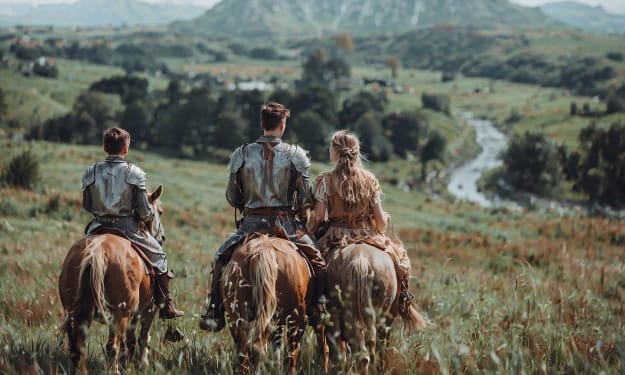
The rivers ran backwards the day the queen vanished. Her King had long since ridden off into the mountains among the high places on a holy quest to find a dragon—for only the noble creatures could heal the festering rot that plagued their son. Spring dawned and blossomed but neither king nor child returned. Then, on the first strange day of summer, the sun lingered too high, and the earth shivered.
By R. B. Booth8 months ago in Fiction
Bomb Scare
It was 2027, and the world never thought it would happen. A missle hit the United States, but it wasn't where they had anticipated. A little town in the northeast was hit by a missile strike, they didn't know why, and they didn't know exactly where it hit, but they did know it was a coastal community, somewhere between Maine and Delaware.
By Gregory Paytona day ago in Fiction
Nothing in Stock
The automatic doors sighed open like they were tired of pretending. A burst of refrigerated air hit my face—cold enough to promise milk, to swear on the gospel of dairy—but the first thing I saw was a tower of cartons labeled WHOLE, stacked in perfect family rows, each one feather-light. A woman in a beige coat lifted one, gave it a little shake, and smiled.
By Flower InBloom6 days ago in Fiction

Comments (3)
The witch. The child being gutted and burned. Sad that it was offered to her pagan gods. This line is good, 'the wicked and the good alike feel fear' I like a bit of wisdom in a story. A line that stretches its meaning, and characters steeped in history with a voice so ancient and a mind so current. 'There was no mistaking it. The man was a killer' a fantastic way to instill fear in the reader. The fathers love for woodwork could be felt 👌🏾 Mountain got thrown into the sea 😳 I especially loved the black dragon that came and carried them away. So the giants were the culprit all along and the dragons 🤔 Certain parts of the dialogue rhymes, i liked that surprise. Especially when the thief was talking. Its so sad, the last words. Yet it was so beautifully written. I was scared when he let them go... What a lovely story with a lot to teach. I was entertained throughout and the pacing was perfect 👌🏾👏🏾🤗❤️
You have the imagination and instinct for storytelling of a great author, it's awesome you're working on a novel. I'm definitely interested to see where this story goes as well. The way we immediately understand the dynamic between this father and son and how they interact with the world around them is incredible. Well done!
This was so good Blake. Have you written the whole story?