
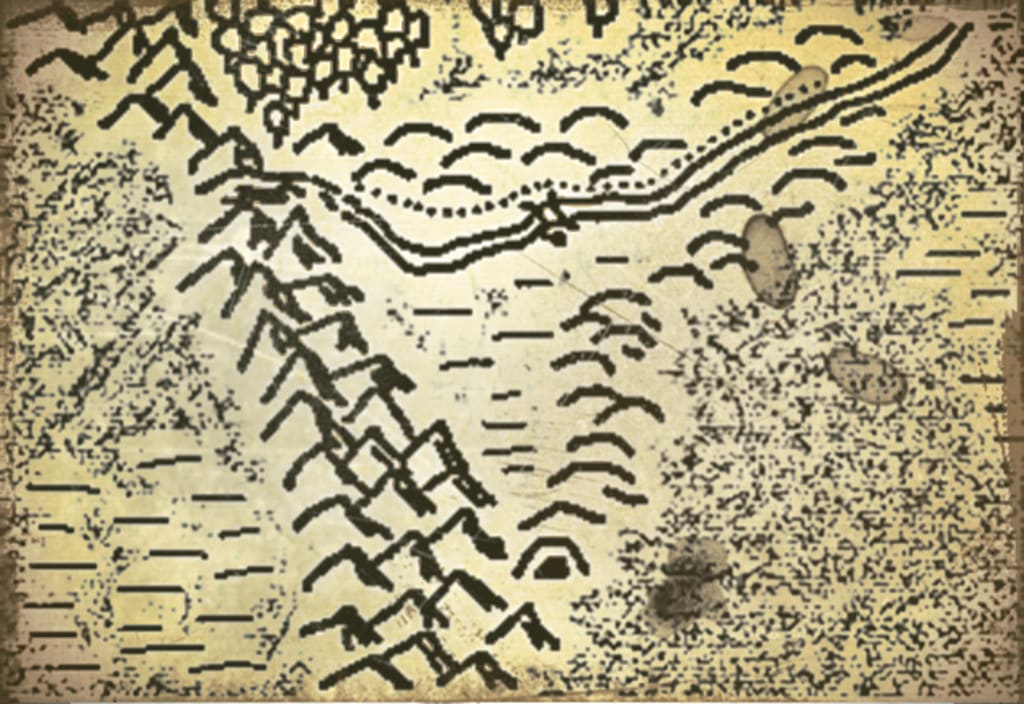
There weren’t always dragons in the Valley. The Treaty of Gildglen, which established the marchlands on either side of the gorge around the Crystalsteel River, allowed the Dragons of the Conclave only to enter the Upper Holdreach Valley to take tithes from the herds there once a year, in late-grass season.
Even still, most Arcanists considered the Upper and Lower Holdreach too dangerous to cross. Not all dragons kept to the rules of Dragon Shogun Shiluuvazan and the Conclave. And, aside from that fact, hostile humans in the service of the wyrms would also enter the river valleys, beyond their proper lands.
It was for this reason that when the sorceress, Lelda Boejaen, requested to cross the Upper Holdreach to the Shrine of Jasinth in the Fireshield Peaks, in the spring of the 90th year of Shiluuvazan’s appointment in Augea, Astar College denied her request. The ranked wizards of Astar did so even though she was one of their most accomplished agents, and they feared to anger her and drive her away.
But they also feared losing her to a dragon attack, if she were to be recognized as an Arcanist while traveling in that land. And they feared that if she were caught, the draconic powers of Odrava, to the north, or Augea, to the south, would accuse Astar of sending an agent to enter their lands through the Holdreach.
Lelda had no fear herself, because on her investiture, she had been given her Fate by the Wind-Maiden Moedraes: “When the last dragon departs Ruugan for the Eternal Stream, only then will the soul of Lelda Boejaen also return to its origin.”
Lelda took this prophecy—at the very least—as validation against the dread of dragons.
Her mentor Illizthis, one of the most-respected governors at Astar, agreed with Lelda. Without the word of the other governors, Illizthis gave Lelda an escort in the form of the sword-channeler, Giiaersten Grath, and sent her through the Fargate at Astar to the gate of the nomish outcasts in the Erberan Caves, just south of the Upper Holdreach.
From Erberan, the pair was to travel without horses, as the terrain was steep in places, down into the valley until they reached the river-crossing at Dissidtown, and then up the other side of the gorge, into the Fireshield mountains, and their goal.
Illizthis guided Lelda in disguising her features as an Arcanist. As for Grath, channelers were not forbidden by the Conclave’s Rule, but, rather, only true spellcasters—though, in this, they underestimated the loathing of the dragon’s cohorts for magic in the hands of humans.
It was 13 days down the slope of the Upper Holdreach Valley to the river-crossing. There was no road, only a winding path.
Lelda wore a simple skirt and cloak, much as a peasant in that region would wear, though darker than was their fashion. She was light of skin, eyes, and hair, but the tips of her locks were dark and thin, as if they had been singed, and so she bound them up. She was lithe, and young in appearance, and her lips were like mountain cherry; Grath often turned his gaze away from her on the journey: for though he was weary of the world, in many ways, he still took seriously the rules of the College, his patron, for such journeys.
Her spellbook, she had copied into a shrunken pamphlet the size of a palm, which she kept in her pocket, and she knew a charm to enlarge it, if she had need. Along with that, she carried a small, enchanted pack, into which residuum could be poured to produce various victuals and other needs, which they both used daily. She had been able to purchase a small vial of residuum from the nomes at Erberan, which was not illegal (and, in fact, valuable) even in countries under the Conclave’s Rule (though many of its uses were forbidden). Thus, she was able to use pure residuum for spellcasting as well, if need be, rather than more exotic elements of spellcraft; and she had also sold unicorn hair, faerie dust, and carniflower nectar at Erberan, so as not to be caught carrying it.
Grath, who was a slender but staunch figure, tanned and weathered, wore only an arming doublet, trousers, and two weapons at his side: one, a long, flattened truncheon of wood; and a short dagger. His hair was light brown but graying, and his eyes were distant.
As they went, they spoke little. Lelda had heard a bit of Grath’s story. She introduced him to her purpose, and he only nodded. He added that formality was not necessary, and that she might call him Giiaersten. After that, the two only spoke much again after they crossed the bridge at Dissid.
Lelda had heard that Giiaersten was a master of the channeling art of the Sword of Devil Winds; that he had long worked for the mercenary academies; that his many duels against his rival in his art, Shaeron, were the source of legend; that finally he defeated Shaeron in battle; and that after that, Giiaersten withdrew. Some even dared to say that his skills had begun to wane.
Lelda slept in a small partition in space which she conjured with her magic once a day, invisible to the outside world. Giiaersten slept on padded grass on the ground, as he was able. He did not join in her in the space, again, citing propriety, in a single word.
They were first able to stay in a public house at the bridge town of Dissid. The next day after that, their course to the high plateau upon which the Shrine of Jasinth was situated overlapped with the major road for that region.
They both noticed a group of dragonoid apotheosids following them. Those half-dozen travelers wore the roseate habits common to monks and nuns in that region, and though they were still at a distance, both Lelda and Giiaersten could recognize, sticking out from their robes, the semi-taloned hands of at least a few of that number, which they knew to be the first stage of the transfiguration.
They also knew that if these stalkers had recognized them as an Arcanist and a sword-channeler, they would likely also know that their spirits, trapped and bound in the apotheotic ritual, would advance them considerably towards their apotheosis. These stalkers could then justify such an act as a fulfilment of the Conclave’s anathema against human magic-users, and not as murder for their own selfish purposes.
At that point, the road closely followed the river, and Lelda indicated to Giiaersten an outcropping in the bank, not far ahead: “There, on the other side, if we are out of their sight, I can cast a veil over us so that they will pass by.”
Giiaersten said nothing, but they increased their pace, and Lelda began the verbal incantation even as they were walking, such was her skill. The apotheosids could not have heard, but they began to run towards them. Giiaersten drew his wooden bat, and they both turned.
Lelda saw the draconic eyes of the one whom she marked as their leader. That one had already acquired the Second Sight which came naturally only to humans with the Gift, and the apotheosid had seen the sigils forming in the air around the sorceress as Lelda had begun her spell. With the flux of essentia caused by the battle about to begin, the spell was lost; but between her Fate and the protection of Giiaersten, Lelda was at ease. She began another spell.
She tried a friendship charm over the group, as they neared, but the nun with the draconic eyes warned the others---“She means to ensorcell you!”---and they set their wills against her, and all resisted but the rearmost one. In that time, Giiaersten gave one warning to them: “Stay back, or die!”
Lelda could feel great pressure form around Giiaersten’s weapon in the air, and she could feel him channeling essentia, not into a spell, with an incantation, but simply through the memory of his muscles. The apotheosids were almost upon them, and he swung.
Every one of them who had charged fell to the ground in blood and cries as their organs split open from within. Even Lelda had a sense like falling in her stomach. She felt a great unseen movement in and of the air, and a heat and a ripple like thunder. Giiaersten lowered his truncheon.
The last apotheosid, whom Lelda’s spell had stayed, stood in awe.
“You are a master of the Devil Winds,” he said. “I was a practitioner myself before I adopted the discipleship of the dragonoid.” He drew a single-bladed sword at his side. “If I must die, please give me the honor of a duel.”
Giiaersten raised his weapon again: “Then—you will, indeed, die.”
But Lelda cast a spell upon the monk, and he fell to the ground in sleep. She directed Giiaersten to move the bodies to the side of the road: “He can make a pyre for his companions when he wakes. And, I hope, think better of the path of would-be dragon-lings.”
Lelda thought on Giiaersten’s display of channeling. She had not seen any such art before to equal or surpass most spells. She wondered how any rumor could be true that Giiaersten’s prowess had waned.
* * *
Another five and a half days past. They left the road, back onto a winding path, further up into the foothills of the Fireshields; and, again, they both wordlessly saw a sign of danger at the same time: what might have been a shadow on the ground of a longwyrm in flight above.
They could not find it in the clouds, but they both knew that even with skills such as theirs, neither their senses nor their reflexes were comparable to a dragon’s, and if that is what it had been, it could be upon them before they could react. Down the hillside a short distance was a sinkhole, and they scrambled to it, and down, hopefully out of sight.
Inside, they found a coiled wyrm: asleep. They had already jumped, and it woke as they landed on the mossy ground next to it.
The imperfect circle formed by its long, ophidian body was at least four steps across, and it might have been two rod uncurled. Its wings were folded on top of it, and its forelimbs and hindlimbs folded underneath. Its scales were mostly of bronze, though some were a bit more coppery and some a bit more gold, and they shone even in the dimmer light in the sinkhole. Though its scales were clearly quite hardened and its muscles rippled beneath them as it shifted, its face was seemingly youthful, having a short, almost dog-like snout, and twinkling purple eyes. It was surrounded by a stony, acidic odor; and had broad, flat, back-sweeping horns.
Giiaersten’s hand was already on the handle of his weapon, though it was not yet drawn, and a heat was gathering. The dragon raised its head up and inhaled. The essentia flow around the sword-channeler was drawn away and the hot pressure dissipated. Lelda saw the air flicker around the corners of the beast’s mouth. Then it spoke:
“I am Teremerix. You would seem to be an Arcanist and a channeler.”
Even with their respective experiences that had brought them to this point, Lelda and Giiaersten each slightly winced to hear the dragon recognize their nature so quickly.
But when he saw that the dragon made no move to attack, Giiaersten asked: “You have seen us correctly, but you do not strike: do you hold to the truce which governs this borderland?”
The dragon answered him: “On the contrary: at this time, I have so little regard for the Conclave and its rules that I see no reason why I should have a quarrel with you at all.”
They prompted him no further than glances of wonder at one another.
“I was sent to the badlands to the west as an advance guard of the armies of the Shogun,” Teremerix explained. “There to keep a watch on agents of Larksia if they were to approach Ethiim Pass at the fortress of Jabrin, I suppose. But what I did was eat giant scorpions, and meet the female, Landupon.”
“Why do you tell us this?” Giiaersten replied.
The dragon crossed its forelimbs in a manner of leisure, and glanced up to the sky above the sinkhole.
“Old Parsorgisol has flown on,” the dragon stated. “If, as I suppose, you two little ones entered into my hiding spot hoping to share it.”
“So we did, mighty one,” Lelda spoke. “You suppose correctly.”
“It would be rude to attempt to beguile me,” the dragon mused, without looking down at her. “I presume you are not only an Arcanist, but a sorceress, specifically. And to answer your question, you can suppose, as your friend does, that I am trying to trick you or lull you off guard, even though I have no need to do so, or you can accept that perhaps I like to talk and to hear myself talk”—at which remark its twinkling purple eyes housed an eerie glint of a smile—“and I have not had an audience since I came into this Valley.”
“Are you, then hiding from—that is, tactically avoiding—the other dragons, great one?” Lelda asked.
“Address me as Teremerix,” the dragon directed. “And, yes, I am hiding: from Shiluuvazan’s army on the one hand, and, even worse, Landupon on the other.”
“The … the female dragon you mentioned?”
“Indeed, female human,” Teremerix answered Lelda, seeming to chuckle, and stretched, shifting the earth in the hole, and causing Giiaersten to warily change his stance. “I will reveal to you a secret draconic law kept well from lesser creatures like yourselves. You know, I presume, that dragons come into this world as embodiments of certain natural features or events. I was hatched of an egg that embodied exposed breccia on a cliff face where the desert met the sea. Landupon’s egg was embodied by the light of the moon on the snow over a buried fig tree. Or so she said. Even the great Shogun Shiluuvazan was once an egg embodied from the Golden Fields of Wheat of the Impress Plains. These embodiments of the forces of the world as eggs occur less and less in the recent age. Or so they say.”
Lelda found it appropriate to nod as he spoke.
“But this spontaneous formation is not the only means,” Teremerix added. “Rarely, very rarely, in fact, a certain act of two young adult dragons, such as myself and another, for example, might produce an egg; or, in even rarer cases than that: two eggs.”
Lelda glanced at Giiaersten with widening eyes at this statement. He did not react, but resolutely watched the dragon.
“The Law of the Conclave is that any such egg so occurring must be taken to the sandy plain of the First Weir east of the island of Murai, there to be registered and monitored. Landupon was not in agreement with this rule. Foolishly, I agreed to watch the eggs while she went off to hunt, and though I was—distracted—but a short time, when I returned the eggs had disappeared.”
“So your mate is trying to kill you, and you are also an outlaw for agreeing to help her in the first place?” Giiaersten concluded.
Teremerix muttered and rumbled, and regarded the sword-channeler thoughtfully.
“What are you strange human users of magic doing in this place, trying to hide from dragons in a hole?”
Giiaersten looked to Lelda, whose gesture was half a nod and half a shrug.
“We are seeking the sphinx which is said to reside on a plateau just northwest of this stretch of the valley, in the Fireshield mountains,” she revealed. “Lix-xil-il-li, she is called—said to be the truest Fate-speaker in this corner of all of Ruugan. It is also said that she will grant knowledge of Fate to those who answer her riddles.”
“That is interesting,” said Teremerix, after a moment. “I presume that you know that many dragons find diversion in riddles and riddling-speak; and I have never yet met a sphinx.”
Lelda again glanced at Giiaersten, and saw him scowling, as if he knew already then what she would say:
“Mighty—Teremerix—the sphinx Lix-xil-il-li may know what happened to the eggs. Her knowledge is said to be nearly limitless, especially concerning those born on these mountains, and in the lands on either side. Perhaps you would do the honor of accompanying us?”
Teremerix answered by suddenly launching himself out of the sinkhole and onto the grassy, wet ground above. He called down to them that the sky was, indeed, safe, and waited several moments for them to scramble up to join him on the ground, before he launched himself into the air with a running start.
Circling back over them, he shouted down: “I will meet you at the ridge at the end of this path.” He made another rumbling sound that might have been a chuckle, this time even more ominous sounding, from above: “You did not think even I, as fallen out of the grace of the Law as I am, would disrespect the Rite of Skyfare by taking you, unearned, on my back?”
And at those words the dragon wheeled away. Giiaersten fixed his charge with a steely glare.
“I know that a dragon cannot be trusted, let alone a seeming rogue of this one’s nature,” Lelda justified. “But he had already identified us, and you must admit he could be useful in dealing with Lix-xil-il-li.”
“You are the mistress of this venture,” Giiaersten answered. “I am only here to serve as a sword.”
Lelda frowned, disliking that response more than if he had argued. Before they could speak any further—if either had anything else to say—or set out again—they saw Teremerix already coming back.
He circled them once and landed, surprisingly softly, nearby.
“It is only fair that I should have asked,” he said: “Why are you seeking this sphinx?”
The sorceress sighed: “By the Oracle Moedraes, I was given the Fate: ‘When the last dragon departs Ruugan for the Eternal Stream, only then will the soul of Lelda Boejaen also return to its origin.’”
“Ah, a ponderous Fate indeed,” mused the dragon. “You seek to have it affirmed by an immortal?”
“No,” Lelda answered: “I seek to learn how to escape it.”
About the Creator
Reader insights
Nice work
Very well written. Keep up the good work!
Top insight
Excellent storytelling
Original narrative & well developed characters
Keep reading
More stories from writers in Fiction and other communities.



Comments