
Fair Play: Finding Clarity in the Clues
How Golden Age Detective Fiction Offers Comfort in Times of Chaos

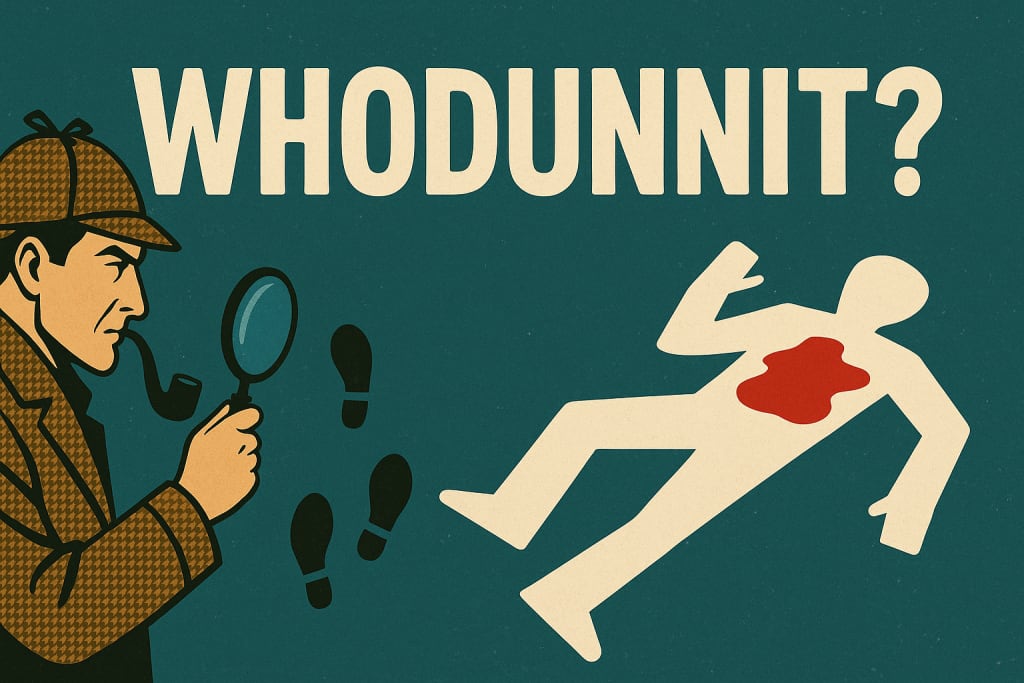
Even when very little does make sense, we humans use narratives to make sense of the world around us. We tell ourselves stories to relax and amuse ourselves. In tumultuous times, people frequently turn to escapist forms of entertainment as a means of disengaging from the broader world. We also find that we frequently turn to detective fiction. People became increasingly interested in bridge, mahjong, and crossword puzzles after the First World War, and this "play fever" quickly spread to detective novels. Murder mystery writers began to write books that were puzzles to be solved and that complied with the fair play doctrine – the concept that the reader should have a fair chance to solve the mystery before the grand reveal. The trick was to give the reader enough clues to have "a sporting chance to solve the mystery," as TS Eliot put it. The authors of Golden Age detective novels were concerned about fairness that does not exist in the real world. In a whodunnit, where everyone knows their part and the story is new and exciting, but ultimately familiar and comforting, life is so much easier. There are solutions, conclusions, and a person you can blame in detective novels. Someone will always be to blame. Someone to haul off to the scaffold. “Once the murderer leaves, the world of the novel begins to approach its former peacefulness...cleansed of guilt, free of complication and obstacles, recreated anew from the shambles of a temporary disorder...the happy and orderly end toward which the detective has been working,” George Grella writes in his essay Murder and Manners: The Formal Detective Novel. However, reality is clearly not like that. It may be tempting to view life as a mystery that must be resolved. And indeed, tempting to believe that everything has a clear and single explanation. Because there is always a solution, we enjoy solving puzzles. We enjoy detective tales because we are aware that there will ultimately be a satisfying reveal—a straightforward narrative that makes everything make sense. Party games based on murder mysteries like Wink Murder and Murder in the Dark gained a lot of popularity during the Golden Age. This gamification of death took the power, the sting, out of a terrible tragedy and emphasised that of course none of this was actually real – it was in fact just a game. the ideal remedy for dealing with the public aftermath of World War I. The popularity of escape rooms, the rise in sales of jigsaw puzzles during the pandemic, and crime logic gamebooks like GT Karber's Murdle series have all occurred more recently, during our own turbulent times. A piece titled "Why do People Read Detective Stories?" was published in The New Yorker in 1944 by American literary critic Edmund Wilson. He came to the conclusion that the "all-pervasive feeling of guilt and by a fear of impending disaster which it seemed hopeless to try to avert because it never seemed conclusively possible to pin down the responsibility" was the reason for the popularity of detective fiction in the years between the two world wars. Who was responsible for the first crime and who would be responsible for the subsequent one? The murderer is suddenly discovered, and relief! He is not, after all, a person like you or me. Nobody appears innocent or safe. He is a bad guy who is known as George Gruesome in the industry. He has been caught by an invincible Power, the egotistical and omniscient detective who knows exactly how to get rid of the guilt. In more recent times, detective fiction, particularly those written in the Golden Age style, has once more attracted readers. The Guardian reported in July 2020, as UK bookshops reopened, that nearly 120,000 more crime and thriller books were purchased in the final two weeks of June 2020 than at the same time the previous year. Crime was, during this period, the UK’s most popular book genre. Another indication of their growing popularity was the Crime Writers' Association's announcement in 2023 that their awards for classic or "cosy crime" novels would now include a Whodunnit Dagger. With Mystery in White by J, The British Library's Crime Classics series has continued to sell well. Jefferson Farjeon became a number one bestseller for Waterstone’s.In my novel Fair Play, I use the fair play rules together with the familiar structure of a Golden Age detective novel – with its murder, its suspects, its Watson and its reveal – to explore the emotions around grief. Abigail, the main character, alternates between the real world and the fictional world of the detective novel following the sudden death of her brother. She is looking for clues—answers—in both worlds to comprehend her circumstances. In the midst of the unpredictability of real life, the murder mystery provides her with a familiar path and much-needed comfort during her grief. In a detective novel, we are aware that we are getting closer and closer to a conclusion—the answer we have been looking for—within each chapter. At least, that's what Abigail hopes for. "We are lost and unhappy in a universe that seems to make no sense, and cling to science, machines, and detective fiction, just because, within their limited fields, the problems do work out, and the end corresponds to the intention," Dorothy L. Sayers writes in her book "Begin Here," which was published during the Second World War.
WRITTED BY ME
About the Creator
Mahafuj Alam
🗞️ Mahafuj Alam | News Curator & Independent Media Voice
delivering news quickly, accurately, and bravely, including headline breaking stories and untold local stories. Stay informed. Keep your power.
Keep reading
More stories from Mahafuj Alam and writers in Fiction and other communities.
One Unchecked Box
"Republished" because it was the only way to add the embed for the newly recorded audio version of this story due to the Top Story badge. Plus it serves as a nice, informal announcement of the podcast's revival for another season (go subscribe!):
By Stephen A. Roddewig5 days ago in Fiction




Comments
There are no comments for this story
Be the first to respond and start the conversation.