
Eyes and dust
An abandoned air base, a bleeding sun, and a locket.
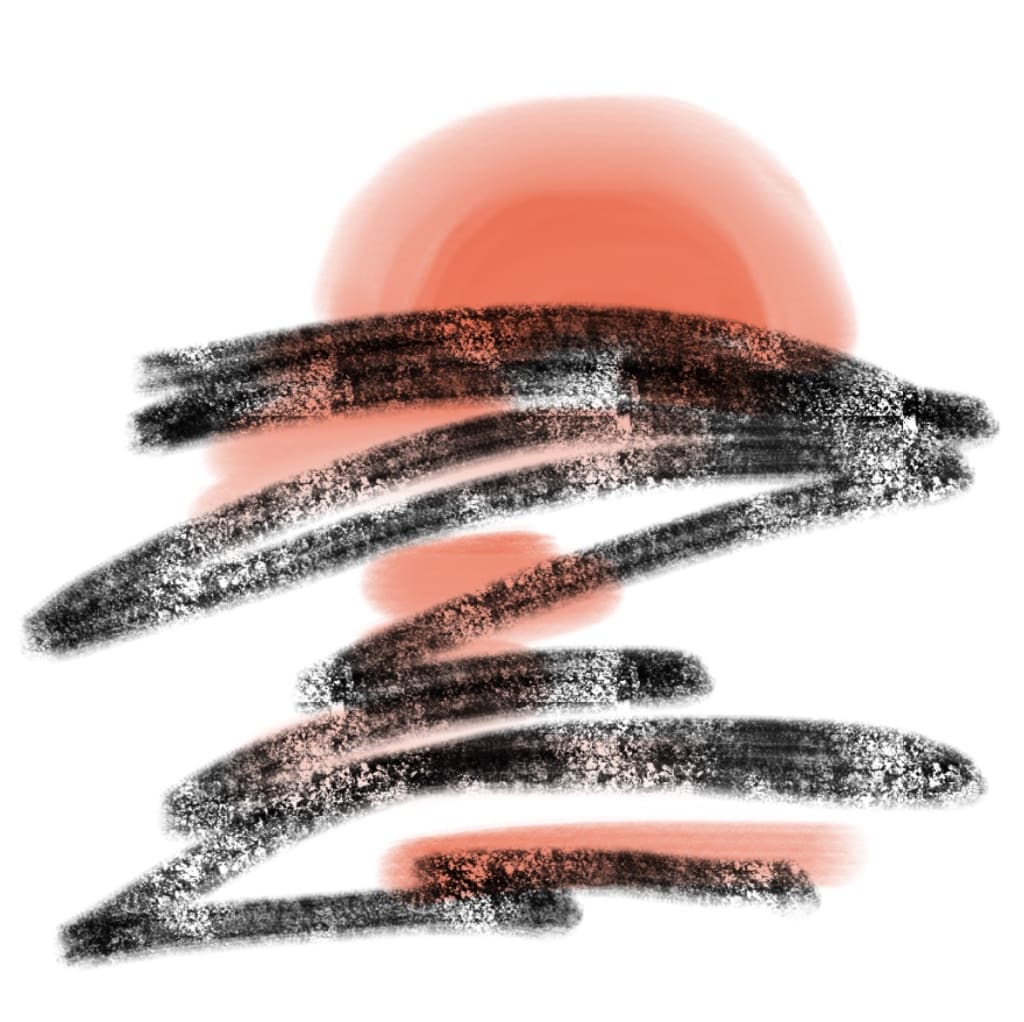
Maryam wakes up with dust in her mouth.
A fine, silty layer has settled over her in the night, and as she sits up she rubs at her lips with her sleeve. She spits a black wad into the corner of the tent and barely misses her sleeping husband.
She tiptoes to another corner, where a bucket of silty water promises some relief. After three splashes, her teeth are still gritty but her face feels clear, and Maryam creeps out of her tent, careful not to make a sound.
Maryam swears that years ago, the desert air was not so grainy, but her husband always laughs at her. “It’s always been like this,” he says, giving her a grimy kiss before stamping off to join his Collection Crew. Years ago she could put on lipstick without sand sticking to the pink. Years ago she could still buy makeup.
At sunrise the desert is hazy and orange-stained, the sun using the distant hills as a canvas for its liquid rays. Maryam’s mouth waters as errant sand grains crack between her teeth, but she knows her husband will only laugh more if she tells him she wants to drink the sun.
A bell tolls, and Maryam drags her eyes from the sunrise to the Collection Center. It’s the best-kept building on the tarmac, inexplicably free from graffiti and bullet holes. During breaks, she and her Collection Crew like to wonder what it used to be. A mess hall? A barracks? Nothing remains in the building but collected piles of scrap, but sometimes Maryam looks at the windows — the glass has not even a hairline crack — and marvels.
It’s another reason she can’t understand her husband’s denials. For he knows as well as she that this used to be an air base of some foreign power. Maryam was too young to know the details, but she remembers a time when the scrapyards didn’t exist and when the tarmac was scrubbed clean by enterprising recruits, baking during their first employment under the desert sun and eager to impress their superiors.
Her own parents had forbidden her from venturing near the base, but the best place to play ball was in the shadowed rectangles of the foreigners’ security walls. She and the other children had done their best to remain unobtrusive, but on one occasion her hearty kick had sent the ball over the barbed wire. She’d approached the fence nearing tears, terrified of the prim soldiers with the shiny black guns clamped in their hands. But the one who’d caught her ball walked to the fence with a jaunt in his step. Under his helmet his eyes were bright green, and above his lip was a perfect drop of sweat.
As Maryam walks to the Collection Center she can see the exact spot where the soldier stopped to talk to her through the fence. She wonders if he ever made it home, wherever home was.
“...Hangar four,” Maryam’s Collection Chief finishes when she makes it to her group, six women wrapped in dust-colored fabrics for a dust-colored job. What’s under the Collection Chief’s mask, no one knows, and Maryam’s Collection Crew has spent time guessing.
“Move out.” The Collection Chief signals, and the women pull on their gloves and begin the trek to Hangar 4.
Maryam draws her own gloves over her callused fingers, but before she can join her crew, the Collection Chief clears their throat. “Maryam,” they say. “Stay back.”
Maryam halts and turns back towards the Collection Chief. They’re arrayed in a sand-colored outfit like her, but the hue is chalkier and cloudier, like someone dumped a cloud all over the fabric. An asymmetrical mask covers their face. Maryam always leaves their encounters imagining a woman with one eyebrow.
“You’re late again,” the Chief says.
Maryam doesn’t respond, instead raising her eyes to exactly where the Chief’s eyes would be if she could see them. She wonders if they’re the same green as the soldier’s.
“There’s a new Collection Chief coming,” the Chief says. “Be on time. They won’t all refer to you by name.” They nod toward Maryam’s chest, where her number — 0156 — is emblazoned over her right breast.
“Okay,” Maryam says. The Chief nods toward the rest of Maryam’s crew, and Maryam turns on her heel to follow them. In her chest, something feels like it’s falling.
Hangar Four is the westernmost building, and Maryam’s group buzzes as they near it. Since they’ve joined the Collection Department as children they’ve only been to the first three hangars. Maryam feels a stab of excitement as they walk through the door, and she imagines the massive planes that made their home here before all of the soldiers departed.
She mentions this to a fellow crew member, who laughs. “You’ve never even seen a plane,” she giggles.
Maryam shrugs. “They used to be here,” she says, but the other women roll their eyes — they’re all younger than her, too young to remember when the air base was anything else but a vandalized scrapyard.
Their chatter halts when they reach the main hangar, a cavernous room that Maryam can already tell will take them days to pick through. Junk litters every part of the floor, and some old machine parts hang suspended from the ceiling. A warm desert wind blows through cracks in the roof, but despite the small piles of sand here and there, the thick metal walls have done their jobs in keeping out the elements. Maryam is glad of the respite from the dust.
The younger women get to work right away, scampering towards the most compelling piles of junk. Maryam picks her way through the piles to the far corner, away from the chatter and scuffing noises of moving metal. Maryam gazes at the polished floor, which despite scattered bolts and bullets has retained a sheen from decades past. Below her tent the tarmac is crumbling, but what would happen to this floor, with the metal walls to protect it? If they could, would people come for miles to marvel at its permanence? She stamps her foot, not hard enough for the others to hear, but hard enough that she can feel the solidness beneath her boot.
She squats and begins to pick through the garbage. Old wires, cleanly sliced by a blade eager to escape the desert. Shoes, dirty and warped, broken in by a foot much larger than hers. She sniffs at one, halfway hoping to get a whiff of old human skin. Nothing.
Maryam follows protocol and dumps all valuable metal into a Collection Basket, but to her the treasures aren’t nuts and bolts. When she began the Collection as a child, she’d toiled for a few years, barely sleeping because of her sunburn’s itch. She doesn’t like to remember this time, because her mind grew darker, and even when her sunburn faded her eyes just wouldn’t shut at night. Her mind twisted, like a fuel-slick bolt had burrowed into its soft, pink folds. She began to daydream about old plane parts, in all their sharpness.
At the advent of her warping she’d gone collecting, halfheartedly because the scrap had been picked over many times and she knew in the deepest part of her being that she wouldn’t find a thing. But then the wind shifted enough to turn her head, and she’d seen it: a photograph.
A sunny day, and two people. One definitely a foreign soldier, one a bearded man with clothes similar to Maryam’s. Both smiling. Cups clutched in their hands. Next to them, a tree, something Maryam hadn’t seen since before the soldiers’ departure. On the back were some scribbles she couldn’t read and a number: 2003. She didn’t know who any of the people were, and the photo was hardly larger than her palm, but for countless days afterwards she stared at the picture, consumed.
Over the years she’d found similar scraps. A tiny note with illegible handwriting. Doodles in a yellow booklet. A brush so minute she couldn’t imagine its purpose. A few more pictures, torn almost to pieces but still bearing faces and smiles and — she liked to imagined — rumors of futures.
Maryam is thinking about these objects when her gloved hand feels something misshapen below an old engine part. She hesitates — it will take effort to retrieve, and she doesn’t want the agony of working with a broken arm — but something shifts within her, and with difficulty, she frees the object.
Immediately she bends to cover it, because it’s the most beautiful thing she’s ever seen. A bloated metal shape, with two humps that flow downward into a point. Strung onto a piece of leather. She used to have a word for this, but it faded long ago from disuse.
She explores the bloated metal shape with delicate fingers, and sees a tiny protuberance on its side. She flicks it, and the humped shape moves, revealing a compartment within the bloat.
Inside is a tiny blue object, a quashed cylinder. She’s never seen anything like it before. Without thinking she grazes it with her tongue, and she coughs because the taste is so harsh. Her head spins. She reels back but keeps hold of the object. Where her tongue touched it, the blue has dissolved into white. From afar one of her crewmates calls her, and her heart hammers wildly.
When the workday ends, Maryam keeps the object in her pocket.
Over the next few days, Maryam feels sick. She vomits almost hourly, and the grainy water offers no relief. Her husband and the Collection Department grow impatient. When she recovers, she wakes up to go out with her crew. She’s about to leave when she remembers the object, shoved beneath her blankets on the tarmac rubble. After a beat she stuffs it in her pocket, careful to leave her husband sleeping.
As she nears the Collection Center she can tell something has shifted. Her crew doesn’t speak, and as she joins them she realizes why: though the Collection Chief doesn’t look different, a new person obviously wears the uniform.
“You’re late, 0156,” the new Chief says coldly, and though Maryam half expects abuse she isn’t prepared for the heavy hand that crashes down upon her cheek. She falls into a pile of garbage and whacks her head against the pavement. Blood fills her mouth. The number rings in her head. 0156. The word “Maryam” threatens to flee her mind, and she clutches at it.
“You won’t be late again,” the Chief says. They signal for Maryam’s Collection Crew to move out.
Maryam hauls herself up, nausea roiling through her, and is about to follow when she freezes. The object in her pocket. 2003. The soldier’s green, green eyes.
She starts to run.
She can’t make it far. But she knows where she’s going, and no one else does. The Chief shouts at her to stop, her own crew chases her, the men on top of the hangars with guns — she has always ignored them, but why bother now? — load their magazines. But they can’t predict her path, and in a few minutes she’s there.
The fence. The soldier. The ball. The bead of sweat above the lip. Green, green eyes.
Footsteps, close by. There is no ball to throw over the fence, no home to escape to. Enemy footsteps. The only smile is a cruel one, or a furtive one.
Her hands are shaking, but she strips off her gloves and pulls out of the object. In her naked hands the metal is somehow cool. She opens the bloat, and the blue object sits there, stark in its forbidden existence, one corner dissolved.
Voices raised. Guns cocked. A bead of sweat above the lip. Green, green eyes.
“Get her!”
She swallows the blue object, and the last thing she sees is the orange sun bleeding.
About the Creator
Keep reading
More stories from writers in Fiction and other communities.
A Love Forboding
The chipped stone slope caused unbearable footing. I slid, skirting on my heels. I cast my shield, relinquishing my guard to stay upright. Left with my double-edge and a prayer to the maker, I skated toward my objective. The earthly stubble gave way to solid ground. I found myself restored, a trail of dust in my wake.
By James U. Rizzi3 days ago in Fiction


Comments
There are no comments for this story
Be the first to respond and start the conversation.