
Eyeball Planets: They Are as Eerie as They Sound
Unveiling the Enigmatic Realms of Eyeball Planets
The hunt for interesting exoplanets and potential life forms in the vast expanse of the universe continues unabated. We are on a quest to find a second Earth, a planet similar to our own, where we might finally encounter extraterrestrial beings. We are not picky; any form of life, even bacteria-sized organisms, would be fascinating. This search primarily focuses on the habitable zone around other stars, also known as the Goldilocks zone, where conditions are just right for liquid water to exist—whether on the surface of a planet or a moon.
The hotter the star, the more expansive the habitable zone, offering a wider range of exploration possibilities. In terms of the vastness of space, which we still know so little about, this opens up a tremendous amount of work. This is why red dwarfs, which make up around 80 percent of the hundreds of billions of stars in our galaxy, are particularly appealing. Their cooler nature means their habitable zones are smaller and closer to the star, giving us a better idea of where to look for planets orbiting them. And with some luck, when a planet passes in front of its star, blocking out some of its light, we strike gold and make a discovery.
The Kepler space telescope has already aided in the discovery of thousands of planets using this transit method, with a significant number of them orbiting red dwarfs. Some of these exoplanets are similar in size to Earth, and many of them could possess up to 25 times more water than our entire planet.
Now, let's explore these planets that scientists have discovered. One interesting category is the super-Earths. They are more massive than Earth but lighter than Neptune and can be composed of rock, gas, or a combination of both. Some have thick atmospheres, while others have thin or no atmospheres at all. Additionally, we come across many Neptunes—planets almost as big as Neptune but with solid cores, unlike normal gas giants. This unique characteristic allows them to support a dense atmosphere with water and other life-supporting chemicals.
On the other hand, we have hot Jupiters. While fascinating, they are only desirable if they are distant from us. Imagine that one annoying and unpredictable neighbor whom you can never figure out or get rid of—that would be a hot Jupiter. Their strong gravity can destabilize the orbits of smaller planets or celestial bodies in the system. Fortunately, Jupiter is a good and peaceful neighbor, minding its own business, at least for now.
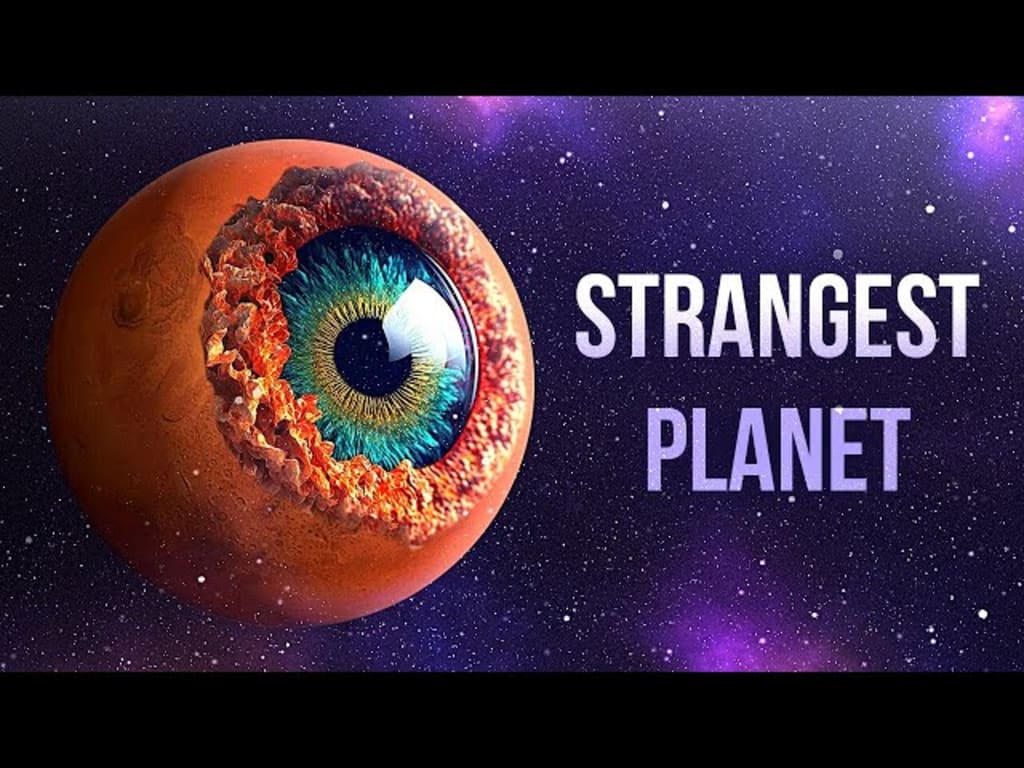
But let's leave all these diverse planets alone for a moment and imagine traveling through space, encountering a giant eyeball floating in the darkness. It starts at the central star of its solar system. Don't worry, it's not a monstrous creature—hopefully, our future space friends won't be as intimidating. It is, in fact, a planet, a little bizarre but still captivating. These peculiar worlds are aptly named eyeball planets, and surprisingly, they are quite common. In fact, even normal planets have the potential to transform into eyeball planets.
Eyeball planets form when matter and dust accumulate around a star, gradually forming a solid object. As the planet spins, the star's gravity slows down its rotation until it becomes tidally locked. This means one hemisphere is always facing the star while the other is in perpetual darkness.
Interestingly, we have a nearby example of this phenomenon—our moon. It orbits Earth once a month, taking the same amount of time to rotate once on its axis. As a result, we always see the same face of the Moon. Perhaps the other side is even more beautiful, adorned with craters and other features.
About the Creator
Keep reading
More stories from Ntivuguruzwa Philemon and writers in Fiction and other communities.
When Skies Turn Yellow: Are You at Risk?
Imagine looking up at the sky and seeing it bathed in an unusual yellow hue. It's a sight that would undoubtedly grab your attention and make you wonder what is happening. While it may seem like a scene from a science fiction movie, there are instances when skies do turn yellow, and it can be a cause for concern. Let's explore this phenomenon and understand if you could be at risk.
By Ntivuguruzwa Philemon3 years ago in Earth
Stories Before a Wedding, or The Fairytale of Beauty and the Beast
Once, a long time ago, it was custom that on the night before wedding all the married women of equal Rank and status would gather around the bride in her chamber. While helping put the finishing touches on the bride's dress and trousseau, the women would take turns telling Tales of their great Romance and own marriages. This served two purposes: these stories taught the bride what she could expect from her own marriage and wedding night, and it also served as a history of these women and their stories. The most romantic Tale and the woman who told it would earn the right to give the new bride away into her married life. Now, in most cases, naturally the bride's mother or grandmother or some favorite cousin would quite easily be announced the winner and told how their story was such an inspiration to the new bride. In this way, weddings passed from mother to daughter, matriarch to descendant, and the women’s stories remained alive and aided a new bride in preparing for what was to come.
By Dionearia Redabout 13 hours ago in Fiction
One Hard Thing
Stop me if you’ve heard this one before: You have the number, you know your schedule- you’ve even picked out the perfect day and time to make this appointment. Shoot, you’ve even picked out alternative days and times just in case their schedules can’t accommodate you!
By Taylor Rigsby2 days ago in Motivation


Comments
There are no comments for this story
Be the first to respond and start the conversation.