
Excerpt From A Guided Tour Of The Museum Of Terrible Things
"What opera isn't violent? Two things happen, violence and love. And other than that, name something else. You can't." —Cab Calloway

1.
There it was, hidden among the whut whut whut of the comings and goings, hidden—just barely hidden—behind the pearly voice of Glory Good as she ran through the morning announcements: savory pudding dust for dinner, mandatory march at four, may the good ones keep us safe and similar. The sound was unmistakably there—and it went on until Mondita could no longer ignore it.
“What is that?” Mondita Flax asked the lab at large. The technicians sighed and shrugged, the lab-ladies and lab-lads avoided her eyes, and even the rats in their little bauble-shiny cages made not a whisper.
“I can’t concentrate like this,” Mondita said, and she slammed up the window with a huff, and shouted out into the narrow, bottomless corridor of the Undercity: “Will you quit that racket!”
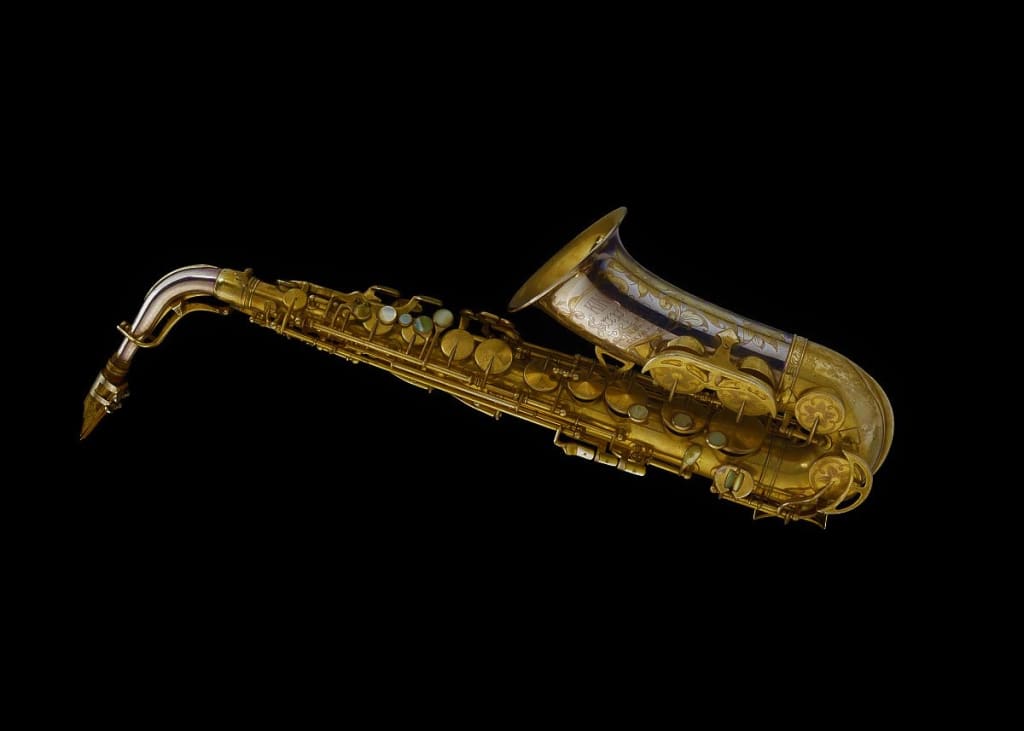
The noise came from a window some floors down on the opposite side of the chasm. A weird contraption of gold stuck out the window-lip, into the air.
Woooooogle-whoaaaaa-whoraaaaggglee, the gold thing said.
“I said STOP THAT RACKET!” Mondita shouted. It was just unbearable, that’s what it was, and on a weekday morning!
The noise, which had begun to crescendo in a babbling aaaoooooghaaing kind of way, cut out abruptly, and the gold object retreated into the window. Then a man’s face popped out. It was an ugly face, but sweet, with jug-ears and a frizzy black halo of hair that absolutely must mandate a cutting soon, if not yesterday, before the Department of Similarities had words with him about it.
“I suh-say hullooooooo!!!!” The man said, waving. “Pleased to make your acquaintance! Heard any good suh-songs lately?”
Mondita could only stare back at him in confusion. ‘Songs’, in her rough, academic understanding, were a part of music, and music had been outlawed ages ago.
“We need you in here,” Mondita’s lead technician said, tapping her on the shoulder. She closed the window and went over to where one of the rats had been navigating the mazes with frightening alacrity.
“If there’s a flaw in the medicine—" the tech began.
“There’s no flaw in the medicine, Widdles,” Mondita said. “You know sometimes the pills don’t work. It’s a one-in-a-million thing.”
The rat was taken out and killed with a hammer. After a lunch of chicken-and-peas dust, Mondita made a call to the Department of People Who Think Too Much and was granted permission to have Widdles taken out and killed, as well. Mondita hated a worrier.
2.
The good ones came in shining boats that took the vast space of the universe and folded it into nothing. At the outset they were called the Good One, but human beings did not seem to understand hive-mindedness, even though the Good One promised it would be their salvation, so they switched to being called the Good Many, and then just the good ones, which had a nice casual sort of lowercase sound to it.
They—the good ones, that is—they removed all of the things that alerted the Listeners to planetary civilizations in their vulnerable infancies: the bombs and the arts, the many religions, and helped human beings to get through the Great Filter without helping too much because that would have been cheating, and one day they packed up their folding boats and left. But things improved.
Glory Good was elected secretary-to-the-world to govern over everything and make sure nobody put a toe out of line or disrupted peace and prosperity for all the others.
The weak were executed and the strong were executed, the amoral and the just, and of course all the painters and musicians were executed until only the middlemen were left to enjoy their middling society. And it was all very fine.
The next Glory Goods kept things in much the same way. Then a Glory Good (may her name live on forever) came along and decided that killing all the strong and weak and amoral and just and everyone who showed creative tendencies was seriously diminishing the population, and she came up with the idea of the middleman pills, which made just about everyone the same.
It was a brilliant idea. Too brilliant, in fact, and Glory Good was obligated to execute herself. She was replaced by another Glory Good. But the pills—those were kept.
Then, long after everything, came the Boogie Man.
3.
In the Undercity he was whispered about—the Boogie Man or sometimes the Boogie-Woogie Man. He was a rumor. Then a story. And stories were strictly outlawed. He was a religious man, they said, or an immortal, he had a terrible stammer (that much was true), he had a musical instrument and he could kill you with a blast from it, send your brain out your ears. He was The Profane and Wicked Prince, he was Humbert Humbert but without the creepy pedophilia aspect, he was a factory laborer that had fallen into a vat where they mixed the stuff that went into the pills and gone mad from it.
In reality, he was a skinny man with a mop of dark curled hair and jug-ears and an onyx locket shaped like a heart that he never took off. In the locket was a picture of his lover, a man named Britz who called himself a chef—a dirty word—and made meals out of things other than dust.
The jewelry-slash-lover thing was bad enough, the meal thing worse, the music unforgivable. The Boogie Man had a golden saxophone and it was a mystery where he had gotten it. All his life he had been dodging the Similarities people, who wanted to execute him because he had been jittering and humming, making up songs, ever since he was a child in the school camps.
The Boogie Man persuaded Britz to cook a meal for everyone in the Undercity, which was impossible, because there wasn’t enough un-dusty food anywhere in the world, everyone had been on protein powders for a century now. They managed anyways, nobody knows how, and one Monday night a piping-hot plate of vegan spaghetti bolognese arrived at the doorstep of every man and woman and child—and those in-between—in the whole damned Undercity. Some people simply ignored it until it spoiled, but some people...well, they ate it...and found it to be better than dust.
The Bureau of Meal Management was in a tizzy. The phones rang up and down the building all day long with people demanding a repeat of the new, different, non-dust dinner. An old woman named Brenda Klick starved herself to death as an act of protest, which prompted a panic. Glory Good made a special televised announcement.
“This…food incident was an act of domestic terrorism and will not be repeated,” Glory Good said, into the cameras and the microphones. The studio lights flickered and went out with a whirrrupppp. There were several moments of darkness, and the lights flickered back on and there was Glory Good, tied to a chair with a rag around her mouth, and the Boogie Man, his golden saxophone slung over his back, his onyx locket firmly fixed, was kissing Britz, one hand curled through his lovely hair.
The Boogie Man jumped back, cleared his throat, and faced the cameras.
“My brothers, my suh-sisters, and those in between!” The Boogie Man sang, smiling his crooked smile, “The good ones lied to us! Our lives are dull and colorless! I propose we bring back painters and poets and jewelry and sculpture and...and music! Everyone who tried the spuh-spaghetti is invited to join my rebellion! Tambourines and triangles will be delivered to your homes!”
Then the Boogie-Woogie Man grabbed his saxophone and played a piece he had written himself, called Blast Furnaces Over Poughkeepsie, which sounded exactly like Pachelbel’s Canon in D if it were played on the sax, although the Boogie Man didn’t know it, and nobody else knew it, either.
4.
Glory Good ordered the Boogie Man executed, but he was as clever as he was quick, and he and Britz went into hiding. The Undercity went into crisis mode when triangles and tambourines were sent to the spaghetti-eaters, as promised. Standing orders were to have any soul caught using the instruments killed on sight, but half of the Executioners had joined the Boogie Man’s revolt, and there seemed to be more tambourines than hammers about.
Mondita Flax couldn’t sleep. The constant music kept her awake. What with the tink-tinkling and the chime-chiming, it was a wonder anything was getting done at all.
Very little was getting done. Mondita called for two musically inclined lab-lads to be hammered, but the agency of People Who Think Too Much was backlogged, they said. Mondita could have sworn the dispatcher’s voice had carried a tune, that there were chimes in the background, but she was hung up on too quickly to be certain.
Finally, she called Glory Good’s office.
“I know where the Boogie-Woogie Man lives,” she told the receptionist. “I’ve seen him there, playing his horrible instrument. I’ll give you the address.”
Glory Good herself came on the line after that and praised Mondita to the sky, but Mondita ended up feeling a little sick anyways. Probably from the creamed corn dust that she’d eaten for supper: it had always turned her stomach.
5.
They caught Britz the chef, but the Boogie-Woogie Man had been out conducting an impromptu orchestra in the park, and so he escaped.
Glory Good ordered a public execution, and Mondita and her laboratory employees gathered around the television. There was Britz, his beautiful face gaunt, his hair—as golden as the Boogie Man’s saxophone— plastered to his cheeks with sweat, or tears.
“Oh, brothers and sisters and those in-between,” Britz said when the hammer was poised over his head. His voice was as musical as the Boogie Man’s saxophone. It hurt Mondita’s ears just to listen to it.
“The Boogie Man is a coward and a scoundrel, and I never loved him, I only cared for sameness and the grace of Glory Good,” Britz said.
“To call myself a chef was wrong, and evil, and to speak of poetry and music and painting was—disruptive, and ugly and cruel,” Britz went on. “And you should all try to get back to your lives...I...I’m so sorry for it—”
He seemed as if he would say something more—in fact, it seemed as if the whole of the Undercity was waiting for the Boogie-Woogie Man to swoop in and save his lover—but nothing more was said, and no saving happened, none at all; the hammer came down, once, and twice, and then again, and Britz was dead. Dead!
“How very gory,” said the lead technician.
“Get back to work, Widdles,” Mondita said, turning away from the screen.
“I’m Jorgenson, Mz. Flax, not Widdles,” the technician protested. “You had him killed, remember?”
“I mean to have you killed next, if you don’t mind those rats,” Mondita said.
6.
They found the Boogie Man in the park the very next day, strung up in a tree by the strap on his saxophone. Undercity opinion ruled it a suicide, and his body was taken away to be burned. The onyx locket (a picture of Britz inside) was promptly stolen and disappeared from history forever; the saxophone was confiscated and put in the Museum of Terrible Things, which was, as always, closed to the public.
For a while there was still a feeling of revolution, of rebellion...but gradually people forgot the taste of vegan spaghetti bolognese, the color of Britz’s hair, and the singing, stuttering sound of the Boogie-Woogie Man’s voice. The Executioners put down their tambourines and took up their hammers.
7.
“Do you remember all that nonsense about the Boogie Man, a while back?” Mondita Flax asked Technician Jorgenson.
“No,” Jorgenson said. “What was that? Something on the television?”
“Mmm,” Mondita said. “I was very proactive during that whole situation. Widdles would have been proud of me—he was a good sort to have around. But it...it...doesn’t matter now—do you hear that? What is that? What’s that racket?”
About the Creator
Are Kölsch
Do those clowns really believe what they teach?
Keep reading
More stories from Are Kölsch and writers in Fiction and other communities.
Blank-Legended Lilith
"Dr. Yurna. Please help me. I have to have an abortion." It was as absurd—and as illegal—as if the girl had asked to devour her whole, bones and all, here in the consultation room. The population was staggering back from the abyss even now, wilted as a clutch of violets after church.
By Are Kölsch5 years ago in Fiction
So You Decided To Become a Nurse Practitioner:
So you decided to become an "Advanced Practice" nurse. Congratulations!... is what I would say if this was a good idea. Grad school? In this economy? What were you thinking? Likely it was something along the lines of either 1) “I've seen these other chucklefucks do it— Why can't I?” or even 2) “I've got a nice career, I should shake it up. I miss feeling like I have no clue what I'm doing.”
By Sandor Szabo2 days ago in Fiction



Comments
There are no comments for this story
Be the first to respond and start the conversation.