
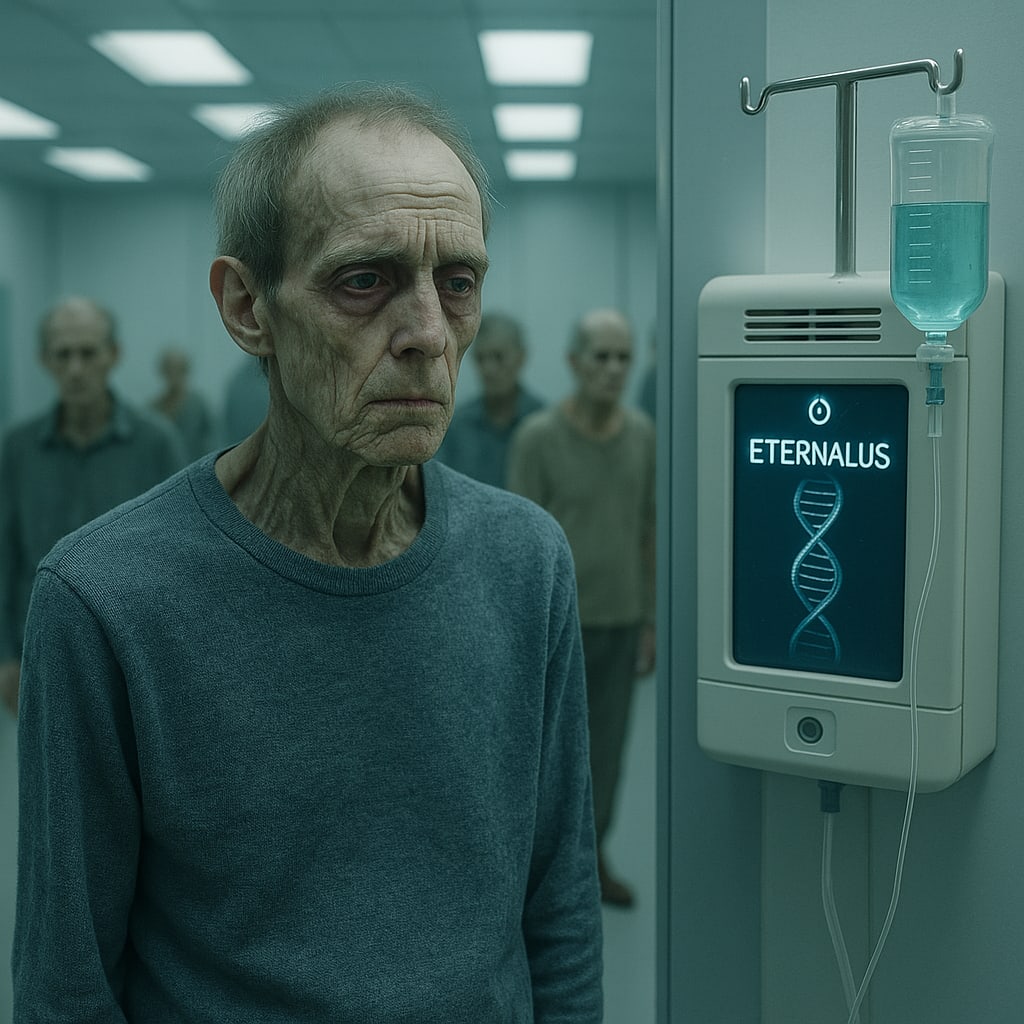
In a world not too far in the future, there was a breakthrough—a technology that promised to extend human life indefinitely. It was called Eternalus, a bio-engineered serum created from the most advanced nanotechnology. It rewrote the rules of biology, replacing the aging process with a sophisticated regeneration system, keeping cells perpetually fresh and functional.
At first, the world celebrated. Governments rolled out the serum as a solution to the rising mortality rate, while citizens rejoiced at the prospect of immortality. The wealthy were the first to embrace Eternalus, ensuring that their legacies would not fade with time. The rich lived for centuries, their influence and power undiminished. Meanwhile, the poor were left to wonder if they’d ever see the same opportunity.
But as years passed, something began to shift. It wasn’t just the societal gap widening—there was something deeper, something unspoken. People had stopped living in the way they used to. With no urgency to accomplish great things in a lifetime, ambition waned. Art became repetitive, business grew stagnant, and even relationships started to lose their depth. People began to live in cycles—decades of familiar faces, echoing the same conversations, the same routines.
And then came the children.
New generations grew up knowing only a world of immortals, and they could not escape the long shadows cast by those who had already lived so many years. The idea of having a purpose or fighting for a future seemed absurd to them. Why strive for anything when time would simply stretch on forever?
Society’s foundations began to crumble. The elderly—those who had lived for centuries—became stagnant, unsure of how to cope with their endless existence. The world’s leaders, those who had been in power for centuries, now faced a disturbing realization: it wasn’t just the death of the old that was needed for society to evolve, but the birth of the new. Without the natural cycle of life and death, the world was slowly suffocating under its own weight.
But even more terrifying was the discovery of the Longevity Virus. A flaw in Eternalus had gone unnoticed for years: it was highly contagious, and it spread through touch, through breath, through shared experiences. As people continued to embrace immortality, it spread like wildfire. Soon, it wasn’t just the rich who were ageless. It was everyone.
The virus began to mutate, becoming stronger, feeding off the very essence of humanity. Those who had taken the serum began to change, becoming something unrecognizable. Their emotions dulled, their minds stretched thinner as they struggled to remember the sense of living. They had all the time in the world, but no reason to spend it. And with each passing day, humanity's connection to the world around them diminished.
In a desperate attempt to reverse the damage, a group of rogue scientists worked on a cure. But the virus had evolved so much that the very concept of death had become foreign to human biology. The idea of mortality no longer existed in their genetic code. To undo the serum would be to undo the very essence of what it meant to be human.
As the world teetered on the brink of an existential collapse, a new question emerged: could humanity truly live forever, or was it that in seeking immortality, they had unknowingly sealed their own fate? What happens when life itself becomes a burden, and there is no end?
The story of Eternalus became a cautionary tale: a reminder that the quest for longevity, while seemingly a gift, was never meant to be part of the human experience. Life and death, intertwined, had given humanity its purpose, its meaning. Without it, everything seemed hollow.
And so, as the last immortal wandered the earth, staring out at a world that had stopped changing, they finally understood. To live forever was not to defy death—it was to surrender to a slow, unyielding decay of what it truly meant to be alive.
About the Creator
A Love Forboding
The chipped stone slope caused unbearable footing. I slid, skirting on my heels. I cast my shield, relinquishing my guard to stay upright. Left with my double-edge and a prayer to the maker, I skated toward my objective. The earthly stubble gave way to solid ground. I found myself restored, a trail of dust in my wake.
By James U. Rizzi4 days ago in Fiction
Killing him slowly
There’s an intruder in my house again. He stumbles through the door, wet carrier bags in hand. He’s bought me offerings. I show my appreciation, letting him caress my beautiful body. He wants to touch me. I rub myself against his legs. He sighs, dropping the bags. He can’t resist touching me. Running his hand slowly down my spine, I arch my back towards his caress, let out a low purr. It’s what we both need.
By N J Delmas7 days ago in Horror



Comments
There are no comments for this story
Be the first to respond and start the conversation.