
Epic dinner conversation
Some conversations are best left when you are older

The protagonist of the tale is Clay, a father figure who is torn between the actual world and the enigmatic magical world. He takes his responsibilities as a parent seriously, always attempting to mentor Eloy and safeguard him from the perils that wait in the shadows. However, Clay's ambiguity regarding his true identity and the ongoing reminder of his imminent death makes his parenting challenges much more difficult. Eloy's rebellious character and the unanswered questions about his family's background present him with constant challenges in his desire to give the youngster a secure and nurturing atmosphere.
Eloy, on the other hand, is an adolescent on the verge of finding himself. He is lured to the magical world and is eager to accept his fate as a lost prince. He does, though, struggle with his human background and his attraction to the mundane world. His yearning for a gun—a symbol of disobedience and a rejection of the laws and prophecies of the magical world—reflects this inner conflict.
Eloy's friend Luke Boone acts as the main character's antagonist. Luke, in contrast to Eloy, who strives to strike a balance between his mortal upbringing and magical blood, enthusiastically embraces the chaotic and unusual. He defies the accepted standards and exhorts Eloy to defy fate, having a long-lasting effect on Eloy's choices.
Mary, the mysterious and magical mother figure, is connected to Eloy and has a close relationship with him. Mary personifies anarchy and freedom, whereas Clay stands for protection and order. Her morphing and erratic behavior capture the spirit of the magical world. She pushes Eloy to reevaluate his views and ambitions while also serving as a source of wisdom and a catalyst for transformation in his life.
The idea of identification is a major element that runs through the entire narrative. Eloy struggles to understand who he is and where he fits into the worlds of magic and mortals. He wonders about the makeup of his family, his parents, and their impending fate. Clay also has identity issues because he is unsure of his background and the reason for his existence.
Another important issue is destiny. Eloy's destiny as a lost prince and his parents' impending fate is predicted in prophecies, which adds to the atmosphere of unpredictability and urgency. Eloy's defiance of fate represents his quest for autonomy and mastery over his own life.
There are many ways to explore parenthood. Clay's commitment to his paternal responsibilities shows how much he cares about and is accountable to Eloy. He struggles to strike the right balance between defending Eloy from harm and giving him the freedom to make his own decisions. Mary shows her unwavering love and support for Eloy by having a maternal instinct and being willing to be bonded with him.
About the Creator
Keep reading
More stories from David C. Connor and writers in Fiction and other communities.
A Single Mother & A Stranger Boy – An Unexpected Love Story
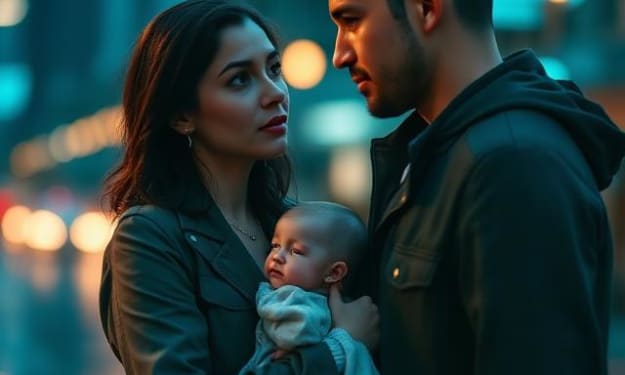
It was raining that evening—the kind of rain that makes everything feel heavier than usual. Ayaan stood under a small café shed, watching the droplets hit the ground like broken memories. He wasn’t waiting for anyone. He never was. Life had taught him to keep moving without expectations. That’s when he saw her. She rushed in, holding her child close to her chest, her hair slightly messy, her face tired—but still… beautiful in a way that didn’t try to impress anyone. “Can we sit here?” she asked softly, pointing to the empty chair beside him. Ayaan nodded. Her son, maybe five years old, clung to her arm. She smiled at him gently, brushing his hair back. “You’re safe, sweetheart.” There was something about her voice… warm, protective, yet hiding a quiet sadness. Minutes passed in silence. Rain poured harder. “You come here often?” Ayaan finally asked. She let out a small laugh. “No… life doesn’t really give me that luxury.” He smiled. “Yeah… I get that.” She looked at him for a moment, studying his face like she was trying to understand something deeper. “I’m Sara,” she said. “Ayaan.” And just like that, something shifted. The next few days, Ayaan kept coming back to that café. Not because he liked the coffee… but because somewhere deep inside, he hoped she would be there again. And she was. Same corner. Same quiet strength. But this time, she smiled first. “You again?” “Maybe I like the rain,” he said. “Or maybe you like coincidences.” “Or maybe… I like conversations that haven’t finished yet.” She looked away, hiding a small smile. Days turned into weeks. Their conversations grew longer. Deeper. He learned she was a single mother. Her husband had left years ago. No explanations. No support. Just silence. “I stopped waiting for him,” she said one evening. “But I think a part of me stopped waiting for everything else too.” Ayaan didn’t say anything. He just listened. Because sometimes, being heard is more powerful than being fixed. One night, the café was closing early. Rain had started again. “Let me drop you home,” Ayaan offered. She hesitated. “I don’t usually trust people easily.” “I’m not ‘people’ anymore, remember?” he smiled. She looked at him… and for the first time, she didn’t say no. Her house was simple. Quiet. Her son had already fallen asleep in the car, and Ayaan carried him inside carefully. “Thank you,” she whispered. Their eyes met. And for a moment… the world outside disappeared. There was something in the air. Something unspoken. She stepped back. “I should… go inside.” “Yeah… you should.” But neither of them moved. Weeks passed. The distance between them slowly faded. Late-night calls turned into long walks. Casual smiles turned into lingering glances. One evening, sitting on a bench under dim streetlights, she finally said it: “You know this isn’t simple, right?” “I never wanted simple.” “I have responsibilities. A child. A past…” “And I’m not scared of any of that.” She looked at him, almost searching for doubt. But there was none. “Why?” she asked softly. Ayaan took a deep breath. “Because when I’m with you… everything feels real. Not perfect. Not easy. But real.” Her eyes filled with emotion. “No one has said that to me in a long time.” That night, something changed. Not suddenly. Not dramatically. But deeply. They didn’t rush into anything. Their connection wasn’t built on just attraction—it was built on understanding. But yes… there was attraction. The kind that makes your heartbeat louder when they’re close. The kind that makes silence feel heavy. One evening, as they stood in her living room, just talking… she stepped closer. “You’re dangerous,” she whispered. “Why?” “Because you make me feel things I promised myself I’d never feel again.” Ayaan didn’t respond. He just looked at her. And that was enough. She didn’t step away this time. Their relationship wasn’t perfect. There were doubts. Fears. Moments when she pulled away, afraid of losing everything again. “People like me don’t get happy endings,” she said once. Ayaan smiled gently. “Then let’s not call it an ending. Let’s just call it… now.” Her son started calling him “Ayaan bhai” at first… then slowly, just “Ayaan.” And somehow, without forcing anything, they became something like a family. Not by name. But by feeling. One rainy evening, just like the first day they met, they sat together at the café. “You know,” she said, “I used to hate the rain.” “Why?” “Because it reminded me of everything I lost.” “And now?” She looked at him… smiling softly. “Now it reminds me of everything I found.” Ayaan leaned back, watching the rain fall. Life hadn’t become easier. But it had become meaningful. And sometimes… that’s more than enough.
By Umar Farooq5 days ago in Fiction
A Historic Declaration
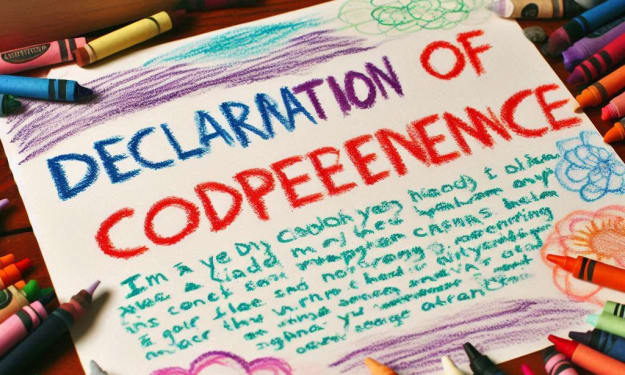
We the People of the Husbands of the United States of America, in Order to form a more perfect Union, and I mean you...with me...establish Justice, insure domestic Tranquility, provide for the common defence, promote the general Welfare, and secure the Blessings of Liberty to ourselves, after Puberty, do ordain and establish this Declaration of Co-Dependence.
By Gerard DiLeo4 days ago in Humans


Comments
There are no comments for this story
Be the first to respond and start the conversation.