
The thunder of “out of beat” chugs intensified as the two locomotives on our train pulled against the brakes. With an exhausted squeal, the train finally ground to a halt, and I closed the throttle on my engine. It was business as usual on the Western Maryland Railway. We stopped here, at the summit of the railroad near the small hamlet of Deal, to do a brake test to ensure our safe descent down the eastern side of Big Savage Mountain.
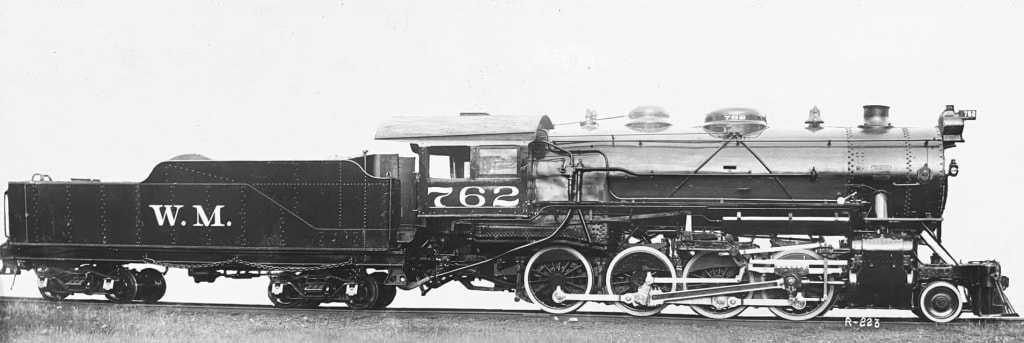
This section of the railroad, what we called the “New Line” had just been put into service a year ago, and as such, I was still getting used to it’s different oddities. Equally young was my engine, number 762, which was built specifically for this mountain. She was a fat boilered, little wheeled behemoth, her air pumps panting and banging away vigorously as I climbed out of the cab to check her running gear. Her oil headlamp high atop the boiler shone dimly into the night, as an army of snowflakes fell lazily through the beam. The shiny gray boiler diffused the illumination from the firebox, and added a mild glow to the otherwise dark area around the engine. The shiny tops of the rails ahead gleamed with anticipation as I took the time to check the wheels, connecting rods, and various mechanisms on the engine. I was the youngest engineer on the “ole WM” at the time, and seeing that the company trusted me with its newest engines, I made it a point to inspect each engine in my charge with a discerning eye at every stop. 760’s chunky appearance and waddling motion she made when she ran earned her the nickname “Elephant”, which I affectionately shortened to “Elly”.
“Ain’t ya gonna perform the brake test, Charlie?” A voice from the cab called. I looked up, and, in the dim lantern light of the cab stood the grimy silhouette of my stoker, young Tommy O’Brien. Tommy had just been qualified to tend to the fires on these new engines, he was an impatient, ambitious 18 year old who was always in a rush.
“I’ll be up in a moment, Tommy.” I said, brushing snow off the collar of my trench coat. The heat radiating off of the boiler took the edge off the still, but frigid, night air.
Just then, I heard what sounded like talking, coming from the rear of the helper engine, number 730. Although the hissing steam, and air pumps made it hard to hear, I then heard the distinct clatter of broken glass. I made for a brisk walk over to the rear of our lash up of engines, and found sitting on the frame of the first car behind the engines, a hobo, covered up in snow. “This ain’t no place for a bum!” I said, calmly but firmly, stepping between the rails. The hobo turned to me, his apparently inebriated state made evident by the haphazard way in which he moved. His snow covered beard and hat made him look more like a snowman. He slurred his speech as he spoke; “I own this road bub… I can ride any train I want, anytime I want.”.
Company policy was clear, no “non-ticketed passengers” were permitted on any trains. “Not tonight pal.” I said, more annoyed than anything.
It had been a long day, and the cold November air only added to my irritation as he spoke again: “Mark my words *hic* mister engine-muh-neer… I have the powers.” He leaned over, putting his hand on my chest, supporting himself, and preventing his fall from the hopper car. “I can start trains, and stop ‘em. I am the wizard of the rails” his voice began to raise, “I am the ki…” He cut off his… speech as I grabbed his collar and pulled him from the car. “What’re ya doin? I own the ‘Westland Maryern’, unhand me you fiend”.
I was beyond annoyed at this point, quickly losing my calm demeanor. His feet stumbled dramatically through the snow as he sailed into a shallow ditch below the tracks. As I walked back towards my engine, I heard a weak cry from the ditch “This is my road, ya hear?! MINE!”.
Shaking my head with disdain, I climbed the gangway into the cab of the engine and began the process of the brake test. The brakemen under my charge inspected the cars while I made certain everything on the locomotive was functioning properly. We only had 50 coal cars on tonight’s train. Not a terribly large train, but still a formidable challenge to bring down the 21 mile long hill ahead of us.
A short fat figure approached my engine from a small shack adjacent to the track, holding a piece of paper. “How ya doin Rob?” I called to him.
“Ya know I fair better in the heat, Charles.” he called up, shivering.
“I should think with that goodly layer of, uh, ‘insulation’ you’d enjoy this weather” I joked.
“Who ya callin insulated?” he snapped back, handing up new orders. We had no railroad signals back then, every movement on the railroad was governed with paperwork.
I read the sheet of paper, and then inquired “Is the Pittsburgh Dispatch running on time tonight?”
“Sure thing, Charles. Yuh should see his lights comin’ through the trees at any moment, at which point yuh are clear to proceed to Frostburg, where yuh must stop and allow the Western Express to pass.”
As we sat on the passing track, talking, like magic, the lights of the Pittsburgh dispatch thundered into view. With a friendly “Toot toot” from the engineer, the train clattered past like a rocket, tossing the fresh snow on the tracks to the side. For a minute or two, the heavy loaded freight cars rattled headlong towards their destinations, and then, with a hurriedly busy look to it, the brightly lit caboose bobbed past and down the tracks into the night. I turned to Tommy, “Can you get her hot and ready, bud?”.
“You bet!” he enthusiastically called back, hopping to his feet, shovel in hand. He took a scoop full of coal, opened the fire doors, and tossed the small black lumps into the fire. The engine seemed anxious to leave, the pressure rising quickly in response to the now ceaseless onslaught of “black diamonds”.
The glow from the fire illuminated the cab more brightly than before. Reflected in the pressure gauges in front of me was my sooty, weathered face. Yes, I was young, but railroading in that day and age was hard, and the unending flow of stressful situations took its toll even on the most prepared and experienced railroaders. Railroading paid alright, but in 1912, it was a dangerous business. Paperwork mistakes, and equipment failures caused serious pileups. The steam locomotives were powerful, but even the most modern could be prone to boiler explosions and running gear failures. I had been railroading for 5 years, and I had my share of near misses. The interaction with the hobo at this point had become a distant memory, when suddenly, I felt a tap on my shoulder.
“We’ve got a good brake application on the train, Chuck.” Said a voice behind me. I spun part way around and asked my brakeman, Phil Dunn if he was ready. The burly, balding figure behind me nodded, and I turned to my fireman, who, without even stopping his skilled and precise shoveling, said “ready to go!”.
I released the brakes, and choked out two toots on the whistle. The engineer on the 730 responded with two toots of his own, and I instinctively tugged on the throttle. Rob called up before disappearing in a bank of steam “Have a safe trip!”.
The two locomotives, hissing and barking, almost leaning forward like a team of mules, laboriously began moving, shooting thick black smoke high into the air, and blowing steam in every direction. As the entire train began to roll, the chugging of the two engines intensified once more, as my trusty Elly clawed her way up the final mile or so to the summit at Big Savage Tunnel. The barks of the 730 in rapid succession sped up dramatically and then fell away as the older engine lost her footing, her wheels spinning frantically, trying to grab the rail again.
Tommy swung his shovel like a machine, feeding the hungry engine, stopping only once to wipe the sweat off his brow. The white flames flashed brighter with every chug the engine made, as if Elly was breathing. The exhaust from the smokestack violently disturbed the tree branches it passed beneath, blowing each collection of snow off the boughs and down to the earth. Elly, too, slipped her wheels for a moment, but as though she was determined, she gripped the rails again.
We spun around one curve, and into the next, coming face to face with the tunnel, and the summit. The large concrete monolith stood agape, as if beckoning us. I called to Tommy, who already had his bandana covering his mouth and nose. I placed mine over my face, and then signaled the rest of the crew, in the helper and in the caboose, with a long and short toot. Hot smoke and steam filled the air as we labored into Big Savage Tunnel, the deafening sounds of the heaving, thrashing engines reverberated off the walls of the tunnel, and in doing so, left our ears ringing as we crawled underneath 3,000 feet of earth.
Tommy took a moment to catch his breath, while I listened intently to the engines. The moment the thunderous exhaust lightened, I put a little bit of brake pressure on the train, and began to close the throttle. Half way through the tunnel was the summit, and we began on the downhill portion of the run to Ridgeley. Car by car, the train crested the hill, and we began to accelerate. Not abnormal at a spot like this, so, I added more brake pressure. I was at 10 pounds now, surely the force of our descent would be retarded by that.
We shot out of the other end of the tunnel, charging downhill, unhindered by the fluffy white snow laying across the tracks. I again added more brake pressure as we glided into the first curve beyond the hill. The wheels of the engines squealed in agony as they ground along the insides of the rails. I was trained by an old engineer… Jim was his name. The one thing that he said to me that always stuck with me was;
…“If at any point you feel as though you cannot control your train, it is your duty, for you as well as the men in your charge, to put the brakes into ‘emergency’ and stop the train”...
As I became more alarmed at the situation, I realized that I was running out of options. What started as a downward descent at 15 miles per hour, was now pushing 30… and the speed was STILL rising. I edged my brake handle closer to the emergency position, and, in a small fit of panic, I threw the train into emergency.
The wheels on the locomotives locked up, sliding and skidding as the icy snow covered rail vibrated under the weight and pressure. Sparks flew from the wheels, and the sudden force of the engines slamming on the brakes caused the cars behind to violently bump into us. Surprisingly, we still would not slow down. I looked behind, the orange glow of the sparks and became startled to find that, the entire moonlit train behind me, all fifty coal laden cars, were free of sparks or brake smoke. Nothing. No brakes.
“Dear God!” I shouted, as the realization hit me square in the face. Over the squeal of the engines trying to hold back thousands of tons coal, I called to the brakeman. “Phil! I got nothin! I can’t get ‘er stopped!”. Elly began to rock violently as we shot into the next curve. Phil’s eyes grew wide. “I don’t know what’s wrong! Our only hope is the handbrakes!”. Phil nodded, his gruff experienced face knew what to do. He would have to leap from rail car to rail car, on a train careening down the mountain at an ever increasing rate of speed, and tie down the hand brakes one at a time. It was a long chance, but it was the only one we had.
The frigid wind stabbed its way into the cab through the forward windows. “Good luck!” I shouted as he disappeared behind me, climbing over the locomotive tender and across the gap to the helper engine. There, he would pick up the other headend brakeman, and together, they would scale the coal cars one by one.
Tommy looked at me. His fiery red hair blew around in the wind, as his worried eyes looked to me for reassurance. “Tommy, keep shoveling, we need steam to keep air pressure on the locomotives, and if we find the problem, to stop the train.” I reached for the whistle cord and blew several short blasts through the night air.
The men in the caboose; the rear end brakeman and the conductor knew what it meant. They put two and two together and started the arduous task of setting the brakes on the rear.
Elly lurched into the next curve, now reaching what I perceived to be 40 miles per hour, on a stretch of track that was rated for 30. Still sliding along the rails, I released the brakes on the engine, lest the locked up wheels bind up and cause us to careen off the rails prematurely. Instead, I threw the reverse lever to the rear, and opened the throttle. Groaning and squealing under protest, the wheels began spinning in reverse, causing the locomotive to vibrate and shudder. The engineer of the helper engine saw what I had done, and attempted to do the same.
The curves on this stretch of railroad were relatively gentle, so with some luck, there was still hope for us. Provided we slowed the train before we reached the horseshoe curve at Woodcock Hollow, or the Helmstetter’s Curve. There was no way at our present rate of speed that it would be possible to traverse those curves, let alone the speed we were quickly gaining. Luckily, curves in railroad tracks cause friction and resistance. Between the curves, the locomotives in reverse, and handbrakes being set, there was still a little ray of hope. I heard the first handbrake apply, a showering tumult of orange and yellow sparks, blazing a path through the night.
The two locomotives trembled and jerked as they slid down the icy rail. Still picking up speed, we shot into a section of straight track. With our speed reaching 60 miles per hour, we’d be at Woodcock Hollow in 7 minutes, or sooner. Back on the hoppers, first Phil and then the assistant Brakeman leaped from the first to the second car. The cars bucked back and forth under the intense forces of what little brakes were applied to the train.
Phil pointed to the next car, “Tie the next one down, I’ll get this one!” He called out as the biting cold wind whistled around them. Standing on the little metal platform at the end of the car, he began to spin the brake wheel. With each turn of the wheel the shower of sparks and squealing grew as the brake shoes tightened against the wheels. He watched the other brakeman carefully as he worked the brakes, taking care to witness his leap to the next car.
He flung himself across the gap, the 10 foot chasm that had nothing at the bottom but certain death. He landed on his side in the snow covered coal pile. Reconstructing himself from the temporarily motionless mass of flesh and bone, he leaped to his feet, and made haste towards the brake wheel. He pulled the wheel as hard as he could, cinders and snow pounding at his backside. His car too added to the brightening cascade. Back on my engine, Tommy, soaked in sweat, his freckled pale face covered in coal dust, shoveled vigorously, as I kept a watchful eye on the track ahead. Dimly illuminated by the headlamp ahead was the portal of Borden tunnel. I swore under my breath, hoping the brakemen on the cars would hear my call as I pulled the whistle cord. Elly’s voice pierced the moonlit night air, shooting a warning towards the men on the tops of the cars.
Knowing exactly what was meant, Phil and his assistant dropped themselves instantly, laying flat against the coal. The icy cold of the snow covered coal was juxtaposed by the hot smoke and steam that clung to the ceiling of the tunnel as we rocketed through. With only inches to spare, the tunnel sailed over us, and then fell away into the night again. The men struggled to their feet again as we continued our headlong rush to oblivion.
Sailing through one curve and into the next, Elly groaned as we approached what I perceived to be 70 miles per hour. Up ahead lay the lights of the Frostburg station. The station agent, who expected the sound of a slowing train, was startled to hear the clattering tempestuous roar of a runaway freight. He threw the door to the station open just in time to see our train lean into the curve beside the platform. He flung his hands in the air in a vain gesture to stop us. I leaped from my seat, and leaned out the cab window, the ground shaking as we thundered past.
“I can’t get ‘er stopped!” I shouted. The current of air knocked his flat cap from his head, and stopping his hands mid-wave, he took a moment to absorb the situation.
“The Western Express!” He shouted to no one in particular as the caboose bobbed past. He ran towards the telegraph inside the station, tapping out a frantic message to the station in Mount Savage. “Extra 760 running away stop. Western Express in danger stop. Try to flag down the express at Lapp stop.”
The message was meant for an old friend of his, Joshua Baker, the station agent in Mount Savage. The small town was served by a competing railroad, the C&P, but this was an emergency. Mr. Baker, a thin, lanky middle aged man, accidentally shoved the contents of his desk to the floor as he started for the door, not even taking the time to grab his coat. Outside was his trim new motorbike. Hopping onto it as a man does into the saddle of a horse, Mr. Baker ripped into the night, and up the slick dirt road towards Lapp. A few miles behind him, he could hear a distant wail, as the runaway whistled in warning over railroad crossings. “Trimble road…” he thought to himself.
Back on the train, I had to make a decision. I could let the locomotive slide in reverse, which would eventually cause the running gear to disintegrate, and derail the train, or, I could put the engine in forward again, and in doing so remove the retarding force provided by the engines. It was like a game of chess. Ultimately, my goal was to keep us on the rails as long as possible, and so, I threw my engine into forward gear. Away we rocketed, jumping in speed instantly. I could no longer tell how fast we were going. Back in those days, steam locomotives did not have speedometers on them. I could only guess, but it seemed as though we were somewhere in the ballpark of 90 miles per hour.
Mr. Baker sped as fast as his bike would let him, knowing the clattering and banging of the runaway was slowly catching up behind him. The whistle echoed through the night again.
He went to make the turn up Sunnyside Road, but the ice and snow caused him to skid off the road. Careening from the bike into a ditch, Mr. Baker crumpled up as he hit a rock. The bike continued on its wayward path, striking a tree before tumbling to a stop. Regaining his composure, Mr. Baker could hear the staccato chug of the uphill Western Express. Rising to his feet with some sort of leg injury, Mr. Baker attempted to sprint up the last stretch of road between him and Lapp. It was a haphazard run, his movements made erratic from the limp he now possessed.
Now passing the town of Mount Savage down below in the valley, our descent into Woodcock Hollow would be just around the bend. I decided once again to assault our speed with a reversal of the wheels. Again, the cars behind slammed into the engines, causing Tommy to lose his balance, and smack into the wall behind him. Dropping the shovel, he clung his head and yelped from the sudden splitting pain. I jumped from my seat, struggling against the aggressive vibration as I hopped over to Tommy. I grabbed his head, and felt what I could see was blood, its own crimson mixing with the orange-red of his hair.
“ Are you okay?” I asked, almost shouting over the tumult of clattering and groaning. He nodded, although probably fighting the pain. I tore my bandana from my collar, and wrapped it around his head. He winced as I tied it in a knot. “You’ll be alright… take a moment…” I said.
It seemed as though our descent began to slow slightly, perhaps backing down to 70 or so, as we ground around the curve into Woodcock Hollow. The braking cars on the front, now 10 in number, must've been making some sort of impact on our speedy adventure. The cars rocked too and fro as they squealed around the curve.
Mr. Baker fell to his knees by the tracks. The Western Express started around the curve, being pulled by the handsome, tall wheeled, engine 204. Baker, realizing he had forgotten a lantern, took his matchbook from his pocket. Pulling his short pork pie hat off, he struck a match, and used his hat as a torch to flag the 204 down. Seeing the flailing blaze in the night, the engineer of the 204 threw the train into emergency, finally getting stopped right next to Mr. Baker. Out of breath, Mr. Baker shouted “Runaway… coming… get into the… side track!” The engineer of the 204 saw the blaze of sparks through the trees on the other side of the hollow, and immediately put his engine in reverse.
“Christ!” he shouted, opening the throttle, the wheels of the 204 spinning in defiance as they backed down to the side track.
Elly slammed into the curve, her left side lifting from the rails as she rounded the bend. The sharp movements threw me over to the right, sending me out the gangway and plummeting towards the rocks below. By some miracle, my hand reached for, and grabbed a handrail, which I clung to for dear life. I swung out and then back towards the engine, slamming into the side of the tender. The concussion of which caused me to lose my grip, my fall continued, but not before the injured Tommy could reach for my arm. He caught me just as Elly’s left wheels slammed back down onto the rails, screaming and wailing, as though in pain. Tommy heaved me back into the cab, he and I sighing in relief as we fell to the dirty, gritty floor.
Using Tommy’s help, I climbed back into the seat. My sigh of relief quickly switched to horror as the headlight and marker lights of the Western Express came into view. I threw the engines into emergency once more. As we left the curve and entered the straightaway, the train picked up speed again, and we could do nothing but watch as we rocketed towards the passenger train, full of sleeping passengers and an unassuming crew.
A half mile away, the reversing Western Express slid to a stop, Mr. Baker jumping on an injured leg from the front of the engine, to line the switch in the other direction. The points clicked over and the 204 thrashed and barked as the engineer opened the throttle as much as he could to avoid disaster. Disaster that was now a quarter mile away. 204 labored into the siding, her engineer swearing inarticulately. Quickly, more detail appeared on the cars of the passenger train as we got closer. We thundered past the 204, and I shielded my face as the rear car of the passenger train displayed itself for sacrifice. With an anticlimactic clang, we clipped the rear of the car, pulling the railing off the observation platform, and trampled over the switch.
We sailed into the next curve, the engine rocking again, trying to leave the rails and end this mayhem. I felt a tap on my shoulder. Phil appeared behind me. “I found the issue!” he shouted over the noise, “Somehow the brake valve got closed between the locomotive and the train! I tried to open the emergency valve, but the air has been bled off!”
“The hobo” I said to myself, realizing that he had sabotaged us. Phil continued “I have the valve open if you want to try to charge the brakes again.” I nodded and took the brake handle, and jammed it into the release position. The sudden lack of retarding force caused our speed to surge again.The air pumps on Elly began to hammer and slam violently, like a volley of cannon fire, or some sick twisted ancient drum ritual. Banga-Banga-Banga-Banga, adding to the vibration causing the engine to convulse, as if she had sudden heart palpitations. Tommy again shoveled with all his might and energy to supply steam to run the pumps. The squealing wheels behind died out one by one as the brake shoes burnt off from the intense heat.
“Where’s the young guy? '' I called to Phil, worried something had happened.
“He’s alright, he had a panic attack, but he's alright. He’s about 15 cars back, still trying to tie brakes.''
”Good” I said. I watched the air brake gauge needle climb slowly as the air pumped up on the train. We had made it around Woodcock Hollow, but I knew we’d never make it around Helmstetter's curve at this speed, which was now pushing 100 miles per hour. I waited in impatient silence as the brake system charged. Like a monster aiming to swallow us whole, Brush tunnel became revealed by the headlight. Another Long and Short toot on the whistle, and we blasted into, through, and out of the tunnel at the highest rate of speed ever achieved by an engine of this type.. And ever achieved on the Western Maryland Railway.
Just under a mile away was the curve, the pumps now racing the speed of the train in their evident haste to save us from disaster. The needle kept rising, as did our speed. More squeals, more groans, more clatters and bangs, hissing and screaming and convulsing.
“Dump it!” cried Tommy.
“Not yet!” I replied.
“Do something!” he retorted.
“Not yet, give it a minute!” I demanded. We began down the straight track leading into the curve, the needle just below the mark that I needed. I reached for the whistle, the pumps beginning to slow, another few short blasts, and I yelled “Brace yourselves”!
I threw 762 into emergency. A rush of air like a shotgun burst from the valve as a cascade of sparks and smoke shot into the night in all directions. Sudden force threw myself, Tommy and Phil forward toward the boiler. I hit my head on the brake gauge, Phil caught himself on the throttle, and Tommy slammed his shoulder into the boiler backhead. We entered the curve.
Elly lurched to the side, once more lifting off the rails sailing headlong down the track on one side. I pulled the whistle cord and held it down in warning to the railroad crossing at the other side of the curve. The screaming wheels, the wailing whistle, the roar of the train behind, it is a sound that I will never forget.
We started into the next straightaway, the entire train clinging to the rails for dear life as it careened around the bend. Not being able to take the intense heat, or pressure anymore, one of the wheels on the Elly derailed. Bouncing over the railroad ties, the rest of the wheels followed suit as Elly smashed and splintered her way down the track. We hung on like we were riding a bull, being flailed about like rag dolls.
Slowly, but aggressively, the bumping and slamming slowed, and the squealing quieted. Elly leaned over to the right, ready to roll over, and then stopped, in a precarious position, hunched over as if she sat down for a rest. I leapt from the cab, kissing the snow covered ground, and thanking Elly for leading us to safety. Tommy threw his shovel down in anger, and Phil collapsed into the seat behind him. I had no idea there was any truth to the old railroad adage… Uphill slow, downhill fast, tonnage first, and safety last.
About the Creator
Keep reading
More stories from writers in Fiction and other communities.
The Path to Salvation
The late autumn evening air filled the monk's lungs, but it wasn't the season that chilled his bones. The heavy-handed presence of evil he had sensed upon entering the woods surrounding this mountain village had not bothered to conceal itself from him.
By Made in DNA7 days ago in Fiction


Comments
There are no comments for this story
Be the first to respond and start the conversation.