

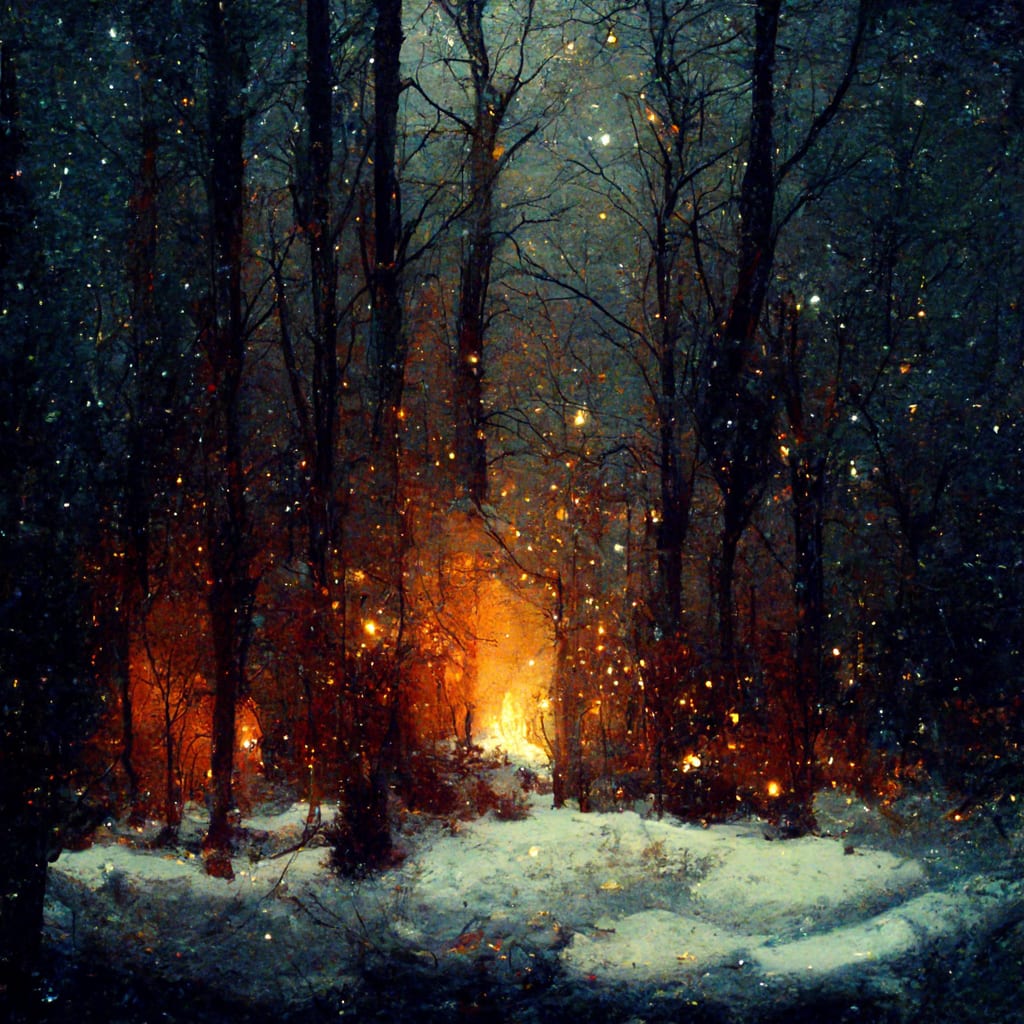
The sky was growing inky in the spaces between the stars. Amarya gazed up, feeling the silhouettes of a tired world around her.
The pines, the coral dogwoods, the stark birches, weathered by the creep of time. The stones, whittled with each year. The peaks above, shrinking day after day, beaten by sun and rain. She, small in the fangs of the forest and maw of the mountains, a tiny giant in the vastness of nature, beneath an even vaster sky.
The last of the sun crept away, and shadows bruised the horizon, leaving footprints across the sky, until the expanse above her melted into a well of emptiness. It seemed darker than dark, and she could smell snow on the breeze.
Amarya dug her talons deeper and let exhaustion saturate her. Her amber eyes closed as she sank into the brush, and focused on the world around her.
The furrows of the earth, soil cold in the quicks of her claws. Her teeth, white slivers in a black mouth. The smell of the mud, something deep and iron-like. Fungi, dampness, dripping decay to her left. The hiss of the trees overhead, the whine of wind through a crevasse. The susurrus of leaves, the ebb of the breeze, the groan of the mountain’s heart far below. It purred and writhed, wrinkled with age, exhausted.
She felt her years, creeping like cobwebs behind her, weaving out the threads of a long life and a longer death. Like the fungi, a mycorrhizal network of strands linked to memory, reaching into the past, interwoven with the lives of people and creatures, so inextricably she had thought they were one.
Now, she had come to the mountains alone, and was waiting for the spark of death to burn up the shadows of life.
The stars shivered, and every moment seemed a lifetime – yet her lifetime no more than a moment. In it, she had tasted love and loyalty and kindness and betrayal. It had been painful, burning like the fire in her belly, and then the pain had gone, and left her with nothing but quiet ash. It crumbled to dust within her, like the dry soil, like the dead leaves, like the mountains themselves.
All must pass. Let me pass too.
The moon ghosted from behind a cloud, spilling light down on the world, making it new and pale. Amarya settled deeper, waiting for sleep. She breathed out, and sensed the grass flatten beneath the caverns of her nostrils. The scarp of her neck arced. The fissures of her feet shifted. One with the mountain, she felt, and one with the mountain she soon would be. Even her bones wouldn’t last long in the face of the world’s turning.
Amarya tasted the restlessness that came with chasing sleep. It lay just beyond her mind, fluttering and teasing. If she could just go a little further, it would slip across her like a glove and claim her, but she couldn’t go, and it wouldn’t come. She drifted on the edge, unable to take the last steps, numb to the passage of time, alive but senseless to the changing of the world.
For a long time, the dragon lay motionless, save for her shallow breathing. Clouds inched in, and snow began to blur the world, whiting out the trees, deadening the sounds, swallowing the stories the forest kept. Tracks disappeared, contours levelled, and thorns grew soft with frozen water. Chilled, the wilds drifted towards slumber.
Yet not everything was asleep.
A noise, like the whine of wind through grass, broke the quiet shell that Amarya had crept into. She drew her snout from the earth, and felt the heaviness of her limbs, stone slabs that cost great effort to move. Her tail was like rock, her head the great trunk of a tree. She had to work to lift it. It was as though the ground had begun to split, and she was slipping into the cracks.
The keening continued, and she struggled with herself, scrabbling for purchase within her own mind. The languor peeled away, and she found herself in the forest once more, entombed in tiredness. Snow pressed upon her back, melting into cold rivulets that pooled between the keels of her scales. Her internal fires were low, almost out.
The wind picked up, juddering through the trees and singing up the mountain paths, and Amarya recoiled from a world that seemed new and sharp and hard. After lingering in the softness of death’s lap, even the mountain that had cradled her had teeth and angles. The great pines towered and the wind began to snarl. Sleep seemed further away than before, harder to reach. She would have to dig deeper to find it.
A new scent came to her, lifted by the breeze. A human, a youngster. Out in the forest, late, in the snow.
Amarya picked herself up and shook the snow from her snout, a sense of discontent finding its way through the weariness. Could she not even die in peace?
Death is rarely so, she thought, as she looked at the trunk of a fallen pine. It had split in a storm, and its broken bark jutted skywards. Its girth was thicker than her tail. Its life had been long, teetering on the brow of a cliff, a giant even among its kind as it stood on a pinnacle above them. Snow drifted into its hollows and flattened the texture of its bark, and moss grew on its underside.
Old enough to die.
The noise came again, thin and impatient in the chilly air, shaking Amarya from her thoughts. Humans were such fast-moving creatures. She tested her weight on her feet and lumbered into the dark, towards the smell and sound.
The child was about a quarter of a mile away, hiding beneath a bush. By the time Amarya reached it, the snow was getting heavier and it was hard to see. The moon had been swallowed in the clouds, and it felt darker than night should feel. The child was crying, and Amarya breathed out, tired. It seemed it was not yet her night to go – though it couldn’t be much longer.
She sank down beside the bush, curling her body around it, and then shook her wings open and spread the left one to tent above the foliage. The snow’s teeth bit the fine webbing, but she settled the digits against the ground to support the canopy’s weight, and rested her head on her talons. After some time, the tears and trembling ceased, and she both heard and felt the child creep closer. A few tentative breaths passed, and small fingers touched her scales.
The hand quivered, and then a second one joined it, stroking back and forth against a patch of scales on her flank. Amarya noted how cold the child’s skin was and sighed quietly, reigniting the flints in her belly. She felt the embers stir inside and drew a deeper breath, feeding them with oxygen until they swelled, and the warmth stole through her. The hands pressed tighter, and then she felt softer skin and the tickle of hair. A few more strokes, and the child sank down somewhere beside her, pressing against her still.
Amarya coiled her tail in and propped her nose upon it, closing her eyes. The warmth inside her was strangely comforting, a half-forgotten glow, a little vein of lava in an extinct volcano.
Perhaps it is fitting, to flare a little before I go out. Tomorrow, the child can go home, and the ashes can come at last.
Amarya slept through some of the cold beats of the night, and woke to watch the dawn. It was so slow it was almost unnoticeable, just that the dark pressed less and less, a skein of blackness unravelling and peeling away. The only indication of the rising sun was a brightening in the clouds, which threatened more snow. Yellow, uneasy light steeped through the trees. Leftover snow percolated through the pines, dropping from branch to branch, turning to water before it struck the ground.
When the light was bright enough to see, Amarya shook the slush from her spread wing and pulled it against the warmth of her flank. She snaked her head around, and observed the child curled against her hip, in the hollow between leg and body. A girl, she thought, with dark curls and black eyes, a white face. She wore furs and soft boots, and the tip of her nose was pink.
“What’s your name, child?” she asked, and her voice sounded strange to her ears, as though it had got lost in the mountain passes. There was silence, save the thud of melting snow.
“Jika,” the girl said at last. “Go home?”
Amarya waited for the girl to move, and then heaved herself up, her body juddering as she stretched sleepiness from her limbs. To her surprise, she felt the small hand again, a thumb tracing over her scales. The black eyes looked at her, frightened and curious.
“The village in the foothills?” she asked, and the girl nodded, though Amarya couldn’t tell if she really knew. She was too young, probably, to identify her home by anything but sight. Human hatchlings grew slowly. Still, it was likely true. There were no other human habitations nearby.
She sat and assessed the situation, watching the girl touch her scales. Her fingers were light and small, brushing along the keel and the hollows. After a moment, the child backed away and began to pluck berries from the nearest bush to eat.
Night had passed. Amarya could leave the child to find her own way, and return to the peaks – settle back down and try to slip into the cradle of sleep again. Perhaps other humans would be out looking by now. On the other hand, the girl was small and more snow threatened, and she might die if they didn’t find her in a few hours. Human hatchlings were fragile.
It would not take long to return the child to her village, and then she could settle without being disturbed. A last task for the people before sleep. It seemed somehow fitting to preserve a young life when she was ready for hers to end.
“Come, then,” she said. A doubtful look – and not unfairly so, she realised. To climb onto her back would have been a challenge for an adult; she stood around the height of a young tree, and though her scales were ridged, they offered no handholds to speak of.
She bent her neck and manoeuvred until her snout was positioned above the child’s head. The child ducked when her jaws opened, but that made it easier to snag the scruff of her furs and lift her. Amarya moved slowly so she wouldn’t tear the fabric or nauseate the little one. She curved her neck around until she could reach to position the child on her back, between her dorsal scutes.
“Take off your cloak and put it under you,” she said. “My scales are sharp.”
The girl blinked, but moved to obey, her hands clumsy with cold. Once the furs were folded into a seat, she settled into it.
“You will need to hold on tightly, Jika. I will fly gently. We will stay low, as the air is cold up high.”
A nod was all she got in response. Amarya gazed at her for a moment. It was some time since she had last seen a human, and she had forgotten the sleekness, the delicacy, their slightness. A brief creature. Not like the deer, leggy and leaping, nor like the wolf, its stocky body low to the ground and its ears pricked. Clumsy, but skilled with their hands in a way her mind could not begin to unpick, and clever as dragons in their intellect. Worth a few hours of effort to preserve.
A flake drifted in front of her eyes, jogging her to the present again. Amarya shook out her wings and heard the child’s squeak of protest – but it felt good. The breeze caught in them, fluttered beneath them, teasing her with the lure of flight. In the ashes of her tiredness, she felt a faint hunger for the skies.
There was a cliff nearby that would give them a gentler launch than if she ran. Amarya was not sure the child would keep her grip, nor that she would catch her if she fell, so she picked her spot with care. Free from trees, it jutted into space, and in three bounds, she had flung herself from it, thrusting her wings downwards to provide an upbeat. The shriek from her back was almost lost in the roar of air, but she felt the fingers tighten and cling, and the heaviness of her passenger still upon her.
For a few moments, they fell. The world rushed and tore, and then her wings caught up with her weight. She beat them hard, feeling the burn, the tingle like kindling. The muscles began to sear, struggling to lift her, and then they pulled free from the lee of the trees, and a gust took them. It filled the membranes and lifted her, relieving the strain on weary muscles.
The eddies of air throbbed and hummed against her skin, a pleasure like no other, and she shut her eyes for a moment, silently welcoming the sky as it welcomed her. Rivulets and dips, breaths and sighs pulled her up and down, and she began to glide instead. Intense pleasure flooded her at the smoothness and weightlessness, the safety she found in her wings and flight. She almost forgot the small, rigid creature clinging to her back. Her world became full of colour, a different hue describing every current and twist of the air.
It made her sorry, in a way. She would not feel this again – the lift, drifting like a seed, a speck in an unfathomable horizon. This would be her last flight, save the return journey, which would be tiring and hard uphill. The last time she’d coast down the great, steep cliffs, and watch the trees quiver like a field of clover below.
It was fortunate that humans had hands with which to grip, she thought as she neared the edge of the forest, and became mindful of her task once more. Had she been carrying a fawn back to its mother, it would have fallen on the landing.
“Hold tighter, Jika,” she called over the wind. The glide was gentle, but the landing would be bumpy. Her feet snagged on the last oak on the edge of the forest, jolting her to one side. She had to snap her right wing up to compensate, veering them back the other way. The ground rushed up below, a flurry too fast to comprehend, and she felt the jerk as her first foot touched, then the second. Her wings yanked uncomfortably, still moving with the air, while her feet struck the ground.
She had to gallop, and she almost stumbled down onto her snout. Her legs, unused to the work, struggled for a few crucial seconds. Jolting and jerking, they came down, and she managed to slow, and then stop. The dizzying world settled back into bushes and scrub and rocks, and she found herself breathing hard, her feet stinging from the impact, her wings clumsily splayed on either side.
The fingers and thighs were still there, gripping like vices. Amarya drew a breath and looked around. The world seemed strangely open after so long in the forest. It stretched out in every direction, somehow bigger even than the great mountains. The clouds were clearing, and light spilled out.
Amarya pulled her crumpled wings straight, and folded them against her body as she looked back at the mountain. Soon, the small weight would be gone from her back, and she would return to the cold hollow there. For now, she began to walk towards the human village. The child was still silent on her back, but she could feel the blood thrumming through her, and hear her panting. It felt strange to be near a creature so brimming with life, when her own heart was slow and tired and ready to stop.
“Go home?” Jika asked.
“Yes, child, time to go home.” She began to walk, rediscovering how heavy her body felt. The bulk of her limbs, compared with the twigs of the child she carried. A strange dissonance to die with.
The village stood on the curve of the river, a cluster of huts and tents, just beyond the crest of the hill. It had stood there all of Amarya’s life, but the faces had changed, and she knew no one. She was glad. It would make it easier to withdraw.
As she walked, the child began to stroke her scales, her fingers scudding across them. The sun fell on them and warmed them both, a different warmth from the glow within Amarya. It felt pleasant after the forest’s cool gloom. The world was too bright, too wakeful, but she lifted her head and half-lidded her eyes, enjoying the rays.
They reached the crest and Amarya looked down into the village – or what had been a village. Now, it was desolate. A smouldering wreck, with whorls of steam rising where snow had fallen on sparks. Nothing stirred in the hollow below them. The wet wood sizzled, and tatters of cloth blew smoke into the wind.
Jika was silent, but rigid. Her fingers became hard on Amarya’s scales; her thighs squeezed.
Wind moaned quietly as it curled around the lip of ground that sheltered the village’s remnants. Amarya walked around, and down. The ground grew hot beneath her toes, and became softer as she stepped into ash. Sparks blistered around her.
She stopped a few paces into the village, at a loss. No people were here. No parents to pass her burden to. No sign of where they had fled to, or if they had fled at all. Any scent that might have helped her was gone in the monochrome of smoke.
What had been was over, and she carried the last remnant of it on her back in the shape of a small, stiff child.
“Do you know what happened?” she asked, wondering if the child’s strange appearance in her forest could relate to the village’s destruction. Her question was met with silence, and then the fingers withdrew and she heard breath catching and tears coming.
Amarya turned to leave, and Jika shrieked. The noise was painfully loud, and the dragon recoiled, listening to its echo split the air twice before it faded. For some minutes, nothing more came, save the breathless choking sounds from her back. She did not look round, but stood motionless in the ash and snow.
The fingers clasped her dorsal plates again, and she became aware of how small they were. She could scarcely feel them, even when they grew tight. She looked up at the mountain they had flown from, at the velvet trees waiting to cloak her in oblivion, and listened to the soft, catching breaths behind her. After a few moments more, Amarya sank onto her haunches, and then lay down in the ash. It was searing beneath her scales, and she was relieved that Jika did not try to get down, but stayed on her back, protected from the heat.
Amarya rested her head on her claws and listened to the child cry. At some stage, the child’s cheek came to rest against the scute she was holding, and Amarya felt the wetness there. Gradually, the heat beneath her softened, and the hollow grew colder as more snow began to fall. The ground hissed here and there where the snow met dying sparks, and snuffed them out.
The dragon watched, still listening to Jika’s grief as the afternoon waned. Seeing the sparks die interested her. Some vanished in a blink, while others faded and flickered, then flared and faded again. Some rekindled and burned brightly when they caught upon stray fabric or straw. A gust of wind swept through seemingly dark, dead wood, and sent a flurry of embers dancing into the sky. A few settled and blinked up fresh flames. Others went out in the air, or fell into the snow and vanished.
As the evening drew in, Amarya turned her eyes towards the mountains. The trees shifted and swayed, their calls too faint for her to hear.
Instead, she lay still and quiet, listening to Jika’s heartbeat. The child had also grown still, and was hunched against her. When Amarya lifted her head to look around, she found the girl’s eyes were closed and her mouth was open, her hair tousled across a grubby, damp face.
The question lay in what to do now. She could choose this as her new resting place. It seemed fitting enough. The girl could join her, if she liked, and they would sleep in the ash together. Perhaps the girl’s parents lay here too, snuffed out more quickly, but just as completely. There were so many lights in the world. What did it matter if two went out?
She was young, though, the dragon remembered. Perhaps not ready for death. There was the green quickness of a sapling in her – a will and thirst to live, in spite of sorrow.
Amarya could take her further, leave her with another tribe. A few days’ journey would make little difference to her own weariness, and rest would still come for her at the end. Other humans would care for her; she knew they had an instinct for such things.
She could put her in the care of beasts, allow the bears to raise her, or give her to the wolves. Humans were poorly suited to the forest, with skin that tore and blindness in the dark, but some survived – just as some fawns, some bear cubs, some nestlings died. There was no great sorrow in such things. Perhaps, if she lived, the girl would form her own tribe someday. Amarya would be gone long before the tents were rebuilt and the homes repaired, but that didn’t mean it was senseless.
She looked at the burnt post that rested beneath one of her forelegs. It was a post she knew, and a tree she had known before that. A strong, fat tree, now charred and crumbling beneath her. What did such things matter?
The child stirred, and Amarya shifted. She could smell the forest, feel it dripping and buzzing as it waited to claim her. A strange sense of anxiousness crept over her, for which she could find no source. It was odd to feel anything, beyond observing the sensations her body brought to her. She had thought such things long deadened by time and repetition.
Above, the moon found the sky, and hung as though waiting to be plucked. Amarya watched it, and wondered if it felt old and tired and finished. Not so – the moon was needed, a light ever welcomed when darkness fell. So many lost souls guided by it. Necessary as the rain and the sun, it would never be parched for rest; its purpose ran deep in the veins of the world.
On her back, Jika shifted and snuffled. Amarya put her head back on her feet and thought. Her body felt less heavy than it had before. The click and purr that came from her internal fires felt stronger, sharper. With dusk came alertness, a clarity that had long ago slipped away. Perhaps she would take the child north, find her some kin. Then she could return and fade. There was no urgency, after all.
She did not sleep that night, but lay and watched the world. Flakes fell at times, and stars scintillated. The ashes stirred and curled. Her blood moved. The clouds parted and formed. Beyond sight, creatures rustled and snuffled. The air chilled and grew still and stiff in the hour before dawn, and the sunrise came quickly.
She knew the child had woken only because the hands began to stroke at her scales, running back and forth as though seeking comfort. It seemed strange; she was so large and foreign a creature. Her scales were not a human’s soft skin; they were tough and rock-like, pitted with rain. Her warmth came from fire, not food. She was as far from the girl’s humans as a creature could be.
Still, if it comforted her, let her have that. Amarya found the sensation odd, but not unpleasant. She would take the girl south.
“Come, child,” she said, her voice splitting open the quiet of the graves. “I will find you another tribe.” She rose, and dust rolled from her flanks, stirred up by the movement of her calves, pulled into the space left by her belly.
The palms continued to work at her scales, as though playing with water. She could feel the cheek resting just above them, and could see the serious face in her mind, though she did not look round as she spoke.
“Have you any other family?”
Jika said nothing. Amarya waited, watching the wind tug at the grass beyond their burnt circle. There was little sound beyond the child’s breathing. After some time, the dragon turned her head.
“Jika?”
Jika’s eyes were cast down, gazing at her hands on Amarya’s scales. Her skin was white against the bistre. Her knuckles looked like crags, seen from overhead. Her tendons were contoured ridges of hills. Humans were so different from other creatures, and yet Amarya could see nature in her too.
She blew warm air from her nose, and Jika half-nodded.
A sense of relief came to her – if the girl could tell her, this was a better solution than any she had hoped for.
“Where? I will take you.”
“Here.”
Amarya was quiet while she assessed the word, teasing out the child’s meaning. Did she seek skeletons in the ash, not understanding death? She was young enough. Did she mean another mountain tribe? Did she know her parents had fled and survived the fire?
There went her hand again, soft and kneading, perhaps a little desperate in its touch. No; she understood what had happened. Amarya waited for her to speak again, but she didn’t.
“I am not your family, child,” she said at last. “I am old, and tired.”
The hand did not stop. They sat for a while, both looking out towards the mountains they had come from, the high peaks and washes of green.
“My feeling for the world is gone.” Amarya tried to think how to explain. “Like the sparks. When you are as old as I am, they go out.”
Her passenger was silent, and then Amarya felt the child lean to the side. She twisted around to steady her before she fell, but found that the little one was peering down at the ground beneath them, where Amarya had been lying. Amarya looked at the ashes, and then gave a small huff of amusement. Beneath her, protected from the snow and warmed by her body, a few sparks lingered, bright in the dust.
She looked at the forest, and then back at the child. The anxiety returned, with surprising keenness. She rustled her wings and tilted her head. “I am weary,” she said, but found it less true than before. Where grey had filled her, now there was mingled gold, tipping like honey through her veins. Where she had been heavy, the winds had restored lightness. The child’s fingers, strangely soft on her scales, brought back purpose. In the ashes, the ground grew fertile. She was still tired, but she could feel the stinging of usefulness, and with it a renewed voracity for life.
Jika was still silent, her stubby fingers pressing apprehensively.
“Well.” Amarya shook more dust from her scales, and walked to the edge of the ashes. “Perhaps just for today, child. I know a place where a spring leaps from the heart of the mountain, where the water is so cold it makes you breathless with living. If you can hold on tightly, we’ll go.”
About the Creator
Keep reading
More stories from Jo Lavender and writers in Fiction and other communities.
Mendacious
- If you are a dreamer, come in, - Lucy Parvenu sat quite still, her eyes closed. She was holding a book, running her thumb up its spine. Embossed paper, smooth as candle wax. Ribbons of letters wormed across the cover. She trailed a finger over them, exploring the ridges and frowns of the title.
By Jo Lavender2 years ago in Fiction
The First Rainbow Baby
Pitter-patter, pitter-patter. The rain fell in rhythmic splatters, slowly slowing, but still constant. Mira rolled onto her side pulling the blanket tight against her ears, but still she could hear chitter-chatter and scurrying feet of the creatures that refused to sleep in the lower decks.
By A. J. Schoenfelda day ago in Fiction
The Night the Sky Burned
The desert wind howled across the Middle East as the sun dipped below the horizon. In the distance, the lights of cities flickered like fragile stars—Tehran, Tel Aviv, and distant American bases scattered across the region. The world held its breath.
By Abubakar220a day ago in Fiction
The Forsyth House Fire
Since 1851, Forsyth House has stood on the corner of Union Street and Gordon Street in the heart of Glasgow. Its iconic, or was... because on Sunday 8th of March, 2026, a fire broke out in a small, seemingly un-named shop in the building and tore all that history down. As I write, the rubble is still unsettled and the street is still blocked off. Central Station is quiet on the upper level, and around 30 small businesses have quite literally gone up in smoke.
By S. A. Crawforda day ago in The Swamp


Comments (1)
Congratulations and well done for winning!