
"Echoes of Tomorrow
In 2025, a world on the brink of ecological collapse finds hope in unexpected alliances.

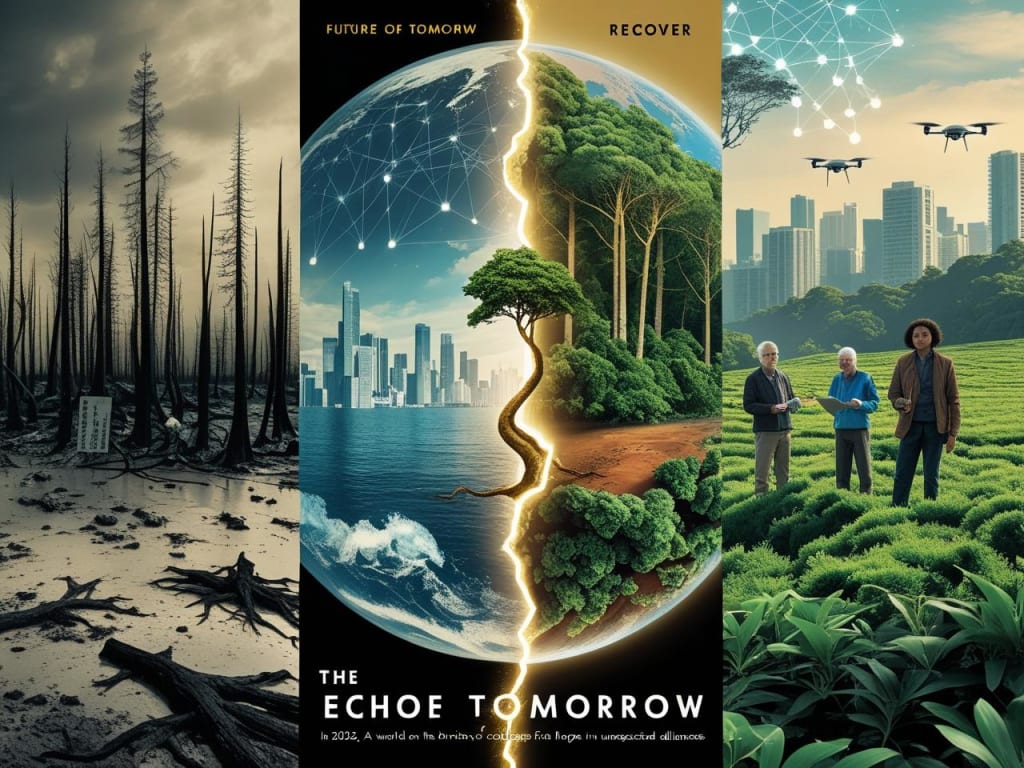
In the year 2025, the world stood at a precipice. Climate change had escalated to a point where once-thriving ecosystems were now barren deserts, and coastal cities had become submerged relics of a bygone era. Yet, amid this environmental chaos, a glimmer of hope emerged from an unexpected source.
In the heart of what was once the Amazon Rainforest, now a vast expanse of scorched earth, a group of scientists and indigenous leaders gathered. They were not there to mourn the loss but to plan the revival. Using advanced biotechnology and traditional ecological knowledge, they had developed a method to regenerate the soil and reintroduce native plant species. Their goal was ambitious: to restore the rainforest to its former glory within a decade.
Meanwhile, in the bustling metropolis of New York City, a tech startup had unveiled a revolutionary artificial intelligence system capable of predicting climate patterns with unprecedented accuracy. This AI, named "Gaia," was designed to assist governments and organizations in making informed decisions about disaster preparedness and resource allocation. However, its creators soon realized that Gaia's true potential lay not just in prediction but in prevention. By analyzing vast amounts of environmental data, Gaia identified key areas where immediate intervention could halt or even reverse ecological damage.
Across the globe, in the arid landscapes of Sub-Saharan Africa, a network of solar-powered desalination plants had been established. These plants provided clean drinking water to millions of people who had previously relied on contaminated sources. The success of this initiative sparked a wave of similar projects in other drought-stricken regions, demonstrating that sustainable solutions were not only possible but also scalable.
As these isolated efforts began to gain momentum, a global movement took shape. People from all walks of life—scientists, activists, farmers, and everyday citizens—united under the banner of "Tomorrow's Earth." Their mission was clear: to combat climate change through innovation, collaboration, and respect for the planet's natural systems.
The movement's impact was profound. Governments, once slow to act, now implemented policies that prioritized environmental sustainability. Industries shifted towards renewable energy sources, and conservation efforts flourished. The world, though still facing challenges, had found a path forward.
In the years that followed, the Amazon Rainforest began to show signs of recovery. The once-dying coral reefs began to regenerate, and endangered species returned to their habitats. The success of these initiatives proved that, even in the face of overwhelming adversity, humanity possessed the ingenuity and determination to heal the planet.
The story of 2025 became a testament to the power of collective action and the belief that, together, people could shape a future where both humanity and the Earth could thrive.
About the Creator
A System That Isn’t Working Challenge Winners
Systems promise order. They organize behavior, distribute opportunity, and suggest that if everyone follows the rules, things will work. The entries in A System That Isn’t Working look closely at what happens when that promise begins to slip.
By Vocal Curation Teama day ago in Resources




Comments
There are no comments for this story
Be the first to respond and start the conversation.