

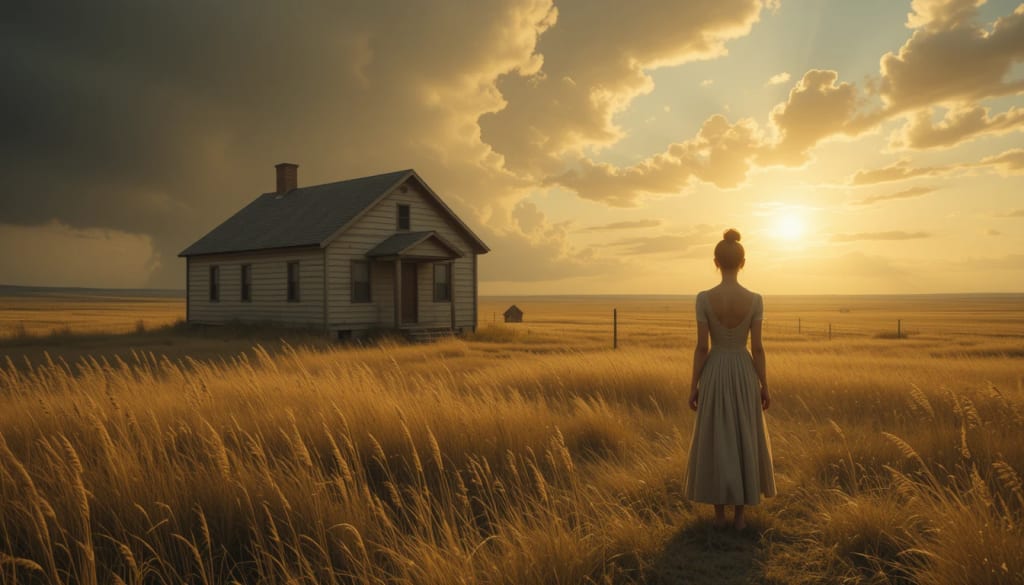
In the windswept town of Plainsview, Nebraska, where golden fields stretch endlessly under a wide sky, a poet named Elara Wren lives in a modest clapboard house. Her verses, once simple odes to the land, begin to weave a chilling tapestry of the future—predicting storms, accidents, and even deaths with uncanny accuracy. As the townsfolk turn to her for guidance, Elara grapples with the weight of her gift. Should she embrace this strange power, becoming a beacon for her community, or silence it to reclaim her peace? Her journey through the plains reveals the beauty of poetry, the mystery of foresight, and the moral dilemmas of knowing too much.
A Poet’s Awakening
Elara, 34, has always been Plainsview’s quiet dreamer. By day, she works at the local library, her fingers stained with ink from late-night writing. Her poems, published in small literary journals, capture the rhythm of rural life—the creak of a barn door, the whisper of wheat in the wind. But in the spring of 2024, something shifts. She writes a poem titled Storm’s Lament, describing a tornado that uproots the town’s oldest oak. Two weeks later, a twister tears through Plainsview, splintering the very tree she described.
The townsfolk take notice. At first, they call it coincidence, but Elara’s next poem, The Red Truck’s Fall, predicts a fatal crash involving a farmer’s pickup. When the accident happens exactly as written, whispers turn to awe. “She’s a seer,” they say, crowding her doorstep with requests. “Will my harvest fail?” “Is my son safe?” Elara, introverted and unassuming, is overwhelmed. She never asked for this power, and its origins remain a mystery—part intuition, part something otherworldly.
The Science of Premonition
Elara’s gift, though fictional, touches on real psychological phenomena. Premonitions, often dismissed as superstition, have been studied in parapsychology. Dr. Dean Radin, a researcher at the Institute of Noetic Sciences, suggests that the human mind may tap into a collective unconscious, sensing patterns before they manifest. A 2011 study in the Journal of Personality and Social Psychology found that participants could predict random events at a rate slightly above chance, hinting at a latent intuitive ability. Elara’s poems might amplify this instinct, her creativity acting as a conduit for subconscious insights.
Her ability also mirrors the concept of “thin-slicing,” where the brain makes rapid judgments based on minimal data. Psychologist Malcolm Gladwell describes this in Blink, noting how experts—like a farmer sensing a storm—process subtle cues unconsciously. Elara’s deep connection to Plainsview, its people, and its rhythms could heighten her sensitivity, her poetry translating these cues into prophecy. Yet, this gift comes with a shadow: the burden of knowing.
The Town’s Reliance
Plainsview, a town of 800, is no stranger to hardship. Droughts, economic struggles, and the slow bleed of youth to cities have left its people resilient but weary. Elara’s predictions offer hope—a chance to prepare for what’s coming. When her poem The River’s Rage foretells a flood, the town boards up windows and moves livestock to higher ground, saving homes and livelihoods. Gratitude pours in—handwritten notes, baskets of apples, a quilt stitched with her words. “You’re our guardian,” says Martha, the town’s matriarch, her eyes brimming with tears.
But the role takes its toll. Elara’s once-joyful writing becomes a chore, each line a potential harbinger of doom. She dreams of disasters she can’t prevent, waking with a racing heart. Her latest poem, The Fire at Dawn, predicts a blaze at the grain silo, a cornerstone of the town’s economy. She warns the mayor, who organizes a fire watch, averting disaster. Yet, the pressure mounts. “What’s next?” they ask, their voices a chorus of need. Elara feels less like a poet and more like a prophet, her art no longer her own.
The Moral Dilemma
Elara’s gift raises profound ethical questions. If you can see the future, are you obligated to act? Philosophers like Immanuel Kant argue that moral duty compels us to help others, even at personal cost. But Elara’s foresight isn’t perfect—some predictions, like a child’s illness, are too vague to act on, leaving her wracked with guilt when they come true. She wonders if her warnings create a self-fulfilling prophecy, as the town’s hyper-vigilance might amplify small events into crises.
The psychological strain echoes real-world experiences of those in high-stakes roles. A 2019 study in The Lancet found that clairvoyants and mediums often report anxiety and depression, overwhelmed by their perceived responsibility. Elara’s isolation grows as friends treat her more like an oracle than a person. Her only confidant, a childhood friend named Caleb, urges her to stop. “You’re losing yourself,” he says, his voice soft but firm. Elara knows he’s right, but the town’s reliance weighs heavily.
The Cultural Power of Poetry
Elara’s story also celebrates poetry’s transformative power. In rural communities like Plainsview, art often binds people together, giving voice to shared struggles. Historically, poets like Walt Whitman and Robert Frost captured the American spirit, their words a mirror to the land and its people. Elara’s verses, with their vivid imagery of the plains, do the same—until they become something more.
Poetry has long been linked to prophecy. In ancient Greece, the Oracle of Delphi spoke in verse, her cryptic predictions shaping destinies. The Romantic poets, like William Blake, saw themselves as visionaries, their work touching the divine. Elara’s gift places her in this lineage, her words a bridge between the mundane and the mystical. Yet, this connection comes at a cost, as her art—once a source of solace—becomes a burden.
The Turning Point
The breaking point comes in the fall of 2025. Elara writes The Child’s Cry, a poem so vivid it chills her: a girl will drown in the creek during a harvest festival. She recognizes the child as Lily, Martha’s granddaughter, a bright 6-year-old with a gap-toothed smile. Elara hesitates to share the poem, fearing panic, but guilt drives her to warn Martha. The festival is canceled, and Lily stays home, safe. The town hails Elara as a savior, but she feels hollow. She
About the Creator
Shohel Rana
As a professional article writer for Vocal Media, I craft engaging, high-quality content tailored to diverse audiences. My expertise ensures well-researched, compelling articles that inform, inspire, and captivate readers effectively.
Keep reading
More stories from Shohel Rana and writers in Fiction and other communities.
I Never Felt Like a Hero
For 25 years, Jack Ramsey fought fires in the heart of Chicago, pulling families from burning buildings and earning medals for bravery. But to Jack, those medals felt like anchors, dragging him into a sea of self-doubt. Now retired at 58, he’s haunted by the one life he couldn’t save—a young girl named Clara, lost in a tenement blaze 10 years ago. When a new disaster strikes his city, Jack is forced to confront his impostor syndrome, seeking redemption in the flames that once defined him. His journey reveals the hidden toll of heroism, the weight of guilt, and the power of second chances.
By Shohel Rana8 months ago in Fiction
How to Succeed at the Benson Directory®
Congratulations and welcome to the Benson Directory® employee #22391! As our newest call handler, you will have the privilege of speaking with dozens of unique and interesting people on a daily basis as well as the opportunity to earn bonuses for high performance. Contained within this handbook you will find a set of ease to follow instructions designed to help you settle in to your new role and begin paving the way to success.
By S. A. Crawford4 days ago in Fiction




Comments
There are no comments for this story
Be the first to respond and start the conversation.