
"Whenever you are buying a used car from a person, there are two things you need to pay the most attention to. The headliner and the trunk. People that take care of their cars, that really love their cars and care about them, always keep the headliner and trunk clean, and in good condition, those who don't, don't. If I see a beat up, dirty headliner or trunk, I walk away." Donnie paused for a moment, furrowed his brow, obviously deep in concentration then continued. "And, oh yeah, don't forget pet hair. If you see any pet hair, it's not necessarily an instant walk away, but you better believe I am knocking the price down by 5-10% off of whatever I was already thinking about offering." Thomas thought about what he had just heard, and it seemed to make a lot of sense. Then again, anytime Donnie said anything it seemed to make a lot of sense. He spoke with an air of authority about any topic, and for both Thomas, and just about everyone else, it made it very hard to question the correctness of anything Donnie ever said about anything. The fact that Donnie had two Ph.D.'s in the biological sciences added a ton of credibility. It was a classic case of authority bias, one of Donnie's favorite cognitive biases, and, one, he never failed to use to his advantage.
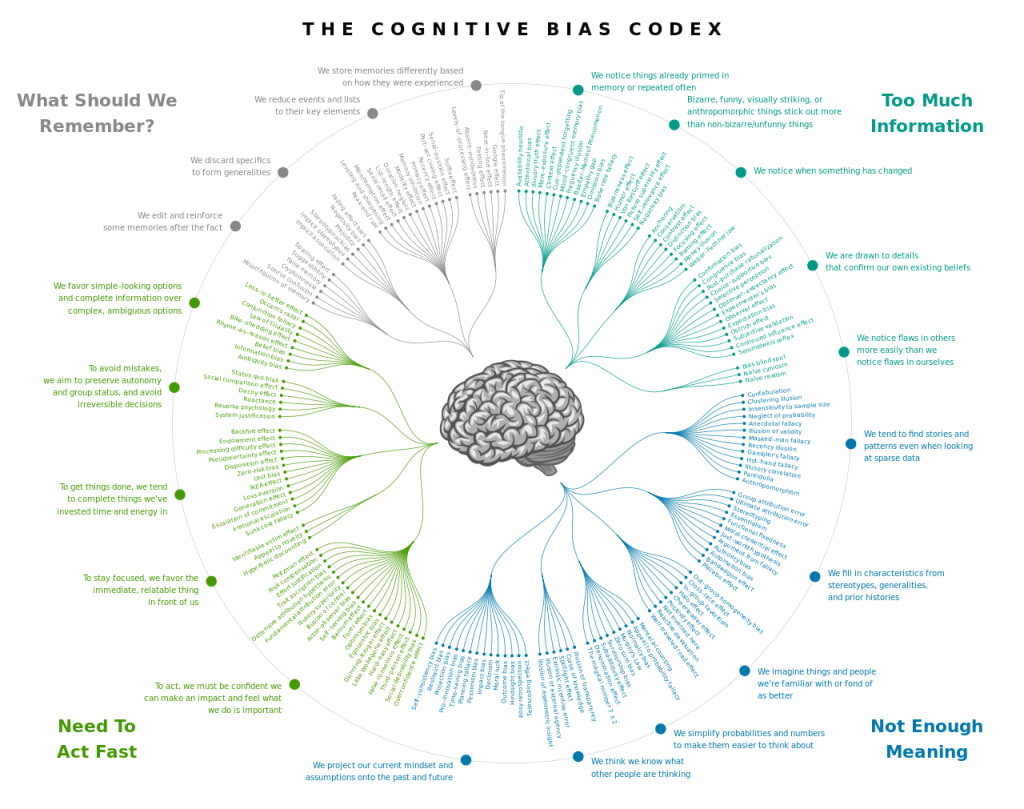
Donnie was a disciple and apostle for the church of cognitive biases. In fact, the very first thing Donnie ever said to Thomas, only moments after meeting him for the very first time and introducing himself, was "You can't help, or, when necessary hurt, yourself or other people, if you do not understand cognitive biases. You must study them, committ them to memory, come to know them like the back of your hand, ruthlessly seek them out in yourself and others, and, when found, do everything in your power to eliminate them, or use them to your advantage." Back then Thomas only had a vague idea of what a cognitive bias even was and dismissed Donnie as a raving lunatic, though there was something about him and the way he spoke with such authority and conviction that eventually drew him into his small circle of friends. Donnie had taken his study of cognitive biases to a level well beyond what even the most dedicated psychologist or behavioral scientist ever had. At all times he carried with him a well worn and heavily anotated copy of the cognitive bias codex. The codex itself is essentially a visual representation of all 250 plus known cognitive biases. Donnie had modified the codex with his own system of notes and observations which he had compiled into a several inches thick notebook. Thomas had never seen Donnie without that notebook and imagined that he probably slept with it under his pillow at night, though he never did work up the guts to ask Donnie that. At various times he had called the codex, "The Bible", the "The keys to humanity", "The tree of human understanding", and "Wittgenstein's wardrobe". That last one Thomas had not even begun to understand. Then again, nobody likely could understand, as Donnie also happened to be one of the foremost (non-academic) scholars of the great logician/philosopher of mind and language, Ludwig Wittgenstein, or so he liked to say. And, as usual, Thomas and just about everybody else believed him when he said it. His writings on Wittgenstein were strikingly original and thought provoking, but Thomas was in no position to judge exactly how other Wittgenstein scholars might view them. However, he was generally inclined to give Donnie the benefit of the doubt no matter what he said because, unlike most other intellectuals he had ever known, Donnie was almost always right, almost. What Thomas genuinely appreciated about Donnie was that, in contrast to most other blowhards, when he was wrong, he was the first to admit it. Whenever he was found to be mistaken about something he liked to say that "It is impossible for anyone to be correct all the time, but by studying and understanding cognitive biases and always applying the scientific method we can rectify our errors, and atone for them." More often than not, when Donnie was wrong about something, he was the first to discover it, and he made sure everybody knew he had been wrong and why. He was harder on himself than anyone else, mostly because there were so few who ever did or could challenge him on just about anything he said. To most people, the errors he had made and would describe in conversation were just as non-intelligeble as the original assertion about which he was confessing he was wrong. His intellect was impressive, but he was not omniscient, and he knew it, and was never afraid to admit it. "If we fear what we do not know, we will never know anything." was yet another of Donnie's trademark pithy sayings, and it was one Thomas very much tried to take to heart.
Donnie believed that the codex and the scientific method together were the keys to leading a "perfect" and "happy" life. He once told Thomas that "A person who perfectly understoood and always recognized cognitive biases in themselves and others, and always pointed them out and eliminated them, and, applied the scientific method in all his interactions with the world and others, would lead a perfect life. All his relationships would be perfect, and he would be happy, and make others happy, at all times." When Thomas pointed out that Donnie's own life and relationships seemed to be a giant mess he simply said, "And that shows you exactly how far I still have to go in my studies, and my work." As to what "work" Donnie was referring too, Thomas had no idea. From what he could tell Donnie rarely worked more than a couple hours a day. At least, worked in the traditional sense, in his role as a research scientist in some large, important, global corporation. The remainder of the time he dedicated to his other work, spreading his gospel of the perfect life to anyone who would listen.
Today, Thomas was listening to Donnie opine about buying used cars and not really paying all that much attention. Donnie called him out for his lack of focus, stared at him directly in the face, scowled and said "Thomas, did you hear what I just said?" "Yeah, I heard you Donnie, the headliner and the trunk and pet hair, and all that." Donnie's scowl relaxed into a frown and he asked more gently "And did you believe me, do you believe me? Am I correct, do you think?" Thomas thought long hard about these questions. Clearly, they were a setup of some sort designed to test him. After a few moments of contemplation he replied "I did believe you, at first. But then I remembered about authority bias, the fact that we tend to give the statements and opinions of people in positions of authority more weight, we view them as more credible, even when the authority has no particular expertise in the area about which they are spouting off." Donnie smiled and laughed softly before replying warmly "Thomas, there is hope for you yet my friend." That made Thomas smile too and they both laughed together for a few brief moments before Donnie said "You know classicly speaking authority bias only applies to actual authorities or experts, however, it should and does actually apply to perceived authorities or experts as well. The person speaking does not actually have to be an expert or authority, in fact they can be a total moron, but the people listening just need to believe he is one, and authority bias comes into play." Donnie paused then, looked down at his shoes, clearly thinking deeply before continuing. "It is quite interesting actually, because in a sense authority bias is self reinforcing. The more one acts like an authority or an expert, the more people perceive them to be one, the more they believe the so called expert. This fake expert, he may well be a total moron, then begins to believe more and more that he is an actual expert as more people perceive him to be one, and on and on it goes. Eventually, the moron becomes widely known as an expert and actually believes himsef to be one as well. Even though he is no authority or expert, but he is a moron, people and himself genuinely believe him to be an expert. Acting like an expert, makes people think you are an expert, even if you are a moron. It is really all very depressing but highly explanatory as to the current status of our political and cultural landscape, don't you think?" He looked at Thomas and smiled as he asked that last question, though Thomas could see the genuine concern and sadness in his eyes.
Whenever Donnie talked about popular culture or the 'world today' as he called it, he would grow wistful and sad. This world was not his world was another thing he liked to say, and Thomas never knew what he meant by it, but it seemed to be correct, exactly like everything else Donnie ever said. "Never forget that lesson Thomas. Use authority bias whenever you can. Now that you have a Ph.D. you have gained instand credibility. You must use it to your advantage. It is the only hope we normal people have to defend the world against the unwashed hordes and non enlightened seeking to destroy everything good and right." Thomas had to smile to himself at the normal people part. A world where someone like Donnie Mellons was considered normal was a world he would very much like to visit. Though he was not so sure, he would want to live there. Donnie talked a lot about the non-elightened, the dark ones, evil-doers, unwashed hordes, or various other names he had for any person or persons he felt would oppose his philosophical positions. His concept of good and evil was not based in any Judeo-Christian framework though it did seem to accept some concepts of that framework such as the prohibition against killing, the importance of honesty, the power of love and forgiveness. Most importantly for Donnie, was the concept of justice as fairness. Donnie also happed to be a huge fan of the philospher Jon Rawls and genuinely believed that "Rawls was basically correct. Justice is fairness. Thus in order to be just we must strive to be fair in all our dealing with ourselves and others." was another thing he liked to say. Of course, who is to be the judge of what is fair and what is not was a problem for which neither Rawls nor Donnie had a good solution. For Donnie, fairness was defined by what he believed was fair, and, in situations where he had seen Donnie apply this principle, he had to agree, he had been fair. As in most things, when it came to fairness, Donnie just always seemed to be right.
About the Creator
Everyday Junglist
About me. You know how everyone says to be a successful writer you should focus in one or two areas. I continue to prove them correct.
Keep reading
More stories from Everyday Junglist and writers in Fiction and other communities.
Simulationalism
There are a group of people for whom the simulation hypothesis is no longer a hypothesis. They believe with their entire beings, their whole hearts and minds, that we are indeed simulated beings living in a simulated world. In the mid to late 1980s, some of them, how many it is impossible to say, banded together to found a church, the Church of Simulationalism also known as the Simulationist Church. Through the process of simulational submersion (also known as transsubsimulationtiation or just transsubsimulation for short), in a sop to the Catholic doctrine of transubstantiation, they come to know of our “real” position in this universe as simulated beings living in a simulated world. The Simulationalists have borrowed heavily from Catholic tradition for their “faith” as you will learn if you read more on the topic. This “religion” was founded on a set of 18 core principles, their foundational maxims or Simulationist’s Creed, which are published in full here. Below I present only the first three maxims of the creed.
By Everyday Junglist2 years ago in Fiction
The Devil's Cut
“Comrade, finally you’re awake.” The voice was smooth, sensual. A flickering incandescent bar was all that lit the white, sterile room. All Vladimir remembered was everything going black. He tried to move his arms and found them strapped to the gurney.
By Matthew J. Fromm5 days ago in Fiction
How to Train Your Unicorn
Congratulations! Despite incredible odds, you found a Malchezedek tier unicorn. It must’ve been a once-in-a-lifetime experience! So now you’re wondering how can you interact with this majestic creature again. Well there are things you should know and certain steps to follow.
By Gabriel Shames2 days ago in Fiction


Comments
There are no comments for this story
Be the first to respond and start the conversation.