
Doctor and Patient Subtitle:
A quiet night in a hospital room reveals the power of words, love, and fragile hope.


The fluorescent lights in Room 306 flickered with a faint hum, casting pale shadows across the walls. Dr. Evelyn Harris stood by the window, her stethoscope hanging loosely around her neck, the night city skyline reflected faintly in the glass. She had been a physician for fifteen years, but tonight felt different.
On the bed lay Michael Turner, a man in his late fifties whose face was etched with lines that spoke of both laughter and hardship. His breathing was shallow but steady, his eyes fixed on the ceiling as though searching for answers only he could see.
"Michael," Dr. Harris began gently, stepping closer, "how are you feeling tonight?"
He turned his head slowly, his lips curling into a faint smile. "The same as yesterday, doc. Maybe a little more tired. But you didn’t come in here to hear me complain, did you?"
She pulled the chair closer to his bedside and sat down. "I came to talk. And to listen. Both are part of my job."
Michael chuckled softly, but the sound dissolved into a cough that rattled through his chest. When it passed, he closed his eyes. "I used to think doctors just patched people up and sent them home. But you—you ask about things other than symptoms."
"Because sometimes," she said, "the mind and the heart weigh heavier than the illness itself."
For a long moment, silence filled the room. Only the rhythmic beep of the heart monitor broke the stillness.
"I’ve been thinking a lot," Michael said finally. "About the time I wasted. About the things I should have said to my daughter before she left for college. I never thought I’d be here, with tubes in my arm, wondering if I’d get the chance to say them."
Dr. Harris leaned forward. "You still can."
"Maybe." He hesitated, his eyes glistening. "But it’s hard to know what’s real hope and what’s just me lying to myself."
She knew that feeling. Years ago, she had stood at her own father’s bedside, clinging to any sign of improvement, refusing to believe the inevitable. The memory still lived with her like a shadow that refused to fade.
"Michael," she said softly, "hope isn’t always about a cure. Sometimes it’s about the moments we still have—the conversations, the forgiveness, the laughter. You can still give those to her."
He nodded slowly, his gaze drifting toward the window where the city lights blinked in the distance. "She called yesterday. Said she’s visiting this weekend. I wanted to sound strong for her, but my voice cracked. She pretended not to notice."
"She noticed," Dr. Harris said, "and she’ll still come. Because she loves you."
Another silence followed, this one heavy with unspoken fears. Dr. Harris knew the test results waiting on her desk would not bring good news. The disease was advancing faster than expected. But telling him now would rob him of these final days of anticipation.
"Can I ask you something, doc?" Michael said, breaking the quiet.
"Anything."
"Do you ever get used to this? Watching people fade?"
She took a deep breath. "You don’t get used to it. You learn to live with it. Some days it feels like carrying a stone in your chest. Other days, you remember the smiles, the thank-yous, and it feels lighter."
Michael studied her face for a moment. "You’re good at this. Not just the medicine part. The human part."
A faint smile touched her lips. "Thank you. That means more than you know."
The clock on the wall ticked toward midnight. Dr. Harris knew she had other patients to see, but something in Michael’s voice told her this was not a moment to rush.
"Tell me," she said, "what’s one thing you want your daughter to remember about you?"
He exhaled slowly, thinking. "That I loved her more than I loved anything else. Even when I worked long hours. Even when I was tired and cranky. I want her to know she was always my first thought in the morning and my last at night."
"Then tell her exactly that," Dr. Harris said. "Don’t wait for the perfect moment. Sometimes the perfect moment is the one you have right now."
Michael smiled faintly, the lines around his eyes softening. "You sound like someone who’s been there."
"I have," she admitted. "And I learned the hard way that unspoken words can feel heavier than grief."
The nurse peeked in, holding a tray of evening medications. Dr. Harris stood, giving Michael’s shoulder a gentle squeeze.
"I’ll see you in the morning," she said. "And when your daughter visits, I expect to hear you’ve told her everything you just told me."
He gave a slow, deliberate nod. "You will."
As she left the room, Dr. Harris paused at the doorway, glancing back. Michael had turned toward the window again, the glow from the streetlights painting his face in gold and shadow. He looked peaceful—hopeful, even.
In the hallway, she allowed herself a deep breath. Being a doctor was more than diagnosing and prescribing. It was standing in the spaces between fear and hope, holding both for as long as the patient needed.
That night, long after her shift ended, Dr. Harris sat at her desk, the unopened test results still in front of her. She knew she would face them in the morning. But for now, she let herself believe in the same fragile hope she had given Michael—that there was still time for words, for love, for moments that mattered.
And sometimes, she thought, that was enough.
About the Creator
Hazrat Bilal
"I write emotionally-driven stories that explore love, loyalty, and life’s silent battles. My words are for those who feel deeply and think quietly. Join me on a journey through the heart."
Keep reading
More stories from Hazrat Bilal and writers in Fiction and other communities.
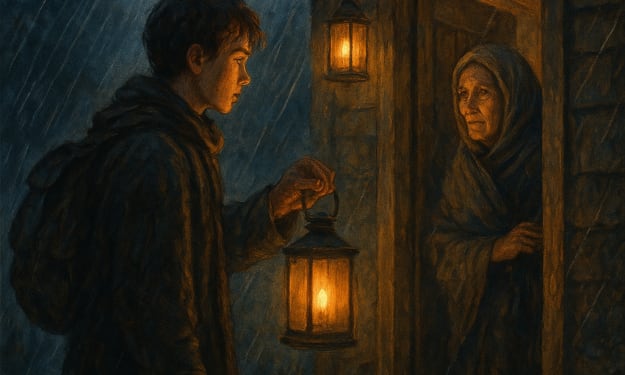
The Lantern in the Storm
The rain began before sunset. At first, it was gentle — the kind of drizzle that painted the air silver and made the road smell of damp earth. But as night approached, the drizzle turned into a fierce, unrelenting downpour. Trees groaned under the weight of the wind, and the narrow path through the hills seemed to vanish under a curtain of rain.
By Hazrat Bilal5 months ago in Fiction


Comments
There are no comments for this story
Be the first to respond and start the conversation.