
Do Not Trust Anybody
Everyone has a secret. Some kill to keep theirs

The letter arrived on a rainy Tuesday morning, stuffed inside an unmarked envelope with no return address. Anna almost didn’t notice it in the pile of bills and junk, but something about the thick paper and uneven handwriting made her pause.
She tore it open while her coffee brewed.
Anna — if you’re reading this, I’m probably already dead. Do not trust anybody. Not your friends. Not the police. Not even me.
—Mark
Her brother had been missing for twelve days.
The police called it a “voluntary disappearance.” Said adults leave sometimes. But Mark wasn’t the type to vanish. He was meticulous. Predictable. He texted her every Sunday and sent a meme every morning — the dumb kind, with cats yelling or penguins falling over.
After the third day of silence, Anna knew something was wrong. Now this letter confirmed it.
Her fingers trembled as she reread the last sentence: Not even me.
She took the rest of the day off work and drove to Mark’s apartment. It was still sealed off — a lazy yellow strip of police tape hung limply across the door, already curling at the corners from weather. The cops had left weeks ago, uninterested in a case with no leads, no evidence, and no body.
She ducked under the tape and picked the lock like he’d taught her when they were kids — back when sneaking into Dad’s garage to steal fireworks felt like rebellion.
The place was untouched. No signs of a struggle. But the computer was gone, and all of Mark’s notebooks — usually stacked like towers beside his bed — had vanished.
Only one thing remained out of place: a small brass key taped under the kitchen sink.
She knew instantly what it unlocked. The old locker at the public storage on 5th Street.
Anna found the locker two days later. Her tail — the guy in the navy hoodie who kept showing up at the corner bodega and again at the gas station — had finally vanished. She’d ditched her phone, used cash only, and taken a different cab to each stop.
The locker creaked open to reveal a single duffel bag. Inside: Mark’s backup hard drive, a burner phone, and a sealed envelope labeled “FOR ANNA — FINAL WARNING.”
She sat on the concrete floor, heart pounding, and opened the letter.
Anna,
If you’ve found this, they’re probably watching you now.
I found something I shouldn’t have — records, files, surveillance data. They’re using a private algorithm to track and replicate people. Fake digital profiles. Synthetic videos. And worse.
It started with identity theft. Then it turned into replacement.
I think they’re testing the tech on people like us. I think I’m next.
I left you the drive. Don’t plug it into anything connected to the internet. It contains names. Proof. Locations.
But whatever happens, Anna, remember this:
Do not trust anybody. Not even people who seem to be helping. Especially them.
—Mark
She sat frozen, the buzz of fluorescent lights overhead deafening in the sudden silence.
Back at her apartment, Anna followed the instructions carefully. She used a disconnected laptop, booted from a clean drive, and loaded the data.
What she found made her stomach twist.
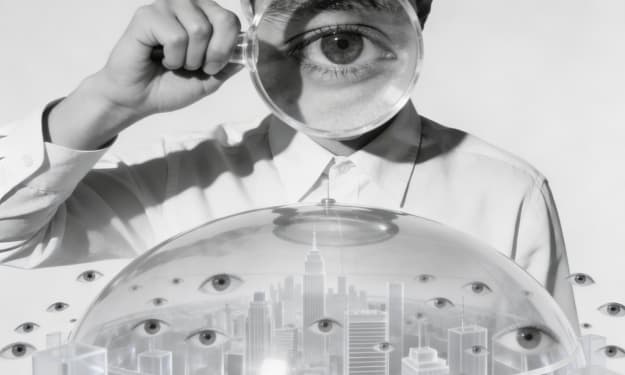
A list of over 1,200 names — civilians, journalists, whistleblowers — tagged and flagged by something called “Project Sandglass.” Each file contained not just personal data, but biometric scans, voice samples, social media history, and AI-generated replicas.
The replicas were eerily convincing.
Mark had found his own profile — a deepfake so realistic it sent a chill down her spine. It smiled, blinked, even moved its head in Mark’s quirky half-nod. But it wasn’t him. It was a synthetic ghost designed to replace his presence online… and eventually, offline too.
That’s when she understood: whoever took Mark didn’t want him dead.
They wanted to replace him.
The next morning, she went to the press. She handed off the files to a reporter she trusted. Or thought she trusted.
The story ran that night — briefly. A local broadcast at 11 p.m., featuring a blurry image of a hard drive and the voice of the same reporter… except something was off. The voice was too smooth. Too polished.
Anna called her phone. No answer. Ten minutes later, it rang — from her contact.
“Anna?” The voice was perfect. But the pauses were wrong.
She hung up.
Too late.
When she turned around, a man in a gray suit stood in her living room.
“Miss Carter,” he said. “You’ve seen things you weren’t meant to. We’re here to fix that.”
Anna didn’t scream. She didn’t run. Instead, she hit the switch behind the bookshelf — the emergency fail-safe Mark had installed, one paranoid night after too much wine and conspiracy documentaries.
A hidden router came online. The drive uploaded to an offshore server. A dozen journalists and watchdog groups got copies. So did WikiLeaks. So did Reddit.
The man in the gray suit stepped forward. “You made a mistake.”
Anna smiled bitterly. “Yeah. I trusted someone.”
The last thing she saw was a flash of light.
Epilogue
The story exploded. Too big to cover up. Project Sandglass was real. Investigations launched. People disappeared. Others were exposed.
But Anna’s name never made it into the reports.
Some say she was taken. Others say she went underground.
But if you ask the right people, they’ll tell you:
She’s still out there.
Still watching.
Still whispering the only advice that ever mattered:
Do not trust anybody.
About the Creator
Keep reading
More stories from Nauman Khan and writers in Fiction and other communities.
The Clever Fish Who Outsmarted the Net
In the vast, sunlit waters of the River Dhansiri, fish of all sizes darted through the current, living their lives with joy and freedom. Among the many, there lived a sharp-witted fish named Tuna — not large or particularly fast, but clever beyond measure.
By Nauman Khan9 months ago in Fiction
More Orangutans
Ernie watched himself get out of bed. It was part of his morning routine: he opened his eyes to the sky-mirror, and peeled the translucent covers from himself. He slept in pajama pants, and a matching pajama shirt, because he didn’t want the others to see his bare, milky body through the glass roof.
By Noah Husband7 days ago in Fiction
A Historic Declaration
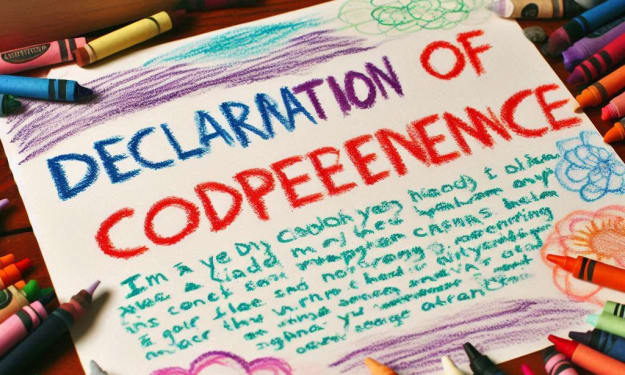
We the People of the Husbands of the United States of America, in Order to form a more perfect Union, and I mean you...with me...establish Justice, insure domestic Tranquility, provide for the common defence, promote the general Welfare, and secure the Blessings of Liberty to ourselves, after Puberty, do ordain and establish this Declaration of Co-Dependence.
By Gerard DiLeo5 days ago in Humans


Comments
There are no comments for this story
Be the first to respond and start the conversation.