
Day One: A Partridge in a Pear Tree
Me & You and a Dog Named Roo
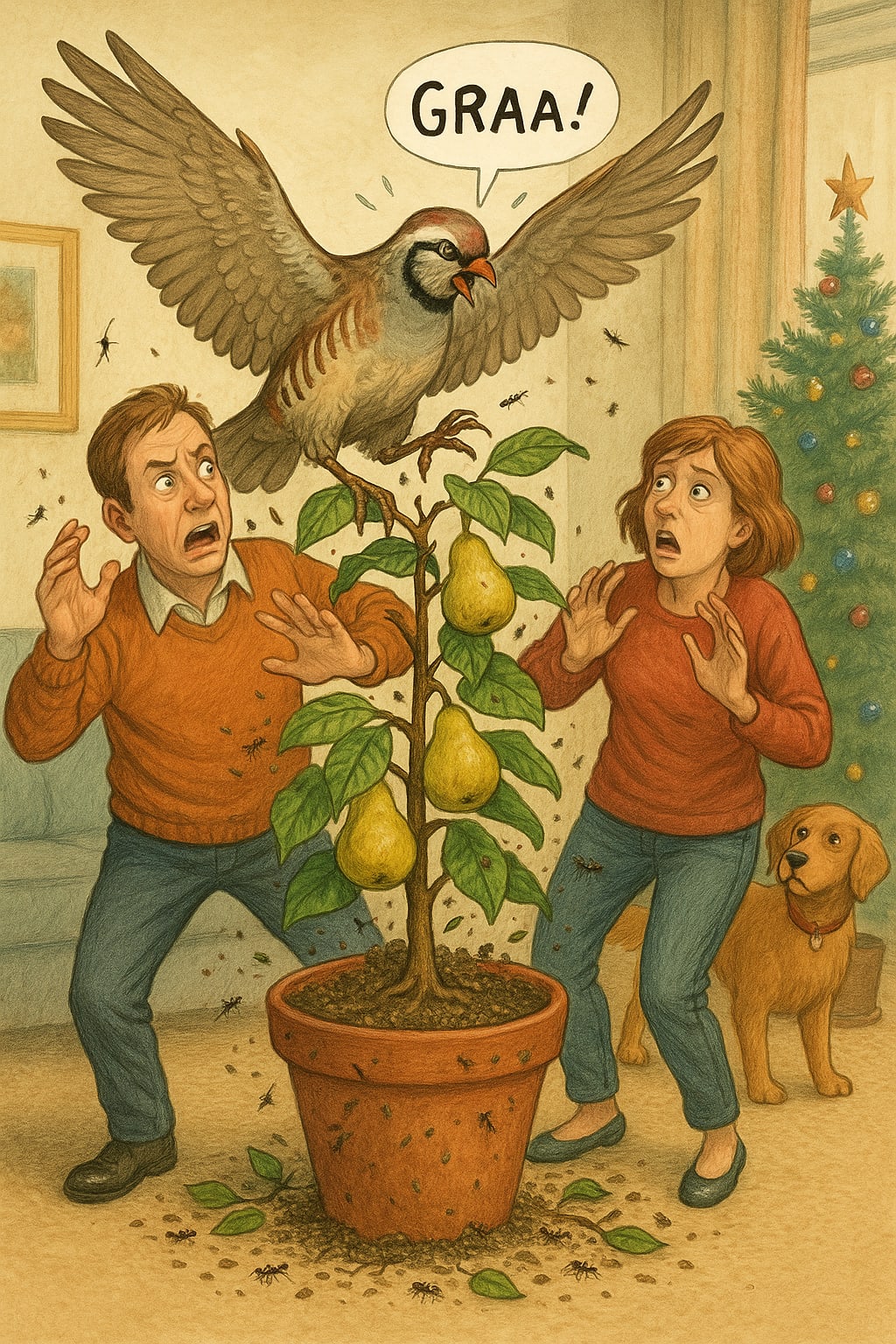
Stephen had never seen a contractor look so defeated by a tree.
“It’s… indoor?” the man asked, standing in the hallway with a rootball the size of a corgi wrapped in burlap. The pear tree’s leaves trembled as if laughing, and a slick of damp soil tattooed the carpet in dark commas.
“It’s temporary,” Stephen said, which was only true in the cosmic sense. He had the voice he used with stakeholders—reasonable, low, exactly three shades warmer than the problem deserved. “Part of a surprise.”
The contractor glanced past him into the living room, where Jane sat cross-legged on the rug, sketchbook open beside her laptop. She was wearing a Stevie Nicks sweatshirt and the expression she kept for emails from people who’d “circle back.” A pencil rested behind her ear; the page in front of her showed the early outlines of a fox in a scarf—one of her picture-book characters in progress.
Roo, their brown Cockapoo, had already claimed her morning post—belly up, paws aloft, the household’s self-appointed Head of Tummy Tickle Operations on standby. The morning had been ordinary until it wasn’t. The parcel, the men, the cheerful clipboard. Christmas was nineteen days away, which meant nothing would be simple now.
“What surprise?” Jane asked.
“You’ll see,” Stephen replied, carefully neutral. He believed in two things: agile frameworks and the restorative power of a reveal. The first had mostly worked out.
The men wrestled the pear tree through the door, gouged the paint, apologized, and then—because the work order said *planting*—they positioned the tree in the exact centre of the living room, over the rug where the coffee table usually sat. Alignment felt important to them. They used a spirit level. One man patted the soil like a father tucking in a baby. The other stamped the burlap down with the solemnity of a flag ceremony.
“Lovely,” Jane said, meaning the opposite. Her illustrator’s eye twitched. “But shouldn’t it go in the garden?”
Roo gave a soft growl, as if sharing the sentiment.
The partridge arrived separately, in a crate with air holes and a robust sense of grievance. The delivery man set it down and asked for a signature, giving Stephen the look men give other men when they suspect a shared understanding of impractical decisions. Stephen signed *S. Claus* and felt brave for six seconds.
“I’m going to ask a stupid question,” Jane said, kneeling beside the crate and peering into the shadowed slats. “If this ends up in one of my stories, you’re getting full credit for chaos. Why?”
Stephen evaluated a dozen answers—airing them, rejecting them—and settled on, “Tradition,” which was both true and not. He had a private theory that if he could make Christmas big enough, ridiculous enough, it would spill over whatever the year had chipped away.
Work had turned his voice into something that solved, scheduled, parked for later. Jane had learned to nod and walk backward from the parking. They loved each other, very much, with the slight carefulness of people who had recently redrafted their budgets.
He lifted the lid. The partridge exploded into the room like a winged argument, all claw and feather and prehistoric shriek. Jane yelped and fell back onto her hands; Roo barked furiously from behind the sofa—officially logging the incident; the contractor ducked; the partridge made a hard left and perched in the pear tree, which quivered like a tuning fork. A ripe smell of damp soil rose, and with it—almost theatrical in its timing—a small, pale galaxy of aphids began to appear, turning the leaves from green to starred.
“Oh,” Jane said faintly. “Friends.” Then, half to herself: “If this were a children’s book, we’d call it *The Bird Who Ruined Christmas*.”
“It’s fine,” Stephen said—the worst of his assurances. “They’re… part of the ecosystem.”
The partridge, offended by ecosystems, launched itself again, clipped the lampshade, and performed a strafing run over the sofa. It left behind a white punctuation mark that no one wanted to interpret. Roo barked once more, satisfied that due process had been observed.
The tree, meanwhile, had gone from symbol to situation. Tiny insects poured out as if the burlap were a border crossing; they colonised the rug in all directions. One of the contractors stepped back onto a wayward Christmas bauble, which gave a small, crystalline scream and died. The partridge took this as applause and, gathering itself, attempted to mate with the curtain.
Stephen moved with project-manager efficiency. He found the broom, the dustpan, a Tupperware he imagined for containment (of what? hope?), and the little spray bottle labelled *PLANT MISTER* in Jane’s looping hand. He misted like a benevolent god. The aphids drank. Jane sneezed into the sleeve of her sweatshirt, and he had the sudden, bruising memory of the first winter in this bungalow when everything had been drafty and the radiator clanked at night like a train far away. They’d lain under too few blankets, inventing imaginary furniture they couldn’t afford—and Roo, a new pup then, had slept between them like a small furnace of reassurance.
“Okay,” Jane said, more to herself than anyone. “We’ll… relocate the tree.”
“As per scope, ma’am,” said the contractor, helpless. “This is the location.”
“The location,” Jane repeated. She looked at the ceiling. The ceiling offered no comment. The partridge, having lost interest in monogamy, found the kitchen and began a brisk career in knocking magnets off the fridge. Roo followed, tail wagging, hopeful that snacks were involved.
Stephen stood still for a moment, broom in hand, feeling the absurdity settle into something softer. He told himself he was building a bridge—but maybe what they needed was a pause.
Jane handed him a mug and nodded, holding her warmth like a small animal. She wasn’t smiling, but she was here. Roo, as ever, was on her back—the household’s self-appointed Head of Tummy Tickle Operations. The partridge screamed at the kettle. The pear tree shed a single leaf with theatrical sorrow.
“Okay,” she said. “Day one.”
“Day one,” he echoed, trying not to think about the remaining eleven—waiting somewhere in a warehouse, translating romance into logistics. He told himself bridges were what people needed. Roo snored softly; the partridge, disagreeing, launched itself at his head. He ducked and laughed—really laughed—and for a moment, ridiculous, he felt light.
About the Creator
Reader insights
Outstanding
Excellent work. Looking forward to reading more!
Top insight
Excellent storytelling
Original narrative & well developed characters
Keep reading
More stories from Stephen Stanley and writers in Fiction and other communities.
Bomb Scare
It was 2027, and the world never thought it would happen. A missle hit the United States, but it wasn't where they had anticipated. A little town in the northeast was hit by a missile strike, they didn't know why, and they didn't know exactly where it hit, but they did know it was a coastal community, somewhere between Maine and Delaware.
By Gregory Payton5 days ago in Fiction
Crystal Banaba
“Emergency landing requested!” Rachel repeated in a shaky voice. Peering down through thick clouds, she saw an island that seemed to have popped up out of nowhere. It even had its own airstrip! Was she hallucinating, coming out of the storm that nearly split her Cessna? Or was she dead already, with her mind projecting an island that shouldn’t be here?
By Lana V Lynx5 days ago in Fiction
Guard Your Battery
Why are some people so attractive just by standing there? It’s not because they are "likable," but because they don’t need everyone to like them. I realized later that truly charismatic people allow themselves to be criticized, but they never criticize themselves. They never try to please the world; instead, the world stops to watch them.
By Emily Chan - Life and love sharing7 days ago in Poets


Comments (1)
These stories are brilliant! A fresh, modern spin on The Twelve Days of Christmas, full of humour, heart, and sparkling dialogue. I laughed out loud more than once. Beneath the fun, there’s a touching message of love and acceptance that gives the whole collection real depth. Completely magical and exceptionally well written.