
Day Four: Four Calling Birds
Me & You and a Dog Named Roo

Stephen woke to an unusual quiet.
The partridge perched peacefully on the windowsill like a feathered monk. The pigeons dozed in their bathroom exile. Even the French hens had clustered by the radiator, gossiping in polite whispers.
Roo, demonstrating flawless delegation, lay on her back and left the tickling to others.
For the first time in days, the bungalow didn’t feel like a small aviary with a mortgage. Jane was already up, hair twisted with two pencils, mug held in both hands. She paced in circles — quick, anxious loops, the kind she traced whenever she was too nervous to sit still.
Her tablet glowed under her arm, showing last night’s sketch: a lonely lighthouse leaning toward a small girl offering a lantern.
“Big presentation today,” she murmured, noticing Stephen stir. “If this goes well… it could actually change things.”
Her voice trembled almost imperceptibly on “change.”
“You’ll be brilliant,” Stephen said. “You’re terrifying when you care.”
She gave a faint, wobbly smile. “That’s the plan.”
For a moment, they both breathed.
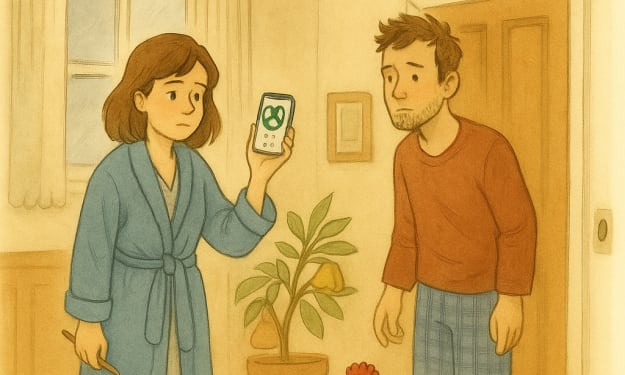
Then Stephen’s phone buzzed.
Your order of Four Calling Birds is out for delivery!
His stomach dropped. He considered cancelling. Actually cancelling. But stubborn festive commitment won out.
He didn’t see the way Jane pressed her palm briefly to her forehead — a protective gesture, as if bracing against an incoming storm.
The courier arrived at nine: a woman with an orange beanie and the wilted expression of someone who has already lived three lifetimes before lunch.
“Four phones, four birds,” she said. “Strangest thing today. And I delivered a chinchilla to couples therapy.”
Inside the crate, four parrots sat in a smug row, each tethered to a duct-taped mobile phone — all ringing in a staggered, chirpy cascade.
Jane flinched at the sound — a tiny, involuntary recoil.
“Oh, Stephen…” she whispered. “You didn’t.”
“They’re calling birds,” he said proudly. “It’s festive!”
“It’s idiotic.”
One parrot perked up. “Idiotic!” it echoed in her exact voice.
Jane shut her eyes. The humour drained from them.
By ten, she’d retreated to the spare room — her studio. Usually a sanctuary of bright sketches and half-built worlds, it now felt cramped, anxious. Pages of thumbnails surrounded her like a fragile paper fortress.
Stephen attempted to contain the parrots.
He failed immediately.
One had worked out how to unlock its phone. Another narrated events into a voice memo. A third rifled through Jane’s contacts with the entitlement of a CEO’s child.
“Stephen,” Jane called through the door, voice taut, “they’re loud.”
“They’re calling birds,” he muttered. Immediately regretted it.
“Please don’t make that your bit today.”
She shut the door — not sharply, but protectively.
The parrots began a ringtone symphony. The partridge shrieked like a dying kettle. The hens clucked in outrage. A pigeon hammered the faucet like an angry percussionist.
Stephen sat amid the pandemonium, feeling all his confidence drain into the laminate flooring.
By eleven, things fell apart.
“Hello?” a voice crackled. “Is this Pizza Napoli?”
The parrots chanted: “PIZZA! PIZZA!”
Jane burst from her studio, eyes shiny at the corners.
“I’m trying to talk about a story that matters to me,” she said, voice trembling, “and something out here is chanting toppings.”
Stephen attempted humour. “Soundtrack to—”
A parrot interrupted: “FAILURE IMMINENT!”
Jane’s face wavered — not dramatically, just enough.
“Stephen… I can’t lose this,” she whispered. “I work so hard. And no one takes children’s stories seriously. I need this one thing to work.”
The crack in her voice hit him like cold water.
“I’ll fix it,” he said instantly.
He muted phones, unplugged the Wi-Fi, bribed parrots with raisins, whispered apologies into feathers.
For fifteen blessed minutes, silence.
Then a parrot bit through a charging cable.
Wi-Fi rebooted.
Four phones lit up.
They began calling Jane’s editor.
Jane’s voice inside the studio broke open:
“Why is something squawking ‘synergy’ on my pitch? Stephen, please—please—”
The parrots screamed in corporate tongues. The partridge shrieked its despair.
Stephen ran.
By two o’clock, the pitch had collapsed.
Jane emerged clutching her tablet like a shield. Her shoulders sagged. A smudge of mascara marked where she’d pressed her fingers to her eyes.
“They thought it was performance art,” she said quietly. “Birds as whimsy. As if I’d staged it on purpose.”
A single frustrated tear slid down. She wiped it away fast.
Stephen stepped forward helplessly. “Jane, I’m—”
“I know you meant well,” she said softly. “But meaning well isn’t the same as helping.”
She wasn’t angry.
She was disappointed.
And it hurt more.
“Well… they were calling birds,” she added faintly. “You just didn’t think about who they’d call.”
Her attempt at a smile flickered out.
That evening, the house softened.
The hens slept like judgmental librarians.
The pigeons murmured in sanctuary.
The parrots muttered “deliverables” like burnt-out interns.
Roo twitched in a dream, belly-up and blissful.
Jane sat on the sofa, scrolling through her sketches with slow, pensive movements. Creatures she loved. Worlds she’d built. The lighthouse sketch lingered on her screen — that stubborn, lonely tower.
Stephen approached tentatively, sitting beside her without a word.
For a long, quiet stretch, she said nothing.
Then she inhaled — not shakily, not defeated — but deliberately.
“I actually liked the hens,” she murmured.
“Really?”
“They had boundaries,” she said. “And opinions. Might be time I did, too.”
Stephen smiled, a soft ache in his chest.
Jane reached for her stylus.
And then — almost shyly — opened a blank page.
She began sketching.
Not the lighthouse. Not the girl.
A parrot.
A ridiculous, smug parrot, wearing a headset and shouting “FAILURE IMMINENT!”
And beside it, a girl laughing, not crying.
Jane paused, then smiled — a real one. One with light behind it.
“You know,” she said, voice steadier, “this might actually be something.”
Stephen watched her draw, awe and relief swelling in equal measure.
He didn’t check the app. Didn’t apologise again. Didn’t fill the moment with noise.
He just stayed — while Jane, despite everything, began building a new story out of the wreckage.
Because sometimes resilience wasn’t loud.
Sometimes it started with a single sketch.
And a spark.
About the Creator
Keep reading
More stories from Stephen Stanley and writers in Fiction and other communities.
Day Three: Three French Hens
At 6:40 a.m., the doorbell rang with the authority of a police raid. The partridge, asleep on the router like a dragon on a hoard of warm LEDs, detonated into the hallway. One of the pigeons cooed in the bathtub as if to say, we warned you about mornings. Jane rolled over and tugged the duvet over her head.
By Stephen Stanley2 months ago in Fiction


Comments
There are no comments for this story
Be the first to respond and start the conversation.