

Some say that art and travel make the ordinary seem strange so that we can see it in a new way. In the routine of everyday life, at our everyday places, perceptions of reality become blunted and stale. Instead of living, we shift into autopilot. Things that are strange: new music; novel artwork; an uncommon figure of speech; a foreigner’s accent; a different locale, clean the windows of our perception. By having to grapple in a more strenuous, self-conscious manner, we experience the familiar anew.
That’s what happened to me in Cleveland. I didn’t go to the usual tourist attractions. I barely noticed ore boats gliding like ghosts on the horizon of the blue steel Erie Lake. I briefly appraised the Cuyahoga bridges for suicide potential and boogied right by the Rock and Roll Hall of Fame. I mostly just drove around, through good neighborhoods and bad, and noted the similarities of Cleveland’s streets to those of my own decaying city.
I got hungry at one point, began to look around for some local spot to consume the atmosphere, came upon the West Side Market, and decided to stop. It seemed to be an old train station converted into a farmer’s market, crowded with cheeses, tubes of smoked meats, and the early spring produce of the hydroponic greenhouses of northern Ohio. It was also crowded with people of every shape and variety. I figured I’d find a gyro.
Picking my way through the market crowds, I was reminded of the hundreds of similar markets and arts festivals I used to go to with Joy. Joyce, I mean, my Ex. I used to call her Joy because that’s what she briefly was to me. It’s what her proto-hippie parents named her until, in the perverse manner of adolescents, she changed it to Joyce. I used to say Joyce sounded like choice but when she was around I had no choice, I simply felt joy. She was my Joy and I called her that whenever I had the choice. Unfortunately, she gave me no choice, so now, like everyone else, I call her Joyce, whenever I call her at all.
She had a passion for looking at boxes of ripe vegetables, woolly macramé, tables of jewelry, paintings of farmsteads, and rusting junk sculptures of comic creatures. She would linger in the tents that sold tie-dye, but she would never buy, for she was a sedate dresser. She would discuss with farmers, feathers clinging to their plaid jackets, the merits of brown eggs versus white while I waited patiently and impatiently, laden with bags of fruit. She’d peer at the photographs hung in tents and inquire into f stops while I lost focus and blinked.
Joyce enjoyed looking at things. She wasn’t much for touching or whispering sweet nothings or hearing what I had to say, but she did have a passion for looking. She had ten thumbs at the end of her hands, couldn’t carry a tune in a shopping cart, and needed a recipe to boil water, but her ocular abilities were in a class of their own. I never knew what she saw in me.
Her passion for looking is why she studied art history in college. I was happy to pay her way and support her through all of her college years until she got her doctorate and would have been happy to continue to support her if she decided to write or curate at some local, poverty-stricken museum; but no, she was offered a job in Kansas and got it into her head to teach Kansans how to see.
There’s nothing to look at in Kansas, I told her. All it is, is flat land, corn, and corn-fed white faces. Stay here and see the inner city graffiti, and the fall leaves. Go with me to art festivals and farmer’s markets. Do they even have art festivals in Kansas? What’s the point of a farmer’s market if everyone’s a farmer?
She wouldn't listen to reason. I’m stubborn by default and told her I wasn’t going, but she called my bluff and went to Kansas anyway. I counted on her coming back to me after getting tired of tornadoes or not making tenure; but she met a Kansas man who was good to look at. Finally, she answered my letters with a packet of divorce papers and a note that said, Sign these please, Joyce.
I always said that these markets never had enough music. They have the occasional chick with a pick stationed here and there, but their music never carries far through the crowds. I often wondered why more buskers didn’t work festivals and farmer’s markets. Perhaps they’re chased off by the goons of the monopolistic musicians’ union. Sometimes I would park myself near a musician while Joyce foraged for things to see, but I’d never stay long. I like the unexpected discovery of music better than the music itself.
For all the scarcity of musicians, there would always be some Peruvians playing their flutes at every festival. I pictured Peruvians piling into a Peruvian bus, the windshield merrily decked in Peruvian tassels, wandering from one festival to the next throughout the United States, the land of opportunity. At the end of the season, Peruvian flutists return to their villages, high in the Andes, filled with stories of America, and trained scores of Peruvian children to blow across pipes. Did they see Peru with new eyes after looking at America? Word must have spread from one village to the next, resulting in a kind of mad gold rush of Peruvian musicians to America. I like to support third world people improving their lives, but I wished they would learn more than one song, a haunting ethereal melody, as thin as the air at 14,000 feet, which they played over and over.
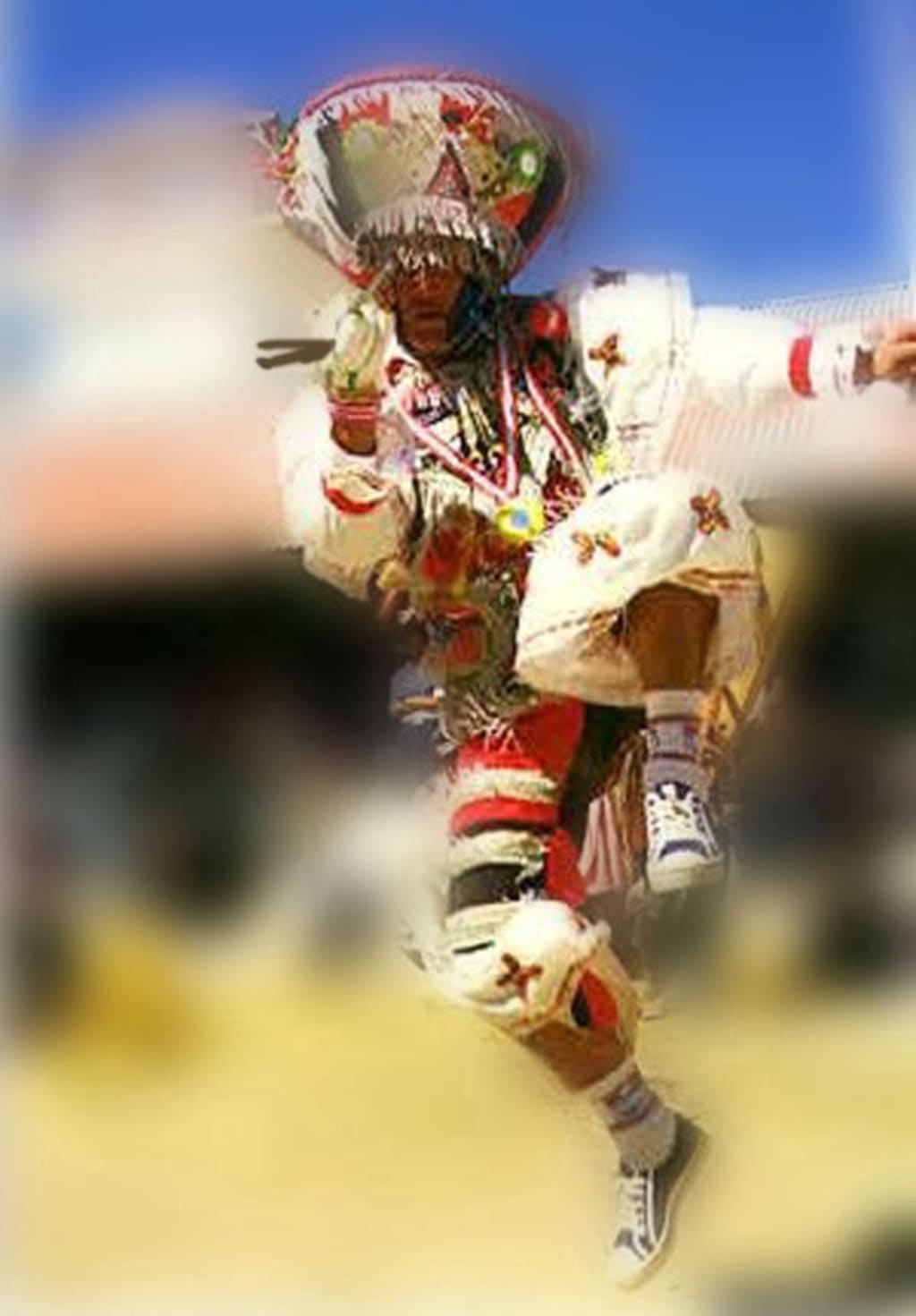
The West Side Market had its own Peruvians; but, these were different from any I’d ever seen. There was no flute, but there was a violin playing what sounded like a Gypsy music and a harpist ungainly holding his harp on his shoulder so that it towered above the crowd. Two dancers alternated in competition, each with a red scarf in one hand and a pair of scissors in the other they snipped like castanets. The dancers wore lampshades on their heads and brilliantly decorated chaps and aprons that left the jeans on their backsides exposed, like hospital gowns. A Peruvian boy passed around a flyer explaining the spectacle.
Dancing with Scissors, it said, explaining that it was a ritual enacted since the 1500s in reaction to the takeover of the Spanish Conquistadors. The Scissors Dance survived as a kind of Inca resistance movement. Dancers believe old Inca gods take over their bodies and drive them to perform this wild dance signaling their return.
I studied the dancers for the presence of divinity. Old gods, like old feelings, memories, and resentments, linger indefinitely, hiding amid the ordinary, showing themselves in the strange.
I didn’t see any Inca gods, but I did see joy. I wished Joy was here to see it, too.

About the Creator
Keep reading
More stories from Keith R Wilson and writers in Fiction and other communities.
Turning White
“You want to know how I’m doing? Those motherfuckers got my eyeballs. I’ll be tapping around with a white cane while they’re in Bed-Stuy showing ’em off to make an example of my black ass. Some Witness Protection Program they got here. You want to know how I’m doing? You can see how I’m doing, and I can’t see who the fuck wants to know. Ain’t you got more of that morphine?”
By Keith R Wilson4 years ago in Fiction
So You Decided To Become a Nurse Practitioner:
So you decided to become an "Advanced Practice" nurse. Congratulations!... is what I would say if this was a good idea. Grad school? In this economy? What were you thinking? Likely it was something along the lines of either 1) “I've seen these other chucklefucks do it— Why can't I?” or even 2) “I've got a nice career, I should shake it up. I miss feeling like I have no clue what I'm doing.”
By Sandor Szabo4 days ago in Fiction


Comments
There are no comments for this story
Be the first to respond and start the conversation.