
Dancing With My Father

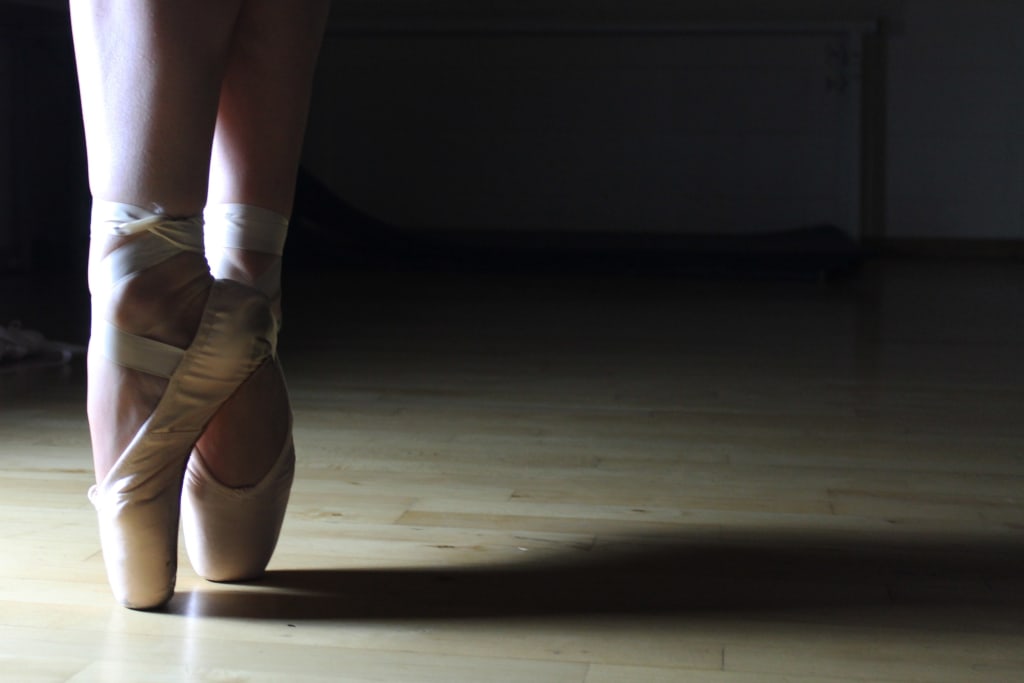
I took a cab from the airport to the nursing home. Ohio cab drivers just aren’t like New York cabbies; is there anyone as phlegmatic about their fares as a New York cabbie? New York cabbies are confessors, captive audiences, sounding boards…and all for two-twenty five the first mile, and thirty-five cents each additional mile or ninety seconds. I waited for your cab because I saw the marquee for my latest ballet at the ABT. Not that I’m dancing in it, but I choreographed it, so it’s mine.
I could have rented a car in Ohio, but I didn’t want to bother with trying to remember my way around. I told the cabbie to take me past Madame Roshenski’s dance studio. He gave me a blank look in the rearview mirror. It’s almost like the look you’re giving me now. You don’t know who I am, do you? I don’t dance anymore, but once, my face was on marquees on cabs like this one, adverting the ABT’s ballet season. But you don’t see my picture on the marquees of cabs, or billboards or playbills any more.
No one can remain prima absolutta forever, much as they might want to. My time was considerable; I reached it before I was twenty, and held on to it until I was in my thirties. I think I would have found it easier to retire gracefully if I’d been injured in some way, a justification for leaving dancing for choreographing. But I wasn’t injured, just old. Old! I wasn’t even forty, and yet I was too old to dance? It nearly broke my heart and my spirit to accept it, but I couldn’t deny it, either. I could barely keep up with the younger girls; even the girls in the corps could out dance me. You rarely see ballerinas on the downslide of their careers; they just suddenly disappear because they’re not getting roles. I didn’t want that to happen to me, I wanted to go out still at the top, still remembered as being the best.
All these blank looks remind me of the look on my mother’s face the day she found another woman’s earrings in my father’s car. Sometimes when I think about my life, I can’t help but compare it to that song from A Chorus Line. You know the one, “At the Ballet”? You have a marquis for it on the cab, too, but have you seen it? I could be that first girl, or rather, that girl could be me. Same father, same earrings, same dance studio. Although I’m probably a more successful dancer than those Chorus Line girls. No, I’m definitely more successful; I became prima ballerina absolutta, and there was never another cattle-call audition for me after that, thank God.
His proposal was oh, so romantic: he informed my mother he was her last chance at marriage so she’d better accept. I never understood why she believed him; she was only twenty-five. But, for whatever reason, she did believe him, and so they got married. I never understood why he even wanted to get married, since it seemed like he was in no way interested in the role of husband or father. Maybe he just wanted protection against one of his many girlfriends making a claim, or maybe it was just that my mother was so easy, never making demands on him, always there for him when he came home.
My father was a traveling salesman for a chemical company based out of Ohio. Back in those days, that was a really good job to have, especially for a man like him. He got a new car every two years to drive around to make sales calls and an expense account. Mom and I got the same old car she had been driving when she’d married and the little bit of money she brought in working as a waitress, plus whatever he felt like adding to the pot. I’ll give him credit and say that he bought a house and made the mortgage payment every month. And dance lessons. He paid for my dance lessons, from my first lesson at Madame Roshenski’s through my early days in the corps, when I was still considered a student and not an actual paid member of the company. All those years he paid for lessons, but he never once saw me dance on stage.
Maybe I remember parts of that day because the next day was the day I met Madame Roshenski. She was Russian; all the best dancers back then were Russian, really. She’d escaped to America to dance, but a dancer can only have one love, the dance. Galina Roshenski had made the mistake of falling in love with a man, too. It might have been all right for her if he’d been part of the ballet world, but he wasn’t, and so her career had been cut short. She seemed content enough to live vicariously through her pupils. Several of them, like me, became well-known dancers. That always seemed to be enough for her, although I never asked and she never said, despite the fact that we became very good friends over the years, not just teacher and student.
Galina wasn’t pretty, exactly. She was small and dark with a dancer’s hard, ugly muscles, and her feet! Oh, her feet were horrible, even for a dancer! Being en pointe gives ballerinas the world’s ugliest feet. She never really lost the look of a dancer, even after she’d had children. Her voice was surprisingly deep for such a little woman, so stern and commanding. For years, all she had to do was say my name in a disapproving tone and it would be as if my world were falling apart around me. But a single word from her in a slightly less unsympathetic voice and I could float on air for hours, no matter how much I might be hurting.
Her studio was upstairs, above a shop of some kind. “Up a steep and very narrow stairway, to the voice like a metronome.” That’s what the song says, and that’s the way it was, oh, that’s just the way it was! I took lessons there until I was fourteen, when I left to join the ABT in New York in the corps de ballet like so many other young girls. The mirrors, the barre and the polished wooden floor were more of a home to me than the three-bedroom house my father paid for, and my mother worked so hard to make a cozy nest. I spent innumerable hours in that studio practicing jetés, pliés, arabesques, soubresauts, ballottés, fouettés and pirouettes in front of those mirrors. I danced my first pas de deux on that floor. I remember using that barre to stretch before I could fully reach it with my legs, standing at the very tip of my toes, and the pride I felt on the day when I slung my heel up there with no problems.
When Galina came back for the last class, she would clap her hands and call out in her heavy accent, “Places, children! We begin with your positions!” Every day that was how we started the last class, with basic positions. If we complained, she would walk over to us with her dancer’s stride, feet turned out, shoulders back, in her black leotard and tights with a scarf skirt tied around her hips and say, “When I was in the corps every day we started thus because this is the fundamentals of ballet, children! Since I have danced and you are still students, we will leave the learning to you and the teaching to me, hmm?”
I had the cabbie drive all over the area where I remembered Galina’s studio being, but I couldn’t find it. Maybe it was gone, or moved. Or maybe I just didn’t remember the town I grew up in. As I looked out the windows at the gaily-decorated shops and streets with colorful Christmas lights everywhere, despite being the middle of the morning, I felt lost, or rather, that I had lost something special. It was like the day that my mother told me my father was leaving and he wouldn’t be back, right before my fourteenth birthday.
She had become more silent and withdrawn; when we’d get home, she’d go about her evening chores in the same silence, and one day I learned the reason for her distraction: she was pregnant again. When my dad came home from his trip, she told him about the baby and they had a horrible fight. I hid in my bedroom and practiced my positions as best I could on the shag carpet, holding on to the poster of my bed. I could almost drown them out counting off in my head. Almost. He left, slamming the door, and then all I heard was her crying. I began to count out loud so I didn’t have to hear her.
The next morning, she was sitting at the breakfast table as usual, but her eyes were red and puffy and she looked tired and so very, very old.
“Your father won’t be back.”
I remember just staring at her across the table and tracing the flower design on the plastic tablecloth while I tried to think about what exactly that would mean for me. Would we have to move out of our house? Would I have to give up dancing?
“It’s because of the baby?” I asked.
“Yes.”
“Will I have to give up dancing?”
“I don’t know.”
“I’m not going to give up dancing!” I told her. I think I probably yelled it at her. “Just because you wanted a baby, why should I have to give up the things I want?”
I jumped up from the table and ran out of the kitchen and all the way to the studio, crying. I didn’t go to school that day; I stayed in the studio and danced in the back room, not any kind of structured dancing or anything like that, just put music in the tape recorder, playing it over and over as I danced and danced until I was so tired I couldn’t stand up any more but lay panting on the floor. That’s how Galina found me. She gathered me up and said, “Devochka moya, dorogaya moya, you must stop this now, you will make yourself sick. Come, vsyo boodet harasho, lyubimaya, ne volnoovsya, vsyo boodet harasho.”
I remember these things in Russian, for she said them often to me. It is funny to say, but when I was dancing, one could not help but learn to speak a little Russian as well as French because there were so many Russian dancers. “Devochka moya,” “little girl.” “Dorogaya moya,” “my dear.” “Vsyo boodet harasho,” “everything is going to be all right.” “Lyubimaya, ne volnoovsya,” “darling, don’t worry.”
I told her all about how my mother was going to have another baby and my father wasn’t coming back and that I was afraid I’d have to give up dancing. She listened and didn’t say anything for a long time and when she did finally speak, she said only, “you are born, I think, to be prima absolutta.”
I don’t know what was discussed between Galina and my parents, but the question of paying for my lessons never came up. I left for New York and the ABT before my brother, Adam, was born. I’d like to say that I took a lot of interest in my little brother but once I went away to New York I became so wrapped up in my life there that I rarely spared a thought for what was going on at home. It wasn’t enough for me to just be able to study at the ABT, I wanted to be a member of the company, and not just any member, but a soloist, a prima donna.
I danced professionally for more than twenty years, but I never appreciated how hard it was to stage a ballet until I stepped into the role of choreographer. Sheer stubbornness kept me at it when all I wanted to do was quit from frustration. I was never destined to become another Misha, leaving dance to form a company and nurture the next generation. Unlike Konstantin Sergeyev and Anna-Marie Holmes, I never created a “signature” ballet that people looked at and said, “Ah, that is her production of this or that.” I worked with both Konstantin and Anna-Marie, assisting with their choreographies, and I found that I truly, truly enjoyed it. I would take their basics and work with soloists to help them become the role. Like Galina Roshenski, I found pleasure in teaching; not that I necessarily did a lot of teaching, of course. My “students” were established soloists by the time I worked with them but several of them became prima ballerinas and I like to think I had something to do with that.
I had a full life; I think it’s important to say that because sometimes, it seems to outsiders as if being out of the spotlight is torture, but it’s not. And people still remember me, and they still acknowledge me at ABT parties and fundraisers. Sometimes I get stopped on the street by total strangers who talk about seeing me dance. I even got married, to an architect who saw my last performance. We live in a brownstone in Manhattan during the season, and at a house he designed in Connecticut the rest of the time. It is a full life.
Until I got the call that had me rushing back to Ohio, despite the craziness of Christmas travel and paying a small fortune for last-minute tickets three days before Christmas. That call about my father, my long-lost and forgotten father, brought back all the years of hurt and I was almost fourteen again. I would have ignored it and done nothing if my husband hadn’t persuaded me that this might be my last chance to do the whole “making peace” thing. I just didn’t know if I wanted to. So there I was, sitting in an office in a nursing home and all I could think about was how much I’ve always felt like this man never loved me, so why was I there?
I knew the answer to that, of course; I was there for me, to settle my own feelings and to see if there really are any answers for the past. I knew there was probably not a lot of hope for that; Alzheimer’s stole from me any opportunity I might have had for answers, and yet it was my own fault, too, for not seeking them when I had a chance. You can live a lifetime of “what ifs” and never find any kind of satisfactory answers.
When I walked into the common room where my father spends his days I expected to see the man I had last seen, right before he walked out of my house when I was thirteen. He wasn’t there. In his place was an old man I didn’t recognize and wouldn’t have known if a nurse hadn’t pointed him out.
“He’s having a good day,” she told me. “He might know you.”
I went and sat across from him and spent long moments just making eye contact. He did the same. We might have sat that way all day, I suppose, if he hadn’t spoken.
“I know you. You’re a dancer. I’ve got pictures of you in my room. Would you like to see my room?”
I couldn’t have been more surprised if he’d jumped up and flung off all his clothes, or something equally bizarre. To hear that he had pictures of me tilted my world in a fundamental way. I wondered how he’d gotten them, why he had them, what they could mean. His eyes were clear and bright, but there was no recognition of me as his child in them.
“You have pictures of me?” I asked him, my voice shaking a little.
“Uhm-hmm. In a big book, lots of them, some in little books inside the big one. I like to look at them because you look so beautiful dancing.”
“Thank you,” I said. I didn’t know what else to say. He had pictures of me dancing, yet he’d never, to my knowledge, come to see me dance in person. I found that incredibly sad, and it brought my heart into my throat, tears to my eyes.
“I had a daughter who danced,” he said, and I thought I heard wistfulness in his voice. “She loved to dance.”
“I know.” It was all I could say.
His face suddenly lifted and brightened and I could see that he’d just had some thought that pleased him. He jumped up and went over to an old record player, turned it on and I heard the scratchy sounds of “Hello, Hawaii” playing. The needle scratched as he moved it a little and he looked over his shoulder at me.
“Do you want to dance? I like to dance.” He said it with a smile and a wave of his hand to join him.
I got up from my chair to the opening strains of “In The Mood” and met him in the middle of the floor. He held out his hands to me and I took them. His were cool and dry; mine were warm and damp. I hadn’t felt so nervous about a dance since I had auditioned for a spot in the ABT Studio Company.
He shuffled his feet and our dance began. The sweet melodies of “In The Mood” swirled around us as we slowly and awkwardly waltzed around the floor totally out of beat with the music. He didn’t seem to see anything odd about waltzing to a ragtime tune, just enjoyed our circling with a brightly lit, professionally decorated artificial Christmas tree casting changing patterns of light on us our only audience; the others in the room had faded from my vision the moment we started to dance. That close I could see the collar of his shirt underneath the cotton jacket he wore and again my world completely tilted. There, on his collar was a small gold pair of ballet slippers with the ribbons floating up and interlacing. I recognized that pin; I had one just like it in my jewelry box in my bedroom. It had been a gift for my first solo with the ABT, a custom made gift given to me by my mother, but when I saw the same pin on him I had a blinding flash of insight: my mother may have presented them to me but they were given to me by my father. The man I was shuffling a waltz with to a haunting ragtime song. The father who didn’t know he was finally, after all these years, dancing with his daughter.
He was out of breath by the end of the song and I led him back to his chair so he could sit down. The clarity in his eyes dimmed into confusion and as I watched, I could see him slipping away before me. It seemed to take minutes, not seconds, for his blue eyes to go from a happy clear to cloudy confusion. He was looking at me as it happened and I watched his face change, too, becoming first a blank mask then his brows drew together and I knew that the man I was sitting next to wasn’t my father, just the sad shell holding a mind emptied of what had made him who he was.
“Hello,” he said. “Do I know you?”
“I just came to dance with you,” I told him.
“Did we? I’m sorry, I forget things.” His lips trembled and his eyes welled with tears.
“Yes, we did and it was lovely. Thank you,” I quickly reassured him, reaching out and giving one of his hands a gentle squeeze.
“You’re welcome,” he said. “I wish I remembered it. You look like you’re a very good dancer.”
“Not as good as you are,” I told him, then stood and bent down and brushed my lips across his cheek. “But I have to go. Goodbye.”
“Goodbye,” he said and he lowered his eyes to his lap and began to play with the hem of his shirt.
The nurse who’d brought me in was just outside the door. “You two looked pretty good out there. He said his daughter was a ballerina and I guess ballerinas can dance all sorts of ways, huh?” There was a kind of detached curiosity in her voice, almost as if ballerinas were some kind of oddity that didn’t behave the way “normal” people would. “I saw you looking at that pin of his. He wears it every day, won’t leave his room until he sees he’s got it on. The night aid misplaced it once and the doctor had to give him a sedative the next morning, he was that upset. He said it was for your first dance, as the Sugar Plum Fairy in the Nutcracker. Or whatever. He has stacks of DVDs of you dancing your brother made from his VHS tapes and he watches one every night as he falls asleep.”
I think I just nodded to her; my eyes were swimming with tears and my throat was too tight to get any words out. I walked outside of that nursing home into the warm sun in the chilly winter day, found a bench, sat with my head in my hands and cried. Why had I waited? Why hadn’t I made more of an effort to see him when he was still himself? The man in that common room was a sweet old man, but he wasn’t the father I wanted to see, had wanted to find my peace with. And the nurse’s words had gutted me, made me wonder what I had missed, might have had, had I known he’d been in an audience watching me.
I felt arms wrap around me and a voice I hadn’t heard in years said, “He loved to watch you dance, you know.”
It was my mother. I turned into her arms and let her comfort me. “Why didn’t he ever come see me, then?”
“He saw you dance many, many times. Just because you never saw him doesn’t mean he wasn’t there. He thought you wouldn’t want to see him. He had so many things he wanted to say to you, things he wanted to make right with you, but he just didn’t know how,” she said.
“Really?” I asked her. I wanted to believe her, but it was hard. Too many years of thinking that he didn’t love me, didn’t care anything about me, stood in my way of true belief. “Why didn’t you tell me?”
She sighed but didn’t answer. Maybe she just didn’t have any answers. Maybe the answers were trapped inside the deteriorating mind of the man inside the nursing home. Maybe they were inside me and had been all along. A world of maybes, but none of it really mattered, not at that moment. I sat there in my mother’s embrace and cried for everything that I had lost: father, mother and brother, a past filled with love and comfort and a future of memories. I lost them to stubborn pride, single-mindedly nursing my grudges, real or imagined.
I want you to know that even though I had everything I thought I wanted, it was little enough in the end, compared to family and forgiveness. I didn’t reach out to my father until it was too late, and I regret that. I’m not sorry that I pursued a career in ballet; I can’t imagine a life that didn’t include dancing. The last girl in the song from A Chorus Line used to imagine dancing with her father but she didn’t get a chance. I got my chance and maybe it wasn’t all that I wanted, but it was enough.
That’s my house, the one with all the lights on. I guess my husband is waiting up for me, waiting to see if I’m okay. I wish now that he’d gone with me; I could have used his support. Thank you for letting an old ballerina ramble on. Look, it’s started to snow. I guess we’ll have a white Christmas in the morning after all.
Here’s a hundred. Keep the change.
About the Creator
Shawna Clawson Chambers
I've always been a storyteller; I wrote my first story when I was 7 years old! I'm an award-winning poet, had short stories published, and written for magazines and newspapers. These days my passoon is for political and social commentary.
Keep reading
More stories from Shawna Clawson Chambers and writers in Fiction and other communities.
Jack Tales
Jack and his family were dirt farmers, out a-ways in Nevada, where there weren’t no big cities, just little towns that nobody never heard of no-ways. Literally, they farmed dirt. Oh, they’d tried to grow things in the dirt, but nothing ever did. Jack’s Momma kept chickens and some goats, so at least they had milk and eggs, though Jack got mighty tired of always eating eggs for every meal. For a while, she had a passel of sheep and a sheepdog or two, but eventually the dogs must’ve got tired of all them eggs, ate the sheep and headed off to find greener pastures. Jack sometimes saw them dogs a mile or so down the road, so evidently they didn’t have to look too hard for them greener fields.
By Shawna Clawson Chambers4 years ago in Fiction
Miss Persephone's Manual to a Seemingly Ordinary Life
Miss Persephone was found at the dining table, her blue eyes swollen, her tears arriving and retreating like the tides of the ocean. Earlier that day, her family had visited her in the retirement home where she had lived for eight years. It was her eightieth birthday.
By Imola Tóthabout 22 hours ago in Fiction
How to Not Become the Woman Everyone Warns the New Hires About
I wrote this manual because I have seen this behavior too many times to pretend it is rare. In many production jobs, toxic behavior is treated as normal, especially when it comes from older Hispanic women who have been there longer. They think they run the place. They mock new hires when they mess up. They give dirty looks instead of help. They laugh, whisper, and call it experience.
By Diani Alvarenga3 days ago in Fiction


Comments
There are no comments for this story
Be the first to respond and start the conversation.