
Cutting losses
A television host makes a hard decision between love and fame. Dark, dystopian sci fi written in a British vernacular

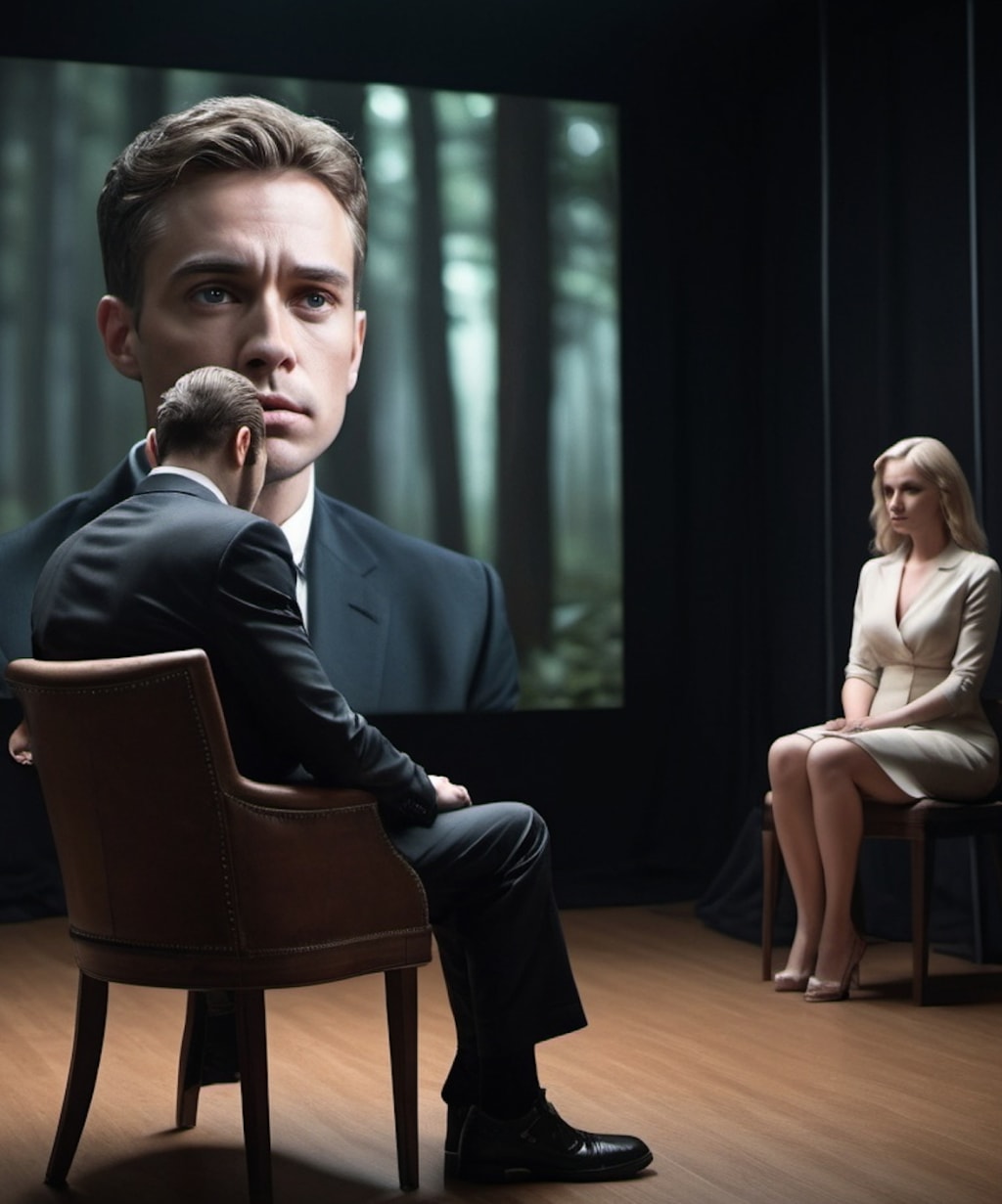
The magician hurried along his row of spinning plates, caught the first one and swung around. His slick touch kept his show afloat, like a seal playing with fish. His audience was ecstatic.
He switched the tv off. More and more, he couldn’t help feeling sick at the sight of the handicapped. This, of course, he would scarcely admit to, even to himself. He felt oddly ashamed, yet contented at times like this. “Yes,” he conceded to his reflection on the now blank screen: “These thoughts are part of me, too.” He knew that most, if not all, of his kind felt this way. That they were bound by an unvoiced accord betrayed in their eyes.
It was nine at night. He was going to do a bit more work before turning in. Around tennish this morning he’d ventured onto the motorway for a stretch of top-gear gas-to-floor gratification. The engine purred and the dashboard’s pale green luminosity winked at him tantalisingly. But he could expect that of one of a limited edition of just five hundred. Then he heard a siren blaring. He slowed down and turned off at the first rest-stop. He was puzzled; he’d kept to the speed limit and, to the best of his knowledge, not broken the Highway Code for years. The rear-view filled with the approaching police sergeant’s ambling presence. He was a stocky, middle-aged man, law and order personified.
“ ‘Day, sir..”
“ Hello,” chirped the Upright Citizen. “Is there a ...problem, officer?”
Unimpressed, the Force kept his shades on.
“ ‘Tis a nice day for a bit of fun, ain’t that right seah,” rasped the civil servant.
He suspected the sarg had recognised him.
“Right.” He still didn’t get it.
“I see you’re taking full advantage of it, too.”
The policeman ran his eyes over the car’s interior.
”You were doing over 140.”
He nodded.
“I was...but the speed limit’s 160 here, isn’t it.”
Then he uttered the sentence he knew he shouldn’t even as he was saying it.
“And I’m not subject to restrictions. I’m not handicapped.”
The policeman slowly lifted his gaze up to his face.
“Average, sir. The term used in the constitution.”
He decided to keep shtoom for the rest of the "exchange".
“...You ‘avent broken any rules...”
He caught sight of himself in the other man’s shades and pictured himself handicapped.
“...But, you know, you are not the only one on the road. It may be that others, other drivers could feel intimidated by your...flamboyance. By your letting rip like this."
“Believe me, officer, I didn’t mean to...”
“I know.”
The policeman stopped his pleading like others zap alarm clocks.
“You didn’t even take notice. It didn’t cross your mind. But I would like you, in future, to pay just a little more attention.”
And that was that. He nodded and went back to his car. As he pulled out and rejoined motorway traffic, so did the sarg, staying in his mirrors. Nothing obtrusive though, always keeping a fair distance. Just to make his point.
As always, the narrow track through the forest nearly eluded him. The path to the house almost blurred into the surrounding walls of seemingly impenetrable woodland; he had to keep focussed to keep the car on it.
Then the forest receded, giving way to the house and the hill beyond with dinky cottages basking in the early morning sun. He stopped the car and rapped on the front door with the knocker. Sara insisted on this black gargoyle head. She loathed the shrill, commanding cry of doorbells and though he’d often suggested one with a pleasant melody, she remained adamant.
Sara was gorgeous. Her long, ash-blonde locks cascaded down her chest and shoulders and her soulful eyes seemed to harbour a smouldering edginess.
Later, in bed, as she slept cuddling him, he lightly ran his fingers over her naked body as if in a dream. Her ethereal beauty compelled him to keep quiet. The sun’s rays pouring in through the skylight danced over her, casting shadows onto her curves; under the shimmering translucence of her skin he could see her bones rise and fall.
Then she broke the silence. He was startled by the hopelessness and resignation in her voice.
“I can’t take it any more! I detest them!”
Sara burrowed her head under his chest, crying.
“Who are you talking about?”
Naturally, he did know, but he wanted her to come out and say it.
“Them. All of them.”
Sara lifted her head, her face glistening with tears.
“Those!”
She petulantly spat out the term which, if uttered in public, under the law of Cleanspeak could have got her as much as three years.
“They disgust me, you understand?”
She abruptly sat up, gesticulating wildly.
“They are everywhere. On the metro, in the shops, everywhere. And they just...stare!”
“Shh...”
He gently restrained her and, stroking her hair, pulled her to himself.
“It’s okay, calm down.”
But she carried on sobbing.
”The looks I get from them, they make me feel filthy. I can’t help it. I spend hours in the shower already.”
She was in full flow, yet he could sense that she was crying more in self-pity now.
They had lunch together in the garden, by the old oak table, but the mood was irrevocably spoilt. Sara was half-heartedly picking at her meal, miles away. He didn’t feel there was any point in his staying, so he stood up, gave her a kiss on the forehead, and was just about to make for the car when she took his hand.
“Why don’t we move away somewhere? Just you and me?”
He sighed.
”We cannot turn our backs on the world, Sara.”
They’d dicussed this many times over but she couldn’t let it rest.
“We have to make some concessions.”
He waited for a response, but the sultry silence sent him on his way.
He was driving more carefully now. The afternoon was spent in frenzied negotiations with the editor and the producer about the next show’s guests and features. They argued at length but he couldn’t get any of his ideas past them, which always made him want to leave his job, the money, everything. He felt they were playing him for a fool. The show bore his name yet he had to grinningly recite others’ vapid scripts, to an assortment of invariably and unbearably inane nonames for guests who didn’t appear able to pick up a safety pin without help.
Well, maybe tomorrow, he thought and stood up from the sofa to have his last smoke of the day on the balcony. He was stopped by a message alert from his phone. It was from the editor, no less. He wanted to see him the next morning.
He had no clue as to what the editor could want from him, so he logged the meeting in his electronic diary and went to bed. But a slew of images from the morning seized his brain there: Sara sobbing in frustration, then her beseeching look giving way to the pain of resignation. At last, he tumbled into viscous unconsciousness and surrendered himself to it.
2.
In the morning, the greasy spoon was already stuffed with breakfasting couriers, civil servants and knackered, end-of-shift working girls. He liked this place, it felt real here, unlike in his district, where he lived and worked. Everyone was equal here, at least while they could keep paying.
He ordered his usual coffee and sandwich and settled down by the bar facing the huge wall-to-wall mirror. He ate hurriedly, not looking up, engrossed in thoughts of the next meeting. When he finished and cast his eyes over the room in the mirror, he felt an eerie chill. He couldn’t put his finger on it–his gaze darted across faces, legs, backs, until they all took notice and fixed him with their collective stare.
Then he knew. Everyone in the cafe, bar him, was handicapped. It was a spectacle of wide and varied human misery and he was suddenly struck by the profundity of Sara’s words to him. He felt impaled on their apish gape. His stomach lurched as if wrenched by irksome hands of urgency. He pushed himself from the bar, cut a path through the gawping, stepped to the manager and handed over a note.Then, not caring about the change, he made a swift exit. He took deep breaths; even so, the nausea took some time to subside. The whole thing was inexplicably scary. He shook his head and made for his office.
Once there, he was greeted by the usual morning mayhem and frantic, though seemingly pointless, toing and froing. He greeted a few of his colleagues then went over to the editor’s room at the end of the corridor. There, the middle-aged secretary gave him a po-faced welcome and a barely-there nod towards the editor’s desk. “Frigid cow,” he thought to himself. She was fully aware of her status and acted accordingly. Sub-editors and producers pandered to her vanity as a strike of her pen could, they all knew, send their shows and jobs into instant oblivion.
The editor sat behind his desk busying himself at his computer. Deeply engrossed in his task, fingers moving swiftly on the keyboard; he even stuck the tip of his tongue out. He smiled broadly and nodded at his boss, then sat down by the coffee-table and lit a cigarette. The editor smoked too, so he didn’t feel awkward. Every now and then they went out for a beer and a chinwag together.
The editor finished his task, lifted a sizeable file from his desk and sat down opposite him. He leant back and, with a devilish glint in his eyes, asked:
“Do you know what this is?”
He pointed at the file. This was one of his usual tricks he used to fox his subordinates. A picture of self-satisfaction, he grinned:
”The ratings. The latest ones.”
His stomach lurched again. Not my day, he thought.
“Would you like to see them?”
“No.”
He shook his head.
“Tell me.”
He peered at his boss through the wisps of smoke and wondered if he actually enjoyed these meetings. He suspected he did.
“Well, your show is doing all right, we’ve got nine percent on WT2. That’s the good news. The bad news is that your ratings in the past six months have been steadily falling. Across the board.”
He did not move but waited for the editor’s next utterance. It was a sensation not unlike an imminent tornado. There’s no point in running, you can only hope it’ll change course and wreak havoc elsewhere.
“I took it on myself to have a poll done on you. You know, this matters to me, I respect you and all, so I want to know what the problem is.”
He nodded and decided to speak only when asked.
“We asked viewers all sorts of questions. Well, the results are, shall we say, surprising.”
He nodded again–he was starting to suspect where all this was going.
“All seems to be well, except for one thing.” The editor’s eyes narrowed into strips of malevolence. The smile was gone.
“It is you they’ve got a problem with.”
He felt the colour drain from his face. He cleared his throat before speaking.
“This is, khm...surprising.”
The editor shook his head, sadly.
“No, it isn’t, unfortunately.”
He stubbed his cigarette out and leant forward.
“Truth is, I’ve been expecting this for a while, so we’ve done another poll, focussed on you.”
He felt he’d just reached his pain threshold and that it was time to end the conversation. But his boss carried right on.
“They really like you, and this is good, as this means you’ve got potential we can build on. There’s only one thing awry with you. You’re not handicapped.”
“What?”
He stared at his boss, suddenly relieved.
“But this is... ridiculous.”
His boss raised his eyebrows.
“Not at all. This is what the viewers think of you and we have to take it very seriously indeed. You know as well as I do that at least eighty percent of people are handicapped. They represent the vast majority of our audience and we have to work with that.”
“For the love of God,” he exclaimed, throwing off the last vestiges of restraint.
“All my show is about is the handicapped, goddamit, what more do you want?”
“I know, I know...”
His boss looked almost apologetic.
“And that’s the way it should be. But, as they see it, their problems and way of life cannot be accurately represented by someone of superior status.”
He was close to losing it now. He was irritated by his boss’ matter-of-fact manner and unflinching stare.
“This is simply...nonsense!”
He could no longer control himself and sprang to his feet.
“I guess what you’re trying to say is that I’ve been replaced by some noname, eh?”
His boss shook his head.
“No, of course not. This is your show and you are its face. People want you.”
“Then what? I don’t get it!”
He was too wound up to think straight now. He was confused by the editor’s alternating praise and criticism.
“What the hell do you want? To make me one of them?”
He was standing with his back to his boss and it was four or five seconds before he noticed his boss’ silence. He swiftly turned and saw the editor scrutinise him. They silently held each other’s gaze, then his boss spoke:
“Sit down, please.”
As if in a dream, he slowly, hazily sat down, his eyes fixed on the desk.
“You needn’t think this is going to be anything, erm, radical. Your position as a born handicapped person, would, of course, be better, but that is a secondary consideration. They simply need to feel you are one of them.”
As the editor spoke, patiently, persuasively, Sara came into his mind, the curve of her body dappled by the sun.
“Some kind of a token gesture is all that’s needed here, something immediately noticeable..”
His brain, as a last ditch attempt, switched on.
“Not my face, you can’t...” Disembodied, he saw himself in a drop of sweat making its unbearably slow way down his right temple, reflecting all in the room as it went.
“No, no, of course not.”
His boss spoke quickly and leant forward again, visibly relieved.
“We thought of that too, but that wouldn’t be enough. How about one of your...”
He tore his eyes from the desk and looked the editor straight in the eye. Now he knew he wasn’t dreaming.
“This is a joke, right?”
The editor produced a business card from his vest pocket and put it on the coffee table.
“I’m glad we’ve reached agreement on this. I knew you wouldn’t let me down. Here’s his address, he’s the best in town. Naturally, the channel is paying for it.”
His boss stood there for a moment, then picked up the card and walked out.
3.
The clinic was the other end of town and, as he still had half an hour or so til his appointment, he was taking it steady on the road. He got a call. Sara’s voice filled the car.
“Hello! Coming over today?” She seemed cheerful.
He couldn’t speak for a few seconds.
“Sorry, I can’t today.”
“Oh.”
Sara couldn’t conceal her disappointment, but then piped up:
”OK then, Friday tomorrow, be finishing early. See you at mine.”
“I’ll be there.” There was a lump in his throat. He swallowed hard.
“Tomorrow.”
“I love you! Don’t be late!”
“I love you too, Sara!”
Her voice was still in his ears when he pulled up outside the clinic. It was a stern, three-storey concrete block, with no clues as to its purpose. As he entered, he was met by a tall, robust man with an ID tag.
“Sir, all is set for the procedure.”
He thought as much. His boss had arranged all in advance. They went up a flight of stairs then along a long corridor on the left and entered a spartan room where a slight, balding man sat staring at his computer.
“Sir, the patient has arrived.”
“Oh!”
The tiny figure was startled. He switched his sober gaze to them.
The tall man turned and left. There was silence.
“I want everything done as swiftly and as painlessly as possible. This is all I ask of you,” he blurted out.
The polite smile vanished off the other man’s face, who replied:
“Naturally, sir. I can assure you that you won’t feel a thing. Follow me, please.”
They went along another long corridor, past some men in white gowns he ignored, keeping his eyes glued on the tiny one’s back. Finally, they arrived.
“Your clothes here, please!”
He took off his jacket, shirt and tie and lay supine on the operating table. They took a blood sample from him and switched the machine on.
“Laser,” he said to himself. “It’ll be over in half an hour.”
A hand placed a mask over his face, but then took it away.
“Which one did you say?”
He looked at himself in the mirror on the ceiling. I’m a corpse. Dead. Been that way a long time. He lifted his hand.
“The left one.”
His body looked unfeasibly pallid.
“I didn’t like it much, anyway.”
About the Creator
Judit Gabris
A quiet introvert with an inner fire who loves to discern and describe inner worlds.
Keep reading
More stories from Judit Gabris and writers in Fiction and other communities.
THE PLACE THAT REMEMBERS
They hadn’t seen each other like this in years—not all together, not without weddings or funerals as an excuse. Mid-twenties, edging into their thirties. Old enough to have jobs and habits. Young enough to still talk about high school like it was a country they once lived in and barely escaped.
By Tifani Power a day ago in Fiction
Wild Card Weekend Recap: What Happens Now?
I think I figured out why I love Wild Card Weekend so much. It's because it's the first playoff anything of the calendar year. The NFL season starts in the fall, and once upon a time, the champion was crowned either on or slightly before New Year's. The evolution of the NFL schedule has resulted in the playoffs starting just into the New Year, and currently, the final week of the season falls on the first weekend of the New Year, with Wild Card Weekend coming a week after that. So yes, chronologically, the NFL's Wild Card Weekend serves as the first playoff anything of the calendar year.
By Clyde E. Dawkins5 days ago in Unbalanced



Comments
There are no comments for this story
Be the first to respond and start the conversation.