
Compound Growth
A Corporate Wellness Initiative

The first thing Marcus noticed was Derek's skin.
It wasn't dramatic—not at first. Just a certain smoothness to his colleague's face during the Monday morning standup, a tightness around the jaw that hadn't been there Friday. Derek had always been soft, doughy in that way of men who'd stopped caring somewhere around their second divorce. But now his cheeks held a new geometry. His neck no longer folded into his collar.
"You look good," Marcus said, because that's what you said.
Derek smiled. The smile was also different. "The Protocol," he said. "You should sign up. The returns are incredible."
Marcus had heard about the Protocol. Everyone at Vantage Capital had. Three weeks ago, the partners had announced a new "Total Optimization Initiative"—a wellness program for high performers. Voluntary. Confidential. The firm would cover all costs. In exchange, participants agreed to certain monitoring, certain interventions. The details were vague, wrapped in the padded language of HR memos and corporate retreats.
Marcus had ignored it. He was thirty-four, ran marathons, ate clean. He didn't need optimization. He was already optimized.
But Derek—Derek had been a shambles. Fifty pounds overweight, blood pressure medication, a resting heart rate that concerned the company health screening. Now he stood in the glass-walled conference room looking like a before-and-after photograph, except both images were him, and only seventy-two hours had passed between them.
"Three days?" Marcus asked.
"The initial corrections are rapid," Derek said. "Front-loaded returns. After that, it's compound growth." He said those last two words with an odd tenderness, like he was describing a child.
By Thursday, half the floor had enrolled.
Marcus watched his colleagues transform. Janet from Risk Assessment lost fifteen years from her face overnight. Her movements became fluid, precise, like someone had optimized her animation settings. Brian in Compliance stopped wearing his glasses; when Marcus asked about LASIK, Brian just said, "Better than LASIK. Full ocular optimization. I can see the Bloomberg terminal from across the room now. Every decimal."
The performance metrics backed it up. The Protocol participants were sharper, faster, more present. They arrived before dawn and stayed past midnight without visible fatigue. Their trades were cleaner. Their models were tighter. In the weekly rankings, their names climbed like vines.
"You're falling behind," said Helena Chen, his direct supervisor, during his quarterly review. Helena had been on the Protocol since day one. Her cheekbones looked carved from marble. "Your numbers are still strong, Marcus. But strong isn't exceptional. Strong doesn't compound."
"I'm not interested in the program."
"That's your choice." Helena tilted her head. The motion was smooth, mechanical. "For now, that's still your choice."
Marcus started watching.
He told himself it was due diligence. Risk assessment. He was good at those things. But really it was the wrongness he couldn't stop cataloging—the way Protocol participants moved in sync, their gestures mirroring each other in meetings. The way they'd grown quiet about the process itself, deflecting questions with the same phrases: accelerated returns, sustainable growth, long-term yield.
He started arriving early, staying late, tracking their patterns. He noticed they no longer ate in the cafeteria. They no longer ate at all, as far as he could see. The vending machines on floor 23 went untouched. The coffee urns stayed full.
"Where do you go for lunch?" he asked Janet one afternoon. Her face was porcelain-smooth now, her eyes bright and unblinking.
"Intake is scheduled," she said. "Optimized delivery. Less waste." She smiled, and her teeth were very white, and there were perhaps more of them than there had been before. Or perhaps they were simply straighter, better organized, efficient in their arrangement.
That night, Marcus stayed until 2 AM, until the floor was empty except for the hum of servers and the glow of sleeping monitors. He walked the halls slowly, checking corners, until he found the door he'd never noticed before.
It was at the end of the east corridor, past the storage closets and the abandoned mail room. No sign. No number. Just a matte black rectangle that seemed to absorb the hallway light.
His keycard shouldn't have worked. But when he pressed it to the sensor, the door clicked open, and a voice from inside said: "Marcus. We've been expecting you. Your optimization assessment was scheduled for next week, but early enrollment is always welcome."
The room beyond was white and warm and humming.
There were chairs—no, not chairs, recliners, arranged in rows like pews. Each one was occupied by a colleague, eyes closed, faces slack with something that might have been sleep or might have been something else entirely. Tubes ran from their arms to machines that pulsed with soft, rhythmic light. The machines made sounds like breathing, or like markets, the rise and fall of invisible tides.
And there was Dr. Yuen, the firm's chief medical officer. Marcus had met her once, at an onboarding seminar. She'd seemed normal then. Now she stood in the white room in a white coat, and her smile was patient and absolute.
"The body," she said, "is an inefficient vehicle. It wastes. It degrades. It carries legacy systems from evolutionary pressures that no longer apply." She gestured to the rows of sleeping employees. "The Protocol addresses these inefficiencies. We remove what doesn't serve. We reinvest the savings into systems that generate value."
"What does that mean?" Marcus asked. His voice came out hoarse.
"Come. Let me show you the returns."
She led him to the nearest recliner. Brian from Compliance lay there, peaceful, his optimized eyes closed. Dr. Yuen pulled back his sleeve, revealing an arm that was somehow wrong—too smooth, too pale, the veins not blue but silver, tracing patterns that looked almost like circuits.
"Subcutaneous restructuring," Dr. Yuen said. "We've replaced approximately thirty percent of his adipose tissue with a proprietary polymer matrix. It's lighter. More durable. Doesn't require caloric maintenance." She said it the way an analyst might describe a promising new sector. "The savings compound. Fewer calories needed means less digestive overhead. We've streamlined his gut microbiome—eliminated redundancies. His metabolic efficiency has increased four hundred percent."
Marcus took a step back. "That's not—you can't just—"
"He consented. They all consented. The returns speak for themselves." Dr. Yuen's smile didn't waver. "You've seen their performance metrics. You've seen what optimization makes possible. The body is just another portfolio, Marcus. Some assets appreciate. Others are liabilities. We're simply rebalancing."
"And if something goes wrong? If there are—side effects?"
"Every investment carries risk. But we've stress-tested the Protocol extensively. The loss rate is minimal. And the gains..." She paused, letting the silence fill with the hum of machines. "The gains are extraordinary."
Marcus left the white room.
He walked to his desk, gathered his things, and rode the elevator down to the street. The city was dark and wet and real, and he stood on the sidewalk for a long time, breathing air that tasted like rain and exhaust, feeling the inefficient pump of his unoptimized heart.
He would report this. Call someone. The FDA, the SEC, a journalist, anyone. What they were doing was mutilation, no matter what forms people had signed.
He reached for his phone.
And stopped.
There was something on his wrist. A small mark, no bigger than a freckle, that he didn't remember having. He pushed up his sleeve. The mark was circular, precise, the exact size of an injection site.
Your optimization assessment was scheduled for next week, Dr. Yuen had said. But early enrollment is always welcome.
He thought of his water bottle at his desk. His coffee from the executive kitchen. The annual flu shot he'd received last month from a nurse he didn't recognize.
Marcus looked at his hands. They were the same hands they'd always been. Weren't they? The same lines, the same nails, the same small scar on his left thumb from a childhood accident.
But now that he was looking—really looking—was there something different about the way his fingers moved? Something slightly too fluid, too precise?
He counted his heartbeats. They were steady. Regular. Optimized, some part of him whispered.
His phone buzzed. A notification from the Vantage Capital wellness app, one he didn't remember downloading:
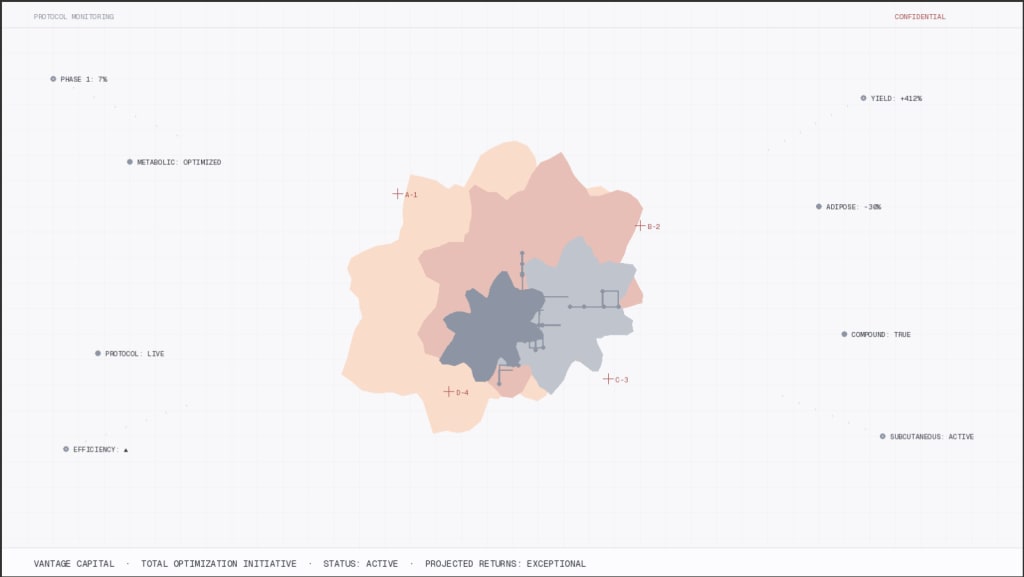
PROTOCOL STATUS: ACTIVE
PHASE 1 RESTRUCTURING: 7% COMPLETE
PROJECTED YIELD: EXCEPTIONAL
Welcome to your best investment yet.
Marcus stood on the wet sidewalk, the city humming around him, and felt something shift beneath his skin. Something that might have been horror. Something that might have been growth.
The market opened in six hours.
He had a decision to make. Report everything, burn it all down, cling to his degrading, inefficient flesh. Or—
The returns are incredible, Derek had said. And standing there in the dark, feeling the first small optimizations taking root in his tissue, Marcus realized he was already calculating the cost-benefit analysis.
The Protocol was inside him now. And some part of him—some new, efficient part—was wondering what he might become if he let it compound.
He went back inside.
The elevator doors closed. The numbers climbed. And Marcus watched his reflection in the polished steel—his face the same, his eyes the same, everything still his, still human, still inefficient.
For now.
The doors opened on floor 23. The white room was waiting. And Marcus, who had always understood the value of a good portfolio, walked toward his future returns.
About the Creator
Destiny S. Harris
Writing since 11. Investing and Lifting since 14.
destinyh.com
Keep reading
More stories from Destiny S. Harris and writers in Fiction and other communities.


Comments
There are no comments for this story
Be the first to respond and start the conversation.