
Cities in Pine
A Lonely Journey
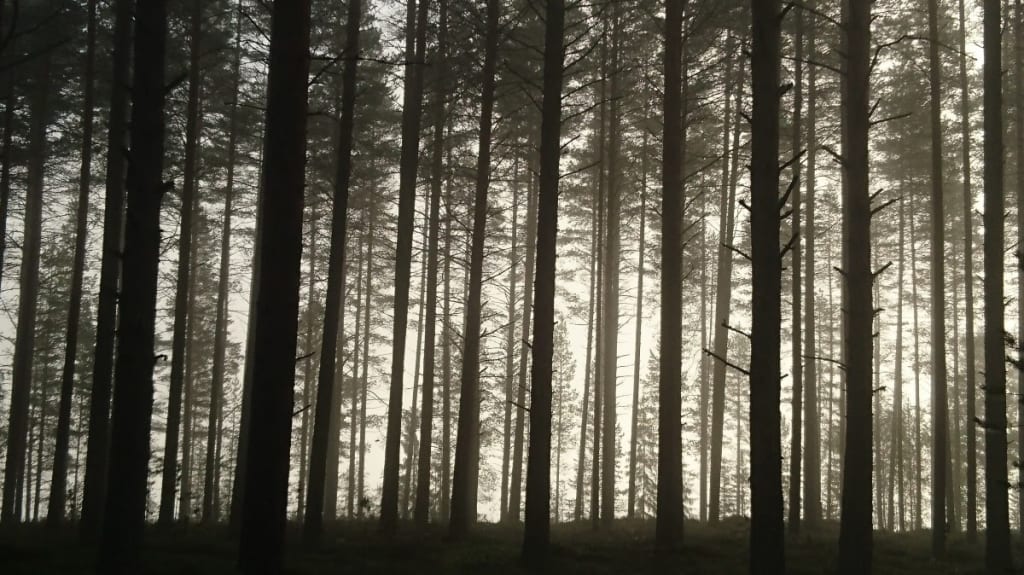
I awake from a dreamless sleep and, as always, gather my scattered thoughts about eternity before rising again. Behind me the boundless path runs to distant forgotten horizons, while the way forward is indistinguishable, absurd, and hazy. Powered by a ceaseless breeze flush with the rich scent-memory of a timeless but purposeful task, I wander the length of what I suspect to be an ancient evergreen tree, but at a scale that has afforded this lonely journey several thousands of years. Every needle-like leaf seems to stretch out before me as a limitless, empty plain bathed in dazzling light, the tree’s thick and unforgiving bark the indomitable mountain ranges that bound these alien landscapes.
What curse or promise resigned me to this seemingly endless and bizarre obligation? Forgotten, distorted by time or misremembered after centuries, now the irresistible compulsion to journey and the bubbling undercurrent of this singular purpose are all that remain. I recall nothing of the person I was before this began or of the beginning or purpose of the journey itself. Pointless to even try, perhaps, as the fallibility of memory is the only true certainty. I have long entertained, and cannot entirely refute, the possibility that I am dead and this is purgatory. My rationalisations about leaves and loneliness are then merely the fevered delusions of a truly-damned soul unwilling to accept the indifference of an empty and meaningless cosmos; these leafy alien forms the broken easel over which I have draped a tattered cloth of half-remembered, vestigial fibres. Somewhere here, for some reason I never knew or have forgotten or distorted over the course of countless empty days and nights, is, I hope, the answer.
A holy punishment seemed the most likely explanation for a time, and so I prostrated myself at the base of a pareidolic outcrop for several decades to contemplate and pray. Nothing around me changed, while, after a thousand nights lost in the terrifying recesses of a half-remembered dream, I uncovered from there a box - plain, wooden and coarse - that contained a perfect tree: bizarrely symmetrical, but also perfect in its bizarre symmetry. For years I lay underneath its whispering canopy as a gentle rain of its leaves fell delicately around me, and the swaying branches of that tree reached out to the edges of the galaxy and dappled the intense light of the first and brightest stars as it fell across my face. But, it was, at the same time, small enough to fit into that old, battered box that I carried with me. As is often the case in dreams, I thought nothing of this grand contradiction. I finally awoke when, looking at a tiny unspoiled leaf on that tiny, perfect tree, I saw myself on the leaf looking into a box containing the same tree. In the barren silence God had answered, and I continued to walk.
For a time I climbed the towering peaks of the transverse barken range that ran upwards to the unreachable sky, and down to the unforgiving earth, and was for years lost in the cavernous valleys of the folds and crevices of the ancient tree’s trunk. It was in these dry gorges and canyons of bark that I felt most alone. On top of a particularly grand peak, which had taken several days to climb, I stopped for a while to survey the limitless extent and perplexity of my enigmatic environment. The sterility of the dead epidermis of the tree afforded it a truly alien quality, that of the surface of a star-baked, airless moon or a coppery asteroid. Although the lush, boundless cellular pastures of the leaves were no less jarring to the senses, they were at least alive and thus somehow more relatable.
The worldscape of the leaf is homogeneity in structural form, but with a rich diversity at the scale of my being. Each leaf indistinguishable from another as a whole, but uniquely varied in composite part. Scale invariant fractality melded by evolutionary pressures obeying thermodynamic rules that somehow also afforded each leaf a subtly unique terroir. The gulleys of the epidermal surface form wide and smooth avenues, promenades of green, red, and blue, and sometimes also rivers and seas. Each cavernous stomata pockmarked across the surface opens to a lush caldera of rising steam and oxygen, and cascading organic compounds of rich, earthy pinene billowing out from the heart of the leaf. Far away, a cloud is forming in the sky.
This tree is to me a galaxy of worlds. I seem to walk unimpeded by fatigue or physics, exploring in detail these microcosmic fusiform landscapes, and ruminating on the long journey. Time passes, but not entropically. The leaves, as I see them, continue to exist in the same physical state as long as I walk their lengths even if they are newly grown shoots, verdant and supple, or the remnants of a disintegrating mesophyllic scaffold crumbling into the firmament of interpine space. They are so busy, so alive, with the raw power of the enormous organic engine of the tree, but also with inhabitants: insects, fungi, bacteria and archaea. Some living with the leaf, some against it. None pay me any heed.
After many years of wandering, I felt compelled to stop for some time to create and to build. I made timeless Sisyphean cities in the canals between stoma on an otherwise unremarkable leaf, near, what I assume, was the top of the tree, and then peopled thousands of empty structures with millions of ghosts, and carved expressive forms to line the prominence of the nearby stomatal crater to display my reverence. I worshipped with the ancestors of the world at the pinnacle of the stoma as towers of billowing steam gushed over us, and broke bread with the high priests of death in their reeking hovels. I adorned their spiteful totems with sacrifices extracted from the split-open chests of my enemies by means of callous augers, and then repented for my sins by constructing an enormous, labyrinthine observatory in the boughs of a dying leaf from the collapsing matter - the waxy exterior and the rotting xylem - to witness the gravitas of boundless decay and study the beauty of the fixed constellations. In each room of the observatory were more rooms, inside those more still. They were filled with the charts I inscribed that captured this singular moment in time by the pattern of the rot that surrounded me, and, to me, the arrangement of the rooms was a testament to the timelessness of that irreproducible configuration that represented both the map and the function of the cosmos. It was disgusting. After centuries of enduring the onslaught of irreversible decay wrought to an inexplicable standstill, I could not bear the sight of the unchanging universe. I burned the temple, and killed the priests.
Setting out on a makeshift vessel, I was captured by the chaotic eddies and microcosmic gyres of a leaf-bound ocean. Likely a rain drop or bead of morning dew clinging by electrostatic forces to a young, green leaf. It was filled with tumbling islands of rock and dust and pollen, as well as tiny, aggressive creatures, bound in a teardrop by surface tension, and my crude ship was dashed to pieces within the violent, undulating meniscus. An ocean-world within a world, I walked the abyssal plain of its depths and watched detrital snow cascade from the surface of the sea, building up in soft layers on the leafy ocean floor. Untethered, I floated in the muddy water to shape a submarine ark of clay and muck, which eventually came to a gurgling stop on the shore of the sea that bounded the relatively smooth, undulating bark of a young, supple branch. The ocean would evaporate soon.
Could you recognise a dying world, if you were walking it? The colour is key: dark reds and purples, yellows and oranges that are the gift of oxidation. The dying leaves take the longest to walk as they have both the greatest obstacles to overcome and the most to see and learn. It was on one such leaf, long ago, when I met another traveller - the first and only since. Where, or when, they ‘are’ was of little interest or consequence to their existence, their projected form an ever-shifting, two dimensional electromagnetic homunculi borne from the incompatibility, but the pitiful necessity, of this incursion into a three-dimensional universe. To my surprise we could communicate, and we spent a long time exchanging tales of our journeys. The traveller told me that their relationship with spatial and temporal dimensions were different to mine, and that they could choose to be as ‘large’ or ‘small’ as they desired, but that they could not see the value in traversing the spatial plane as I had done. Instead, they remained bound to a multi-dimensional coordinate in the ever-expanding tapestry of spacetime, while the physical universe passed them by like a raging stream. Their only, and most-desired, means of travel was through time. On the occasion we met, at the basal point of a beautiful, dying pine-needle of flaking crimson plates, leaf-snow was tumbling from crumbling promenades surrounding a natural, decaying amphitheatre in which a cosmic coincidence afforded us this chance encounter: a fleeting reminder of the continued existence of an external reality, albeit one that was unfathomable and intangible to us both, but that seemed more absurd than the juxtaposition of form and purpose we presented. There we found ourselves, for a time and at a space, balanced at the arête between the intersecting tails of two probability distributions whose limbs dropped away to a cosmic asymptote down which we would inevitably fall forever apart. The traveller told me about a time, far in the future, when they were the size of a galaxy.
Despite the millennia of travel, the countless diverse and lonely leafy islands I have traversed, a consistency in form, of being and structure, becomes evident. It is the phenotype of the fundamental laws of the Universe: those that govern the shaping of the world, the transformation of matter to energy, energy and life, life and death, and all between. There is diversity in shape and form to each of the leaves and the endless promenades of the barky interior, no two leaves truly alike at this scale (or any other), but there exists boundaries to these forms and physical limitations that cannot be overcome. Scale invariant tools of the cosmos: the binding and shaping of gravity, the canvas of the electromagnetic plane, the attraction of the nuclear forces. After millenia of travel, I can say for sure that these are leaves, and this is a tree. But nothing else.
My surprise at encountering the temple that night on a leaf piled deep with snow soon turned to apprehension and fear. It was unnatural and beautiful, and repugnant in the straightness of its lines and form. It was built of cold sandstone, and its surface was too smooth. After lifetimes wandering the ruddy, fragrant landscape of my vast acicular prison the brilliant planar surface of the temple was painful to observe and process. It was imposing, not just in contrast to the stomatal ridge from which it inexplicably jutted, but in the sense that its presence imparted an almost debilitating nostalgia that suggested a connection to another place and time that I once knew. Scores of indecipherable hieroglyphic text lined the doorway, which was enormous, imposing, and doorless, but the view of the interior of the temple remained obscured somehow in deep, unnatural shadows.
Inside the antechamber, to which I ventured without incident after ruminating on the temple for several weeks, it was bare and freezing cold. I realised that I had not felt cold in a million years or more. There were no decorations on the formidable walls, nor any text or inscriptions to reveal the mysterious purpose of the structure. In the centre of the cavernous central room, whose interior dimensions were strongly at odds with those of its exterior, was a raised platform on a narrow column. On the platform, a box. A familiar, course and poorly-finished box. The rough wooden sides felt as solid as unyielding rock, and, inside, was a tiny, perfect, pine tree. I studied the form of the branches, their bifurcations and subtle curvatures. I recognised each leaf, saw my abandoned ghostly cities etched into their pores, and dredged up vivid memories from within the dew-drop oceans still clinging to their tips. The course bark of the diminutive trunk was inlaid with the interminable canyons and caverns I wandered for hundreds of years in darkness. Placing the box delicately back on the plinth, I slowly turned and walked out of the temple into a forest of ancient pine trees bathed in dazzling, warm sunlight.
About the Creator
Andrew Rushby
I am a research scientist who has worked at NASA & the University of California studying worlds like our own around distant stars. I also like to write poetry & fiction with a philosophical bent.
Visit my personal webpage here
Keep reading
More stories from Andrew Rushby and writers in Fiction and other communities.
A Final Word
A translation from a scroll recovered from the uninhabited planet ‘Paradise’: I am T’ak and this is my foretelling of the end of this skein, recorded for the first and last time and to be preserved forever in the holy script of our people, which is rarely used. For generations greater in number than the islands of the world, our history has been recorded as song, poem, dance and hymn. But, now, as we observe the signs of our coming doom, we attempt to preserve our unique bifurcation along this long path of years atop these islands for our ancestors and our descendants to judge, as they are doing now and have been throughout our long sojourn, on this singular scroll.
By Andrew Rushby5 years ago in Fiction
The Devil's Cut
“Comrade, finally you’re awake.” The voice was smooth, sensual. A flickering incandescent bar was all that lit the white, sterile room. All Vladimir remembered was everything going black. He tried to move his arms and found them strapped to the gurney.
By Matthew J. Fromm4 days ago in Fiction
How To Save Your Life With A Glass of Water
Step 1. Acknowledge the smallest solvable problem I can tell you are reaching for the big stuff, saying something like—“If I could just quit drinking…” or “If my mother had never died…” or “If I wasn’t single…”—these are not what I am talking about.
By Aubrey Rebecca2 days ago in Fiction


Comments
There are no comments for this story
Be the first to respond and start the conversation.