
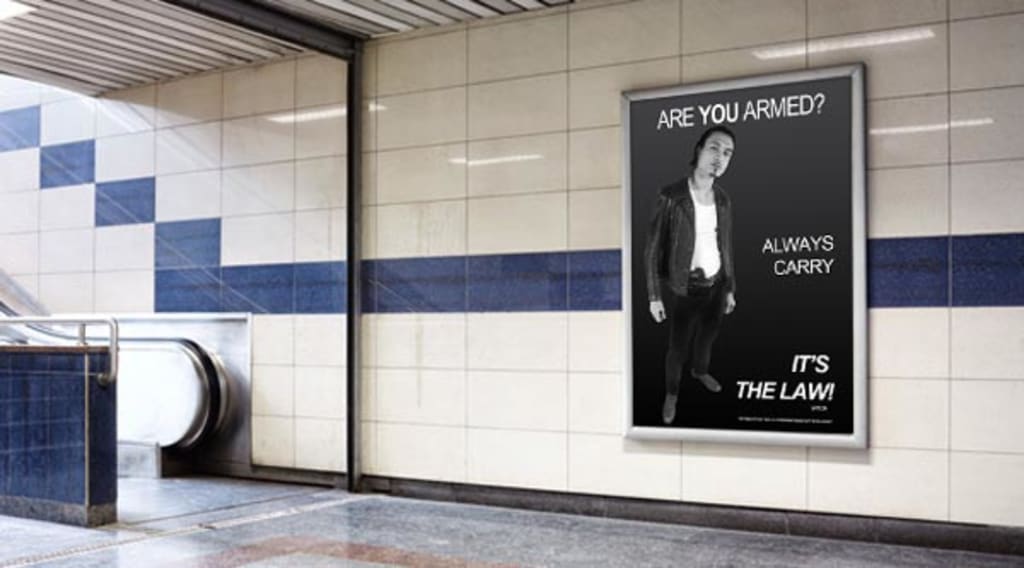
“You didn’t sign the Personal Safety Affidavit,” the interviewer, Mr. Ramirez, said. “Did you forget?”
Katie suddenly felt sick. The interview had been going so well. Of course she hadn’t signed the affidavit, and she wasn’t going to sign it. “Mr. Ramirez,” she managed to say, “about that affidavit….”
Ramirez gently interrupted.
“There is a lot of paperwork in the application packet and online. Did you just miss it?”
It wasn’t really a question, and she knew that he was trying to give her a chance to sign the PSA and complete the interview. She really needed this job. She was more than qualified for the open position, and both of them knew that she would truly be an asset to the company – and not in that “our employees are our best asset” kind of way, but in a helping-turn-the-floundering-division-around kind of way.
She’d been hoping - childishly, she knew - that the question would not come up. But it always did. She had one more interview at another company scheduled in a few days, and then that was it. No other interviews after that.
She could have simply signed the affidavit, as she had at her previous job. But there were frequent, random checks by employers to confirm that employees were complying with company policies, and she’d been caught in violation. It was only through the efforts of friends that she hadn’t been prosecuted for violating policy and lying on the PSA that she’d signed. She’d “only” lost her job.
“No,” she finally said. “I didn’t forget. I’m not going to sign it.”
Ramirez studied her for a moment. “Ms. Chen, you know that there is not one company in the country that would hire someone who can’t or won’t carry a firearm. The liabilities are enormous. They’re not going to open themselves up to lawsuits because you couldn’t or wouldn’t protect yourself or others.”
He leaned back in his chair, and she knew that the interview was unsalvageable and over.
“This would have been a very good opportunity for both you and this company,” he said, and then leaned forward. “If I may ask – why don’t you carry?”
His tone, familiar to her from what seemed like a hundred times before, was both incredulous and genuinely interested. The same tone that people whom society deems as eccentrics always get, with even the questioner knowing that the answer would be unfathomable to them.
“My child….” She began, and then knew that she would not finish the answer, as she never could, because the reason, always there, was always in the front of her mind as it was every day. The backyard BBQ. The sudden, awful loud noise. Her four-year-old lying there with only half of her head left. A gun had fallen out of one of the guest’s pockets. An accidental discharge. Tragic, but unavoidable, everyone said then, and still said. No one’s fault. Accidental Discharge. “A tragic, but necessary, price for freedom,” her husband used to say bitterly, before he drove his BMW through the barricades and into the front lobby of the local NRA chapter.
“Thank you for coming in today, Ms. Chen,” Ramirez said, understanding that she would not finish her answer. He was ending the interview. Katie mumbled thanks as they both stood and shook hands.
“Just a moment, Ms. Chen,” he said, as she started for the door. He pulled out his wallet, opened it, and extracted a business card.
Katie stiffened, suddenly wondering if he was coming on to her.
“Here,” he said, handing her the card. “Maybe you can go by and check with this company. They will have what you need to land your next job.”
On the light rail ride home, Katie sat looking at the card. It simply read “FAR EASTERN IMPORTS” in awful faux-Chinese font, and below that, in Comic Sans, “Toys and Novelties.” There was an address in a rather seedy commercial part of the city, but no telephone number, web site, or e-mail. Printed by hand at the bottom in faded ink was an ungrammatical “ask about our japanese line.” The card was well-worn, as if passed around a lot.
She had no idea why Ramirez had given her this card. Was it because she was Asian? Was he that clueless? And what would a place like that have to do with her getting a job and on with her life again? Curious, she Googled the company on her smart phone and found only the same basic information as on the card. But the location was very near the light rail – just a few stops ahead.
Someone in the crowded car was getting loud. Instinctively, she looked up without looking like she was looking. Everyone sat, as usual, in glum silence, staring at either the floor or ceiling of the car. Some passengers were openly carrying firearms, and everyone had the worried, hunted look that most everyone carried every day in public now. The loud person was a twenty-something man standing near one of the doors, wearing a backpack covered with Anarchist symbols, one hand thrust in his jacket pocket, obviously gripping a bulky object. He was singing, loudly and terribly, to whatever music was running through his earbuds and openly staring at the other passengers. None made eye contact.
As her nervousness grew, Katie - oddly, she felt - remembered a bumper sticker that she’d once seen in college. “A well-armed society is a polite society.” When the memory came to her, she almost felt that she was going to start giggling nervously. No one was polite. Everyone was scared, because there was always someone, either because of bravado or stupidity or insanity or drunkenness, who was not scared. It was like the old cowboy movies where the Bad Guys would taunt the polite Good Guy (it was always just one polite Good Guy being taunted) and then the guns would come out and the polite Good Guy would quickly dispatch the impolite Bad Guys, but the movies never showed people being inexpertly shot in every imaginable part of their body and screaming and taking a long time to die and they never, ever showed a little kid with half of a head.
The train started slowing for the next stop, and backpack man got louder. Katie felt her hand shaking as she instinctively clutched the locket she always wore under her blouse - an empty locket that was once heart-shaped but now had two-thirds of it removed.
The train stopped. A number of passengers, more than would normally get off at a stop in this part of the city, abruptly got up and left the train. Katie followed as well. She’d wait for the next northbound train, and knew that that was what many of the others exiting the train were doing as well. She looked back in the car as the doors closed and the train pulled away. The twenty-something looked at them on the platform, smirked, sat down on a now-empty bench seat, and put his feet up. It was what he’d wanted all along.
“Bastard,” someone muttered, barely audibly, but nobody really said anything and simply seemed resigned to waiting for the next train. That was what most people did now. Avoid any confrontation. Avoid any problems at all. Passively wait for the next train, or taxi, or table, or job.
“An armed society is a polite society,” she thought again. It was the same kind of politeness and deference shown by people who were always aware of the constant potential for explosive, random violence. It was the same kind of Polite Society as that of the Jim Crow South.
While waiting, Katie realized that this stop was the nearest to Far Eastern Trading. On impulse, she left the platform and crossed the street. Within a few hundred yards, she found Far Eastern Trading in a non-descript, aging commercial complex, sandwiched between a pool supply warehouse and an event staffing company. The company must have been there awhile. There was even a faded, half-missing NO FIREARMS ALLOWED decal on the dark-tinted glass door. Companies couldn’t have those policies nowadays. Everyone must be able to defend themselves at all times. It was the law.
Katie couldn’t see anything through the dark glass for the door. She opened it and stepped in, not knowing what to expect. The door jangled with an old-fashioned bell attached to the top. The few people working in the small administrative area to the left looked up briefly and then bent back to their desks and computers. Invoices, order books, and all of the miscellaneous paperwork associated with a warehouse and distribution company were stacked about in the office. The rest of the front room was a surprisingly large showroom of products that the company distributed – toys, balloons, party favors, and all manner of the cheap “throw away” goods many people associated with manufacturing in Asia. The sound of a forklift came through an open door in the back wall.
“May I help you?” The woman who got up from her desk and came over to Katie spoke with an indefinable middle-eastern accent.
“I’m not sure,” Katie said, showing the women the business card. “I was given your card.”
The woman took the card and looked at it. “We have a lot of things from Japan,” she said, uninterestedly, handed the card back. “What are you looking for?”
“I’m not sure…. I….” Katie had no idea why she was there. “I was told….” She trailed off.
“We do have a complete adult selection….” The woman began helpfully, unsure of Katie’s hesitation.
“No!” Katie snapped. “I have a job interview later this week, and I was told that you could help me with that. I’m sorry for wasting your time,” she said, turning to go.
“You need something for a job requirement?” the woman asked. “We have what you need.” Katie stopped. “What do you mean?” she asked.
“We have what you need,” the woman repeated. “In our Japanese line. I’ll show you, in the warehouse.”
The woman led Katie to the open door, put on one of the hardhats hanging from a hook beside the door, and handed Katie a hardhat marked VISITOR. The warehouse was larger than Katie would have thought. Boxed merchandise was stacked on Costco-style heavy shelving. Several trucks were backed up to the open doors in the back, and forklifts whirred about. Katie realized that Far Eastern Trading must be a regional distributor at the least.
They walked through the warehouse to a locked office near the back and the woman unlocked the door. The office was filled with boxed records and paperwork. Boxed computer hardware showed that they used this office to store their expensive office equipment. The woman went to a large metal cabinet against one wall and unlocked it. “These are all Japanese,” she said, opening the cabinet. “The best.”
The cabinet was full of handguns.
Katie felt cold. “I don’t want….” She started to say.
“They’re just like the real thing,” the woman said, interrupting her. “The same size, and weight, with the same markings. They even break down exactly like the real ones, but they can’t fire. Even if you put a real bullet in them, they can’t fire. No one can tell the difference. But you’ll know.”
Katie stood and stared at the cabinet full of fake handguns and started crying. She now knew why no one would talk about what was really being sold and why she would have to be as circumspect as Ramirez when she’d pass the business card to the next person. Katie cried and asked the woman how much one of the illegal toy pistols cost.
About the Creator
Keep reading
More stories from Darin Price and writers in Fiction and other communities.
After the Rain
“I didn’t see you in church this morning, Brother Richard,” Lindsey said. Stevens thought that he would fall as his fear leaped into terror, his legs suddenly too weak to support his weight. His fear had been mounting since he had heard Lindsey and the other men squelch through the wet grass as they came around the side of the house to where he was working in the garden, and now fear was tearing at him in a blind ravenousness.
By Darin Price5 years ago in Fiction
Me, Myself, and I
“Alright. Get in, get out.” “What do you mean, get in, get out? You have to buy stuff for a party!” “Yeah, but I know exactly what I need to get. None of that anxious debating between two items for who knows how long. And it’s just stuff for French bread pizza. The others are bringing the rest of the stuff. And I already got the cheese at the other store. Man, I was lucky there was a sale!”
By Rebecca Patton7 days ago in Fiction




Comments
There are no comments for this story
Be the first to respond and start the conversation.