
"Calmness is the Cradle of Power"
The Silent Strength - captures the essence of calmness as hidden power, while tying directly to your protagonist
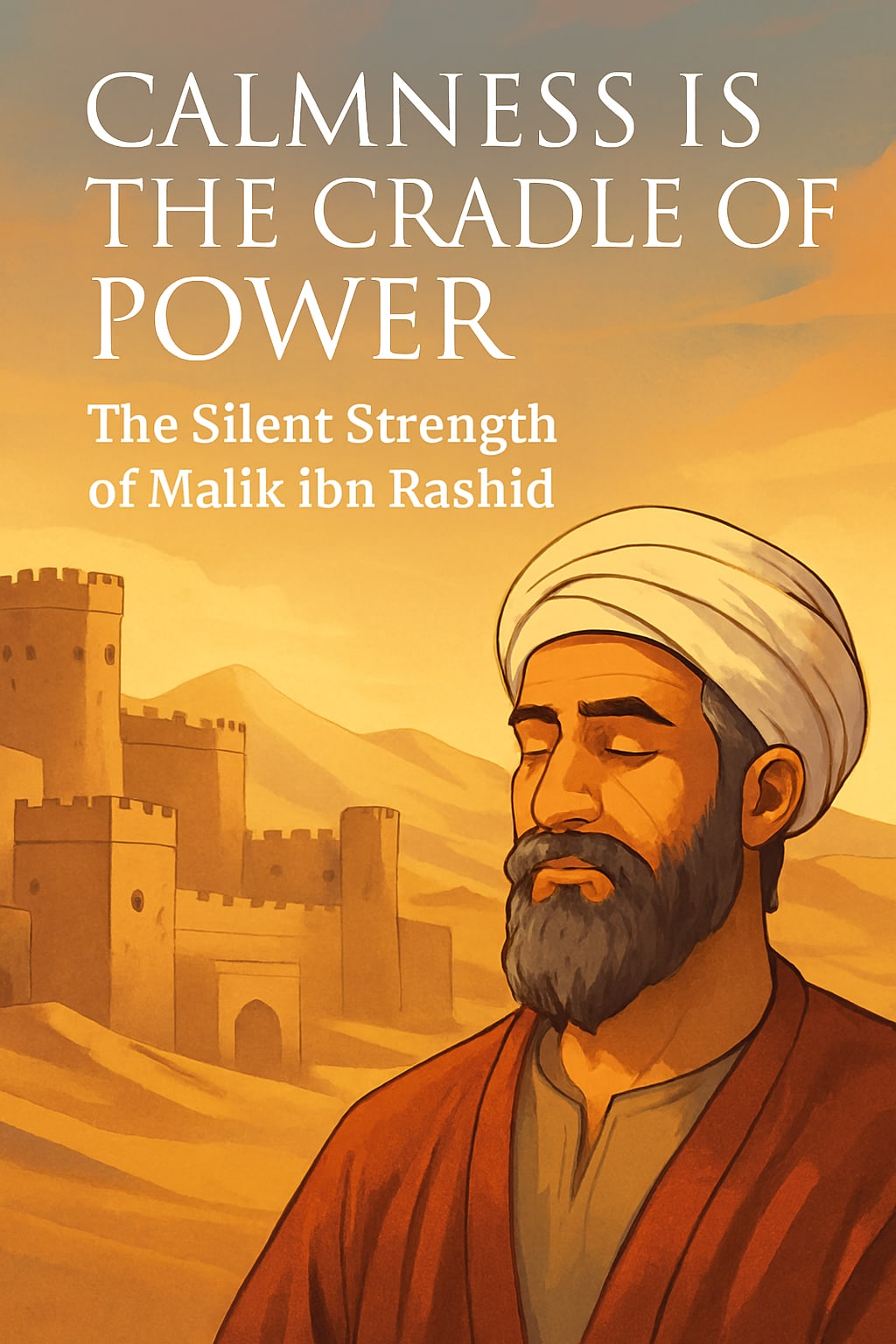
The desert stretched endlessly, its golden sands shimmering under the merciless sun. In the heart of this vast emptiness stood the fortress of Al-Qamar, a citadel carved from stone and silence. Within its walls lived Malik ibn Rashid, a ruler whose reign was marked not by conquest or cruelty, but by an unusual strength—his calmness.
Malik was not born into power. He was the son of a humble scholar, raised among scrolls and ink rather than swords and shields. His father taught him that true mastery lay not in the force of arms, but in the discipline of the mind. “The storm destroys itself,” his father would say, “but the river, calm and steady, carves valleys through mountains.” Malik carried those words with him long after his father’s passing
When the neighboring tribes waged war, Malik was chosen as leader of his people. Many doubted him. He was not the loudest voice in the council, nor the fiercest warrior in the field. Yet when others shouted, Malik listened. When others panicked, Malik breathed. His calmness became a strange kind of armor, one that no blade could pierce.
The Siege of Al-Qamar
One summer, a coalition of rival tribes gathered to overthrow Malik. Their armies were vast, their banners blotting out the horizon. The fortress of Al-Qamar trembled with fear. Soldiers whispered of defeat, merchants packed their goods, and even the council urged Malik to surrender before blood was spilled. But Malik did not surrender. He stood upon the walls, gazing at the sea of enemies. His generals demanded orders, expecting him to shout commands or rally troops with fiery speeches.
Instead, Malik spoke softly: “Fear is the enemy within. If we master it, no army can master us.”
His words spread like water through the fortress. The soldiers steadied their hands, the merchants unpacked their goods, and the council fell silent. Malik’s calmness was contagious, a quiet fire that burned away panic.
The siege began. For weeks, the enemy hurled stones, arrows, and insults. Yet Malik never raised his voice. He walked among his people, listening to their worries, offering a steady presence. When food grew scarce, he ate the same ration as the poorest soldier. When the walls shook under catapults, he placed his hand upon the stone and whispered, “Stand firm, as we do.”
The enemy expected fear to break Al-Qamar. Instead, they found themselves breaking. Their leaders quarreled, their soldiers grew restless, and their supplies dwindled. After forty days, the coalition dissolved, retreating into the desert. Malik had won—not through force, but through calm endurance.
The Test of Betrayal
Years later, Malik faced a different trial. His most trusted advisor, Harun, betrayed him, selling secrets to a rival kingdom. When the treachery was revealed, the council demanded Harun’s execution. “Strike him down,” they cried, “for betrayal must be punished with blood.” Malik summoned Harun to the great hall. The traitor trembled, expecting death. But Malik’s eyes were steady, his voice measured.
“You have wounded me,” Malik said, “but anger would only deepen the wound. Tell me why you betrayed me.” Harun confessed that greed and fear had driven him. He expected Malik’s wrath, but instead received silence. Malik dismissed the council and spoke privately:
“You sought gold, but found shame. I will not kill you, Harun. Instead, you will serve the poor until your hands learn the weight of true wealth.”
The council was outraged. They saw weakness in Malik’s mercy. Yet over time, Harun’s transformation became a lesson for the kingdom. He rebuilt orphanages, fed the hungry, and became a symbol of redemption. Malik’s calmness had turned betrayal into service, weakness into strength.
The Whisper of the Desert
As Malik grew older, his reputation spread beyond the desert. Travelers spoke of the ruler who defeated armies without battle, who punished betrayal without blood, who governed not with fear but with serenity. Scholars wrote that “Calmness is the cradle of his power,” and poets sang of his quiet strength.
One evening, Malik sat alone upon the fortress walls, watching the desert stars. His son, Amir, approached. Unlike his father, Amir was fiery, impatient, eager to prove himself.
“Father,” Amir said, “why do you never show anger? Does calmness not make you weak? Power comes from force, not silence.” Malik smiled. “Look at the desert, Amir. The wind howls, the storms rage, but it is the silent sand that endures. Calmness is not weakness—it is the foundation upon which power rests. Anger burns quickly, but calmness builds slowly, shaping destiny.”
Amir listened, though he did not yet understand. But the words settled in his heart like seeds waiting for rain.
The Legacy of Calmness
When Malik passed away, the people mourned not just a ruler, but a presence. His calmness had been their shield, his serenity their strength. Amir inherited the throne, and though his nature was fiery, he remembered his father’s lessons. In moments of rage, he would pause, recalling the desert stars and the whisper of calmness. Slowly, he too learned that power was not in the storm, but in the silence that survives it.
Generations later, the story of Malik ibn Rashid was still told in Al-Qamar. Children learned that calmness could defeat armies, heal betrayal, and shape kingdoms. Travelers carried the tale across deserts and seas, reminding rulers and rebels alike that true power is born not from fury, but from stillness.
Reflection
The story of Malik teaches us that calmness is not passive—it is active strength. It is the ability to hold steady when the world trembles, to listen when others shout, to forgive when others demand vengeance. Calmness is the cradle of power because it nurtures wisdom, endurance, and clarity.
A storm may terrify, but it passes. A calm river, steady and patient, shapes the land forever. Malik’s life was proof that the greatest victories are not won by force, but by the quiet strength of calmness.
About the Creator
Keep reading
More stories from Miss Maryam and writers in Fiction and other communities.
You Fear, You Die!
The Whispering Town The town of Wrelmere was a place you wouldn't find on any map. It sat between two old hills that were falling apart, and it was always covered in thick fog. The people there talked in quiet voices, avoided looking at each other, and locked their doors before the sun went down. Very few people came to visit, and even fewer stayed for long.
By Miss Maryam2 months ago in Fiction
The Devil's Cut
“Comrade, finally you’re awake.” The voice was smooth, sensual. A flickering incandescent bar was all that lit the white, sterile room. All Vladimir remembered was everything going black. He tried to move his arms and found them strapped to the gurney.
By Matthew J. Fromm4 days ago in Fiction


Comments
There are no comments for this story
Be the first to respond and start the conversation.