

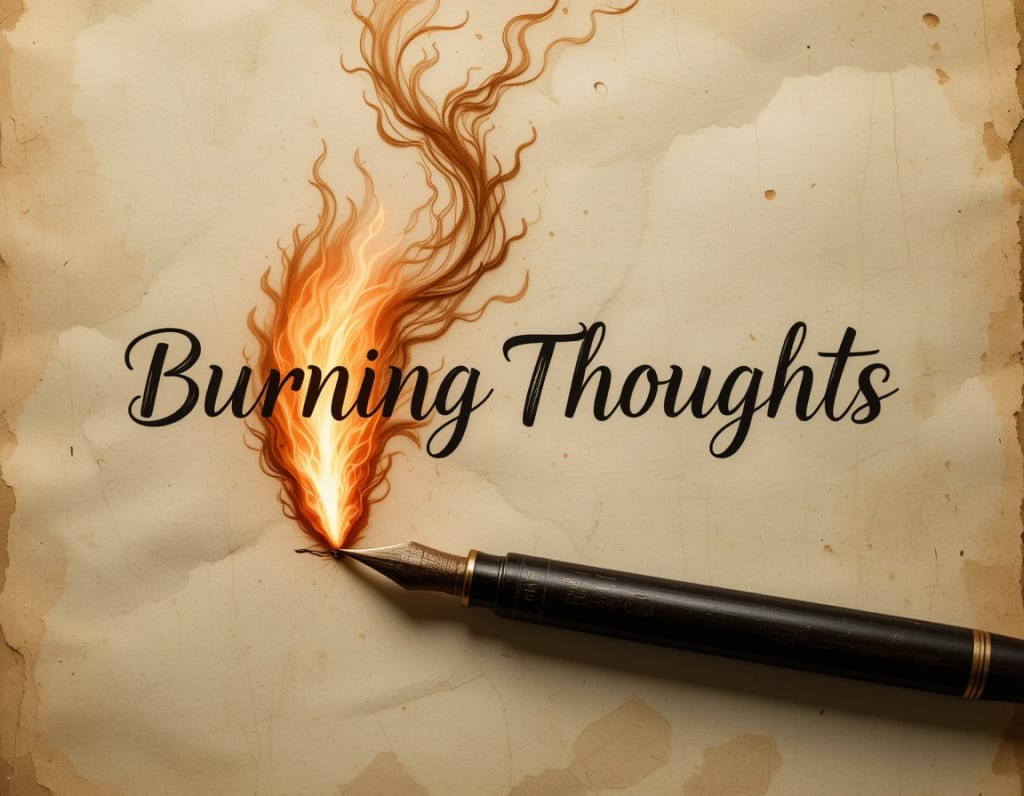
In a quiet town tucked between the edges of a forest and the rhythm of a river, lived a young man named Rayan. He was a reserved soul, not for lack of words, but for the overwhelming tide of thoughts that crashed inside his mind. He wasn't the kind to speak first, or speak often—but when he did, there was a weight, a warmth, a strange illumination to his words. People noticed, but few ever really understood.
Rayan worked at a bookstore owned by an old widower named Mr. Kael. The store, The Rusted Spine, was as much a sanctuary as it was a business. Between shelves packed with ideas and imagination, Rayan found solace. But more than that, he found paper, ink, and silence—the perfect companions for a soul ablaze with thought.
Each evening, after customers had gone and the city folded itself into quietude, Rayan would write. Not with a laptop or a phone, but with a fountain pen passed down by his grandfather—a silver instrument with a chipped nib that bled like a living thing. With that pen, he scribbled into a worn notebook, its pages warped with time, sweat, and sleepless nights.
His writings weren’t stories, not in the traditional sense. They were bursts—of emotion, observation, questions, fury, joy. Sometimes, he wrote a paragraph that read like thunder; other times, a sentence as still as morning mist. He never intended to be read, yet every word he poured out felt urgent, like a whisper demanding to be heard across time.
One winter night, snowflakes fell like ash outside the fogged window. Rayan sat hunched over the counter, notebook open, candle flickering beside him. The pen trembled in his hand, not from cold, but from something deeper—a conflict he couldn't name.
That day, he’d overheard a customer mocking poetry. "Useless scribbles," they said. "It doesn’t build roads, doesn’t feed mouths." The words had stung. Not because they were directed at him, but because they echoed the doubts he'd quietly carried.
What was the purpose of writing, he wondered? Why burn himself into pages no one might read?
He stared at the blank sheet in front of him. His reflection in the window looked like a ghost, flickering with the candlelight. And then, he wrote:
“They say words are weightless. Yet I have carried some for years.”
The sentence fell like a stone into water. Ripples surged inside him. He kept writing.
“I have been silent not because I had nothing to say, but because my thoughts were flames, and the world around me—paper.”
The ink flowed, not just from the pen but from the furnace of his spirit. He wrote of the pain of being unheard, of the loneliness of deep feeling, of how the world often favored noise over nuance. He wrote of beauty found in quiet things—the sound of turning pages, the breath between two sentences, the ache after reading something that moved you.
By the time he stopped, it was dawn.
Weeks passed. Rayan continued to write, more feverishly than ever. His notebook became a forest of ink and emotion. Mr. Kael, curious but careful, one day asked, “What is it you write with such... fire?”
Rayan hesitated, then replied, “Thoughts that burn too bright to keep inside.”
The old man smiled. “Then don’t hide the light. Let it kindle others.”
At first, Rayan resisted. Sharing his words felt like opening a wound. But slowly, he began to leave his writings tucked inside the books he shelved—between chapters, on end pages, in margins. Not as formal pages, but as folded slips, hidden truths.
To his surprise, customers started returning—curious, contemplative, eager.
“I found a note in a poetry book,” said a girl with tears in her eyes. “It felt like someone knew exactly what I was thinking.”
“Do you sell those?” asked a young man, holding a slip that read: “Sometimes we seek meaning not because we are lost, but because we are human.”
Rayan said nothing, only smiled. And wrote more.
His words spread like sparks. People began asking for "the paper messages." Some came just to read one and leave. It was never about his name. It was about connection. Every note, every line, was a mirror—showing others the quiet flames inside their own minds.
Years later, the bookstore was still there, though Mr. Kael had passed, leaving it in Rayan's care. Now, framed on the wall above the counter was a single handwritten quote:
“Ink on paper, fire in the mind.”
It became the soul of the shop—and, somehow, of the town itself.
Teachers quoted it. Artists painted it. Children wrote it in their notebooks. It reminded people that words, though small, could ignite revolutions inside the heart.
Rayan never published a book, never gave speeches. But his legacy lived in margins, in folds, in the thoughts he dared to burn onto paper. His gift wasn’t in shouting—it was in lighting tiny fires and trusting they would spread.
And that is the story of Rayan.
Not a hero of action, but of articulation. A keeper of thoughts. A writer of fires.
So the next time you find a slip of paper in an old book, or hear a phrase that moves something unspoken in you, remember: someone, somewhere, had a thought that burned too brightly to keep inside—and they gave it to you, quietly, through ink.
Because sometimes, the loudest flames come from the softest hands.
About the Creator
Keep reading
More stories from Taslim Ullah and writers in Fiction and other communities.
📢 Raise Your Voice Thread: 01/08/2026
Our “Raise Your Voice Threads” are hosted most alternating Thursdays at 12PM ET to offer creators more avenues to uncover exceptional stories on Vocal. As we are continuously searching for fresh creators and inspiring stories, this thread provides an opportunity to exchange and discuss the stories that have moved and motivated us on Vocal.
By Raise Your Voice by Vocal6 days ago in Resources




Comments
There are no comments for this story
Be the first to respond and start the conversation.