
Brothers In Arms
By Celia in Underland and Mark Gagnon

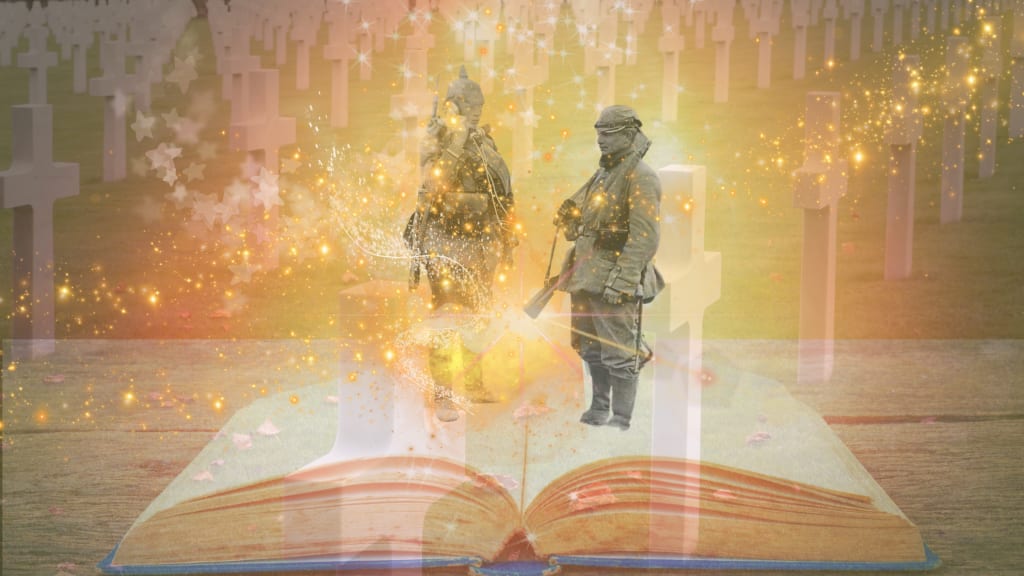
Franz
Franz Anderson squatted with his back against a muddy wall of the trench assigned to him. Mud was the word of the day. The goopy stuff oozed over the top of his boots, stuck to his pants, coated his skin, and even infiltrated his food. When he ran for cover from incoming fire, it slowed his progress. If the officers ordered him “over the top," the mud transformed his charge into a slog. Just the rats that infested the trenches were unhindered by the mud. The only positive effect of having so much mud was that the British and French had to deal with it as well. When the phrase War is Hell was coined, what they really meant was War is Mud!
No one asked Franz if he wanted to be part of this great war. The government drafted him and almost every other soldier stuck in the muddy trenches that lined the German half of no man’s land. Had Franz been offered a choice, he would have continued with his studies at the University of Bonn. Unfortunately, the only choices were volunteer to defend the Fatherland or get drafted. As an act of defiance, he waited until the army drafted him.
Fatherland is a term that always stuck in Franz’s craw. He had no father, at least not one that he had ever met. His mother had given Franz his father’s last name, Anderson, but refused to give up any information about him. He would see other boys walking with their dads or playing catch and wondered what he did wrong to make his father go away. His mother remained silent about the man’s identity. She died of influenza when Franz was seven, taking her secret to the grave.
The second part of Franz’s identity mystery was his last name. Anderson is not a German name. It wasn’t unusual for someone to ask him what country his parents came from or where he lived before moving to Deutschland. When he had no satisfactory answer, many people shunned him. Alienation increased as Germany inched closer and closer to war with the rest of Europe. Soldiers from every country have their last names on their uniforms. Now everyone could simply look at his chest to see his last name.
Some people in his unit thought he was at least part English. Now Franz had to put up with wisecracks. Aren’t you in the wrong trench, or you’re not going to shoot me in the back, are you, were some of the more common ones? All he could do was to prove himself on the battlefield. He saved several of his comrades’ lives and had the second-highest kill ratio in his unit. Eventually, the remarks stopped, and they accepted him as a stalwart soldier.
Winter stretched its frozen tendrils across the battlefield, leaving the soldiers on both sides of no man’s land shivering in the icy muck. The hail of bullets and consistent mortar fire slowly decreased from terrifying to more of a nuisance. A fellow soldier pulled a small calendar from under his trench coat. He studied it for a moment, then announced to everyone within earshot that it was Christmas Eve.
Emotions ranged from tears of sadness shed by men who missed their loved ones to fits of rage toward the enemy. One thing everyone agreed on was no one wanted to be there. Franz started singing O Heilig Nacht softly, almost to himself, but his voice increased in volume as those around him took up the song. The chorus swelled throughout the trenches. Remarkably, when there was a pause between songs, they could hear the British and French singing Christmas carols as well.
To this day, Franz has no explanation for what he did next. The soldiers had an old football in the trenches with them. Ignoring the danger, Franz grabbed the ball, climbed out of the trench, and began dribbling it with his feet. No one took a shot at him. Instead, a soldier from the other side climbed out of his trench and motioned for Franz to pass him the ball, which he did. Soon, combatants from both armies had formed teams and were playing against each other on the battlefield.
It was at the end of the match that Franz saw a British soldier with a nametag that said, Anderson. He had to talk to this man.
Jacob
Across the wasteland, The British soldier sat uneasily on an upturned crate, his back sinking into the muddy trench wall. A bitter chill of winter crept through his tattered uniform, a world away from the peaceful life he had known in England. He thought of the village. The pocketed cottages, almost painted. The overflowing hills, lolloping into each other, meshing shades of green like a knitted scarf. He thought longingly of the peaceful life he had had.
“Bloody Germans,” he thought bitterly as he squished his muddy boot further into the squelching gunk beneath his feet. The mud was overwhelming. Everywhere he looked, the dark stench of it. The gray and black horror of it all caved in on him. Mud. It hampered his every movement, a ball and chain attached to his ankles as he ran from enemy fire. “Bloody Mud,” he muttered to no one in particular.
“What’s that, Anderson?” a booming voice intercepted his thoughts. He didn’t reply. And the speaker didn’t bother to ask again.
War had not been on his agenda for life. He was intent on following in his father’s footsteps and becoming an engineer. Whenever his father would return from an assignment, they would always build together. Usually, father and son constructed ships out of matchsticks. Sometimes, the two created other things as well. Buildings and Vehicles were some of their favorites. It was how they bonded. They didn’t need to speak. The shared purpose was all they needed to communicate. When he died the year before the war started, Jacob was even more determined to study engineering. He had been waiting for responses from Cambridge, but the war had gotten in the way.
In his misguided state, he had signed up for the war. They had told him it would be over quickly. That he would return home a hero. In the midst of his grief, Jacob needed to be the savior. The son that would make his father proud. Besides, he knew that conscription or the white feather brigade would get to him eventually, so he enlisted. But he had neither the constitution nor the hatred for the enemy that seemed to drive his other comrades. He thought this Wilhelm fella (What kind of name is that, anyway?) needed a good bloody pelting and they could all be on their merry way.
Huddling further into himself, he thought of home where his mother now toiled in the munitions factory and, of course, his Linda. The smile of joy on her face when he had proposed just before he had left. He needed something to remember her by.
As he sunk further into the mud and his own memories, a soothing sound encircled his solitary moment. “Long lay the world in sin and error pining ‘Til He appears and the soul felt its worth.” It took him a few moments to realize that his regiment had congregated and were singing the hymn together. The chorus echoed through the trenches. He left thoughts of home behind and joined in with the collective. Tears streamed white down his mud-drenched face.
As the song came to a close, they were about to start another when they realized they were not the only carollers. The Germans were mid-refrain of their own version of “Holy Night.” “Remarkable,” the lieutenant stated, shocked at the revelation. “Not really,” Jacob thought to himself but dared not speak his mind. “They are just humans, too.”
The regiment began their second rendition of the carol. “Jesus Christ. It’s a bloody Hun!” The voice halted the song, mid-refrain. The soldier was pointing manically.
In the midst of this desolate war zone, a German soldier was dribbling a ball with his feet. The English stared over the top of their barricade, clamoring over each other to glimpse the spectacle.
“Has he lost his damn mind?” a voice shouted.
Before anyone could stop him, Jacob had rushed out onto the makeshift pitch and the two enemies were playing kickball in the dirt.
Carried by the hope of Christmas or a desperate longing for peace, soldiers from both sides joined them, forming teams.
If only for a game of football, the psychosis of war had temporarily given way to humanity. In no man’s land, the simple act of passing a ball had allowed them some respite from the harshness of the cold and the desecration that surrounded them.
As the winter sun began its descent and the game fell into itself, Jacob saw a German soldier staring at him intently. “Strange,” he thought as he trudged back to his side of the earth.
Connection
Thick fog blanketed no man’s land shortly after each side returned to their trenches. It was impossible to resume the battle since soldiers weren’t capable of seeing the enemy. Besides, after sharing a Christmas game of football, no one had a strong desire to kill the other team. Franz was sure the other side felt the same way. It was during this lull in the action that one of Franz’s superiors decided the fog created a perfect cover for a scouting patrol. They selected Corporal Franz Anderson and his unit for this mission.
Dummkopfs thought Cpl. Anderson. This is a stupid idea. How are me and my men supposed to see where we are going, or what might be waiting for us when we get there? True, they all had compasses, but that only gave them a heading. It didn’t tell them they were about to walk into barbed wire fencing or a minefield. Yes, a stupid idea, but orders are orders, and he had to obey them.
The five-man patrol went over the top and formed a standard V formation, with Franz taking the point. They hadn’t gone more than a hundred meters when he lost sight of the trailing men on either flank. Not being able to see if the enemy was nearby, it was unwise for him to call out to his missing men. The soldiers on either side of Franz drifted further from his position and after another two hundred meters, they were also enshrouded in fog.
A flash of light reflected off the thick fog, followed by a muffled explosion and a cry of pain. The sequence repeated on Franz’s left. The only explanation was that two of his men had stepped on land mines. Fear took control of his remaining men and they headed back to their side of no man’s land. In a matter of minutes, another explosion and another man had died. Corporal Anderson was now alone, shrouded in fog.
Franz was now faced with a life-or-death dilemma. He had no idea what lay ahead of him, but he knew that the way back to his trench lay strewn with mines. The third option was the worst choice of all. He could stay where he was until the fog cleared and try to make it back to the German side. Option three would make him a sitting duck.
As he stood deliberating his fate, the fog parted slightly, allowing a sliver of light through. The ribbon of light acted as a pathway through the obscurity of the ground-hugging cloud. It wasn’t a tough choice for Franz, after all. He would follow the light to wherever it led. Hopefully, its source would be someplace safe and warm. A foolish thought in the middle of a battlefield, but it was all he had.
The longer he walked, the brighter the light became. It was his beacon of hope in a sea of despair. Franz wasn’t sure what to expect, but he wasn’t expecting a light source like this. Blocking the end of his path stood a massive stone structure. The Ionic marble columns supporting the front of the roof stood fifty feet tall. They framed a large intricately carved double door. Fifty marble steps offered access to the entryway.
Franz was so in awe of the vastness of the structure that he absentmindedly set down his rifle and stepped on the first stair. He heard the distinct click of a rifle bolt sliding a bullet into the chamber. He turned slowly to face a British soldier, pointing a weapon at him. Cautiously, Franz raised his hands in a gesture of surrender. He recognized the soldier from the football game. In times of stress, the brain works in odd ways. He remembered his mother insisting he learn English while most of the other kids were learning French. At the time, he hated it. Now he was grateful.
In heavily accented English, Franz said, “I am unarmed and mean you no harm. Do you know what this place is?”
Jacob, his rifle still trained on the German, stared silently, torn between suspicion and curiosity. Off balance by the strange but magnificent façade of the building, and coming face to face with the enemy had rendered him incapable of action.
“No bloody idea.” He muttered, lowering his gun cautiously, “I’ll be damned. Right here in the middle of a bloody war zone.” He shook his head vigorously as if trying to realign his brain. “Whatever it is, it ain’t no ordinary place. I can tell you that much”.
“Agreed.” Franz lowered his arms carefully. Jacob didn’t seem to notice—too caught up in the spectacle. “It looks like some sort of err library or archive,” he said tentatively, gesturing to the massive columns and the grand entrance.
Feeling more comfortable now and his curiosity piquing over his fear, “A library, eh? Well, that’s rather odd. So how did you manage to get yourself here, then?” The words hung in the air like gunfire, neither sure of the answer. Franz decided to go with the simpler response rather than the life story.
Exhaling loudly, Franz explained, “I was part of that Christmas… you know, the football game we had earlier. When the fog rolled in, my patrol was,” he paused, searching for the English word, “divided.” He mulled it over for a second, content with his choice, “Yes. Divided and I … then this strange light. I followed it here.”
Jacob’s expression softened, and his shoulders visibly shrank into his usual stance. Recognizing the absurdity of the situation, he stifled a laugh. “Well, I’ll be damned. You and I, enemies not too long ago, and here we are.”
Franz nodded, “Indeed. War can make strange, umm bedfellows, as they say.”
Jacob stepped cautiously closer to Franz. “So, what do we do now? Do you think we’re dead? Who’d have thought death would be a bloody book storage facility? Luckily, I like to read. How about you? Umm Err”
Franz extended his hand. “Franz, My name’s Franz Anderson. “
Jacob took a step back before moving forward to shake the hand held out before him. “Anderson, eh? All very bizarre this I must say.” He paused as he took the hand in his. “Anderson, you say? Looks like we have something in common, aye old chap,” he chuckled uneasily. As the two shook hands, the building seemed to glow like the waxing moon after a heavy storm.
In symbiosis, they both looked up. A gold leaf plaque, embedded in the enveloping wall and engraved in the black lettering of eras the past proclaimed, ‘The Great and Auspicious Library of Living Tales.’ It appeared to levitate, enlarging and twisting before filtering back into the wall.
“What the…? Jacob began.
Franz reached out and touched his arm gently.
In that gesture, a silent, tentative agreement took place. The two soldiers, once bitter enemies, now united by their shared curiosity, walked up the imposing steps and into the library.
On the long table of the reading room, the two men read of their lives and the ones that had gone before. Mothers that had shared in the pride of home. It told of their love of their only son along with living with an often-absent engineer father. As each turned the last page and let the leaf fall to the hardcover, they understood why they were there.
Brothers in arms, yes, but more importantly actual brothers as well.
They fell into each other. The war and the horror seemed a distant past.
And outside, in No Man’s Land - in the space between the countries, bloodstained snow marked the spot of the fallen men.
(The library could do with a few more stories. Find a writing partner and add to the collection. This is not a challenge, it's a call to arms!)
About the Creator
Mark Gagnon
My life has been spent traveling here and abroad. Now it's time to write.
I have three published books: Mitigating Circumstances, Short Stories for Open Minds, and Short Stories from an Untethered Mind. Unmitigated Greed is do out soon.
Keep reading
More stories from Mark Gagnon and writers in Fiction and other communities.
Revenge
Zephyr meticulously mixed the potion to ensure its maximum strength. When his brew was complete, he drained every drop from the cauldron into a waiting mug and guzzled it down. The mixture took effect immediately. His beard changed from long and white to a salt-and-pepper gray stubble. Zephyr’s back straightened and stretched, adding several inches of height to his already imposing frame. His eye color transformed from a mysterious black to an alluring deep ocean blue. There was nothing about him that resembled his original self.
By Mark Gagnon2 years ago in Fiction
Incident Preparedness Guidelines: Safety Procedures for Unplanned Incidents.
Dear New Staff Member, Herein are instructions that are provided as a courtesy to ensure safety across our green campus. Please follow them carefully. As you are aware from your recent onboarding course, your wellbeing and that of the children in your care is paramount to our institution. Consistency is key. In precarious situations, panic is somewhat inevitable. Naturally, we aim to minimise this as much as humanly possible. You will invariably, from your mandatory attendance of the above-named course, recall that children under undue pressure respond best to routines that are both familiar and rehearsed.
By River and Celia in Underland about 16 hours ago in Fiction




Comments (5)
Damn, thought I had commented on this. This was stunning. Beautiful, poignant and the characterisation was wonderful. Loved how you gave it a grounding in reality by way of the war and the Christmas Day football match. Well done Mark and Celia. Sorry about delayed commenting!
That library was so fascinating! Such a creative concept! I loved how the beginning of the story seemed very ordinary but the ending was extraordinary!
Wow, what a story and great collaboration . Not an easy thing to do. This turned out beautifully.
That was so cool, you two! Loved the way you ended it.
Thank you! Loved working with you 🤍🤍🤍