
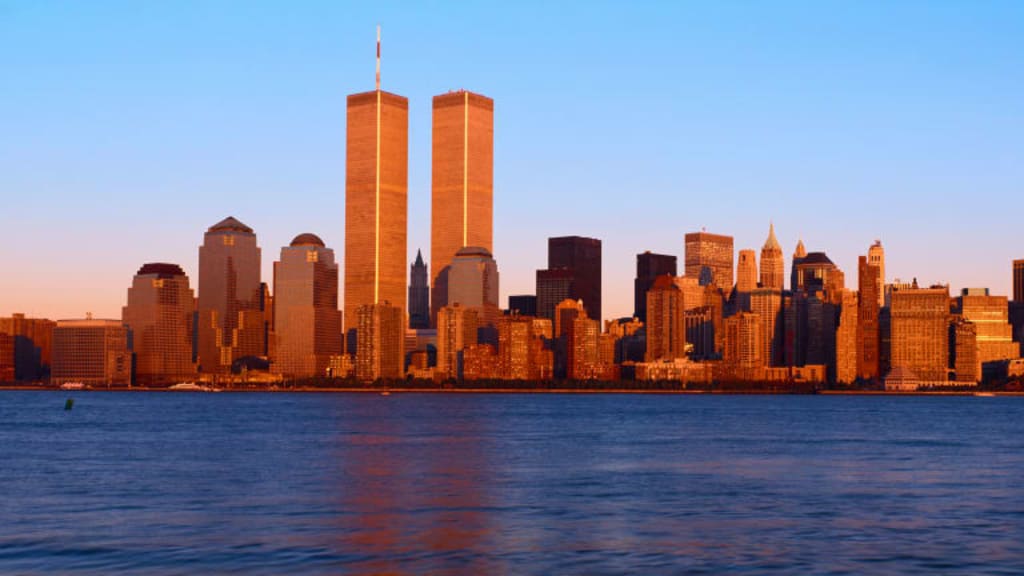
Somewhere north of ultramarine, a little west of cyan; there is a blue that I will never forget. A blue like a robin’s egg. Or that salwar I wore on Eid, my junior year. The bright blue of that portentous New York sky; sprayed with grey puffs like the streaks in my Abbu’s eyes. Puffs that, they said, stole America’s innocence. But what no one talked about, was how it also stole mine.
The truth is, that blue wasn’t special. I had seen that blue so many times, in its many myriad shades, even before that fateful day when smoke painted the skies in a hundred shades of death- I had seen that blue eating hotdogs on Franklin with Abbu and Rizvi, on the steps of the Met with David, on the day of my first kiss with Jeff- I had seen the blue before.
On the perpetually warm and sticky United Air flight from Lahore, I saw that blue in the eyes of the white man in the beige suit who sat across the aisle from us. In the echoing drawl of the evening azaan that pierced through the humid air of the airplane, carrying with it, scents of spices and burned rubber, my father’s sweaty arm pressed against mine as he struggled to place our luggage in the overhead compartment. ‘Noor, meri jaan, help your father with the bags, please’ amidst baby Rizvi’s restless yawns, Ammi said, in her outside-voice, the constructed inflection that she had mastered over the years that worked equally well with both Urdu and English (quite different from her “home voice”, the one in which she sang old Bollywood songs to herself while cooking, recited the Quran while praying, and snored while sleeping). And as I helped Abbu push the duffel bag into the overhead compartment and turned to find my way back into my seat, in the beige-suited man across the aisle from us, I saw that blue, the blue of condescension.
In the waiting room of Mount Sinai, months after that plane ride, through the glass panes, I could see Ammi, a frail shell of the woman she once was, her off-white hospital gown clinging to her as she stared at the ceiling from that ghastly bed. Tubes and wires ran from her skin and into the many metal contraptions that surrounded her. Like a grotesque monument to uncertainty, the black-and-green screen next to her beeped in a steady, unsettling rhythm. Lubb dubb. Lubb dubb. Lubb dubb. ‘Honey, it will be alright’, the woman on the chair next to me said, her voice kind and her hands almost touching me. Almost. But not quiet. As I looked down, on her apprehensive fingertips, I saw the blue again.
‘The lubb is heard at the beginning of the systole caused by…’ I heard in my head, as Ms. Wharton’s AP Biology came back to me. The day she taught us heart sounds was the day David and I had ditched early to go get hotdogs and watch Jeff play. I had been in love with Jeff for as long as I could remember and he had only started to notice me at that time. Three weeks later, I had kissed him. A blue sky and the starchy stickiness of beer on his chin. I remember walking back home at the dead of the night from his party. Ammi had caught me sneaking back into the house. That was the day she had slapped me. For the first and last time. Her eyes bloodshot, she had yelled at me. She had called me a randi. A slut. In her indignant eyes, I saw that unmistakable blue. The blue of disgust. Of shame. Of disappointment. A month later, hooked on to more tubes and contraptions than I could count, somehow, Ammi had looked so much less scarier. So much less Ammi.
I remember Abbu standing up that day outside the intensive care room in Mount Sinai, the frown on his forehead reaching the bridge of his nose. I heard him mutter something. Arabic perhaps. Maybe Urdu. I had never paid enough attention to either to know the difference. And then he just walked. I remember catching up to him just outside the parking lot. He was fumbling with his lighter. The bloody tumor, he swore. Madarchod. Frustrated, the lighter fell from his hand onto the tarmac. By the time I walked up to him, he was just staring at the lighter on the ground, lost. Flickers of frustration clouded his glance as he sighed in a hundred fleeting moments. The lighter lay by his feet and yet he couldn’t bring himself to pick it up. He stared at it like a ship caught in the eye of the storm. I looked at him. My Abbu. So small. So trepiditious. His eyes told me he was sad. His stoop told me he had no idea what to do about it. Somehow he looked smaller than he was. Like an everyday, regular, mundane thing that people took for granted; like a toothbrush, or the odor of cold metal on a coin. And the cigarette sticking out of the side of his lips, well, it just looked lonely. I remember picking up the lighter and holding it ablaze for him. He stooped a bit further to touch the tip of his cigarette to the heart of my flame. Slowly taking in the pungent smoke, staring aimlessly at the concrete nothingness, Abbu had whispered, for the first time ever, “Thank you.” And there in his grey-streaked eyes, I had seen a different blue.
I saw that blue again in the practiced kindness of the aunties who were cleaning and dressing my mother’s body. The blue of sympathy. Of pity. I should have cried. But I didn’t. I remember not knowing how to feel. Somehow everything was different but then again, nothing felt different at all. What was I supposed to feel, I remember thinking. How was I supposed to act? As I stood there, oiling my mother’s hair with attar, all I could think of was why she had never bothered to oil my hair with this perfume instead of her rancid coconut oil.
‘Sit still, beta’ Ammi would hold me down as she rubbed tempered oil into my scalp.
Ammi had thought of herself as some kind of a Pakistani beauty guru. ‘Haldi makes you golden. Glowing. Fair. Everyone likes a fair girl’; she would say. ‘And besan makes your skin smoother. Dahi keeps your face young.’ There were few fates worse for a Pakistani girl than being dark. Comparable only to not not getting into medical school, or falling in love with an Indian, a Hindu, or god forbid, to a gora-a white boy.
It was always haldi and besan and dahi with her, never turmeric, gram and yogurt. The angrezi words were abominations. A bastardization of the sweet secrets of the motherland. Armed with her oils and besan and haldi, she would corner me. I remember remembering our fights. I never wanted egg-whites and yogurt rubbed on my skin! I wanted the serums and lotions everyone else in my class used. Ones that didn’t smell like food. Ones that glittered and shined.
‘Fine’ I remember murmuring as I walked to the bathroom sink. That was the night of Jeff’s party. Like someone once said, with desi parents, one only had so many cards of defiance one could play a day, and I wanted to hold on to all of mine for the party and not waste it on Ammi’s silly beauty routine.
‘Look at you now!’ Ammi had beamed as I washed away the turmeric, nay, haldi scrub from my face. ‘You are glowing!’ She had said.
By the time I started crying, Ammi was already in the ground. I would never see her again. Far away across the cemetery, I remember my father and uncles performing the Salat al-Janazah. On the steps of the mosque, Rizvi was fast asleep on Leila Phuppo’s hips, oblivious.
I remembered Jeff’s party. I had fought with Ammi that night. I had done everything right and yet she wouldn't let me go to the party. But back then that party had felt like the biggest thing in the world.
‘Ansari! You made it!’ Dave had yelled as he had tackled me to the ground.
‘Fuck off, McGoyer’ I had pushed him away, laughing. ‘Are you drunk?’
‘Hell yeah, I am! This is our first high school party!’
‘Whatever am I gonna do with you!’ David had taken my hand and got back on his feet, dusting his trousers.
‘So tell me, Noor, how did you convince your folks?’
‘I didn’t’
‘No!’ His eyes widened with mischief. ‘Nooo, no no no no. Don’t tell me you-’
‘Yes I did.’ I laughed
‘The window?’
‘Uhm uhm.’ I nodded
‘You jumped off the roof?!’
‘I tried to convince them! I played all my cards, man. They still wouldn’t let me. I fucking hate my mom.’
‘So I have heard.’ David always had a smirk on his face that was insufferable because of how effortless it seemed. ‘You’re sixteen now, honey. You do realize you don’t need your parents’ permission for everything right?’
‘You don’t get it, D. It’s different for me. My family is so weird. They don’t have any respect for or even any understanding of personal space. Did you know they threw a party for every Punjabi in Manhattan when I had my first period? So embarrassing!’
‘Yeah, you might have mentioned.’ David had laughed ‘Only like 500 times!’
David had punched my arm and shook his head.‘You know what I just realized? In Sabrina, this is when we would know if you are a witch or not.’
‘We both know I’m not. Only white girls in Archie comics get to be witches.’
‘Hey, you have bangs, you listen to Britney and you have a gay bestfriend’ Dave had winked. ‘If you aren’t a white girl, I don’t know who is.’ And then, David had hugged me, whispering, ‘You know I’ll always be there for you right, Ansari?’
‘I know.’
‘Now go get yourself drunk.’ Punching my arm again, he had disappeared before I could retaliate. Wading into the crowded living room, I smiled. And then, amidst the noise, someone had yelled, ‘Welcome to High School everyone! We are going to have the best four years of our lives!’
Walking back from that party, Jeff’s kiss on my lips, adrenaline in my veins and a palpable trepidation in the pit of my stomach; I had for a second almost believed that. The best four years of my life.
On the day, the first day of fall of my junior year, I first saw the fateful blue on TV. I came home to Abbu, stiff as a rod, Rizvi on his knee, the TV lights flickering on his face. As we watched, a commercial airliner crashed into that unmistakable tall building. Half of it still protruded out, hanging in mid-air like a precarious, broken toy. In moments, a second plane crashed into a second building and turned into a garrulous ball of fire. There was smoke and white dust everywhere. Tiny people jumped out of the tall buildings and floated down like flecks of ash. It wasn’t a film, the TV said. I looked out the window, too stunned to talk, outside I saw the blue sky and then, I saw the smoke.
On that day, the day, my Abbu cried. My abbu who woke up in the dark smelling of coffee and the dream. My Abbu who always bought his clothes a size too small. My Abbu who combed his hair in the car as he hummed old Bollywood songs. My Abbu who stifled every pain in a hundred fleeting sharp sighs. That day, my Abbu cried.
I had never seen him cry before. Not when he had lost his big toe in a car accident. Not when he lost all his business to loanshark in Charlotte, and had to move to New York and start a bodega. Not when the green lines on the black screen next to Ammi went quiet, taking with it a piece of our hearts. And not even when our handfuls of soil filled the Ammi-shaped hole in the universe. Not ever before. But he wept that day. Alone, silently. I did not understand him then, but he had seen the blue all his life. And that day he had seen it again. The unmistakable blue of fate. Of knowing that nothing would ever be the same again. After what seemed like forever, my father spoke: ‘What matters it, O! Monsoon winds; if now has come the rain. When I have lost them both, my pasture and my nest.’
He had never been very religious, but he went to the masjid that day. Took baby Rizvi with him too. ‘There is a blood drive. I want to help.’ He had told me. And then he had gotten that glassy look in his eyes again. The same look he had that day in the parking lot of Mount Sinai. And then, almost unsure of himself, he had added, ‘I should….shouldn’t I? It’s….It’s only right.” When he had returned, his face was red with emotion and there were pieces of glass stuck to the elbow of his jacket. He held Rizvi close to his heart, hiding him inside his oversized jacket. My eyes asked him questions that he never bothered to answer. ‘It’s alright,’ was all he said, and we never talked of it again.
‘You haven’t been picking up my calls!’
‘I’m sorry’ Dave had murmured, unable to even look me in the eye as he had told me that we could no longer hang out. ‘It’s not you, Ansari. It’s just, you know, everything’s been so crazy, I just need a minute…’
‘D! We have been friends since kindergarten!’
‘I know, I know….Hey, try to understand. My folks have been-’
‘You promised you’d always be there for me’ Tears and snot streamed down my face as he stood up from the table. ‘You fucking promised.’ I spit as he turned around and walked away. He almost turned back to look at me, but he didn’t. In his hung head, I saw the blue I would soon come to recognize as an old friend. A blue of guilt.
‘Maybe, you should take a few days off.’ Mr Whitman had told me, his eyes betraying his emotions. ‘Just so you can take care of yourself.’
Jeff had walked past me in the hallway. I had looked at him, but he did not look back. When I got home, our window was broken, the glass a million shades of blue.
On the driveway, my Abbu swept up the pieces of glass in a meditative hurry. Seeing me walk in, he smiled; on his lips, the blue of pain. ‘Come on, beta’ he had said. ‘Pick up a broom’.
Sand-nigger. The note on my locker was simple. Two words, three syllables. The blue of a robin’s egg.
‘Don’t you dare cry.’ Abbu whispered when I handed him the note. ‘And don’t you lose your temper.’
I had stared at the man who I barely recognized anymore.
‘Ansari women are strong, Noor. Did you know your Dadi came to America on a ship with nothing but the clothes on her back? She had run away, you see, run away…’ Abbu’s voice had trailed. ‘She was being married off to an Emirati man…. An old man. So she ran away to London with her cousin’s help. And then from there, to America with your Dadu. She never cried. My mother.’
I remember looking at my father and then at the picture of his mother that he kept framed on our living room wall. A woman I never knew but in whose courage I was expected to partake in. Ansari women, he had said. The phrase so easy on his tongue, it rolled off almost effortlessly. As I stood in the living room covered in a countless shades of blue, I found myself wondering, Did Ammi count as an Ansari woman? Was she brave too? The question filled my head like the loud ringing of a church bell but I said nothing. I simply sat by Abbu on the couch as we let the TV drown out our thoughts.
‘Someone egged the bodega’, Abbu said nonchalantly, picking cloves off the discount Biriyani from the community center. I had come home from college for the weekend. Rizvi, in middle school now, ate quietly with the gravity of a much older man. Abbu sat next to him, hunched over the aluminium tray of rice and meat. His beard was shaved now and he wore a baseball hat.
‘Why don’t you do something?’ I had asked.
‘It’s not their fault. They are afraid.’
‘We might lose the house, Abbu…’ I had hushed.
‘It doesn’t matter.’ He had replied. ‘The house doesn’t matter because I take my home with me, beta, and so do you. We are nomads, a diaspora of unbelonged. We are always home, beta, we are always home.’
His blue, now, was of acceptance.
As Rizvi grew up, the blue had already become a part of our lives. He doesn’t remember a life before those skies. But I do. A time when I could pretend the blue didn’t exist. When I could feel like Sabrina and listen to Britney. But he never had that. His blue was the blue of burden. Of hating yourself and hating those who made you hate yourself. The blue I held in me, every time my kandaan felt betrayed by how little my headscarf covered, while my friends edged away from me by how much it covered. The blue I carried in me when the well-meaning bigotry of my professors and coworkers tried to “save” me from the oppression of my forefathers. The very different blue when the well-meaning sanctimony of every auntie, every mullah, every ustad, tried to save me from the sins that lived beneath the cap of the whiskey bottle and the battery of my vibrator. The blue of a hundred shades of disgust when I wanted saving from neither- not from the sanctimony and definitely not from the bigotry. And the blue of not belonging to either. The blue of the nomad. Of the diaspora of the unbelonged. The blue that grew in me, from high school to college to every workplace, every relationship, every late night at every coffee shop, every early morning in every subway station. The blue of my skin. Of my name. Of my history. Of my destiny. Of this land. Of that fateful day in New York city.
Now, the blue was in my glass of scotch that I straddled. A blue sky that overwrote the blue of my passport. I will never belong, the sky told me. Every employer, every therapist, every lover, every friend, rival, doctor, councilman- inadvertently, they all told me. The blue was all I would be. All I could be. My blue was a weapon, a cover, an election manifesto. My blue would destroy nations, and raise leaders into office. My blue would crumble hopes and step on a hundred dreams. But my blue would never leave me.
The blue across from me today, had fifty stars. All white, like diamonds shining through a cold twilight. Red stripes interspersed the blues and the whites that blurred together in my teary field of vision. Wrapped within the blue-white-and-red, lay my baby brother. The fifty stars covered him like the stones on Leila Phuppo’s jhumka. Between my Ammi and the wall of the mosque, baby Rizvi became a handful of soil. He was always her favorite. And now here they were, together forever. I did not cry. Again. Somehow, I never really figured out death.
David stood at the edge of the crowd, head lowered in respect.
‘I heard about your...uh...Noor, I am sorry about your brother. I wish I could thank him for his service.’ He said, a flower wreath on my brother’s rock.
‘Haven’t seen you since that day in the cafeteria.’ I said. ‘It’s been sixteen years.’
Rizvi’s olive green uniform sits uneasy on my lap. His was the blue of burden, I remembered. Of having to prove his love and his loyalty. His was the blue of having to fight in the lands of our grandfathers, of having to turn their rivers red. He had sent me a postcard from there, Charikar, it said. Four lines scribbled on it, a little note in his twenty-year-old hand. A tiny flag of Afghanistan bordered his handwriting next to the green banner of the American-led troops. Underneath the English, there was Pashto, Persian and Urdu. Ammi had wanted to teach me how to read Urdu. But I never learned it. And it didn’t matter. Not anymore.
I walk outside the mosque cemetery and look up at the birds chirping. The sky looked blue today. Like how blue it was on that day. On the sidewalk outside the cemetery, I filled out the paperwork for Rizvi. Home Address? 5756 Erben Ave, NY, I penciled in. What a lie. I felt like my home was here, in the cemetery, my family six-feet under the earth, buried in a blue that can never be washed off. What other home had we known? The old country my grandmother ran off on the night she was to be sold to an Emirati trader as his child-bride? Or the new country that promised to take us in, wretched masses yearning to breathe free, only to have our windows shattered into a million shards of rejection? Where was home? In my Ammi’s lap where I had been too American to be home? Or with the world where my baby brother had to die before he could be deemed American enough?
‘I take my home with me’ I remembered my Abbu, the streaks in his eyes, the same grey as the clouds over that blue sky. We are nomads, he had said, a diaspora of unbelonged. And we were always home. And yet, Rizvi’s uniform, stained with the rivers of red he had shot open for the privilege to call home the very land that had othered him, told a different story. But how much innocent red would he had needed, in order to wash out the blue in his name? To earn his fifty stars?
I hand the papers to the man who brought my brother. And then, I sit down on the sidewalk. A cool breeze blows at me, my hair on my face. I turn the post-card Rizvi had sent me, in my palm. The paper feels foreign, but also so familiar. For the first time in a long time, I cry. So much for Ansari women, I think as I turn the postcard to where Rizvi’s running hand had scribbled me a note. And then I read his little note. Blue ink on yellow paper. A blue I will never forget. A blue like a robin’s egg. Or that salwar I wore on Eid, my junior year. Four lines, a poem I had heard so many years ago,
‘What matters it, O! Monsoon winds;
if now has come the rain.
When I have lost them both,
my pasture and my nest.’
About the Creator
Keep reading
More stories from writers in Fiction and other communities.
The Path to Salvation
The late autumn evening air filled the monk's lungs, but it wasn't the season that chilled his bones. The heavy-handed presence of evil he had sensed upon entering the woods surrounding this mountain village had not bothered to conceal itself from him.
By Made in DNA3 days ago in Fiction
7 Deadly Syns
Pride is where the scene is. They always are. Today it’s an observation deck above the Social District, wrapped in one-way glass that turns the city into a reflection until you’re close enough to realize it isn’t. From here, the crowd is abstracted. Movement without individuals. Applause without hands. 'And yea though I walk the alley, in a brush with death. I will fear no easel...for thou art is with me.'
By Kristen Keenon Fisher5 days ago in Fiction
Autonomy Is The Real Privilege
Good morning, freedom-seekers! Today we’re gonna be looking at autonomy. A strange word, I know; one many would probably look at blankly and run away from on sight. We’re gonna figure out what it actually means, consider how it’s achieved, and decipher just how deeply most of us are tangled up in dependence without realising it.
By That ‘Freedom’ Guy5 days ago in Humans




Comments
There are no comments for this story
Be the first to respond and start the conversation.