

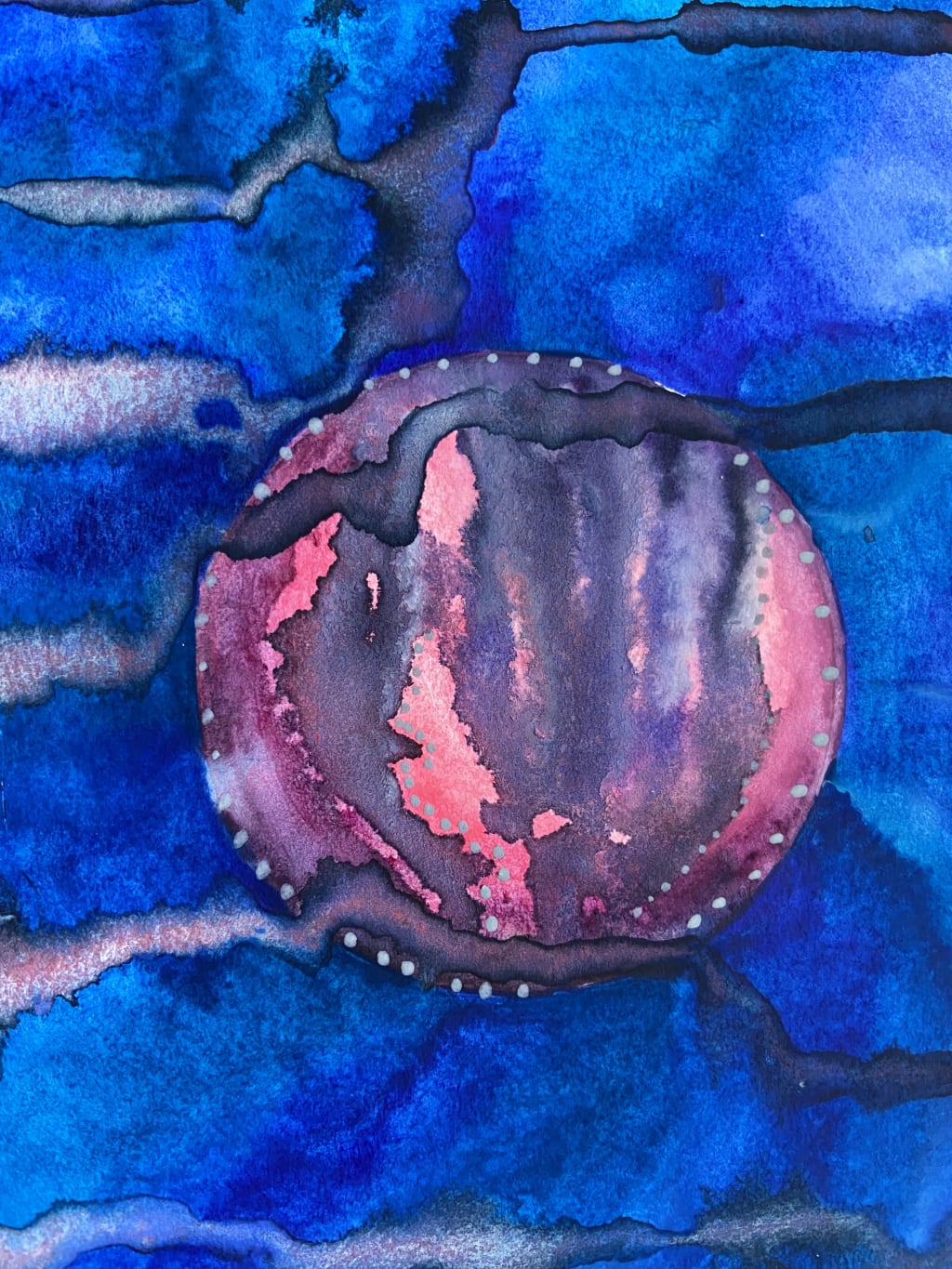
I’ve had blue dreams for thirty-five nights now. Each dream is the same. I run in a field of long grass left to grow, my bare feet pressing into the soft, brown soil beneath. I am five years old, and I run towards the figures of a child’s imagination – pirates and princesses and ponies that prance. Then, as the last bit of sun disappears behind the trees, my world turns blue. The skies drip with a darkened blue that bleeds into the grass, the dirt below my feet, and my mother’s garden in the distance. Blue shadows loom over my house, and my breathing quickens with fright as I look down at my small hands, finding my skin stained with shades of blue as well. Tears swell in my eyes, and I blink because I know this is just a dream, and blue is just a color. But when they open, every part of the world I was just standing in has turned blue, so that that the trees blend in with the sky and the grass and me. All I see is blue, all I think of is blue, and I can’t remember what it’s like to be human because all I am is blue.
Mother thinks I’m crazy, but she says that we’re lucky. I wander through the tall, dimly lit halls of our cabin to find her and tell her about my dream. When we first boarded Voyager 45, the perpetual rocking of the floorboards made me dizzy and sick. Now, my feet balance perfectly against the tides as I make my way to her room. I find her where she always sits -gazing out the small window by her bed at the vast, endless ocean before her. She does not notice as I enter, and I take a moment to watch her in unbothered peace. The lines of worry that normally stretch across her face vanish as her eyes follow the waves lapping against our boat.
I clearly remember the smell of her corn cobbler as she pulled it out of the oven in our yellow painted kitchen. I was six, and she turned and yelled at me for dragging mud into the house. There was always something for her to worry about – a dirty plate left in the sink, my father coming home late from his work with The Government, the news blasting from the television. She would sit, waiting for her cobbler to bake and for my father to return, and she would watch the screaming and dying plastered across the screen. She scolded me for watching with her and made me play outside, but I remember everything. Mother used to say my photographic memory was up to no good, but now she depends on it. We both do, I guess.
I remember the rigid blizzards on the east coast of North America that left entire cities to starve – three whole states consumed by thick, white walls of snow. I remember the announcements that came on every hour with a bleak voice stating, “This is The Government with your hourly reminder. Conserve water. Conserve food. Conserve energy. We are entering the new era and we must adapt. Remember your 3 C’s.” I remember the statistics – 1.6 million dead in India from starvation, 1 billion dead in China from toxic air. Hawaii vanished, as the unforgiving sea devoured all 137 islands. I remember the heart-shaped locket I placed in my father’s hands before one of his long trips overseas with The Government. “So you don’t forget me,” I whispered, as he gently tucked it in his uniform pocket. And I remember the night he did not return.
“Hey,” I say, my voice cracking against the silence that fills her room.
“Emma,” she smiles in a frail attempt to welcome me.
“I’ve had the dream again. I think it means something Mother - I really do.”
“Hush, you’re only seventeen and you’ve seen the worst of the world. It is normal to have nightmares – I do. Think about how special you are and how thankful we should be…”
“Stop Mother,” I interrupt in disgust, knowing well that she will continue.
“No, it’s true. If it weren’t for you, I don’t know what we would have done. I prayed to the heavens, but I thought that there was no hope. You saved us Emma.”
“It shouldn’t have been like that though,” I argue.
“It’s fair. The Government knows what it’s doing – people far smarter than us built it to do what we couldn’t do. They’re doing the best for the future of humankind, and you are a part of that.” She smiles, fully this time, and I almost believe that she believes the words coming from her lips.
“Okay Mother. I’m glad we are okay,” I whisper, and I squeeze her hand before I leave.
As I journey down the corridor back to my room, I think of my father. When I was fourteen, he came home one night and scooped me up into the comforting grasp of his strong arms. He turned off the screaming and dying on the television and looked at me with his stern, gray eyes.
“Emma,” he said, “Pay attention because I’m only going to say this once. What you see on the television – all this dying and sadness – it’s going to come here before you get to grow up. It’s going to come here soon. The Government has a plan. They’ve built 100 ships made from the last steel resources we have, designed to withstand years of sailing, and they have greenhouses and water filter systems and everything that you need to survive. But not everyone will be welcomed on these ships, and here is the important part. Your photographic memory can get you a spot on a ship. They need people to remember and document what has happened here, so that we do not forget. I have already put your name in for consideration. You are allowed to bring one person as your guest, and you will bring your mother. This is what will save you Emma, and you must not think of who you are leaving behind. You must not act with selflessness. The selfish have taken the world and destroyed it, and I know that your heart is not that. But you must be selfish now.”
Questions bubbled in my throat, but his forceful hug and quick kiss on my forehead stifled my words. When his saddened, broken eyes met mine, I knew that he was leaving me. A part of me knew that I would never see him again.
It’s three in the afternoon, which means that it’s my shift to work. I slide my Government card through the scanner and enter a lofty room stuffed with thousands of boxes - each containing newspapers, books, video footage, and Internet histories from the past thirty years. I sit at one of the empty tables in the center and begin. There are five of us with photographic memories on the Voyager 45. We take turns sitting in this dusty room, watching the horrors we left behind and permanently filing them into our memories. We serve as the knowers – the people who won’t forget our damaged world, so that we won’t make the same mistakes. I plug in one of the videos from April two years ago, and footage brightens the screen, with a man’s panicked voice narrating the scene before him. “I’m in Nepal, and there’s some crazy stuff going down,” he whispers fervidly. “Hell has broken loose, and we’re the ones who opened the doors,” he continues. The burning fever in his voice consumes me, and I feel as if I am there with him. The camera focuses to display the sun scorched streets of Nepal as a flurry of hot sand whips through like a tornado. He dives beneath a deserted car to find shelter. “I’m going to die soon, I know this, but if anyone ever watches this, hear what I say.” His voice calms, and my I sit forward in my seat, my eyes peeled to the screen.
“There’s something going on here, and it’s not just us. Well, it is us, but we could have solved it. We could have survived, and now I’m going to die. The Government - they’re going to kill us all,” he laments, shoving the camera towards the sandstorm that circles around him. “They’re here right now, killing and raiding our homes and pushing us towards death. They’re the only ones who have the machines to predict when these natural disasters occur – think about it. I didn’t believe it at first, I followed their words and their instructions, but it’s all a lie and they know it.”
He turns the camera, so that the lens focuses on his bloody face. One eye has been gouged out and bleeds profusely. “This is what they did to me. And this is what they will do to you. They determine a natural disaster, and then they push the poor and the unprepared right into it… into death because they know not all of us can survive. They know, so they’re making sure they’re the ones that do.” He’s crying now, and he turns the camera back to the world crumbling around him. I watch as an army of men dressed in The Government’s heavily lined black uniforms march out of the wall of sand. I can hear their shots before my eyes catch up to what they are doing. They proceed to enter the small houses of villagers and fire their guns over and over and over. I cry as starving families run out of their homes into the unforgiving sand before them, as they are whipped down by heat and wind and despair. The last of the footage is an all too familiar voice shouting, “Hey! You there! What are you doing? Come out, now!” The camera falls to the ground. The last frame centers on a blood-stained heart-shaped locket, clumsily tossed aside in a struggle between the two men, as one man meets his almost certain death at the hands of my father.
I’m not sure how much time passes before I move. I sit, frozen in a cold sweat that spreads across my entire body, my mind spiraling to foreign thoughts that have never before surfaced. Slowly, they creep out of the shadows that hide them, and I cannot ignore what I feel.
My feet barely press on the floorboards as I make my way back to my room. A couple of farmers, here for their greenhouse work, shuffle past me as if I don’t exist. One of them makes a joke about something I can’t hear, and the other one throws her head back with explosive laughter. They look happy, and a part of me wishes I could experience the ignorance that blankets their existence. To believe in The Government, to believe in the plan, is to believe that everything is going to be okay. When the winds started howling, and the storms rolled in, and the ocean rose and devoured the land, we needed something to believe in – even if that something was a lie. We believed in a lie until we made that lie true.
I sit, my legs crossed, and my weary eyes float out to the ocean waves that spread beyond our ship. I cannot see anything but the calm blues before me, as they serenely blend together like watercolors on paper. A blue sky filled with clouds meets the ocean against the horizon, and beyond, I know blue is what awaits me. Our ship sails onward with no destination, and blue swallows our world and who we are. All I see is blue, and all I think of is blue, and I can’t remember what it’s like to be human because all I am is blue.
About the Creator
Keep reading
More stories from writers in Fiction and other communities.
A Dart at Dusk
Seconds ago, the sullen sun set on the two of us… my exuberant furry companion and me. A fresh breeze embraces us, delivering welcome relief from the day’s oppressive heat. His typical stumbling and staggering along — apace with a sloth — has turned into trip-trapping, high-stepping, almost skipping along.
By Angie the Archivist 📚🪶7 days ago in Petlife


Comments
There are no comments for this story
Be the first to respond and start the conversation.