
Blade Runner 2049 is a science fiction movie released in 2017, directed by Denis Villeneuve and produced by Ridley Scott, who directed the original Blade Runner in 1982. The movie is set thirty years after the events of the first Blade Runner and follows a new Blade Runner, Officer K, as he uncovers a dangerous secret that could potentially plunge society into chaos.
Characters:
Officer K (Ryan Gosling): Officer K is the protagonist of the movie and a replicant of Blade Runner working for the LAPD. He is assigned to hunt down and retire older model replicants that have gone rogue. K is a very skilled fighter and a master of detective work, but he is also a deeply introspective and melancholic character.
Niander Wallace (Jared Leto): Niander Wallace is the villain of the movie and the CEO of Wallace Corporation, a company that manufactures replicants. Wallace is a blind megalomaniac who sees replicants as the key to humanity's survival and is obsessed with creating a new generation of replicants that are more subservient and obedient.
Deckard (Harrison Ford): Deckard is a former Blade Runner from the original movie, who has been in hiding for thirty years. He is tracked down by K, who needs his help in uncovering a secret that could potentially change the world.
Joi (Ana de Armas): Joi is K's love interest, a virtual assistant that he purchases to keep him company at home. Joi is a holographic AI program, but she is programmed to feel emotions and provide companionship to her owner.
Luv (Sylvia Hoeks): Luv is Wallace's right-hand woman and enforcer, a replicant who is fiercely loyal to her boss and is willing to do whatever it takes to protect his interests.
Plot:
The movie opens with Officer K, a replicant Blade Runner, hunting down and retiring an older model replicant who has gone rogue. During the mission, K discovers a buried box that contains the remains of a female replicant who died in childbirth. K's superior, Lieutenant Joshi, orders K to find and retire the child to prevent the revelation of replicant reproduction.
K's investigation leads him to a replicant memory maker, who confirms that the memory of the female replicant in the box is real and not implanted. K also discovers a serial number on the remains, which he traces back to Wallace Corporation. K visits Niander Wallace and his enforcer, Luv, who confirm that the female replicant was a prototype created by Wallace Corporation and that the child may be the key to unlocking replicant reproduction.
K is instructed to find and retire the child, but his investigations lead him to discover that he may be the child himself. K is torn between his loyalty to the LAPD and his newfound identity as a potential saviour of the replicant race.
As K delves deeper into the mystery, he comes into contact with Deckard, a former Blade Runner who has been in hiding for thirty years. Deckard is initially hostile to K but eventually agrees to help him find the child and protect it from Wallace.
K and Deckard are pursued by Luv and her team of replicants, who are determined to retrieve the child at any cost. In a thrilling final act, K discovers the truth about his own identity and makes a sacrifice that will have far-reaching consequences for the future of replicants and humans alike.
Themes:
Blade Runner 2049 explores many complex themes, including the nature of humanity, identity, and memory. The movie asks the question of what it means to be human and whether replicants, who are biologically identical to humans but cannot reproduce or experience emotions, can be considered equal to humaequalhis is further explored through K's character, who begins to question his humanity as he learns more about his true identity and origin.
The movie also delves into the idea of memories and their importance in shaping one's identity and sense of self. Replicants are implanted with false memories to give them a sense of history and purpose, but K's discovery of a real memory challenges his understanding of his past and his place in the world.
Another important theme is the impact of technology and corporations on society. Wallace Corporation is shown to have immense power and influence over the replicant industry, with Niander Wallace using his wealth and resources to manipulate and control the lives of others for his gain.
Visuals:
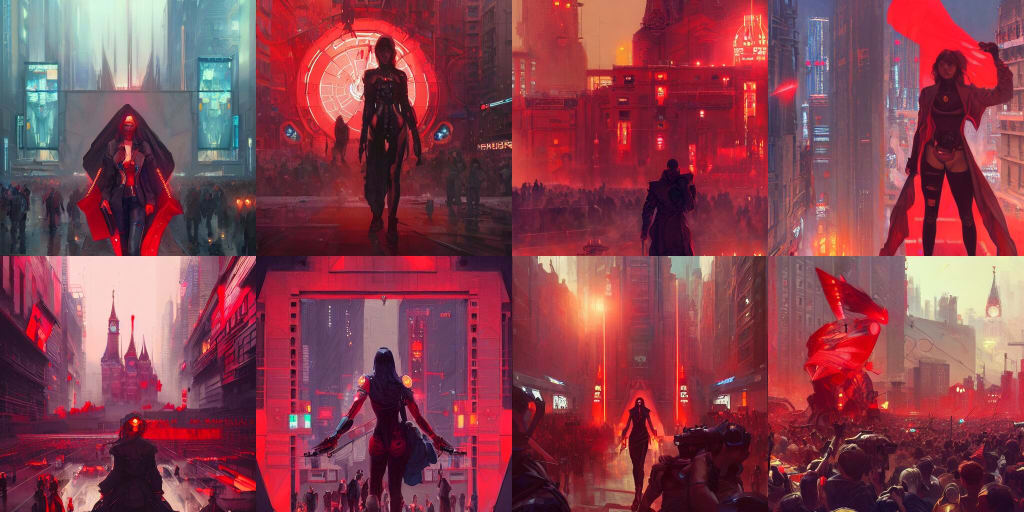
One of the most striking aspects of Blade Runner 2049 is its stunning visual design, which pays homage to the original movie while also expanding on its futuristic, dystopian world. The movie is set in a dark and foreboding Los Angeles in the year 2049, with the cityscape dominated by towering skyscrapers, neon advertisements, and pollution-filled skies.
The movie's special effects are particularly impressive, with seamless blends of practical and digital effects used to create futuristic technology and environments. The film's cool colour palette rich includes deep blues, oranges, and greens are used to great effect to create a sense of mood and atmosphere.
Conclusion:
Blade Runner 2049 is a thought-provoking and visually stunning science fiction movie that expands on the themes and ideas of the original Blade Runner. The movie's strong performances, particularly from Ryan Gosling and Harrison Ford, add depth and complexity to the characters, while its striking visual design immerses the audience in a dark and dystopian future. The movie's exploration of themes such as humanity, identity, memory, and the impact of technology on society, make it a must-watch for fans of the science fiction genre.
About the Creator
Keep reading
More stories from Kishore kumar and writers in Fiction and other communities.
The Last Stand of Captain Roberts
Captain Roberts had seen his fair share of battles throughout his long and storied military career. He had fought in conflicts all around the world, facing down enemies both foreign and domestic with equal ferocity. But as he surveyed the battered remains of his small platoon, surrounded by enemy forces, he knew that this would be his last stand.
By Kishore kumar3 years ago in Fiction
Becca
"Everything is so... flat." Denille said stupidly as she looked around her new neighborhood. She looked around at the muted desert where even the smallest sign of life seemed to have given up. The plant life was shrubs that were half cooked by the heat and where there should have been a lawn, a mess of white rocks laid glistening in the sun. Even the sky looked stretched thin, like the sun had ironed it smooth. She’d moved from Riverside, where at least there were hills, but here in Barstow, everything felt baked and brittle.
By Sara Wilson7 days ago in Fiction
The Keeper of Forgotten Hours
Elara Voss had never believed in things that couldn't be measured. She was a horologist — a restorer of antique clocks — and her world was built on gears, springs, and the cold mathematics of time. Every second could be accounted for. Every tick had a reason.
By Dr Hamza Yaqoob 4 days ago in Fiction


Comments
There are no comments for this story
Be the first to respond and start the conversation.