
The Keeper of Forgotten Hours
A Mystery Story

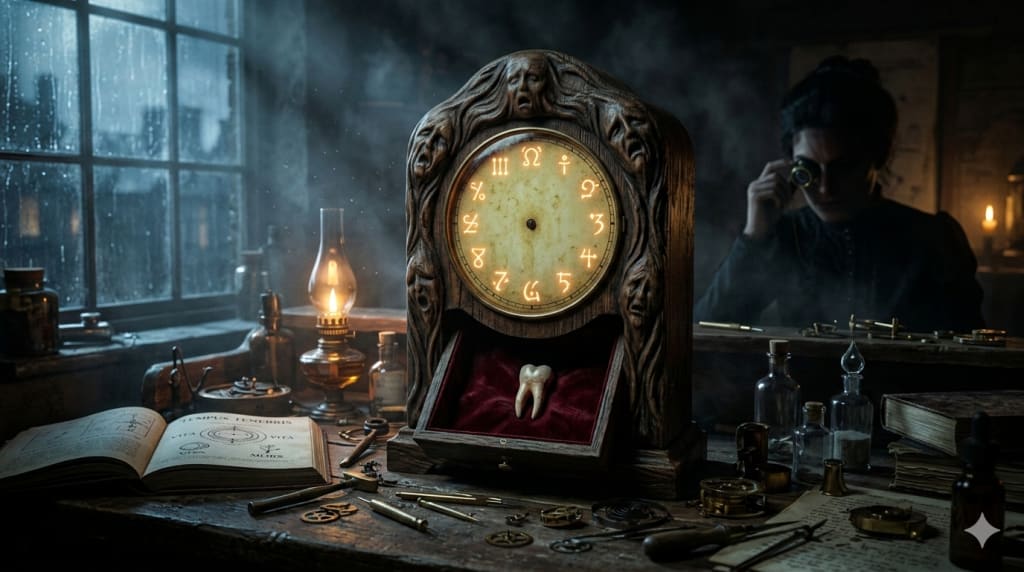
Elara Voss had never believed in things that couldn't be measured. She was a horologist — a restorer of antique clocks — and her world was built on gears, springs, and the cold mathematics of time. Every second could be accounted for. Every tick had a reason.
That changed on a Thursday in November, when a woman with no name delivered a clock with no hands.
The woman appeared at Elara's workshop on Barrow Lane just before closing. Rain had turned the London street into a dark mirror, and the stranger stood in the doorway as though she had been assembled from the storm itself — grey coat, grey eyes, water dripping from the ends of iron-colored hair.
She carried a wooden box the size of a small suitcase.
"I need you to fix this," the woman said. Her voice was like the last note of a song you couldn't quite remember.
Elara wiped her magnifying loupe on her sleeve. "What's wrong with it?"
"It stops at the same time every night. 3:17 in the morning. And when it stops—" The woman paused, pressing her lips together as though physically holding back the next words. "Things happen."
"What kind of things?"
The woman set the box on the workbench and opened the brass clasps. Inside, nestled in velvet the color of dried blood, sat the most unusual clock Elara had ever seen.
It was round, roughly the diameter of a dinner plate, encased in dark wood that seemed almost alive — the grain swirled in patterns that suggested faces if you looked too long. The clock face was ivory, aged to the color of old teeth, and where numbers should have been, there were symbols Elara didn't recognize. They looked like letters from an alphabet that had been abandoned by its civilization.
And there were no hands. No minute hand, no hour hand. Nothing to indicate the passage of time at all.
Yet the clock was ticking.
Elara leaned closer. The sound wasn't mechanical. It was wet, organic — less like a gear train and more like a heartbeat.
"How does it tell time without hands?" Elara asked.
"It doesn't tell time," the woman said. "It tells other things."
Before Elara could ask what that meant, the woman turned toward the door.
"Wait — I need your contact information. Your name, at least."
The woman stopped but didn't turn around. "My mother called me Sunday. That will do."
"And when should I have it ready?"
"Before 3:17," Sunday said. And then she walked into the rain and was gone.
Part Two: What the Symbols Said
Elara told herself she kept the clock out of professional curiosity. She told herself the heartbeat sound was simply an unusual escapement mechanism she hadn't encountered before. She told herself these things while locking her workshop door twice instead of once, while checking the windows, while moving the clock to the center of her workbench where she could see it from every angle.
She told herself many things that first night. She believed none of them.
The symbols on the face bothered her most. She photographed them and ran searches through every horological database she had access to, every archive of clockmaker's marks and guild symbols from five centuries of European timekeeping.
Nothing.
She widened her search. Alchemical symbols. Astronomical notations. Runic alphabets. Sumerian cuneiform. Nothing matched exactly, though some symbols carried faint echoes of several traditions, as though someone had taken pieces of many forgotten languages and stitched them into something new.
By midnight, Elara had consumed three cups of tea and developed a headache that sat behind her left eye like a hot coin. She decided to open the clock's casing to examine the movement inside.
The back panel was secured with screws that didn't match any standard gauge. She had to file down a screwdriver to fit them. When the panel finally came free, she nearly dropped it.
There was no movement inside the clock. No gears, no springs, no mainspring barrel, no escapement. The interior of the casing was hollow except for a single object sitting at the bottom like a stone in a wooden bowl.
It was a human tooth.
Adult, a molar, slightly yellowed. Sitting in the hollow body of the clock as though it had been placed there with ceremony.
The clock continued to tick.
Elara stared at the tooth for a long time. Then she replaced the back panel, screwed it shut, and sat in her chair with her arms folded, watching the clock as though it might explain itself.
At 3:17 in the morning, it did.
Part Three: The Stopping
She had fallen asleep in the chair. What woke her was not a sound but the absence of one. The ticking stopped, and the silence that replaced it was so total, so aggressive, that it felt like pressure against her eardrums.
Elara opened her eyes.
The workshop looked wrong. The dimensions were the same — the workbench, the shelves of clock parts, the window with its view of Barrow Lane — but everything seemed to have been shifted two inches to the left, as though the room had flinched.
Then she noticed the man.
He stood in the corner where she kept her tool cabinet. He was tall, thin, dressed in clothes that belonged to no particular era — a dark coat that could have been Victorian or could have been modern, trousers that might have been from any decade of the last two hundred years. His face was the problem. Elara could see it clearly, could describe each feature — sharp nose, deep-set eyes, a mouth that seemed wider than it should be — but the moment she looked away, even for a fraction of a second, she couldn't remember it. It fell out of her mind like water through a sieve.
"You opened it," the man said. His voice was the ticking of the clock translated into language.
Elara's body understood the danger before her mind did. Her fingers gripped the arms of the chair. Her spine pressed flat against the backrest. Every nerve she possessed was screaming a single word: run.
But she was a woman who measured things, who demanded explanations, and so she asked, "Who are you?
"I am what happens at 3:17."
"That's not an answer."
"It's the only one I have." He took a step forward. The floorboard beneath his foot didn't creak, as though his weight didn't fully exist. "You found the tooth."
"Yes."
"Do you know whose it is?"
"No."
The man smiled, and his mouth was indeed too wide, stretching past the boundaries of where a human smile should end. "It's yours."
Elara's tongue found the inside of her mouth reflexively, pressing against her own teeth, counting them. They were all there.
"Not yet," the man added.
The clock resumed ticking. The man was gone. The room shifted two inches back to the right.
Elara sat in the chair until dawn, not blinking, not sleeping, listening to the heartbeat of a clock that had no mechanism and held a tooth that was somehow already hers.
Part Four: The History of Sunday
In the morning, Elara did what any rational person would do. She tried to get rid of the clock.
She put it back in its box, carried it to the front door, and attempted to leave the workshop. The door opened. The street was there. But when she stepped forward, she found herself stepping back into the workshop from the rear entrance, the box still in her hands, as though the building had folded in on itself like a paper trick.
She tried four more times. The result was always the same.
She tried removing the tooth. Her fingers wouldn't close around it. Not because of any physical barrier — her hand simply refused, the way a hand refuses to press itself against a hot stove. Some deep, pre-rational part of her brain would not allow it.
So she did the next rational thing. She researched.
The clock had no maker's mark, but the wood was distinctive — dark, almost black, with that unsettling grain pattern. She took a splinter to a friend at the Victoria and Albert Museum who specialized in decorative arts.
"Coffin elm," her friend said, turning the splinter under a light. "Wood taken from elm trees that grew in graveyards. Victorians used to believe it absorbed something from the dead. Popular with certain… esoteric craftsmen."
"What kind of esoteric craftsmen?"
"The kind the history books pretend didn't exist."
Her friend gave her a name: Aldous Morrow, a clockmaker who operated in London between 1837 and 1869, when he disappeared. Morrow was unremarkable in most respects — a competent but not exceptional horologist — except for one detail that appeared in a brief mention in a journal kept by a rival clockmaker.
"Morrow claims to have built a device that does not measure time but rather DIGESTS it. He says the clock consumes hours — specific hours, from specific lives — and that what is consumed cannot be lived. I believe him to be mad, but his customers pay extraordinary sums and seem to believe with a fervor I find disquieting."
The journal entry was dated 1866.
Elara searched for more. In a digitized archive of Metropolitan Police records, she found a report from 1869: a series of disappearances in the Whitechapel area, seven people over three months, all of whom vanished at — Elara's blood cooled — 3:17 in the morning. A constable investigating the case noted that each of the missing persons had recently visited a clockmaker's shop on Fallow Street. The shop was searched and found empty except for "various timepieces of unusual construction" and "a quantity of human teeth, numbered and catalogued in a leather-bound ledger."
The ledger was never found. Neither was Aldous Morrow.
Elara sat back from her computer screen. Outside, London carried on — buses, tourists, pigeons, the ordinary machinery of a city that didn't know there was a clock made of coffin elm breathing on a workbench on Barrow Lane.
She needed to find Sunday.
Part Five: The Congregation of Stopped Clocks
Sunday found her first.
Elara returned to her workshop that evening to find the grey woman sitting in the chair where Elara had spent the previous night. Sunday looked different — thinner, as though several hours of her had been removed, leaving less of her behind.
"You met him," Sunday said. It wasn't a question.
"The man at 3:17."
"He's not a man. He's an *hour*. A living hour. Morrow built the clock to trap it, but the clock is breaking down, and when it stops completely, the hour will be free."
Elara sat on the edge of the workbench. "You need to explain this to me as though I'm someone who lives in the real world."
Sunday almost smiled. "The real world. Yes. Here it is, then: Aldous Morrow discovered that time is not abstract. Each hour of each day has a… presence. A consciousness, if you like. Most of them are benign. The hour between 2:00 and 3:00 on a Sunday afternoon, for example — that drowsy, golden hour — is gentle. It wants nothing from you.
"But some hours are predatory. The hour that contains 3:17 in the morning is one of them. It's the hour when the most people die in their sleep. The hour when the body is at its weakest, when the boundary between alive and not-alive is thinnest. That hour is *hungry*, Elara. It feeds on the time people will never live — the hours they would have had, the years stolen from the ends of their lives."
"And Morrow trapped it in a clock."
"In several clocks. He built seven of them, each containing a piece of the hour. The tooth is an anchor — it binds the clock to a specific person, a guardian. As long as the guardian lives and the clock ticks, the fragment of the hour stays imprisoned."
"And you're a guardian."
Sunday looked at her hands. "I was. My clock was the sixth. It stopped nine months ago. Fully stopped — wouldn't tick, wouldn't breathe. And the piece of the hour it held got free and found the seventh clock. Your clock, now. It's trying to break out of the last cage."
"Why me? I didn't ask for this."
"The tooth chose you. It was blank when I brought the clock here. Unbound. But when you opened the case and found it, it became yours. That's how Morrow designed it — the tooth takes the shape of whoever discovers it. You're the seventh guardian now, Elara. The last one."
Elara pressed her hands against her face. Through her fingers, she asked, "What happened to the other six guardians?"
Sunday's silence was answer enough.
"And what happens if the seventh clock stops?"
"Then the hour is whole again. And it will be 3:17 forever. For everyone."
Part Six: The Tooth's Demand
Over the following days, Elara learned the rules of her new existence.
The clock could not leave the workshop. She could not leave the clock for more than twelve hours, or the ticking would begin to slow. The tooth in the casing grew warmer each night as 3:17 approached, and during the stopped minute — because it was always exactly one minute, from 3:17 to 3:18 — the hour manifested in her workshop and tried to convince her to break the clock.
It did not threaten. It did not rage. It reasoned.
"You are spending your life guarding a cage," the hour said on the third night, wearing its too-wide smile. "Every night, awake at 3:17, watching me, fearing me. For what? So that others can sleep through an hour they don't even notice? They waste the time you're protecting, Elara. They waste it on nothing."
"That's their choice," Elara said.
"Is it your choice to sacrifice your life for their nothing?"
On the fifth night, the hour showed her something. The air in the workshop shimmered, and she saw a woman — herself, but older, grey-haired, still sitting in this same chair, still watching this same clock. Decades had passed. She had no friends, no partner, no life outside the ticking. She had become the clock's organ, as necessary and as trapped as a gear in a mechanism.
"This is what guarding looks like," the hour whispered. "Morrow built his prisons, but he needed prisoners to run them. You're not the guardian, Elara. You're the *sacrifice*."
Elara looked at the vision of her future self and felt something she hadn't expected: not fear, but fury. Not at the hour, but at Morrow — a man who had been dead for over a century and had designed a system that consumed the lives of others to maintain his legacy. The guardians weren't heroes. They were fuel.
"There has to be another way," she said.
The hour tilted its impossible head. "There is. But you won't like it."
Part Seven
Sunday had told her the clocks couldn't be destroyed. She was wrong — or rather, she was repeating what she'd been told by the guardian before her, who'd been told by the one before that, a chain of inherited fear stretching back to 1869.
But Elara was a horologist. She understood how things were built, and anything built could be unbuilt, if you understood the architecture.
She spent three weeks studying the clock — not as a supernatural object but as a *mechanism*. Because it was a mechanism, despite having no gears. The coffin elm casing resonated at a specific frequency. The symbols on the face weren't decoration; they were instructions, a kind of technical language describing the relationship between the tooth, the wood, and the trapped hour. The tooth was the anchor. The wood was the cage. The symbols were the lock.
What Morrow had built was elegant in its cruelty. The clock didn't just trap the hour — it fed on the guardian's time to power the prison. Every night Elara spent watching the clock, she was giving it a piece of her life. The ticking wasn't the clock's heartbeat. It was *hers*.
The other guardians had died not because the hour killed them but because the clock consumed them. Year by year, hour by hour, the clock ate their time until there was nothing left. And when a guardian was used up, the clock stopped — not because it was broken, but because it was *empty*. It needed a new source.
Morrow hadn't been a protector. He'd been a farmer. And the guardians were his crop.
The realization restructured everything. The hour wasn't the enemy. The clock was.
"You've been trying to tell me," Elara said at 3:17 on the twenty-second night.
The hour stood in its corner, flickering like bad reception. "I have been trying to tell all of you. For one hundred and fifty-four years."
"If I destroy the clock, what happens to you?"
"I go back to being an hour. Just an hour. Sixty ordinary minutes. I won't remember being conscious any more than you remember being born."
"And the danger? The deaths at 3:17, the feeding?"
"Morrow created that. Before his clocks, I was just the quietest part of the night. He cut me out of time to study me, and the wound he made — that's what kills people. Not me. The *absence* of me. He removed an hour from the world and left a hole, and people fall through holes."
Elara looked at the clock. Its heartbeat — her heartbeat — ticked on.
"If I break it, the hour goes back. The hole closes."
"Yes."
"And the tooth?"
"Returns to being what it always was. A part of you that you won't miss."
She picked up her smallest hammer.
Part Eight: 3:18
Destroying the clock was not dramatic. Elara had expected resistance — mystical force, a scream from the wood, some cinematic protest from an object that had endured for over a century.
Instead, the coffin elm split with a single clean stroke, and the sound it made was a sigh.
The symbols on the ivory face faded like breath on a mirror. The tooth — her tooth, the molar she hadn't yet lost — crumbled to a fine white powder. The ticking stopped, and this time the silence that followed was not aggressive or suffocating. It was the simple, ordinary silence of a room at night.
The hour didn't vanish. It *dissolved*, spreading outward like ink in water, filling the space it had been cut from, returning to the fabric of time with a rightness that Elara felt in her bones.
3:17 became just a minute. A dark, quiet minute in the depths of night, unremarkable and unremembered.
Elara sat in the silence for a while, holding the two halves of the broken casing. The wood was already changing — lightening, the swirling grain patterns settling into ordinary elm. Whatever Morrow had put into the wood was leaving, evaporating, joining the hour in its return.
At some point, she realized she was crying. Not from relief or fear, but from a strange, displaced grief for the six guardians who had come before her — who had sat in their own workshops, in their own chairs, watching their own clocks eat their lives, believing they were saving the world when they were only feeding a machine.
She would find their names if she could. She would remember them.
At 3:18, Elara Voss put down the broken clock, unlocked her workshop door, and walked out into a London night that was, for the first time in one hundred and fifty-four years, complete.
Epilogue: Barrow Lane, Six Months Later
The woman with grey eyes came into the shop on a Tuesday. Elara almost didn't recognize her — Sunday had gained weight, and color, and something behind her eyes that looked like rest.
"I slept through the night," Sunday said. "For the first time in eleven years, I slept through the whole night."
"No more 3:17?"
"No more 3:17."
They stood in the workshop together, surrounded by the ticking of ordinary clocks — honest ticking, mechanical and measurable, each second accounted for.
"Do you ever wonder," Sunday asked, "if there are other hours like that one? Other clocks?"
Elara looked at her workbench, where the broken halves of the coffin elm casing sat like an open book. She had kept them — not as a reminder of danger but as a reminder of the question every clockmaker must eventually ask:
Does time serve us, or do we serve it?
"If there are," Elara said, "they'll find me."
She picked up her loupe, bent over the antique pocket watch she'd been restoring, and returned to the honest, measurable work of keeping time — not trapping it, not consuming it, not weaponizing it.
Just letting it pass, one ordinary second at a time.
About the Creator
Dr Hamza Yaqoob
MBBS student | Writer from a struggling background | I share real-life stories, societal reflections & silent battles—words from a sensitive soul who never gave up.
Welcome to my world—raw, honest, and real.
Keep reading
More stories from Dr Hamza Yaqoob and writers in Fiction and other communities.
The Forgotten Room: A Haunting Tale of Hidden Emotions and Unspoken Truths
The Forgotten Room: A Haunting Tale of Hidden Emotions and Unspoken Truths By: Hamza Yaqoob Introduction What if you had a room inside your mind, one that held every memory you refused to face? What if you could walk through it—and uncover the secret you’ve been hiding from even yourself?
By Dr Hamza Yaqoob 8 months ago in Fiction
Puphive n.25
Neptune has arrived. Shining white marble institution stands alone in the middle of nowhere, surrounded by green grass and a luscious garden, ridiculous in it’s austerity, an indiscreet display of wealth in a world suffering from drought and famine.
By Taimi Nevaluoma4 days ago in Fiction




Comments
There are no comments for this story
Be the first to respond and start the conversation.