
There’s only about three minutes a day, in the early morning, when my mind is hushed. My brother is always turning and groaning away in his bed having himself a hissy fit at this hour, but not me. I'm out the door before the sun starts chasing off the indigo sky.
Ma always said I shouldn’t have been born so dang early. “4:29AM,” she said, “And crowing like you thought you was a rooster, too.”
She thinks I made a habit of it from day one, like it was somehow my fault for the way my body never yearned for another minute of slumber. I always tell her I don't mind it, the waking; that working was the most unnatural part about it all.
I couldn’t stand the way my breath would stop in front of me like it didn’t know where to go, and the way my toes would prickle all morning, torn in an unbearable limbo between numb and almost-numb ‘til the heat crept up and warmed me. My frosted bones were always the last in line to thaw. Seemed a boy with prickly toes walking fields too big for him took less precedence to the life around me.
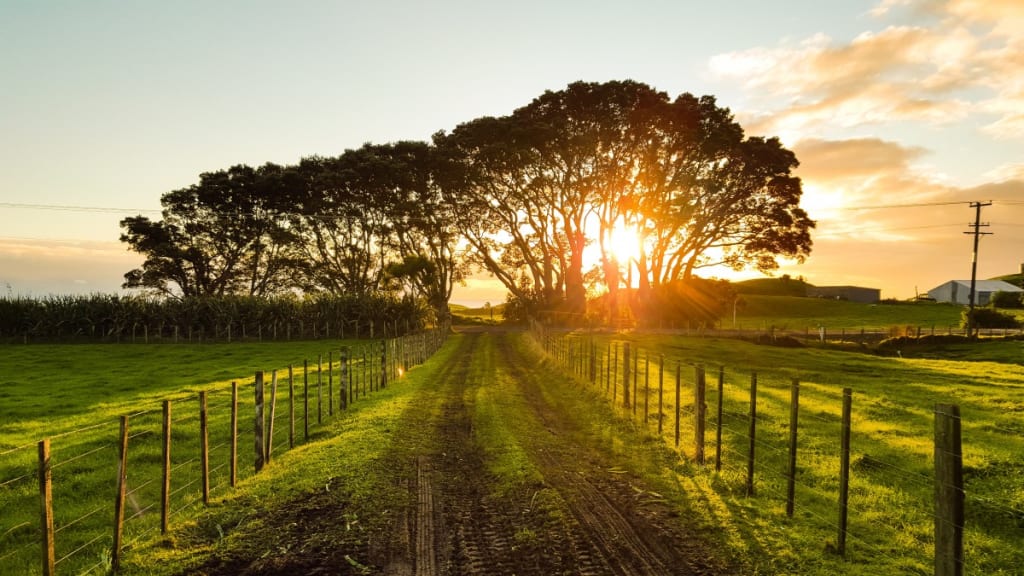
The first sign of warmth was gifted to the rime crunching beneath my boots. Rafters of light would run across the fields like they were trying to race one another to the other side of the horizon. The grass would glow with beads of dew and begin to yield underfoot.
I never knew who woke first, but the songbirds were the first to let me know. There’d be rustling all along the line of trees surrounding the property as they shook out their feathers. The songbirds—cardinals and robins, more or less—would sing gently to the new day, and I’d stand still out in the fields feeling the weak heat trying to bat at my frozen face. It was peaceful, their songs. My cheeks would just about warm enough for me to notice I was grinning, and then the roosters would follow, slicing open the three-minute serenity with the sharp reminder that there was labor to be done.
I’d work through the sunrise alone ‘til Alan joined me. My brother was always bigger than me growing up despite my being older. He had the wide shoulders you wanted to see on a farming boy, with hands as big as dinner plates. He never had to deal with his toes prickling but could never seem to shake sleep off like I could. I figured he’d be of more use if he weren’t dead on his feet. With pillow marks still staining his cheek, he’d hand me a steaming cup of coffee, give me a nod, and pick up where I left off while I took a break under the pear tree.
I took all my breaks under that tree. It was mature since I could remember, but no good ever came from it. Despite its efforts, it bore nearly no fruit when the season came, and what did fall was so bitter you couldn’t stomach to swallow it.
The last place I saw my father was under that tree.
I don’t remember much of him, but I recall that he never looked well. He had an unkemptness to him; a wild abandonment that should've been a forewarning. There wasn’t a day he wasn’t unshaven or unwashed in some shape or form, and he carried ‘round with him a sour note, as if all his distastes had sat on his tongue too long and soaked him from the inside out.
He wasn’t the best fit for working. His hands were too small to grip comfortably ‘round a pickle jar, and he tended to lose his breath so quickly he'd quit a job before it even got started.
Perhaps my father's lack of workmanship should have been made up with other qualities, but that wasn't the case. He was cold to all of us, but especially me. Maybe I reminded him of himself too much—I could never get the jars open, neither. He liked Alan more because he looked more the man, but the both of us took a beating of the heart much the same. Pa’s words would hit you like a horse that got spooked and kicked you in the chest; sharp, swift, and you couldn’t quite tell what damage had been done ‘til you stood still and had a chance to get yourself righted again.
I think he cursed that pear tree, the way he seemed to do with everything else. The fence he built ‘round the property fell after a year’s worth of wind, and his front door was more crooked than my ass’s front teeth.
After he left I came to wondering if he spit out a pear on the roots. Ma tells us it used to be a worthwhile use of space on our land; that it would give us six baskets of perfectly edible produce in a whole summer, but I found that hard to believe. Maybe the fruit used to taste alright, but he was never a man to find contentment easily. He’d have felt the skin break and a gush of sweetness rush past his teeth. He’d have held it on his whiskey-soured tongue for a second, maybe two, before heaving it as far from his body as he could, like the bite of pear had wronged him. Never did care for anything soft, that man.
So, I reckon he’d have spit it onto the roots of that tree. And it would have stayed there—maybe in tatters after a crow or two took to it, but it’d have stayed there—and the rains would have helped take it down into the earth. The juice from that ripe pear, mixed with the rank spit of my father would have soaked into the roots, you see, and there ain’t no going back from a father’s curse. The tree holds a little of his poison so it could never be good to us. Always bitter to the taste and disappointing in its offering. I would’a chopped it down years ago if it wasn’t such a nice spot for a kip in the sun.
It was those moments, during our lunch break under the bitter tree, when the sun was giving us a beating so unforgiving you had to try to sleep it off, that Sam joined us. He worked in the kitchens at the local diner frying up eggs for the folks heading into the city, but in the afternoons he hung around ours for some extra work.
“Yeeewww-hoooo!” he’s holler as he hopped the fence line. He’d bound over to wake Alan and myself up from whatever life we’d been quietly dreaming about.
“Ain’t you ever shut up?” Alan would grumble under his hat.
“Not when there’s money to be made and boys too lazy to make their own,” he said through a grin, by which time Alan was usually back on his feet, kicking up dirt trying to get a swipe of him. Sam would run off with fresh legs til he gave up, and my brother’d make his way back to the fields muttering under his breath about propriety.
Alan was too serious sometimes. Sam just knew how to talk, and I could respect that. He had no money, no land, no daddy back home either, but he sure did know how to make a meal of words. I’d seen him charm his way into a ride to town looking like he hadn’t showered in weeks. He could have a flock of debs doubled over in fits on their way to a ball, awaiting husbands long forgotten. Some called it charisma; I called it a good smile and knowing what language to pick.
The three minutes I get with the songbirds each morning I’m at my stillest, my most peaceful, but every second I spend with Sam I was most alive. My skin buzzed with nerves. I got stomach aches not knowing what he’s gon’ do next. It could've been stuffing a chicken up my shirt or smacking Alan’s behind with a rake, but he was always at something or other that made me feel like a boy again. Not the way Pa did, like I couldn’t be a man someday, but that there’s some worth in being youthful.
I kissed Sam in the barn once. It was about a year after he started on the farm and we had to till half of my lot in a day. Nearly broke our backs doing it, but Alan brought some whiskey after the sun sank and we got drunk on the haybales. Sam was singing off-key and dancing with the half-empty bottle. Alan was passed out on the seat of the tractor, his shoulders already starting to blister from the heat of the day.
I watched the fool dance and sing about some Tennessee girl until I figured it was time to sleep. My shaky legs didn't seem to be speaking to my head and ended up taking me the wrong way, til I was standing in front of him. I don’t recall why I did it, but I kissed him then. It was the only time I could remember him quiet for more than ten seconds.
I fell asleep under the pear tree that night. It wasn’t cold, but I couldn't stop shivering. I spat the memory of him off me ‘til the sun came up.
Sam stopped coming ‘round in August of that year—managed to save a penny or two, apparently—and Alan and I were scraping by on our own. We put some ads out in town for a hand, but all too soon we got used to back-breaking work between the two of us, and there ain’t nothing like learning a new normal.
He moved closer to the city at the New Year. Met a young lady and supposed they fell in love in the span of a short month. Alan was watching the side of my face the whole time the mister from the diner was telling us. I’d never wanted a swallow of whiskey so bad in my life.
The next few months were the hardest I’d ever worked. We lived in a constant state of sweat and aching bones. I’d wake before Alan and lumber off to bed long after he was asleep. I couldn’t sleep a wink that summer; fought to stay awake and fought even more to get some rest. I hated the way my mind stole moments I didn’t ask for. Fixtures of trickery, it was. Pushing, pulling. Calloused fingers in my hair. Skin that wasn’t mine in a mind that wasn’t right. I wanted to write him, but the words never quite fell right on the page.
____________________________________________________
When I wake it’s October. I wasn't napping or nothing, but I can hear the songbirds, and the smell of my steaming coffee suddenly makes my mouth water.
I just so happen to be under that tree again. My boots are more worn than I remember wearing ‘em. Alan is off in the barn, and the sun looks to just have jumped up off the horizon. I look around to what had done it.
A pear fell on me. Split right open. The juices cool the crown of my head as a breeze washes through my hair. Looking at it on the ground there I can feel a bubble of laughter in my chest—pale skin is burst open and there’s a bruise forming from its great fall; a splash of clear nectar smatters the dirt beside me. I can’t seem to stop another giggle rip from my lungs. By the time I pick it up I'm laughing like a madman. I take a mouthful.
Damn near the second sweetest thing I can quite remember.
About the Creator
Autonomy Is The Real Privilege
Good morning, freedom-seekers! Today we’re gonna be looking at autonomy. A strange word, I know; one many would probably look at blankly and run away from on sight. We’re gonna figure out what it actually means, consider how it’s achieved, and decipher just how deeply most of us are tangled up in dependence without realising it.
By That ‘Freedom’ Guy5 days ago in Humans



Comments
There are no comments for this story
Be the first to respond and start the conversation.