
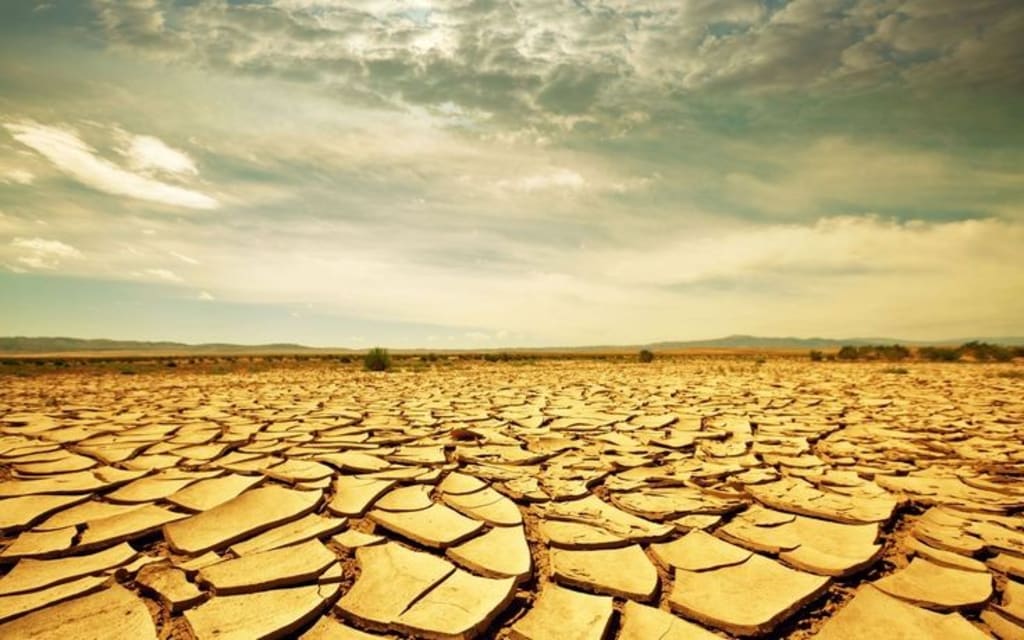
Outside the walls of Eden, the world was barren. Nothing could survive in the dry, cracked earth beyond the oasis. No greenery could grow, no animal could thrive. Beyond Eden, beyond the handful of colonies scattered across the world, there was nothing but the Wasteland.
The Wasteland was where Nora would die.
Nora stumbled into the Wasteland off the back of a solar engine with nothing on her person but the clothes on her back, a week’s worth of food and water, and a tarnished, heart-shaped locket. She stood passively back and watched as the solar engine trudged back the way it came, back to the safety of Eden.
Someone more desperate might have sprinted after it, might have tried to slip back through the gates of Eden before they could close behind the solar engine. Nora just turned and faced the sprawling nothingness of the Wasteland.
The supply of food and water was a farce, a pretense at kindness. The nearest colony to Eden was nearly a thousand miles away; when Nora ran out of food and water, there would be no finding more. The barren land stretched on for miles and miles, and the sun beat hot on Nora’s shoulders. She would run out of food and water first, and then exhaustion and heat would kill her. Or perhaps the heat would kill her before she ran out of food and water. It didn’t matter either way. Nora was going to die out here, and she knew it.
The locket reflected the sun back into her eyes when Nora pried it open, staring at the faded image inside it. Three faces that resembled her own stared back at her—one man, one woman, one boy. Nora stared at the image for as long as she could bear it, and then she snapped the locket closed, letting it fall against her chest.
Behind her was Eden, metal walls reflecting sunlight back across the Wasteland, making it impossible to look at the colony for too long. But Nora didn’t look back. Instead, she hitched the supply bag around her shoulders, set her chin defiantly, and set off into the Wasteland.
*
Nora was fourteen when her father died, Marlow not quite a year old, her mother still bedridden after the birth. Guardian Anden delivered the news herself, apologetic and pitying.
It was a malfunction in the solar engine he was reconfiguring, she explained. The vehicle harnessed too much energy and overheated. The explosion occurred while Nora’s father was under the vehicle. He died instantly.
The Ceremony of Passing was held three days later. Her father’s image was projected into the casket, showing him as he was unblemished and unscarred. He looked just as he had in life, no hint of the fire that had killed him. His real body, Nora had been told, was too burned and broken down to display.
Working for the Guardians, Nora’s father was sometimes away for weeks at a time before Marlow was born and he had to stay home while Nora’s mother struggled with whatever internal trauma she’d suffered during the birth, so his absence in the house felt less like a death and more like he was just gone for work. Caring for Marlow became Nora’s job since her mother still couldn’t leave the bed, but the Guardians continued to send her father’s monthly salary to their family to support them after losing their sole provider. Nora didn’t have to work, and her mother could continue her slow recovery without worrying about food or water or bills.
But her mother never recovered.
*
Moonrise came slow in the Wasteland, the moon inching across the sky as if dragged along on a string through molasses. By the time it was fully dark, Nora had blistered everywhere her skin had been exposed to the sun.
Her shoulders had taken the brunt of it, bubbled and stinging as she tried to maneuver her knapsack into a makeshift pillow. Even her scalp was tender and burned beneath her hair. Her body trembled with both fever and the chill of the night as she stared at the stars clumping together in the sky. In Eden, the streetlamps made it difficult to see the stars; even from the roof of her house, Nora was able to make out only the brightest of stars.
It felt like she could see every single star in the universe, lying on her back in the Wasteland. And Nora felt nothing.
*
Nora’s mother wasn’t supposed to have another child after Nora. Healers told her parents that a second birth could and most likely would kill her. But the Two-Child Mandate, which had been enforced since long before either of Nora’s parents were born, dictated that every family unit must have two children: one boy, one girl. Nora’s mother had no choice but to have Marlow.
It was a medical miracle that Nora’s mother survived as long as she did after Marlow’s birth, the healers said.
Her mother’s internal trauma never healed, despite the best efforts of Eden’s best healers. Nora and Marlow were celebrating his second birthday when the latest healer came out of their mother’s room, white apron turning brown with blood, a deep frown on her face. The damage to her mother’s internal organs had finally beat the healers and all of their advanced medicine. She was gone.
The Guardians came for Nora and Marlow the same day, telling Nora to pack their things, that they were being placed in new homes. Nora was placed with an older couple, whose son had already left and started a family of his own, but had been unable to give birth again after him. The Guardians refused to tell Nora where Marlow was sent, no matter how much she begged, no matter how much she cried. If they were able to communicate, it would inhibit both of them from bonding with their new family units.
Nora lost what remained of her family unit all in one day.
*
Nora was out of water.
It had been five days, and she’d spent so much time under the unbearable heat of the sun that her skin was blackened where it had burned and died. If she bothered picking at it, it flaked off to reveal tender, pink skin underneath. She tried to avoid flaking it off; the sun burned worse on the new skin.
The food was almost gone, too. Nora had eaten more than the Guardians thought she would need for a full week, because they hadn’t taken into account the caloric deficit she entered into walking from moonfall to moonrise every day. Nora had enough food to last one more moonfall. After that, it was only a matter of time before her body gave out.
Nora thought the darkening sky was indicative of time moving without her realizing, moonrise coming sooner than she’d anticipated. She was stumbling further along every day, and sometimes spent hours unaware of her own movements, only coming back to herself when hunger or exhaustion drove her to stop and rest for a moment. It was only when the first drop of rain hit her overheated scalp that she realized time had not been racing along any faster than normal.
She walked ten more paces before the sky truly opened, and rain gushed forth from the heavens, soaking her to the bone within seconds. Nora couldn’t help the shocked laugh that bubbled up out of her lips, or the self-preservation instinct which drove her to refill her canteen with rainwater.
There were likely a few hours yet until moonfall, and Nora could make it another few miles before her body needed rest too much to go on. But instead of pushing forward, she let herself collapse to the ground, flat on her back, eyes closed against the cool rain beating on her burned skin.
*
After her father’s death, the only thing preventing Nora from stagnating in her grief was her mother and Marlow. Nora felt that same crippling devastation now, but this time it was accompanied by anger. The Guardians didn’t have to take Marlow away from her; they didn’t have to enforce the Two-Child Mandate. But they did, and because of it Nora lost everything.
When she burned down the new expansion of the birthing center, construction was a few moonrises away from finalization. No one was inside the building. No one got hurt. The Guardians found her after a few hours, sitting on the dirt in front of the collapsing building, watching it burn.
Exile was a common punishment in Eden, especially when the crime affected all of society. It was masqueraded as a kindness, a second chance at life, but no one survived in the Wastelands. They might make it a week, two in a rainy season, but it wasn’t life. It was a death warrant.
*
Rain in Eden was rare; rain in the Wasteland was rarer. Nora opened her mouth and drank water straight from the sky, and laughed again. After a moment, as the downpour let up slightly, she pushed up into a sitting position, soaked and shivering and alive.
There was a tiny, green sprout, just barely breaking up through a crack in the ground in front of her.
Nothing green could grow in the Wasteland. Yet here was a bud of new life in the middle of them.
When she opened the locket, Marlow and her parents beamed back at her from her mother’s bed as Marlow smiled for the first time, just over two months old. Her parents were gone now, and Nora would never see them again, never hear her father’s laugh or her mother’s humming. But Marlow was still alive, somewhere, and his parents had also died. Nora couldn’t leave him, too.
Nora was alone in the Wasteland, and there would be no guarantee that she could survive long enough to reach another colony, to beg for assistance getting her brother back. But if this tiny sprout could survive in the midst of barren lands that rarely saw rain, perhaps Nora could, too.
About the Creator
Keep reading
More stories from writers in Fiction and other communities.
The Path to Salvation
The late autumn evening air filled the monk's lungs, but it wasn't the season that chilled his bones. The heavy-handed presence of evil he had sensed upon entering the woods surrounding this mountain village had not bothered to conceal itself from him.
By Made in DNA2 days ago in Fiction
Burnt, Buried, and Banished
Carice had no children as most people would define the word, but she considered herself a mother all the same. After all, it wasn’t her fault that Nathaniel hadn’t figured out he didn’t want to be a father after all until after they were married and he’d moved them both away to the top of this mountain.
By Shannon Hilsonabout 10 hours ago in Fiction
Autonomy Is The Real Privilege
Good morning, freedom-seekers! Today we’re gonna be looking at autonomy. A strange word, I know; one many would probably look at blankly and run away from on sight. We’re gonna figure out what it actually means, consider how it’s achieved, and decipher just how deeply most of us are tangled up in dependence without realising it.
By That ‘Freedom’ Guy4 days ago in Humans




Comments
There are no comments for this story
Be the first to respond and start the conversation.