
Better than Sex
Pete Rawcliffe has to negotiate his coal mine through disaster.

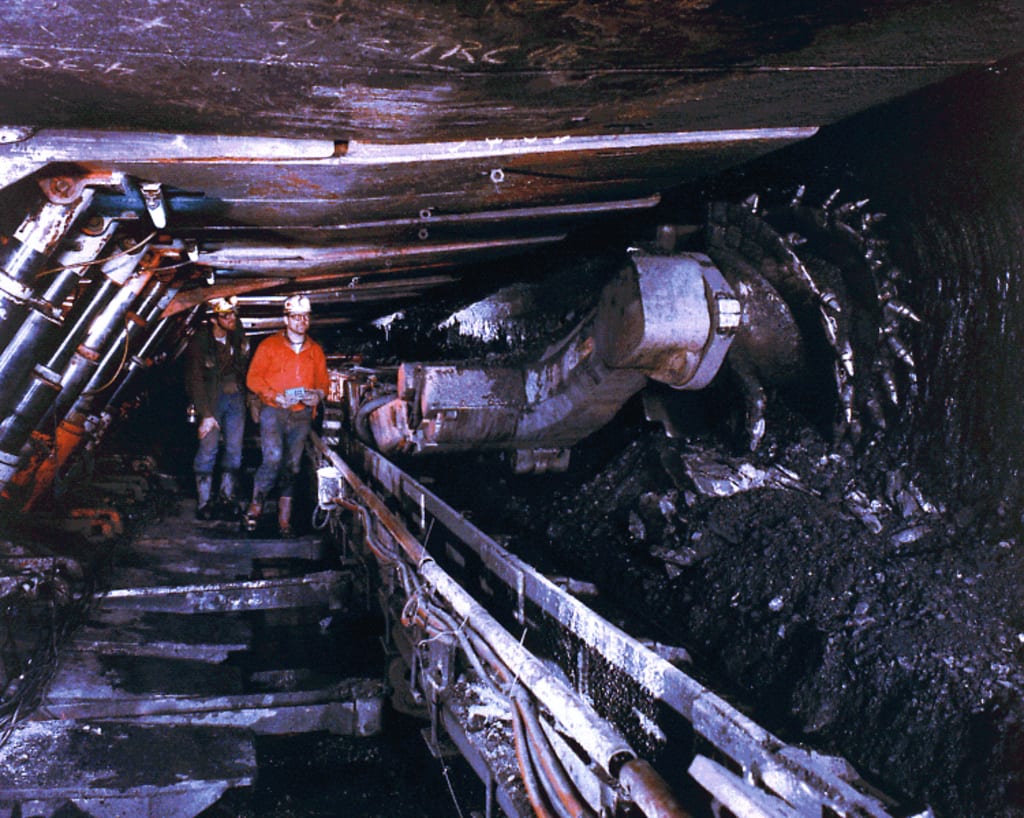
“This is better than sex” shouted Andy Erickson excitedly. His two companions looked at him dubiously. The three were standing at one end of the longwall at the Colleen Coal Mine. The noise was tremendous and made it hard to hear. The face conveyer was spewing coal at more than 3,000 tons per hour onto the panel conveyer. “Let’s go to the crib room and talk,” shouted Pete Rawcliffe.
Rawcliffe was the mine manager. He had been on the job only ten months, after his predecessor had been fired. The mine had been eighteen months behind schedule and $100 million over budget when Rawcliffe took over. Erickson had been on the mine for three years. He was responsible for the longwall, which was by far the main coal producing asset at the mine. He had been hostile to Rawcliffe at first, but had come to appreciate his qualities. The third man, Gary Cook had been brought in by Rawcliffe from another mine where they had worked together. He was in charge of development.
The longwall worked panels 300 meters wide and 3,000 meters long. The shearer was by far the most productive unit at the mine. It worked along the 300-meter width of the panel, shearing off a one-meter slice of coal It was the principal coal producing machine at the mine. The longwall was Erickson’s baby. He had specified the equipment, supervised its installation, and trained the crews.
But the longwall panels required meticulous preparation. Each panel was serviced by a number of tunnels in the coal. This is where Gary Cook came in. He was responsible for the tunneling crews. If the tunnels weren’t completed on time, the longwall couldn’t start and production would be stalled.
The three men retired to the crib room, a few meters down the access tunnel. They sat at a table and Gary Cook drew out a map. “I am working on number 1 panel being complete by the end of October” he said. “We have another 4,200 meters of development to have number 2 panel ready. We were well on track to complete ahead of time, but this unexpected double fault we have encountered in the head drives and now also in the tailgate drives is slowing us down. Its making quite a lot of water at both locations. We haven’t been able to extend the conveyers and running the trucks through the wet ground is slow.”
“Since the panel is being developed upslope, the water is all running back to the main entries” continued Cook. “We have got two crews digging ditches and installing pipes. The water make is high enough to require two of the five pumps at the pumping station. The crews are doing a great job and I think we are over the worst. I am pretty sure we’ll have the panel ready on time”.
“How about you, Andy,” asked Rawcliffe. “What we saw today was pretty impressive – can you keep it up?”
“Well,” said Erickson “after five months we’ve really hit our stride. You might have to speed up the main conveyer to keep pace. I think we are on track to finish this first panel in October. My biggest worry is all that pressure we saw in the middle of the panel. The whole idea of the longwall is that the roof is supposed to collapse once we move the supports forward. That relieves the pressure on the face. But we have a big section that is refusing to collapse. We may have to drill and blast it if it doesn’t come down soon.”
“What about gas levels?” asked Rawcliffe.
“Methane’s pretty high in the worked-out area” replied Erickson. “We could probably extract it once the panel is finished. Also, carbon monoxide is higher than I expected. It’s just continually creeping up – so I don’t think its spontaneous combustion – but we need to watch it.”
At that moment Bill Vickers, the union steward entered the room. “Mr. Rawcliffe,” he said “ we need to talk about the fiasco at the weekend. The guys are pretty upset.”
Rawcliffe looked at Erickson. “Can you spare Bill while we get this sorted out” he said. Erickson nodded his approval.
“OK, Bill, let’s you and I go up to my office and get this sorted. My vehicle’s over at the headgate” said Rawcliffe.
The two men left and worked their way back along the longwall. Their path was a narrow gap that lay between the conveyer and the support devices with hydraulic cylinders that supported the roof. The roof was a little over three metres high and was lit by lights on each of the supports, which were just over a metre apart. About halfway along the three-hundred-metre-long face, they passed the shearer, which was churning coal onto the conveyer. The noise was deafening, and the men felt the mist on their faces from the high-pressure dust control sprays.
Just beyond the shearer two men were working on one of the supports. Their task was to use the horizontal cylinders to push the conveyer forward by the amount cut by the shearer, then to lower the vertical cylinder free of the roof, and then move the support forward again using the horizontal cylinders. They were having difficulty moving the support forward.
Rawcliffe shone his cap lamp into the worked-out area behind the supports. It was a clear space as far as he could see. It should have been filled with broken rock from the collapsed roof. This is what Erickson had been talking about. All the added pressure from the unbroken roof was causing their problems with the supports. In his mind he was thinking about the logistics of bringing in drills, and the regulatory hoops he would have to jump through to use explosives.
Rawcliffe and Vickers shared a few words with the two workers and then proceeded along the longwall. Eventually they reached the headgate tunnel, where Rawcliffe’s modified Toyota Land Cruiser was parked.
They both climbed in and set off down the dark tunnel, the headlights illuminating the walls of coal on either side. After ten minutes, they reached the mains. The layout of the mine was simple. The mains were a series of five parallel tunnels sloping down from the surface. The plan was to develop the longwall panels at right angles on either side of the mains. So far panel 1 had been developed to the north of the mains and was half mined out. Panel 2 lay to the south of the mains and Gary Cook’s crews were working on developing the necessary tunnels to make longwall mining possible. The coal seam sloped down from south to north, so the south panels were higher than the north panels.
Ventilation of the mine was achieved by having three of the mains as intake air and two for return air. A large exhaust fan was situated on the surface pumping air out of the return air tunnels.
Rawcliffe drove up one of the well-lit intake tunnels and within twenty minutes they emerged into the bright sunshine of the surface. He parked next to his office. As he came in, Janice Evans, his secretary handed him a bundle of notes.
He quickly flipped through and said, “Bill can you give me a few minutes, I’ve gotta return a couple of these calls. Please have some coffee and I’ll be right with you in the conference room.”
In his office Rawcliffe dithered between returning calls from his wife or his boss. He had had a nasty argument with his wife that morning. He wasn’t sure whether she was calling him to apologise or ramp up the argument.
So, he called his boss – company vice president David Kirkby. “How’s it going, Pete,” said Kirkby. “Fine.” replied Rawcliffe. “The longwall’s going great. We’ve been doing 30,000 tons a day. We might have to jack up the main conveyer to do more than 3,000 tons an hour.”
“3,000 tons an hour!” said Kirkby, “3,000 times 24 is 75,000 tons a day. How come you’re only at 30,000?”. Rawcliffe inwardly groaned. His boss was a strip-mining man – he didn’t understand the problems of underground mines.
“Anyway, you need to keep going,” continued Kirkby “we’ve got some big shipments coming up. We’ve gotta establish Colleen as a reliable supplier. We can’t afford any trip ups now after all the earlier drama. By the way, I heard from Mike that you have a union problem.” Mike Pretor was the head office industrial relations officer.
“Yeah,” said Rawcliffe “our electrical superintendent did something stupid over the weekend, and now the union want his head.” “Well,” said Kirkby “you’ve got to support your team. We can’t let the union dictate. Don’t give in, but get it settled – we can’t afford a strike with those shipments coming up.” “Great,” thought Rawcliffe “really helpful” but he said “OK, boss” and ended the call.
When Rawcliffe entered the conference room, Vickers was on his mobile phone. He finished up and said, “State executive sees this as really serious”.
“Tell me what you think happened” said Rawcliffe.
“Geoff Grant was in the fan house on Saturday with three of our members” replied Vickers. “They were working on maintenance of fan 1. We had six members working underground repairing supports on the mains. Fan 2 was providing ventilation. When Geoff’s crew finished working on the fan, he shut down fan 2 and tried to start fan 1. But it wouldn’t start. They farted around with it for 12 minutes before they finally got it going. That’s twelve minutes with no ventilation. That’s a serious breach of the regulations.”
“C’mon, Bill” said Rawcliffe “ the mine was shut down for the weekend. There was no production. The shutdown of the fan doesn’t result in even a blip on the gas recording monitors. It’s all a storm in a teacup.”
“The fact remains that it was a serious breach of section 256a of the Mining Act,” said Vickers.
“Well, what do you want me to do about it?” said Rawcliffe.
“State executive thinks he should be fired, but the guys here might be satisfied with a written warning,” said Vickers.
“OK” said Rawcliffe. “If I issue a severe written warning for a breach of the mining regs, could you persuade Ray Jones to drop his charges against Ellen Nutling?”
“She smacked him pretty hard” replied Vickers.
“Yes, but knowing Jones, he probably said something pretty offensive. Ellen Nutling has had to put up with a lot.”
“You know my opinion about women working underground.”
“You can’t turn back the clock. They’re here to stay.”
“OK, I’ll talk to State, you draft that warning letter and I’ll see what I can do about Ray Jones. It’s pretty humiliating for him and I don’t think he’s got much support among the other guys.”
Just as Vickers stood to leave, the whole building shook, cups smashed to the floor in the kitchen and Janice Evans screamed. The shaking continued for 15 seconds, but it seemed much longer. The lights flickered and went out. From round the office alarms were buzzing.
Rawcliffe headed over to the fan house. Vickers followed. The emergency generator had started automatically, and as they arrived fan number 1 kicked back on. Rawcliffe stayed for a few minutes to make sure that the fan continued to work. Then he headed over to the gas monitoring room.
The mine had two gas monitoring systems. There were five electronic gas monitors in the mine. Rawcliffe saw at a glance that the three monitors on the longwall were blinking red – the signal had been interrupted. The two monitors in the development panel were showing normal levels of carbon monoxide and methane.
The second system consisted of a whole serious of plastic tubes that sucked gas from different locations underground and brought them here for automatic analysis. A screen showed a graph of each sample point in turn. All the graphs looked normal. But Rawcliffe knew this was an illusion. It took twenty minutes for the gas samples to come up the small tubes from underground to get to the surface analyser.
Rawcliffe picked up the phone and called the number for the longwall crib room. All he got was a dull tone for number unobtainable. Next, he called the development crib room. Gary Cook answered. “What’s happened?” said Cook. “I don’t know” said Rawcliffe. “It felt like an earthquake. The power is off but the fan is running on emergency now. How is it there.”
“We had a huge shake,” said Cook “and it brought some of the roof down. The continuous miner is buried but everybody is here and safe. A minute or so after the shake, there was a tremendous air blast. I don’t know what that was.”
Just then Vickers uttered a loud exclamation. Rawcliffe turned and saw that black smoke was pouring out of the fan. Turning to the screen he saw that all the longwall points and return airways were showing massive jumps.
“Gary, “ he said on the phone, “there’s been an explosion. Get everyone together and come out. Use your self-rescuers. Call me from each phone point on the way, and don’t go into the return airways. Use the vehicles, but if the quake knocked down the roof, you may have to walk. Either way, your self-rescuers should provide you enough oxygen to get out. Make sure you account for everyone.”
Rawcliffe turned and went back to his office. He called the government chief inspector, Don Bridgeman. “Don, we’ve got a big problem. It seems like there was an earthquake here, and then we had an explosion. I think the explosion was on the longwall. I can’t contact the team there. Our development team is making their way out now. Potentially we have fourteen people unaccounted for, and I fear the worst.”
“When did this happen?”
“About thirty minutes ago” said Rawcliffe.
“What do you need?” said Bridgeman.
“A rescue team and firefighters” said Rawcliffe.
“OK I will get things organized. Please keep me posted, and let me know when that development crew get out.”
As he hung up, the Electrical Superintendent Geoff Grant walked into his office.
“There’s a major short in the underground circuits,” said Grant. “We’ve isolated them and we’re about to turn on the surface power.”
“Great” said Rawcliffe “but that means the pumps are all out of action.”
“Yes – said Grant. “There’s been a huge shock. What the hell happened?”
“I don’t know” said Rawcliffe. “There was an earthquake, followed by a gas explosion and perhaps an underground fire.”
“An earthquake – we don’t get earthquakes here,” said Grant.
“Well, we did today” said Rawcliffe. “Anyway, get the power turned on. And then come back to the conference room.”
“Janice,” he called to his secretary “get Ted Armstrong, Jim Evans, and Brian White into the conference room, and see if you can get hold of Ray Williams over at Nelspruit Mine. Tell them it’s an extreme emergency. We need their help.”
Ted Armstrong was the mine engineer; Jim Evans was the Mechanical Superintendent and Brian White was the administration manager.
When the group was assembled in the conference room, Bill Vickers joined too. “What do you think happened” asked Rawcliffe.
“I think that hang-up behind the longwall suddenly collapsed,” said Armstrong. “That would explain the first jolt. And then that pushed gas out of the waste area onto the wall. Something ignited it – perhaps an electrical short, or sparks from falling rock. Those poor buggers on the wall wouldn’t have stood a chance.”
“That makes sense,” said Rawcliffe.
Just then the phone rang. It was Gary Cook and there was a real note of fear in his voice. Rawcliffe put him on the speaker phone.
“Pete,” he said, “we’ve made it to the mains, but we can’t go any further – they’re flooded, and the water’s rising.”
It took several minutes for the implications of this to sink in.
“OK” said Rawcliffe ”make your way back to the crib room. It should be well above water. Wait there, we’ll get you out”.
Armstrong thought for a minute and said “that collapse must have opened up the strata to the Fairbairn aquifer. We’ve always had to deal with water from there. That’s why we have all the pumps in case we had a break-through. But I guess they’re all out of action now”
“OK” said Rawcliffe “get the surveyors down the mine and find out how high the water is and whether it’s still rising. At least it will have put the fires out.” Looking out the window they could see that the fan was no longer belching black smoke.
Armstrong added “yes, but with the mains flooded, they’ll be no ventilation on the development panel.”
Rawcliffe said “right - the best we can do is pump the water out of the mains. Ted – try and round up as many pumps and pipes as you can. Try the other mines. And get the guys laying pipes down number 1 entry. Geoff – get power down to where the pumps will be. Ted – we need to know how fast that water is rising. Brian, I need the names and home contact numbers of all the people on the longwall. We need to let the families know before they hear it on the news. Bill, we might need your help letting families know. But first you had better tell your state executive what’s happened.”
Rawcliffe went back to his office and called his boss David Kirkby in head office. Kirkby was irate. “I hear you’ve had an accident he said. Why do I hear that from the inspectors and not you?”
“Sorry, I have been busy” said Rawcliffe. He carefully explained the situation. “We have fourteen miners almost certainly dead. We have another fourteen trapped underground. If we can’t lower the water in time they’re going to drown. I’ll send you an email with details, but please hold off releasing it until we’ve had a chance to contact families. If you could handle the press, it would be much appreciated. Also, we need pumps and pipes and mines rescue people.”
“OK – I’ll see what I can do. Good luck!”
At that point, the administration manager Brian White came into the office with the list of contacts for the longwall miners.
“Thanks Brian” said Rawcliffe. “Can you call Mike Pretor in head office and see if he can get a good counselor up here. The families are going to need help. And get the training room set up. We’ll get reporters and TV showing up soon. Put them in there with someone to watch over them. Set it up so we can do briefings.”
White left and Rawcliffe called the development crib room. Gary Cook answered and reported that everyone was accounted for. They were all sitting in the crib room, in the dark in order to save their cap lamp batteries. There was no ventilation but the air was still breathable. Methane had reached 0.6% and needed watching but it was well short of the 5% where it became explosive. Carbon monoxide was at 15 parts per million – also needing watching, but not dangerous yet. Rawcliffe explained Armstrong’s theory of the sequence of events. “We’ve got the team working on it, Gary” he said. “We will get you out.” He shivered as he thought of the thirteen men and one woman crowded into the crib room in the dark with the knowledge of the rising water.
Then Rawcliffe got down to the difficult task of calling the next of kin. He tried to sound sympathetic. Some were accepting and some disbelieving. He assured everyone that they were doing their utmost to rescue any survivors but the situation did not look good. He was able to be a bit more optimistic with the families of the miners trapped in the development section.
When he finished, he called another meeting of his senior staff. Armstrong reported that the water was at the 520-metre level and still rising at 5 centimetres a minute. “At that rate, it’ll reach the crib room in eight hours” he said, “but I hope to God it slows. The inflow rate is probably dropping, but now it’s filled up the longwall it’s got less space to get into”.
Jim Evans reported that a 25,000 litre per minute pump had arrived from Nelspruit mine together with a truckload of 12-inch pipe. They had sent 10 fitters to lay the pipe. “We’re going to put it in number 2 entry” he said. “We’ve got about half our eight-inch pipe laid in number one entry and we are getting our own pumps moved down there.
Geoff Grant reported that they were working on power to number one entry and should have it operational within the hour. He would then prioritise number 2 entry. All the surface facilities were back in operation and powered. Number one fan was still running but of course couldn’t pull air from the flooded sections. They had opened up some of the crosscuts in the mains so that there was good ventilation where the fitters were working on the pipes. He was coordinating closely with Ted Armstrong to estimate exactly where the water level would be by the time the pumps operational. “We don’t want them flooded before we can get them going” he said.
Brian White reported that Anne Hinton, a grieving therapist, was on her way up to the mine. Two TV stations had called and requested permission to land their helicopters at the airstrip. They would be on site within thirty minutes. He had received several requests for media interviews with the mine manager, which he had so far deflected. Finally, there was a light plane on its way with three mine inspectors. They would be at the airstrip in an hour or so.
“OK,” said Rawcliffe, “let’s set up a press conference in the training room in an hour.” He looked at his watch and saw with surprise that it was already 3:30 pm. “At 5 pm” he said, ” get it set up so that media can link into it.”
The meeting dispersed and Rawcliffe headed off down Entry Number 1 with Ted Armstrong. When they reached the water, the surveyors reported that it was still rising at 5 centimetres a minute.
Jim Evans and Gary Grant arrived and said the pump was ready to go. “Let’s start it up” said Rawcliffe.
The pump started with little fuss. They all anxiously awaited the verdict from the surveyors.
After five minutes, they announced “It’s still rising, but at two centimetres per minute.”
“Let’s go see progress in entry 2” said Rawcliffe.
They made their way through the crosscut into entry 2. The Nelspruit fitters were working to connect the pipes. A crane was maneuvering the huge pump into place. Geoff Grant’s electricians were working on the electrical connections. Within twenty-five minutes, everything was ready.
The pump was turned on, again with little fuss. Rawcliffe returned to entry 1. “What’s the verdict” he said. “Dropping at 5 centimetres a minute” said the surveyor with a whoop.
Rawcliffe turned to Armstrong “ I want you with me in the press conference” he said.
When he got to the office, Janice told him “ They’re all waiting for you.”
“First I’ve got to call Gary.”
Rawcliffe went to his office and called the development crib room. This time it was Andy Erickson who answered.
Rawcliffe told him of the latest developments. “Ted estimates it’ll be 6 am tomorrow when the level is low enough to let you out. But we’re working on getting a third pump going – so it should be sooner.”
“Things are pretty bad here,” said Erickson. “I had to stop one guy who thought he could swim out by holding his breath. Methane is up to 1.7% and rising.”
“Tell everyone to hold on – we are going to get you out.”
It was 5:30 before Rawcliffe made his way to the training room and the press conference. He explained the situation as he knew it.
The questions came thick and fast.
“How many people have died.”
“We don’t know yet, we will have to wait and see.”
“When will the trapped miners be out.”
“6 am tomorrow, maybe earlier”.
“You knew about this aquifer, why weren’t you ready to deal with it?”
“We were ready and had the appropriate equipment, but we never expected an earthquake to damage our electrical system.”
Some of the questions were ridiculous.
“What about a dive team to bring out the trapped miners?”
“There are over three kilometres of tunnels to navigate, we will have the mine dewatered before we could plan a dive team.”
It was 6:45 before Rawcliffe could break free from the press conference and head back to his office. Janice was still there. “Kirkby wants you to call him” she said.
“Good job on the press conference,” said Kirkby. “I’ve got a plane organized. Should I be up there?”
Rawcliffe’s immediate reaction was to say, “no way.” The last thing he needed was someone else in the way. But he realized he needed to be diplomatic. “I think you’re more helpful organizing things from head office” he said.
“OK.”
Rawcliffe headed back down entry 1. The water level had visibly dropped, and the pump had been moved further down the entry tunnel. Still dropping at 5 centimetres a minute said one of the surveyors.
Fitters from Midvale mine were working on a third pipeline and were putting another pump in place. Rawcliffe reflected on how underground miners all worked together in a crisis.
Suddenly he felt very tired. He headed back to his office. He called his wife. “You’re on the TV” she said. “It’s big news across the country. And look, I’m sorry about this morning.”
“I’m sorry too” said Rawcliffe, “When something like this happens, you suddenly realise what’s truly important.”
“Well, I love you, and look after yourself.”
“Love you too – but I don’t think I’ll be home tonight.”
Rawcliffe leaned back in his chair and fell asleep.
It was a little past midnight when Janice shook him awake.
“You still here? You should have gone home hours ago” he said.
“The guys are asking for you. You’re wanted at the pumps. Here’s some coffee.”
Rawcliffe gulped down the coffee and headed for entry 1. The third pump was going and the level had dropped dramatically. “Andy and Gary have made their way to the mains,” said Ted Armstrong. “It won’t be long now.”
Forty minutes later Armstrong and Rawcliffe stood in entry 5, the highest of the entries. They could see the top of the development tunnels start to appear above the water level. Moments later there was a splash and Gary Cook surfaced above the water. He swam ashore.
Rawcliffe gave him a hug. One by one the others swam their way out.
They all marched up the tunnel together and were greeted by the TV cameras and a crowd at the top.
About the Creator
Christopher Seymour
In my career as a mining engineer, I have lived in California, New Mexico, South Africa, Australia and the UK. I am now retired in Australia
Keep reading
More stories from Christopher Seymour and writers in Fiction and other communities.
The Farm
Ted Watkins looked at the paddock alongside the Susquehanna River with satisfaction. He had a fine herd of sheep, the pasture looked perfect, and the ewes were all pregnant. He had worked hard over the past ten years improving the herd, weeding out the poor performers. He had kept careful records of the lineage of each sheep, and careful records of how fast the lambs had grown. He knew he could count on reliable growth to bring the lambs to market within four months of birth.
By Christopher Seymour4 years ago in Fiction



Comments
There are no comments for this story
Be the first to respond and start the conversation.