
Beneath the Olive Tree
A Love Written in Silence, Remembered in Prayer
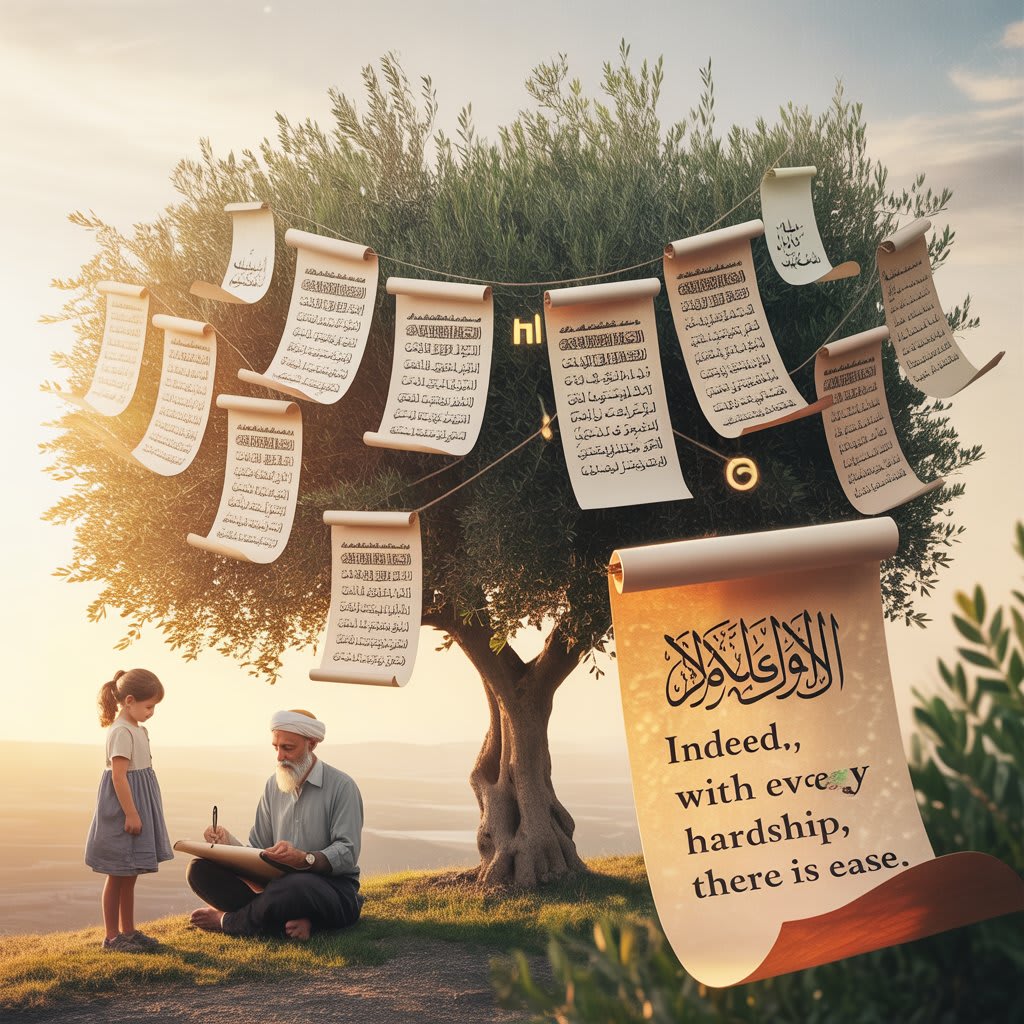
It was the spring of 2009 in the quiet town of Nablus, nestled among the hills of Palestine. The scent of jasmine lingered in the air as olive trees swayed gently under the wind’s hush. Amid this beauty lived Yousuf, a young calligrapher known not for his words, but for the way he painted them. People said he could write Allah's name in a way that made your heart tremble.
He lived a quiet life, spending his mornings in his small shop, inscribing verses of the Qur'an onto handmade parchment. He had no interest in wealth or fame, only in devotion—until one day, the wind changed.
Her name was Laila. She entered his shop not as a customer but as someone lost, searching for a memory. She held in her hands a torn piece of old parchment—Yousuf’s handwriting.
“This... you wrote this for someone named Hanan years ago?” she asked.
Yousuf took the piece gently, his fingers trembling. “Yes. That was for a teacher who lost her daughter. She said it gave her peace.”
Laila smiled faintly. “Hanan was my aunt.”
And that’s how it began.
In the days that followed, Laila would visit often—not to buy, but to watch him work, to listen to his quiet wisdom about the art of patience and prayer. She was unlike anyone he had ever met. She asked deep questions. She listened like every word mattered. And she had a heart that spoke louder than her voice ever could.
Yousuf knew he was falling in love.
But he also knew love wasn’t always about possession—it was about presence. And faith.
One day, as they sat under the olive tree behind his shop, Laila said, “You know, I’ve been proposed to.”
Yousuf’s heart stilled. He didn’t ask by whom. He didn’t need to.
“And what did you say?” he whispered.
“I said I’d pray on it.”
That night, Yousuf offered tahajjud, tears soaking his prayer mat. He didn’t pray to be chosen. He prayed for her happiness—whether or not it included him.
Days passed. Then weeks. She didn’t return.
One morning, a letter arrived.
> “Yousuf,
You taught me that silence can speak louder than words.
I’ve accepted the proposal. He is kind, and he will care for my family.
But I want you to know—had life been different, you were the kind of man I’d pray for.
Please keep writing. The world needs your prayers more than I ever did.
—Laila”
Yousuf folded the letter and placed it in his Qur'an.
He didn’t stop writing. In fact, he wrote more than ever. But his words were different now—deeper, softer, like a duaa whispered in sujood. He never married. Never told anyone. But every month, he would inscribe a verse of mercy and hang it on the olive tree, where they once sat.
Years later, a young girl wandered into his shop.
“My mother said you write prayers,” she said. “She used to sit here when she was sad. She said this place healed her.”
Yousuf looked at the girl—Laila’s eyes stared back at him.
He smiled, handed her a parchment, and said, “Then let’s write one together.”
---
Some love stories don’t end. They simply continue in silence—in trees, in pages, in prayers. And in hearts that never asked for more than the joy of having loved.
Years passed, but the olive tree never stopped blooming. Locals began calling it the Tree of Duas, unaware of the love and longing rooted beneath its soil. Yousuf grew older, his hands slower but his heart just as full. He still inscribed verses, now with the help of Laila’s daughter, who had become his student in both calligraphy and quiet strength.
On a cool spring morning, as the birds sang and the wind carried scents of jasmine, Yousuf placed one final verse on the tree:
> “Indeed, with every hardship, there is ease.” (Qur'an 94:6)
And then he smiled—because some stories don’t need happy endings. They just need to be remembered.
About the Creator
Keep reading
More stories from Mushtaq Ahmad and writers in Fiction and other communities.
When Jasmine Met the Storm
In the tranquil village of Chandinagar, where stories drifted with the evening breeze and an ancient banyan tree stood tall in the heart of the village, lived a gentle soul named Meera. The daughter of the village priest, she carried the quiet grace of tradition in every step she took—obedient, kind, and wrapped in the beliefs passed down through generations.
By Mushtaq Ahmad6 months ago in Fiction
So You Decided To Become a Nurse Practitioner:
So you decided to become an "Advanced Practice" nurse. Congratulations!... is what I would say if this was a good idea. Grad school? In this economy? What were you thinking? Likely it was something along the lines of either 1) “I've seen these other chucklefucks do it— Why can't I?” or even 2) “I've got a nice career, I should shake it up. I miss feeling like I have no clue what I'm doing.”
By Sandor Szabo6 days ago in Fiction
Tall Timmy & the Top Hat
Timmy wasn’t just short—he was the shortest seventh grader in his class. In his school. In his town, even. He had to stand on his tippy toes to reach the faucet in the restroom. He had to suck in his breath and reach for his lunch tray until his back cracked. He had to find small windows of space in the horde of classmates during dismissal, just to spot his mom’s car. She frequently circled the pick-up line, as if she were a fixture on the worst carousel ever.
By SUEDE the poet6 days ago in Fiction



Comments
There are no comments for this story
Be the first to respond and start the conversation.