
Belong To the Night
A night of wandering the city, a life-changing decision to make, will he find where he belongs?

Belong to the Night
D. A. Ratliff
Restlessness evokes strange feelings in a person. There is a nagging little itch one is never able to scratch. An uneasiness as though something sinister lurked around the corner. Light from the city coming to life at night crept into the loft, casting shadows on the walls, as if the darkness was searching for me. That itch and unease had irritated me all day, and my fight-or-flight response triggered as I felt the night close in. I had to get out of the loft.
The last remnants of a deep purple sky faded as the sky turned to ink. The sconces hung by the entrance to my building slowly brightened as daylight faded. Maybe that’s what I needed—to come alive in the dark. Once on the sidewalk, I hesitated. My palms were sweaty, and I couldn’t take a deep breath, but I pushed back the anxiety. With no destination in mind, I decided Midtown would do. I could get lost there.

The sky faded from red and orange to pink and purple hues as I walked west. The streetlights slowly warmed to full intensity to combat the falling darkness, and a warm glow spilled onto the sidewalk from the apartments along the street. It was a week before Halloween, and pumpkins, orange lights, and a few witches and ghost figures decorated the street. There was a chill in the air, a feeling of autumn which made me glad I grabbed a hoodie before I walked out the door.
It was quiet, but a few people straggled into the small neighborhood restaurants. By ten pm, there wouldn’t be an empty table, and music would fill the silence. I scoffed. When was New York City ever quiet? Never to my recollection. I’d walked about three blocks when my phone beeped, and I considered ignoring the call, but it turned out to be my best bud, Matt, so I answered.
Matt didn’t give me time to say a word. “Ben, let’s grab dinner. Meet me at Carmine’s at nine, already made reservations. Gotta go!” He hung up.
Typical Matt. I sent him a text. You could give me time to answer. I’ll be there.
I surprised myself. I had left the loft with absolutely no desire to see anyone. The choice I needed to make weighed on me, and I only wanted to be alone, or so I thought. I guess that wasn’t true. Maybe I needed a friend.
When I reached 4th Avenue, I decided I wanted a drink, and one of my favorite restaurants with a fantastic bar was a few blocks up the avenue. As I walked north, a sense of calm began to settle over me. I had been cooped up for weeks working on my newest play and converting another play, which ran off Broadway for three years, into a screenplay. Why I allowed my agent to talk me into submitting a screenplay to a Hollywood director was beyond me. The pressure of meeting the deadline set by the producer was overwhelming, but I managed to accomplish it and sent the manuscript off to never-never land. The proposal I received in return caught me off guard.
I tried to empty my mind, but my brain cells raced in overdrive. When I spotted the marquee for The Bowery Road restaurant, I nearly broke into a run, but decorum won out. Instead, I walked briskly to the door.
The warm glow of the wood tones and soft lighting in the restaurant invoked an immediate calming effect. The bottles on the shelves behind the bar glittered in the downlights, enticing one to slide into a bar chair and stay awhile.
I did just that and immediately spotted a familiar face. One of the bartenders, Tony Marchetti, appeared in one of my plays that opened off-Broadway. He had a supporting role and was quite good. He recognized me and grinned.
“Ben Hawthorne, great to see you, man.”
“You too, Tony.”
“What can I get you?”
“Bourbon on the rocks with a twist.”
“Got a Woodford Reserve Small Batch, will that do?
“It will.”
He whirled a finger in the air and removed a sleek bottle of amber liquid from the shelf. He poured the bourbon into a lowball glass and set the drink and a bowl of nuts in front of me with a slight flourish. “Enjoy.”
One sip and my nerves soothed. Sometimes, it’s simple things that make you feel better, at least for the moment.
“What are you up to these days, Tony?”
“Just finished a three-month run at an indie theater—a decidedly avant-garde play. I was never sure what it was about, but it paid the bills. I caught the eye of a casting director from LA, who gave me his card and told me to have my agent contact him. Long story short, I'm heading to LA next week to audition for a part in a movie.”
“Good for you. You’ve got acting chops, Tony. And good singing and dancing skills.”
He frowned. “I don’t know about LA and the movie scene. I want to be a Broadway actor. Don’t even care about getting the lead. I love the theater here. As long as I have food and a roof over my head, I’m good with supporting roles, at least for now.”
I was surprised at the words I spoke in reply. “Can’t hurt to try, and another credit on your resume.”
“Yeah. Found a cheap flight, and my mom’s cousin lives there. She said I can stay with them while I’m in LA. So, I’m going to go and see what happens.”
“Keep me informed. You’ve still got my card?”
“I do. What’s up with you? Going to have a new play soon?”
“Putting the finishing touches on a new script, have some nibbles from producers and investors. We will see.”
“Good, man. Keep me in mind if there’s a part for me.”
“I will.”
The bar got busy, and Tony turned to the other guests. I sipped my drink, the bourbon slid down smoothly, and a bit more of my anxiety melted away. Funny, this young actor was ready to meet his fate in LA, while I was running from the decision I had to make. I guess the difference between our ages, late twenties, and the sky is the limit. Mid-forties, not so much, but I guess we’re never too old to take a risk.
I’d been lucky and I knew it. Wannabe playwrights, actors, singers, dancers, and directors, along with far too many people who fancied themselves producers, populate the city. Fourteen years ago, I met a director in a bar. He asked for a copy of my play, and I was shocked when he told me he had an interested producer and investor.
To my utter surprise, the play was a success, and I became the talk of the town. Okay, maybe just a whisper, but when I had a new play to offer, the doors were open instead of slamming in my face. I had successes, but I also had setbacks. Those times when no one wanted anything to do with my work were tough. But Matt kicked my butt and told me to keep writing, and I did. Eight years ago, My Life, a play I wrote in college and rewrote on my agent’s suggestion, was optioned by one of the best producers in New York. He staged My Life in the largest Off-Broadway theater, and it played to sold-out crowds for nearly three years.
I swirled the remaining amber liquid in my glass. I felt like the huge cube of ice spinning as bourbon flowed around it. Events were spiraling around me, and I could do nothing but spin like that ice cube. I had to decide, just not right now. It was nearing eight, and I had a way to go to reach Carmine’s by nine.
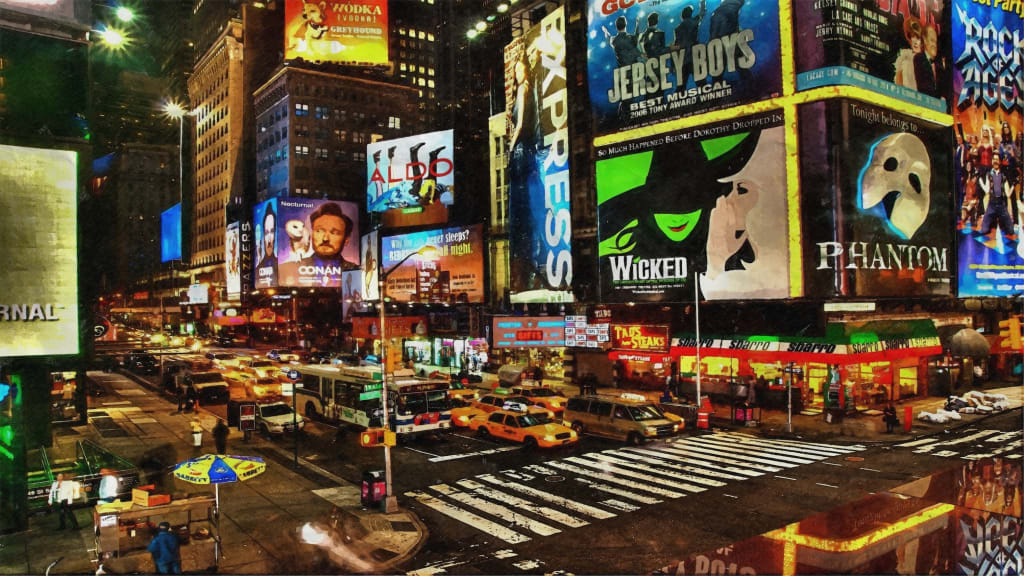
I caught Tony’s attention and threw thirty dollars on the bar to cover the drink and a tip. Carmine’s was a forty-minute walk from Bowery Road. I walked north on 4th Ave, then crossed over to Broadway at Union Square. Twilight had faded into an inky sky but was no match for the glittery lights that lit up the night. This part of Broadway was one-way south, and headlights illuminated the sidewalks. It was hard to tell night from day, but night it was.
During the day, the city bustled with roaring traffic and streets packed with people scurrying to and fro. Even for a native New Yorker, the daytime could be overwhelming. But at night, there was a different vibe. The seriousness of the day turned into excitement, as if everyone anticipated that something thrilling was about to happen.
The city breathed during the day but danced at night. People moved as if they were choreographed, flowing in and out of restaurants and residential buildings, in and out of taxis, on and off buses. On this night, I felt like an observer and not a participant in my hometown. I’d felt that way since the phone call three days ago—an offer that I’d be foolish to refuse but one that would turn my life upside down. I pushed that thought aside and kept walking. It was easier not to think.
At eight forty-seven, I pulled open the entrance door to Carmine’s and immediately realized I was starving. The aroma of garlic, basil, and freshly baked bread wafted through the warm air, and I silently thanked Matt for suggesting dinner. The Matre‘d confirmed the reservation, explaining that Mr. Bergan had yet to arrive, but he would be happy to seat me a bit early. Within a few minutes, I sat at a table for two, surrounded by murmuring diners and clinking glasses.
I ordered a bottle of Amarone Della Valpolicella, garlic bread, and Spicy Scarpariello Wings. As I waited for Matt, I eavesdropped on the conversations around me. I suppose, as a writer and one who concentrates on characters, a restaurant is a wonderful place for people watching.
Two well-dressed women sat in front of me, and I caught a few words indicating one woman was most unhappy with her housekeeper. The couple sitting behind me argued about where their son should go to prep school. I chuckled, first-world problems. It was the two couples sitting beside me that caught my attention. They were obviously foodies as they discussed the finer points of Carmine’s menu items. One of the women said that she missed Brasserie Les Halles. Her husband laughed. “You just missed Bourdain stopping by the table to flirt with you.”
Amid the laughter, the second man became serious. “I miss that man. Anthony Bourdain belonged to this city. He brought a New York attitude to every moment of his life. Talented, irreverent, witty, he transformed food from the mundane into the elixir of life. He understood the human soul and uncovered the emotional depths of those he interacted with all over the world. Food became his celebration of people, and he showed that food connected us.”
The woman beside him chuckled. “We’ve consumed more mortadella sandwiches because of his passion for them.”
Her husband shook his head. “Bourdain was part of the soul that makes New York City so special, but his death took a bit of that soul with him.”
His words swirled in my head. I was thinking about his observation about New York’s soul as Matt walked in. From the moment he entered the restaurant, he owned the place. He was charismatic and one of the nicest people around. I met Matt when my first play was produced, and he was one of the lighting techs. Over the years, I watched him grow until his expertise as a lighting designer had propelled him to the top of his craft.
The first thing he did when he sat down was grab a piece of garlic bread. “I live for this bread, man.” He stuffed half of the bread in his mouth, then picked up the wine bottle. “Good choice.” He poured a glass and took a sip. “Nice. So how are you?”
“Good.” I suppose I wasn’t convincing enough, as his eyebrows shot up.
“I know better. You have ignored my calls and texts – no contact for the last few days. What’s up?”
I took a breath. There was no one better to talk to about this than my friend. “You know my agent, Chris, had me write a screenplay of My Story to send to the producer who had optioned the movie rights. Three days ago, he called to tell me that he had presented the script to the studio and investors, and they had greenlighted the movie. Production will start early next year.”
“Man, that’s great. What’s the problem? You should be shouting that news from the rafters.”
“There was more. Chris sent copies of the scripts for the last two of my plays that were staged here. This producer, Brad de Lora, loved them. He proposed that I come to LA and work for his production company, not only to bring my plays to the screen but also to write other screenplays.”
“I repeat, that’s great.” He paused. “You don’t seem happy.”
“He wants to hire me, Matt. He made it clear that means I would need to move to LA.”
Matt stopped in mid-bite of a chicken wing. “Leave New York?” I nodded, and he shook his head slightly. “I can’t see you in LA, Ben. Not our vibe, but that’s a hell of an opportunity. What are you going to do?”
“I don’t know.” I shrugged. “He wants an answer tomorrow. I’m flying out next week to sign contracts for the movie rights, and he wants time to complete an employment contract.”
“Big decision.”
I could only nod. Matt sensed I didn’t want to talk about it anymore and turned the conversation to football. We ordered dinner, and when we parted, Matt reminded me to stay true to myself. I found it difficult to figure out what being true to myself meant.
The restlessness I felt earlier returned, and I wasn’t ready to go home. I stood on the corner of 44th and 7th Ave when it hit me that I hadn’t been to Playwright Tavern in a long time. It was one of those places where everyone knows your name. Maybe I could figure out things there.
It was a seven-minute walk to the Playwright, and along the way, Glenn Frey’s song, “You Belong to the City,” echoed in my head. The traffic noise and the sound of sirens were constant, and neon lights glared from every direction. I reached the bar and, before going inside, I stood for a moment taking in the atmosphere. There was a palpable vibe to New York City that I had never felt anywhere else.
Miniature Halloween lights and decor festooned the Playwright's dark interior, and the chatter of happy people filled the room. I searched for a seat at the crowded bar when I heard someone call my name.
“Ben, come join us.”
The voice belonged to Marty, a director friend, and with him sat Jaquie, a choreographer, Eric, a vocal coach, and Peter, a fellow writer. A need to be with friendly people washed over me, and I pulled up an empty chair. We laughed and traded stories until last call, and for those few hours, the decision I needed to make slipped into the back of my mind.
At four am, when I said goodbye to my companions and stood on the sidewalk, I was still not ready to go home. I thought about what the most quintessential New York thing I could do was and decided on the subway. I walked to the 49th Street Station and headed south, not taking the exit near my loft, but waited to exit at Bowling Green and walked over to the Battery.
I sat along the concrete wall with the Statue of Liberty in my line of sight. The salty, earthy air was cold, and I flipped my hood up and let the early morning wash over me. I had a choice. I could take a chance and move to LA or stay where I was comfortable. I sat for a long time, running the pros and cons in my head, until I was too tired to think. The decision unmade, I headed home.

I exited the subway at Astor Place and began walking the few blocks toward the loft. The eastern sky was turning golden pink, and around me, even on a Saturday morning, the city rose from the night, much like me. A sense of peace filled me, and my decision became clear. It had taken an evening of experiencing the pulse of this city, its people, its sights, and sounds to provide the answer I sought. I love this city, and I love my life here. I would never leave it.
The sconces beside the door of my building dimmed as the sun rose higher. As I unlocked my loft door, the words the diners in Carmine’s spoke about Anthony Bourdain were true. He had belonged to the city, and so did I. More than that, we both belonged to the night.
~~~
Resources:
“You Belong to the City” Written by Glenn Frey. Produced by Glenn Frey.
About the Creator
D. A. Ratliff
A Southerner with saltwater in her veins, Deborah lives in the Florida sun and writes murder mysteries. She is published in several anthologies and her first novel, Crescent City Lies, is scheduled for release in 2026.
Keep reading
More stories from D. A. Ratliff and writers in Fiction and other communities.
A Choice
The Choice D. A. Ratliff What do you write on a blank page? Let’s face it, words mean something. Isolated words provide little meaning. They must intertwine to impart thoughts, hopes, wisdom, and sometimes convey emotions, ranging from the darkest pain to the highest joy.
By D. A. Ratliff7 months ago in Fiction
Stop Complaining
As a child, he was beaten and bullied. When he complained to his teachers and parents, he was told to stop moaning and grow up. The bullies were allowed to continue, so eventually he realised he would have to take things into his own hands, and a punch and a bully's broken nose was the action he took.
By Mike Singleton 💜 Mikeydred 7 days ago in Fiction




Comments
There are no comments for this story
Be the first to respond and start the conversation.