
Bastion 4
This is not that time. This is not that place.


Aguilar stands in the rain while his abuelita fumbles with her keys. She is trying to open the security gate that protects her store from nighttime bandits. Aguilar is nine, nearly ten, and short for his age. His flip-flops grow slimy under the torrent and the wetter his underwear becomes, the more it starts to itch. Then the sun emerges from behind the heavy clouds and the rain suddenly stops.
Although it has been more than twenty years since that moment, the memory is so vivid that he can feel the hot sunlight on his cheeks even in the cold darkness of his cell. He remembers how the city used to shine after a summer deluge, how sometimes a rainbow would form, arching over the low buildings of his Havana neighborhood. He remembers because memory is all that remains. Havana is gone. So too is his abuelita. The sky, at least the sky he once knew, even that is gone. Six years, eleven months, twenty-nine days, that is how long they have lived underground, that is how long it has been since the asteroid came crashing from the heavens, slamming into the Earth like God's angry fist.
The cell only has enough room for a man to sit down without any hope of stretching his legs. Aguilar prefers to stand, to stay alert. He knows that the waiting is meant to make him wonder, to think, to hope that maybe they won't be back for him. But they always come back. They drag him down the dimly lit hallway, into the room with the chair bolted to the floor. They threaten him at first, knowing that the thought of being hurt is often worse than pain.
But still, they have not been able to break him. Not that he has any information to share. It's absurd that they believe there is some vast homosexual resistance at work as though two men being in love is meant to undermine society.
Same story, different setting, Aguilar thinks.
He hears the footsteps approaching, but wonders if someone is actually coming for him, or if days of deprivation have finally taken their toll on his mental state. When the door opens, the dull light that floods the cell nearly blinds Aguilar. He raises a hand to his eyes, squinting at the silhouetted figure in the doorway. By her height - short - and build - petite - he knows exactly who she is. Aguilar's bowels twist in discomfort. She steps aside and gestures toward the hallway.
The last few times they came for him, he resisted, but seeing her tells him that there is no point in resisting. This one does not use her fists. She does not yell or scream or threaten. He has heard the whispers about her, the murmurings of her calculated cruelty. Her name is Katya and she is the closest thing they have to a legend. Their very own El Cuco.
Aguilar moves into the hallway, growing dizzy as he steps fully into the light. It takes nearly a minute for his eyes to adjust. When they do, he looks up and down the hall. Only this section is lit, leaving both ends caked in darkness, portents of doom in both directions.
“Mr. Aguilar,” she says. “I’m sorry this is happening to you.”
If Aguilar did not know who she was, he might actually believe that she was genuinely sorry about the situation. He wonders what kind of person she was before all of this. She was probably just like everyone else, but the world had changed and people had changed with it. Aguilar knows that he is not the same man he was before life underground. He used to find happiness in ordinary things, like drinking coffee in a crowded restaurant while watching people interact. It was not the same underground, even though he was constantly surrounded by people. It was when he met Raymond six months earlier that he started to feel some semblance of happiness again.
Katya dangles something in front of his face as if he is a kitten come to play. It is a blue heart-shaped locket dangling from the end of a gold chain. Every muscle in Aguilar’s body tenses and he feels his twisted bowels start to rumble. He knew they would have searched his living quarters to find anything they could use against him, but the sight of the heart-shaped locket, his most personal item, still fills him with despair.
“I know you had a daughter,” she says. “I know that she was in Chicago with her mother during the evacuations.”
The sound of Miriam’s laughter suddenly rings in Aguilar’s ears. He used to spend his days thinking about her, wondering if she was still alive. Before abandoning foolish notions of divine intervention, he used to beg God to let Him see her again. Eventually, with his days fully occupied by his work in the water treatment plant, he began to think about her less and less. She came to him in fleeting moments. At night, before he dropped off into sleep, he often heard her dulcet voice saying “Goodnight, Papi.”
“Is she alive?” Aguilar asks.
“There has been some communication between the colonies recently,” Katya says.
“Is she alive?” Aguilar asks again.
He makes eye contact with her. He can tell that she is not used to her subjects looking at her directly because he detects a flash of discomfort on her face.
“Yes,” Katya says.
Aguilar can tell she is disappointed. She could have stretched out her response, could have used his longing against him, but she seems to understand that this tactic won’t work with him.
“She is with her mother,” Katya says.
A sense of relief washes over him, dissipating the tension in his gut. For almost seven years, the loss has haunted him. Aguilar knows that this could be a lie, but it is a lie that he is willing to accept. He also suspects that the next words from her mouth will be a threat.
“And if I don’t tell you what you want to hear?” Aguilar asks.
Katya laughs, but there is no real emotion behind it. It is just another auger in her toolbox. Laughter in a moment devoid of humor is unsettling for most people. Aguilar is not most people. He keeps his gaze fixed on her, piercing her cold façade. The laughter immediately drops off.
“Children are our most important resource,” she says. “No one is going to hurt her, but what you say in the next few moments will determine how she fares.”
Aguilar says, “There is nothing more I can tell you.”
Aguilar thinks about Raymond, wonders how long his lover endured before succumbing to the demands of his torturers, before giving them Aguilar’s name. Not long, he suspects. He and Raymond had enjoyed each other, but both knew better than to make promises. If the situation had been reversed, Aguilar would have submitted to them long ago, but the torturers were not looking for a single name anymore. They wanted a list of names, something Aguilar could not provide. He had always been attracted to men and women but had never been with a man before the underground and Raymond had been his only lover since.
“Just give me names,” she says.
He says, “If I give you names, they will just be random people.”
Katya says nothing. Aguilar knows that this is exactly what she wants from him. He has known since the day he was removed from his living quarters. Their crusade to eliminate homosexuals had nothing to do with preserving the human race. It was just more of the same old, same old. Fear of the other, hatred of that which is different, uniformity as a means of control.
“Understand that I am the final step in this process,” she says. “If I cannot get names from you, then there is nothing I can do to help you.”
“No matter what I tell you, this all ends the same.”
Katya studies him for a long moment. She is an unstoppable force who has been breaking people for years, so she knows when she has encountered an immovable object.
It surprises Aguilar that the showers are so clean. Even though a crew cleans them every single day, the showers in his own quadrant are never this clean. The guard forces Aguilar to his knees in front of the wall. Aguilar studies the tile in front of him and notices a tiny red speck. He wonders if this could be all that remains of Raymond, the man with whom he had shared many tender moments. The guard puts a gun to the back of Aguilar's head.
Aguilar thinks about Miriam, in some underground bunker somewhere in the Midwest. Maybe his decision will make life harder for her, but Aguilar knows from his own experience that hard lives make strong people. Miriam will need to be strong to survive life underground.
Katya stands on the other side of the room, arms crossed over her chest. She looks casual like what is about to happen has no impact on her whatsoever. Aguilar looks over at her, and though the moment does not call for it, he smiles.
“I forgive you,” he says.
She lowers her arms to her sides. Even though her face is implacable, he can sense that his words have invaded her mind in some small way. Psychology is the torturer’s most powerful tool. Aguilar remembers reading that in a book, in a time and place when you could read whatever you wanted. This is not that time. This is not that place. This is Bastion 4.
Katya gives the order to fire.
About the Creator
Mack Devlin
Writer, educator, and follower of Christ. Passionate about social justice. Living with a disability has taught me that knowledge is strength.
We are curators of emotions, explorers of the human psyche, and custodians of the narrative.
Keep reading
More stories from Mack Devlin and writers in Fiction and other communities.
In Black
In April, the cherry blossoms used to fall, covering the courtyard outside our apartment in a pink blanket. Dad used to tell me that the building was designed to look like a Spanish hacienda. I think hacienda means big house, but I never did ask him about it. I’ll never be able to ask him about it. The cherry blossoms won’t fall this year because the trees are dead. Almost everything is dead now, including my dad.
By Mack Devlin5 years ago in Fiction
More Orangutans
Ernie watched himself get out of bed. It was part of his morning routine: he opened his eyes to the sky-mirror, and peeled the translucent covers from himself. He slept in pajama pants, and a matching pajama shirt, because he didn’t want the others to see his bare, milky body through the glass roof.
By Noah Husband6 days ago in Fiction
A Historic Declaration
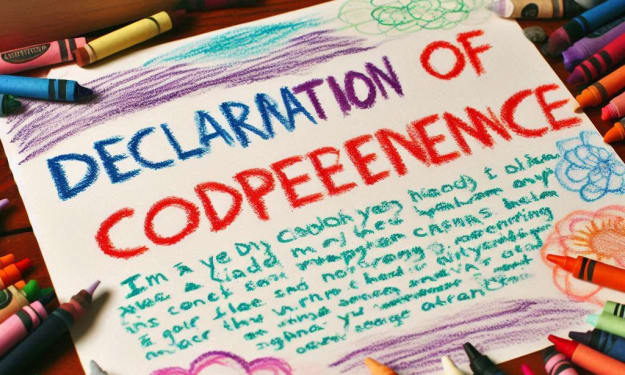
We the People of the Husbands of the United States of America, in Order to form a more perfect Union, and I mean you...with me...establish Justice, insure domestic Tranquility, provide for the common defence, promote the general Welfare, and secure the Blessings of Liberty to ourselves, after Puberty, do ordain and establish this Declaration of Co-Dependence.
By Gerard DiLeo4 days ago in Humans



Comments
There are no comments for this story
Be the first to respond and start the conversation.