
Ashes Between the Blue and Gray
Amidst the bloodshed of the Civil War, a band of soldiers battles not only the enemy—but the ghosts of their past

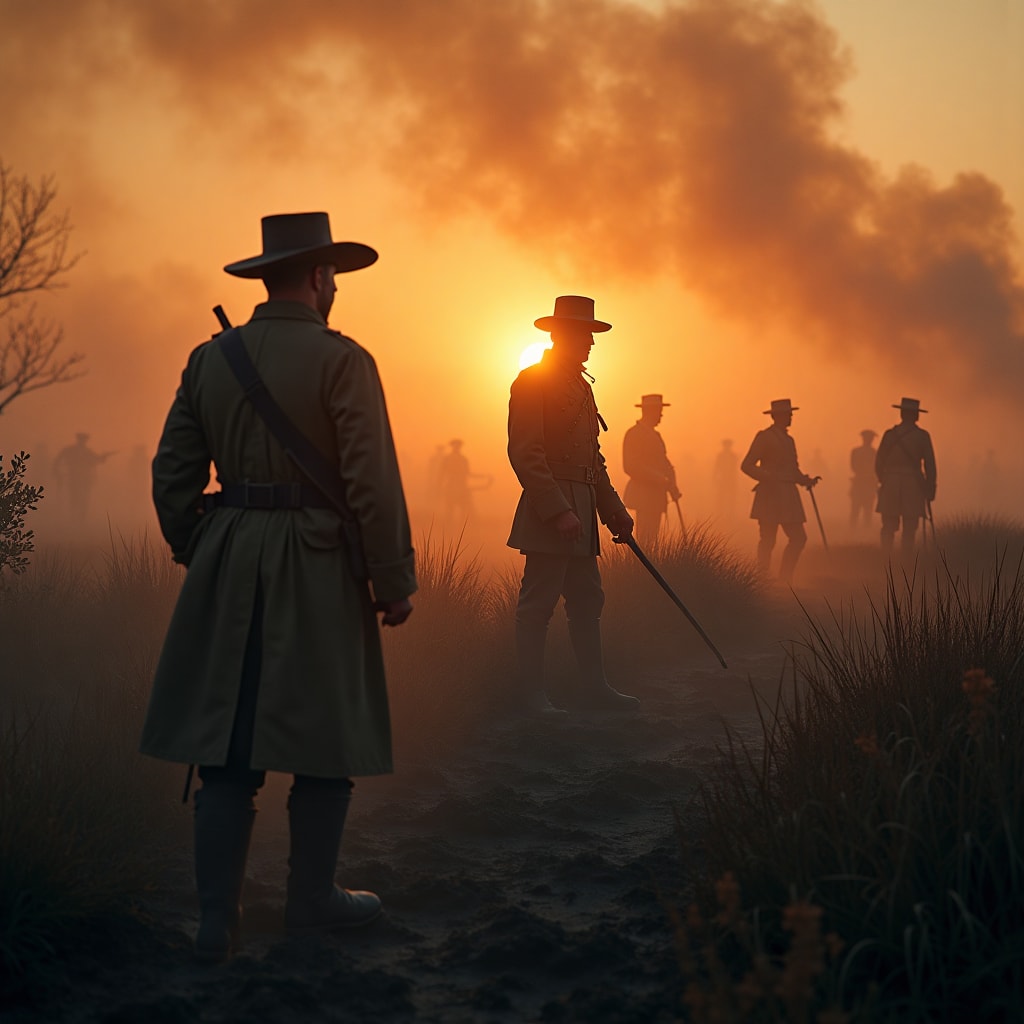
The sun rose over Antietam Creek with a crimson glare, as if the land itself bled from the wounds of yesterday. Sergeant Elias Monroe wiped soot from his eyes and glanced across the field. Smoke still curled from smoldering grass. Corpses lay twisted in unnatural poses, their uniforms torn, their faces forever caught between agony and silence.
Elias had seen war before, but nothing like this.
He led a ragged unit of Union soldiers who had survived more than their share of battles. They were the remnants—men who had lost comrades, brothers, limbs, and reasons to fight. Some called them cursed. Others said they were too stubborn to die.
Private Nathaniel Booker, barely seventeen, clutched a Bible so worn its pages flaked with each turn. He read from it before every skirmish but spoke to no one. Corporal Thomas Grady, once a schoolteacher, now muttered to himself about poetry and blood in the same breath. And there was Wallace Finch, a man so cold and silent some believed he no longer felt pain. What they shared wasn’t camaraderie—it was a haunting.
Their new orders came swiftly: head south, into Virginia, to scout an old farmhouse rumored to shelter Confederate snipers. The land was unfamiliar and unfriendly. Whispers of bushwhackers, fever, and starvation followed them like shadows. But what they found at that house would scar them deeper than any bullet.
Inside the rotting structure, beneath a floorboard, Elias uncovered a bundle of letters—ink-stained, trembling with confession. They belonged to a Confederate soldier, once stationed here, who wrote of a secret massacre, one hidden even from his own commanders. He'd helped murder civilians, including a child who resembled his own. The letters were never mailed. The soldier had hung himself in the barn.
For Elias, the discovery tore open old wounds.
His younger brother had died in the South, fighting for the other side. Elias never forgave him for joining the Confederacy, nor himself for letting him go. These letters were a mirror—revealing how honor, loyalty, and duty could twist men into strangers.
But they couldn’t turn back. Their orders were clear.
That night, as they made camp in the orchard beside the house, Nathaniel finally spoke. “I think we’re all just waiting to die,” he whispered. “We’re not afraid of bullets. We’re afraid we’ve already become the ghosts.”
None of them replied. But no one slept.
The next morning, as Confederate riders ambushed them from the ridge, the men fought like they had nothing left to lose. They didn’t fight for country, nor glory. They fought for something quieter—for forgiveness, perhaps, or the faint hope that surviving one more day meant they might someday feel alive again.
Only three returned from that mission.
Elias never spoke of what happened in Virginia, but he kept the letters. After the war, he rode south, found the soldier’s family, and gave them the words never meant to be read. It was a quiet act in a loud world. But it was something.
Sometimes survival isn’t about who makes it home.
It’s about what you carry with you—and what you choose to lay down.
Thank you for joining me on this journey into the past. May we never forget the real battles that live behind history’s headlines.
About the Creator
Lucian
I focus on creating stories for readers around the world
BAU
I woke up late. Again. Had to rush my kids to get ready and out the door onto the bus (at least they were on time, yay!), then get myself ready. Time to make coffee? No. I’ll get something on the way. Purse? Check. Keys? Check. Laptop? Check. Slide into the pumps and out the door. A rumble and shake of the ground as I’m locking the door. Not bad, must be a few miles away. Can’t worry about that when “we gotta hit those KPI’s!”
By Krystle Lynn Redererabout 4 hours ago in Fiction



Comments
There are no comments for this story
Be the first to respond and start the conversation.