
Animal Farm- Chapter- 4 (George Orwell)
A Fairy story

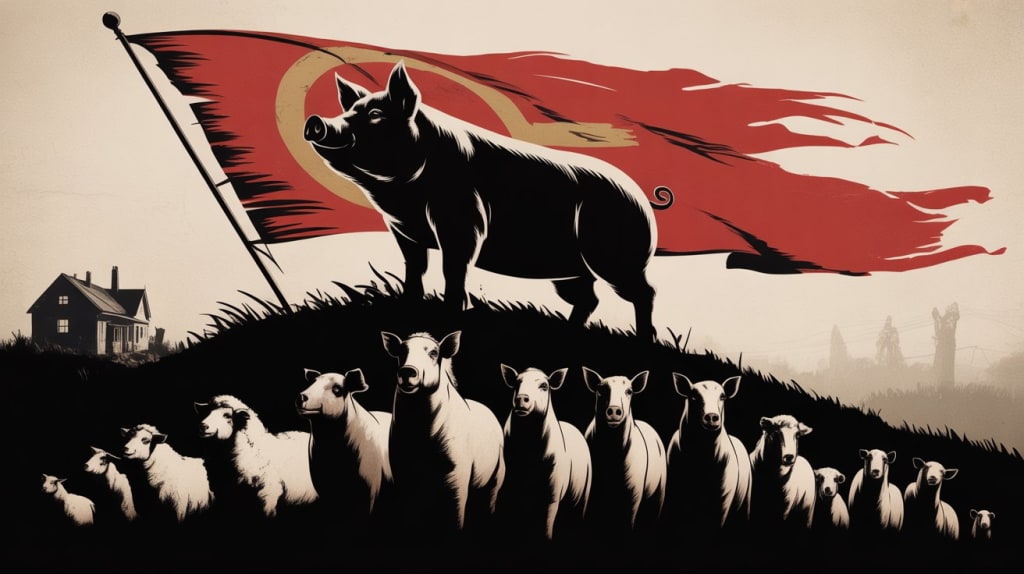
As summer turns to autumn, word of the animals’ successful rebellion spreads far beyond Animal Farm. Snowball and Napoleon send pigeons to neighboring farms to tell the other animals about their revolution and to teach them the song of the Beast of England. The pigeons carry the message far and wide, inspiring animals on other farms to rise up just as they have. Meanwhile, the human owners of neighboring farms—Mr. Pilkington of Foxwood and Mr. Frederick of Pinchfield—become deeply concerned that ideas of animalism might spread. They try to downplay the animal revolution, mocking Animal Farm and calling it a failure, but secretly, they fear a similar rebellion among their own animals.
The animals on the surrounding farms are actually becoming restless and rebellious. There are rumors that cows are breaking fences, sheep are destroying fences to eat more grass, and there are other acts of small-scale rebellion. This worries the human farmers so much that they decide to take action before things get worse.
One day, Mr. Jones, who is still thinking about losing his farm, joins forces with Mr. Pilkington and Mr. Frederick. They gather a group of men armed with sticks and guns, who are determined to retake Animal Farm by force. Their plan is to march on the farm, overwhelm the animals, and restore Mr. Jones to power.
However, Snowball is carefully preparing for such an attack. After studying books on the military campaigns of Julius Caesar, he organizes the defense of Animal Farm with surprising skill. As the men arrive and begin to pass through the gate, Snowball launches a series of coordinated attacks. First, he sends pigeons to harass and distract the men. Then, he orders the geese to peck at their ankles. Finally, he leads the larger animals in a powerful counterattack, driving the men backward in a chaotic rush.
Snowball personally leads the charge, demonstrating extraordinary bravery. He charges straight into the front line, heads the men and coordinates the defense. Boxer, the great carthorse, kicks with all his might, sending a stable boy flying into the air. Even the smaller animals do their part to protect their home, scratching, clawing and biting.
The humans, completely astonished by the coordinated courage of the animals, soon retreat. Mr. Jones fires a shot that is grazing Snowball, wounding his back, but the animals rally around their pig leader. They chase the men out of the field and chase them to the road. The stable boy that Boxer kicked appears motionless, and Boxer is distraught, thinking he has killed him. He shows great guilt and sensitivity, proving that even in battle he is gentle. However, the boy later stirs and runs away, so no one is actually dead.
The animals celebrate their victory with great pride. They call it the Cow War, symbolizing the first successful defense of their new society. Snowball is awarded the title of Animal Hero, First Class and is given a bronze medal, while a dead sheep - the only casualty by the animals - is named Animal Hero, Second Class and is buried with honors.
After the battle, the animals feel more confident than ever, but the differences between Snowball and Napoleon become more acute. Snowball is praised for his heroic role in the battle, but Napoleon is more reserved, avoiding praise and instead focusing on gaining a quiet influence. As always, Squealer steps in to help the animals sort out their thoughts, clarifying any doubts and celebrating Snowball’s courage while still promoting Napoleon’s authority.
Snowball also suggests raising a flag and holding regular ceremonies to commemorate the battle. To keep the revolutionary spirit alive in the animals’ hearts, they fire Jones’s old gun twice a year—once on the anniversary of the rebellion, and once on the anniversary of the Battle of Cowshed.
Yet through all the celebration and pride, a subtle tension can be felt. Napoleon, while ostensibly admiring Snowball, seems to be studying him closely. It is clear that he resents Snowball’s popularity and courage, seeing him as a rival for power. Boxer, meanwhile, becomes even more determined to the cause, vowing to work harder than ever and defend Animal Farm until his last breath.
In Chapter 4, George Orwell paints a vivid picture of the animals defending their freedom against their old oppressors. The animals demonstrate great bravery and unity, but Orwell also hints at a growing leadership struggle. Snowball emerges as a hero, but Napoleon is already working behind the scenes, using silence and subtle manipulation to amass power.
The battle of the cowshed cements the animal revolution in their minds, proving that they can hold their own against humans. Yet Orwell wants us to see that every revolution – no matter how great – must constantly guard against new leaders hungry for power from within. The seeds of betrayal, and the rise of a new tyranny, are already sprouting in the joys of victory.
About the Creator
Echoes of Life
I’m a storyteller and lifelong learner who writes about history, human experiences, animals, and motivational lessons that spark change. Through true stories, thoughtful advice, and reflections on life.
Keep reading
More stories from Echoes of Life and writers in Fiction and other communities.
Animal Farm — Chapter 3 (George Orwell)
With Manor Farm now transformed into Animal Farm, the animals waste no time in putting their new society into practice. They begin working enthusiastically in the fields, more motivated than ever under Mr. Jones. The pigs, thanks to their superior intelligence, take on leadership and planning roles, while the other animals throw themselves into physical labor. Boxer, a huge cart horse, becomes the farm's workhorse in both name and spirit. His personal motto - "I will work harder" - inspires everyone around him. Even the ducks and chickens do their best, picking up stray kernels of corn to ensure that nothing goes to waste. Although harvesting is difficult without human tools and skills, they manage better than expected, with greater success than ever before. There is a sense of pride and ownership in every mouthful of food they produce, which drives them to work harder and cooperate more willingly. The animals, for the first time, feel that their labor is truly for their own benefit, not for some master who steals the fruits of their labor.
By Echoes of Life8 months ago in Fiction
Bomb Scare
It was 2027, and the world never thought it would happen. A missle hit the United States, but it wasn't where they had anticipated. A little town in the northeast was hit by a missile strike, they didn't know why, and they didn't know exactly where it hit, but they did know it was a coastal community, somewhere between Maine and Delaware.
By Gregory Payton7 days ago in Fiction




Comments
There are no comments for this story
Be the first to respond and start the conversation.